
I was asked by the Substack blogger Malatesta to share my thoughts on how a world without rulers might come about, and I wrote him an overview of some of the ways I thought that could happen, which he has posted on his blog.
After doing this, I started to wonder how someone in the future might look back at how that process played out and what had to change for that to happen, and ended up writing something similar from that perspective – which allowed me to address some other ideas that didn’t make it into the other article. I’m hoping this essay will complement that one.
Who knew that in 2060 we’d be living in a world without rulers and states? Thirty years ago, I had been hopeful that people were beginning to realise the real source of their problems wasn’t just capitalism, but all forms of coercion and exploitation – including anyone who ruled over us, and the states that made that possible. However, I didn’t expect such changes to happen in such a short period, as if they’d arranged themselves to show what such a revolutionary change might look like taking place in one lifetime.
But now we can look back over the last three decades and see how the process – from state to statelessness, from dominance hierarchies to personal autonomy and collective community – happened in relatively quick succession. Like many, I had imagined it might take three hundred years to get this far, but it seems people were just ready for change, and that the means of that change led to its ends being realised far more quickly than we ever thought possible. Despite many challenges along the way, I couldn’t have imagined it happening better.
Of course, it’s not as if we’ve now arrived in 2060 at a static point in history, and can be complacent that things will always be as good as this. This jump forwards isn’t the end of an ongoing, people-led movement, but something we must continue to be engaged in to ensure the freedoms we’ve won are maintained. Getting rid of capitalism alone wasn’t enough: we had to replace every form of ownership that let one person hold to ransom what another needed, and every position that placed one person above another with the power to make decisions for them. But that was only part of the story, and the story will continue as long as there are people to be part of it.
It took a lot of work to get to this point, and that’s where the real story starts …
If there is one thing I can thank the governments and corporations of the past for, it is that by 2030 they had proved to most people that they couldn’t deliver a better life and future. Whatever comforts some of the new generation’s parents once enjoyed were far rarer and much more costly, and out of reach for those who were younger, while many who were older were also struggling to enjoy the retirement they thought would be easier. Yet the wealthy got richer and the states became more invasive and controlling.
They had only themselves to blame for people becoming dissatisfied. A few blamed immigrants or heathens or some other marginalised group, but even harsher laws against those on the margins did nothing to improve the lot of the working poor, whose ranks increased in spite of record profits and conflicts that promised to bring back more resources.
This might have been enough by itself – the precarity and marginalisation, the injustices and anxieties people felt certainly opened up the minds of many to wondering why all of this was happening, and quite a few could see it was just the system doing what it was always designed to do and rewarding those it was always built to serve. But the additional pressures of climate – unusual heatwaves, lost crops, diminishing coastlines, and overseas climatic tragedies – brought further pressures which could no longer be blamed solely on outside forces, or individual failings.
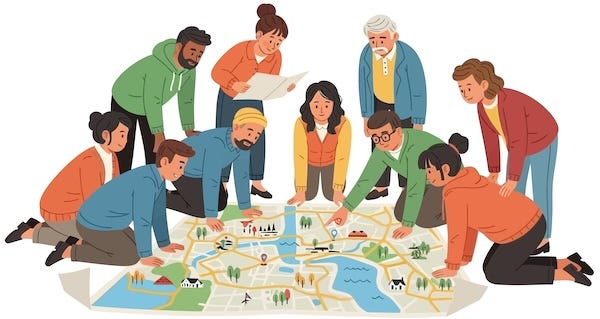
Desperation sometimes leads to blame, but when blame breaks down it can also lead to awareness, or at least the desire for it. Maybe we were better at explaining, storytelling, or showing the concepts of why the world was as it was and how it could be different than past generations. Maybe technology made up for the physical and cultural and experiential differences. Maybe people had just become suspicious and sick of the state and paid propaganda. But whatever the reasons, people began to ask more questions, and they found not only some answers in books or videos, but amongst their neighbours.
Necessity probably prompted some of this, but the breakdown of traditional avenues that once served people’s interests and social life also played a part. More and more people became involved with alternative groups that met needs outside of the state and the market. Groups that found or made their own spaces, but also often offered services that were becoming increasingly expensive, and unattainable for some. Some groups just offered the association of others with no expectation of anything but support and friendship. Other groups organised to offer food, clothing, shelter, and various needs people were struggling to afford, sometimes at cost, sometimes for free.
Such actions might have been enough just to bridge a few gaps during a temporary crisis a few decades earlier, and might not have been so closely tied to radical ideas and actions. But this time it was different. The greed of the wealthy and the insecurity of the state meant that to many they seemed not only impotent to help, but wilfully unhelpful, and more concerned with their own accumulation of money or power. This precariousness helped the oligarchs in their attempts to turn us into modern serfs, but alienated even more of us who realised that the dream of hard work leading to a good life and comfortable retirement was long gone.
What made people reconsider what was possible? A mix of hope and despair. They were afraid of losing what little they had, which might have turned them inwards, but they saw that some were losing that already, or under threat of doing so anyway, and that hiding from the possibility wouldn’t help them. So they spoke to their family, friends and neighbours, and discovered they weren’t as alone as they’d feared.
A few voices warned those at the top how out of touch they were being, and what the results of this might be, but no oligarch or major political party was willing to lessen their own position by conceding anything, for fear someone else wouldn’t, and they would lose out.
Although local groups, knowing how movements had been quickly snuffed out in the past, focused on public-facing acts of mutual aid, which it was hard for anyone to condemn – behind the scenes they had more radical aims, but acted strategically to ensure that they spread the good they were doing to help as many people as possible. There were some on the right who feared this could be a slow revolution, but because it didn’t have an easily identifiable racial or gender or cultural character, the attempts of a few to condemn it seemed out of touch, and harder to sell to their base than going after their old imaginary enemies.
But organisers and activists took on the mantle of the ‘slow revolution’ and began to expand their activities, and to coordinate (albeit haphazardly at first) different neighbourhood and special-interest groups. They realised it was only by scaling up the neighbourhood assemblies that had formed and were forming, into area assemblies and city-wide ones, that they could address the gaps one neighbourhood couldn’t, and mount a larger response to problems that couldn’t be solved with just a few people. This continued until they were ultimately able to network in this way across greater distances.
Many were wary about being associated with anything radical, and that was understandable given the increasing surveillance of the state, but this also encouraged people to seek out genuine, in-person human connection, which brought them into contact with radical people and views they might not have otherwise encountered. There was seomtimes fear of such associations, but there was also consolation and comfort and kindness that helped overcome much of it.
People formed their own social network systems – in real life and online – mostly outside of the for-profit platforms. These evolved to better help put people in contact with those who shared things in common, even if it was just hopes or needs, instead of trying to sell them things they couldn’t afford.
Some of these systems were looked on with suspicion by governments and competing services, but neighbourhoods began to set up their own mesh networks and local intranets to keep them going if they disappeared off the internet. They also used other forms of communication, such as secure emergency networks that could relay signals across great distances. But face-to-face interactions remained essential, and couldn’t be so easily disrupted.
They took an approach that combined the social with the practical and the radical. People had been shut out of some social settings because of the costs attached to using them. But the venues which allied with this new social movement found themselves frequented more often, and became popular places not just for radical meetings or distribution, but also for the social life of the community, including its artistic life.
Early on, local groups learnt that if a meeting came with a meal, people might turn up who wouldn’t otherwise. Other groups found that music, comedy or dance extended the participation and reward of taking part. They learnt that if community centres (or what passed for them in the early days) offered art, games, and so on, then they became places where people could have fun, and also hear what was going on, and get help.
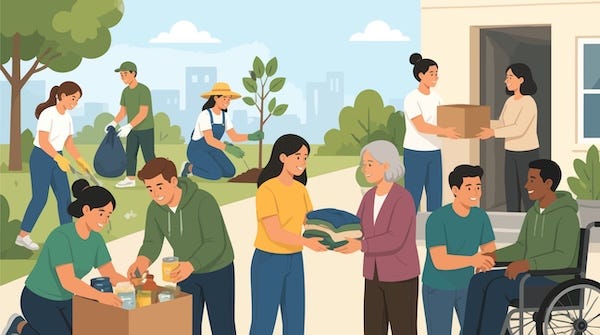
As things in the country got worse, people had come to understand how dysfunctional the system they were part of was, and sought out more solutions outside of government. And as more needs could be supplied at the community level, they realised how little they really needed government or companies at all.
Likewise, as the police focused on protecting the wealthy and powerful and their property and money, the pretence that they were there to protect the likes of us fell away too – it was no longer a believable lie. So communities organised their own self-defence, and in doing so saw many of the causes of the problems they faced, and were able to address them more directly.
Where existing systems couldn’t protect others, or couldn’t stop those intent on doing harm, we found ways to contain or deal with it – not all of them pretty. (This approach was not a direct replacement at first, and had some challenges along the way – for example some bad actors tried to take advantage of others’ goodwill or inexperience – but ultimately it proved to be a better system than the one that had long been failing those it considered less important.)
Eventually we met our own local energy needs using solar, wind, or whatever suited the area, and libraries of things sprang up in every community, so that the tools, equipment, and skills any one household couldn't justify owning outright were simply shared. This principle allowed us to share many things that would have otherwise been considered luxuries too.
Other services that had once been offered by cities or states began to be offered by non-government groups, in many cases by people who had once worked in government departments since downsized, and who brought with them the skills to ensure that even complex processes could continue to be carried out. Healthcare, childcare, elder and disability support, and the education of the young all found their way into community hands too, often run by those who’d once done this work for a wage and now did it because it needed doing.
Where local government wasn’t particularly strong, or national government wasn’t willing to fight it, provision of these services sometimes came entirely under our responsibility, and we discovered (through some teething problems) that listening to the former utility and city council workers who knew their jobs well led to better outcomes for everyone.
None of this could have come without a careful stewardship of nature, especially in light of how much it had been abused for profit. We’d learnt we couldn’t survive without working with it, rather than against it. This was a practice we began with community gardens and ultimately extended to rivers, forests and to all the wildlife around us.
There was no longer any real question of whether this way of living was possible – though resentment remained among those who’d mistaken the extra comforts that came from privilege and exploitation for merit, or for a rightful inheritance.
By the point we were over two decades into this transition the rich mostly lived in their guarded and gated enclaves, did business in their corporate walled micro-cities, where the politicians also stayed, surrounded by what passed for an army for hire. But their power didn’t extend as far as it used to, and the collective power of people had finally outgrown it.
Whereas internationally, networks of mutual cooperation made the creation and maintenance of almost everything possible. It became a parallel production system, one which even corporations would begrudgingly rely upon for their supplies in some areas.
Most importantly, though, this remained people first. People were helped where they were, or were helped to move to where they could obtain help, and when this model spread its way throughout the world it had profound effects on regions that had previously been impoverished or lived in unsafe conditions – to the point that the solidarity and combined efforts of some regions helped remove the dictators who refused to go peacefully in other areas.
This was not a situation those with decreasing power were going to be willing to tolerate indefinitely. Their first response was to try to frighten people into submission. They claimed you couldn’t trust what your neighbours or your community farm produced, that you couldn’t be allowed to trade with each other without licences, and that there were taxes on top, with the risk of jail if you didn’t comply. But this fell on deaf ears, because people’s lived experience proved the former baseless, and the latter ineffective, as so much wasn’t going through the systems that had once tracked such distribution.
Ultimately it reached a point at which it was difficult for some employers to get workers willing to work, as they offered little more than a life of indentured servitude. Increasing criminalisation and prison labour made up the difference for a while, as did automation where it worked, but many corporations still needed to rely on customers for their profits, and they were losing those rapidly. Likewise, politicians seemed more and more irrelevant, no matter how much they tried to justify their existence, even though by this point they were effectively just corporate appointees.
All throughout this process there was pushback, sometimes of a violent kind. But even a few who initially saw themselves as our enemies found they could have a better life, and their children a better future, by joining with us. Many of them had useful expertise or genuine talent for organisation, resource management, and distribution logistics, and wholeheartedly supported the cause. (There were a few who pretended to do so, to try to sabotage, subvert or take over collective systems, but most showed their true colours before they got very far.)
Even after trying to make bad examples of a few of us, jailing organisers in a handful of round-ups, this failed to bring about any substantial change, so they begrudgingly offered people concessions, and even tried to find ways to co-opt these new decentralised systems as a favour to us all. There were some who fell for the sell, but in reality all it did was get other people used to a way of doing things they could do just as well without such institutions, and so it ultimately became their best failed attempt to subvert something that had grown beyond their control.
There were attempts to divide us, to pick us off, to favour one part of a city and pit it against another. But we carried on longer than they had the capacity to try to break us up. What saved us was that the challenges we faced and the help we received didn’t stop at borders. We had more in common with those struggling in an impoverished country than with the wealthy in our own, and as we helped others, they helped us.
Still, some of the powerful were unwilling to let us be, even some who saw they couldn’t win, because they believed they had some god-given or market-given right to their positions. Some tried to go on the offensive, but by this point too many soldiers were unwilling to fight against their family, friends and neighbours. So they walled themselves in, with a few protectors, hoarding whatever they could that they thought they could use to maintain some sort of value, and some live this way still, and a few may continue to do so for a few years, until they need or want something the rest of us have – whether essentials they’ll eventually run out of, or just to be part of a community.
There are still pockets of true believers: those who think one day we’ll come to them for their corporate skill or share-trading genius, those who believe it isn’t godly not to have a government, those who believe this progress wasn’t a proper revolution, because it didn’t meet their theoretical expectations.
But we couldn’t be divided by labels, even though didn’t always agree, and often said so loudly, but we’d learnt to argue our corner without needing to control anyone else’s. A world in which workers collectively managed and benefited from their labour, and produced for need rather than profit, could be called good old-fashioned socialism – but people weren’t obliged to admit it. They could simply see it was more efficient, had many real benefits, and that they had more time off.
A world organised around communities, with effectively no borders, no class distinctions or privileges, and in which many communities had already given up money, was of course the very definition of communism, but we weren’t stuck with one word to describe it, and many just spoke of it as ‘a better way’.
A world without rulers wasn’t chaos, but technically was anarchy, which literally translates to ‘no rulers’. We learnt we didn’t need any – they were the ones who’d needed us all along. But it was never about an ideology winning, it was about removing barriers to freedom, and making sure people’s needs were met. That mattered far more than any point-scoring.
And the story took sacrifices – tit ook people standing up when that took courage, fighting back against those who attacked us when that took risk, and defending our freedoms took the ultimate price for some. Because those with power and wealth were not willing to let it slip away, even though we were prepared to carry out the process peacefully if possible. They were not.
But ultimately we succeeded in moving our society from ownership by a few to housing and food for everyone, and access to whatever is needed. From a few directing and dictating in the interests of their own power and wealth, to people organising freely and coordinating with each other to carry out simple and complex tasks for the good of everyone. From hierarchical power over others to shared power – power from the bottom up – from representatives serving their parties and benefactors, to recallable delegates and working groups that anyone could join, or leave.
It’s a process that could have happened, perhaps more peacefully, over a longer period, through slower cultural shifts, but in our case it was more of a series of upheavals, lurches forward, and scrambling to defend what we’d gained and extend it. I’m just glad we got to see it in my day, rather than just waiting for my grandchildren to realise and achieve it, so that me and my children can enjoy the benefits now.
We learnt early on that most people want the same basic things – freedom, food, friends and some fun – but many didn’t think them possible until they saw an example. That we were right not to try to gain power before empowering people and communities. That we must make opportunities, as well as take the ones we’re given. And that we should never sacrifice, in the short term, the freedoms we want to see, in pursuit of obtaining them at some later point.
Some of this was hard learnt, we made many mistakes. Amongst all the skills we had to learn was humility. Unfortunately, many of us who’d imagined a grand future revolution in which we’d be the heroes fancied that we were more knowledgeable, and in some areas that knowledge did come in use, but it was primarily through listening, including, and working together alongside others, who knew their own situations and what they had to offer far better than anyone else did.
Call it a revolution, or a transition, or an evolution, but it did happen, it started happening long before many of us noticed, and it is still happening, and will need to keep happening if we are to always keep hold of the better world and better life we have won.
Note: This is just from the one perspective of a person living in Western Europe, and is undoubtedly seen through their imperfect lens, speaking of the particular path they took, and prioritising what their concerns and benefits from this transition were. It is hoped in time that other stories will come forward about how similar steps (and some unique ones) took place in other places less like this story, but just as interesting, maybe even more so.
I previously outlined in more detail what such a ‘liberated’ community might look like in my 11-part series set on the mythical island of Antillia.
Liberation Or Liberty?
·
November 7, 2025
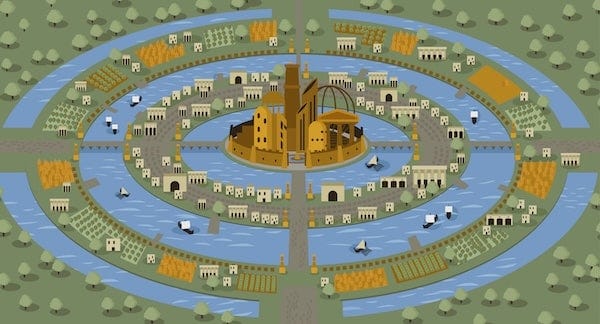
Last year I wrote a short story about a reporter visiting the island of Antillia in the 1930s and how their egalitarian society operated. Since that time the island has become the subject of mystery, and some have wondered if it has maintained its ideals a hundred years later.
A world without rulers and which is organised by cooperation is an anarchist world. All of the elements of transition to such a world have examples in history and are explained in more detail in the following links.
But if you prefer choosing your own ideal future this might help:
No posts
Comments
Nothing yet. Say the first thing.
Sign in to join the conversation.