
It was 1982, and my brother Simon and I had been so excited to go trick or treating ever since we’d watched E.T. that summer. The movie featured a Halloween scene of costumed kids collecting candy, and we’d been counting down the days until we could dress up and carry out a similar haul, going door to door collecting treats. I was 10 and he was 7. My mother was a little wary about my brother going out without her, but I’d promised to look after him and that we wouldn’t go beyond the street our bungalow was on.
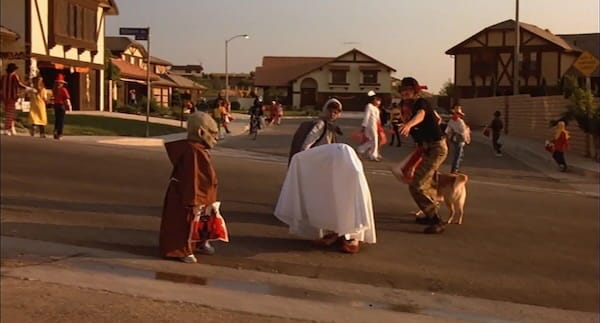
We started at the far end of our street so we’d end up near home with our pillowcases full of chocolate. We were almost back, just walking to the house opposite ours, when a boy of about twelve started trying to pry my brother’s bag away from him. I shouted at him and ran towards my brother, but before I could get there he’d snatched the candy and bolted into his house on the corner of the street.
We went straight across to our house and told my dad. He didn’t hesitate at all. He walked right into that boy’s house and took back my brother’s bag. As I watched him come out, I could see the thief’s father was a much bigger man, and he was shouting at my dad. I worried he’d beat him up, but my dad just gave him a look that seemed to make him shrink and back off. I was so proud of him, albeit ashamed I hadn’t chased the boy myself, but glad we got my brother’s candy back. (For the record, I’d have happily shared mine, but Simon was proud he’d collected that haul himself, in a bag almost as big as he was, and made the sweets last for a week, whereas I ate all mine that night.)
I’ve thought about that night many times since. What stays with me is how simple the whole thing was. A boy took what wasn’t his. My dad walked in and took it back. The thief’s father was bigger and louder, but none of that changed the fact that the candy wasn’t theirs to keep. His size and noise and bigger house didn’t add up to him being entitled to what was ours. They had taken something, and so it could be taken back.
So far in this series we’ve established three things. First, that the commons (the earth and all it produces) once belonged to everyone, and everyone was entitled to use it so long as they were good stewards of it. Second, that the commons were taken: stolen, fenced, titled, sold, and the people whose living depended on them were coerced into being wage workers with nothing to sell but their labour. And third, that because those who took it had no right to own it, restrict it, or profit from it, we have every right to take it back, as some have done at different times and will again.
This is where most treatments of this subject go quiet. Because there is a possible illegality around reclaiming what has been stolen, so the argument tends to stop at that point. Some establish that we should be able to take the commons back, and then leave it there, with little or no indication of how the commons might actually be reclaimed in our own day.
There is no single method for taking the commons back, and no reason to expect one to work everywhere or at every stage. The strategies run from the plainly legal to the frankly illegal, and any real campaign will draw on a mix of them. What serves in one place, or at one moment, may be useless in another. The thread running through all of them is simple enough: a bad law is only as strong as the power available to enforce it.
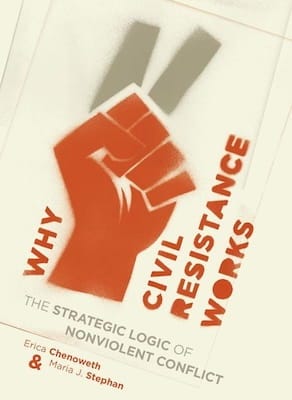
The conditions for a change of this scale tend to arrive well before the final confrontation. Erica Chenoweth’s study of a century of civil resistance found that no nonviolent campaign that drew the sustained, active participation of around three and a half per cent of a population ever failed to reach its aim. A committed minority, refusing in large enough numbers, is enough to make a thing ungovernable.
Sometimes the quickest way to free a thing is to buy it, once, and lock it open so it can never be sold again. Pool the money if you can find it, purchase the land or the building, and place it in a structure that cannot re-privatise it: a community right-to-buy, a co-operative, or a trust. Money is used here against itself: a single transaction to end the possibility of all future ones. But of course this option is only open to those who can raise the funds.
When the people of the Isle of Eigg bought their island in 1997, the £1.5 million came from the sixty-odd residents and thousands of strangers who chipped in, one of them anonymously giving half the total. The island passed to a heritage trust rather than a new laird, and that trust has held it for the community ever since, unable to sell it back into private hands.
However, community owners still live in a world which requires taxes and fees to be paid and that requires a continual income. In 1969 a group of civil-rights organisers in Georgia pooled what they could, bought nearly six thousand acres, and wrote into the founding documents that the land would be held ‘in perpetual trust for the permanent use of rural communities’, leased to the Black farmers who worked it. For a time it was the largest tract of Black-owned land in the country. It did not last. To keep going when drought came, New Communities had borrowed against the land. Refused the emergency credit that white farmers were given, they defaulted, and in 1985 a bank foreclosed and the land was lost.

Ownership only pays because we keep feeding it. Stop paying for it, and its value drains away. It is a simple strategy: boycotting may not just be a method of getting corporations to change but of making them cease to exist, devaluing what they own until it is too cheap or worthless to be worth using violence to maintain, and so opening it up to those who would bring it back into the commons.
The system depends on our participation. Where possible don’t buy from the corporation, don’t use the service, and don’t work for the wage they are offering. This is not passive. It is the withdrawal of the value that makes their ownership worth anything. A factory without workers is a building. A landlord without tenants is a person with a mortgage. Ownership is worth something only because of the dependence it creates, and dependence can be dismantled.
Of course this relies on us having some community sufficiency, especially in the case of food and shelter. But when one community achieves this it can help one that hasn’t or is more reliant to break those bonds too. However, even short of this, in the meantime there are many ways in which we can undermine our economic rulers financially.
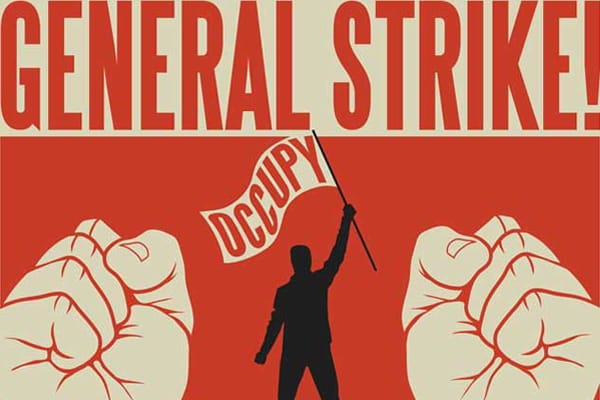
Take the classic Syndicalist proposal. The people in a workplace sit down and refuse to work until ownership is handed to them. The owners call the police to clear them out. If the same thing is happening across a city’s offices and factories at once, the police are not enough, and the state is asked to send in the army. But if this is part of a general strike across a whole country, there is no army that can hold it down for long. And if the people the soldiers are sent against include their own parents and siblings, their partners and friends and neighbours, many of them will not raise a hand at all.
Ultimately we need to withdraw our support of capitalism not just through refusing to buy, but through withdrawing labour. Workers need to collectively refuse to operate the machinery of production. Without workers, factories are useless; without drivers, distribution collapses. The general strike is expropriation in slow motion, the reclaiming of time, of autonomy, of the power to say no. Its aim reaches past better wages to the permanent transfer of control, of production and of the economy, to the people who actually run it.
In Henry George’s Progress and Poverty (1879) he proposed taxing unused land at an increasing rate, to return some of its value to the community around it, or to push owners into using it in ways that benefit that community rather than paying the charge. This approach, however, just changes who collects the rent. The land stays owned and stays on the market, a thing to be bought and sold. Because it is a reform that would work within the system’s own machinery, it could only reach as far as the state is willing to carry it.
Industrialised production already puts the majority of the environmental and health costs back on the community. It is already costing more than the community can afford, in asthma, water pollution, warming air and waste, before we even factor in a penny of tax breaks and subsidies. If communities could bill many of the factories for the true costs they bear, they’d quickly go out of business, or would have to find much more community-friendly ways to operate. But although there have been occasional victories in this area, most politicians realise it would be the end of capitalism and their donors if they were to do this, so they can’t be trusted to carry this out.
There are other ways to load the true costs back onto the owner until holding the thing is a drain rather than a store of value. One way to do this works by obstruction, raising the price of operating until the operation no longer pays. At Preston New Road in Lancashire, residents stood at the gates of Cuadrilla’s fracking site every working day for years, walking slowly in front of the lorries, climbing the rigs, denying the company the quiet it needed. Between the resistance, the earth tremors the drilling set off and the costs that mounted, the wells were never worth what was sunk into them, and they were ordered plugged and abandoned.
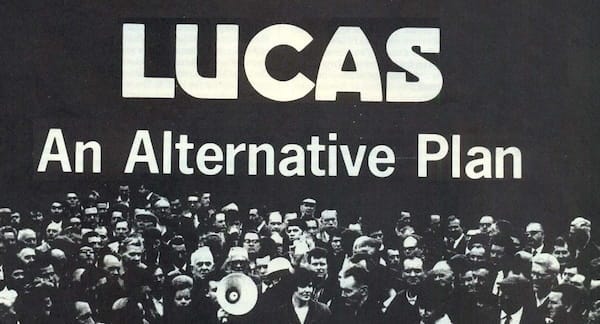
Another way works by conversion, turning the firm’s own capacity to other ends. In 1976 the workers at Lucas Aerospace, told that thousands of them were to be made redundant, drew up an alternative plan of their own: instead of missiles and military kit, the same machines and the same hands would make kidney dialysis machines, wind turbines and hybrid car engines, things their communities actually needed. Management refused it, but the workers had shown that the capacity to build the useful was already there, waiting only for someone to point it the other way.
Underneath all of it is one principle: stop letting them put their costs on us. The polluter who has spent a century handing his waste to the people next door can be made to carry it himself, and a producer forced to carry his own costs loses most of his reason to produce this way. None of it replaces the thing it pushes against. But it raises the cost of holding the world as it is, and if those costs climb high enough, the profit falls out of the old way and leaves room for a community to build something better.
Ownership rests on two things: being seen as legitimate, and someone being willing to enforce it. Remove either and the claim hollows out. The first is cultural, a matter of making exclusion feel shameful rather than ordinary, so that the fence reads as theft and not as order. The second is harder and more decisive: the moment the people sent to enforce ownership decline to. Police who will not evict, bailiffs who will not serve the warrant, soldiers who fraternise rather than fire. This is the hinge on which an occupation turns into a reclamation rather than a crushed gesture. When Portugal’s soldiers refused to prop up the dictatorship in 1974, it fell within a day.
The cultural work is slower. English common rights survived for centuries partly through sheer continued use: people walking, grazing and gathering until the practice hardened into a right no court could easily strip away. Rights of way still work like this, and so, for unregistered land at least, does adverse possession, where occupying openly for long enough weakens the original title. The Right to Roam movement is the modern version, a decades-long effort to make exclusion from open country feel shameful rather than normal. Its founding moment was the 1932 mass trespass on Kinder Scout, when ramblers deliberately walked onto forbidden moorland and several went to prison for it. Most of the access the English now take for granted was taken, not granted.
We previously covered expropriation, taking something back that was ours and should belong to us: this is occupation. The simplest reclamation is to be on the thing and refuse to leave. Occupation, squatting, homesteading: a settlement that presents itself as a fact of reality rather than a protest that asks permission. People living somewhere, working a piece of ground, are hard to argue with and harder to evict, and a settlement that holds long enough makes its own legitimacy. Britain’s postwar squatters showed it briefly, moving into disused army camps in their thousands until the state found it easier to house them than to fight them.
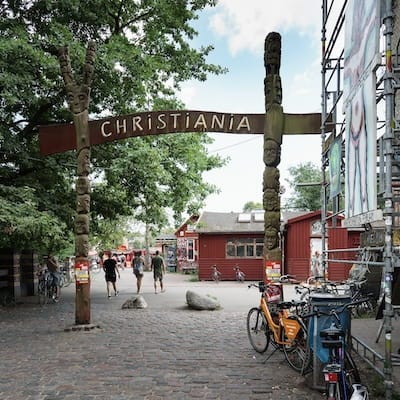
One has held far longer. In 1971 squatters occupied an abandoned military barracks in Copenhagen and declared it a free town. Denmark’s highest court ruled that the state owned the land; the thousand-odd residents of Christiania stayed regardless, outlasting every attempt to clear them and keeping enough of the public on their side that no government wanted the fight. They ran the place themselves, by consensus, for four decades. Then, to make it secure, they did the thing they had set themselves against: in 2012 they formed a foundation and bought the land from the state, some 84 acres for 76 million kroner, on terms that let residents live there but never buy or sell their homes. They had taken it by staying, and could keep it only by buying it back out of the market for good. The Zapatistas did this on a much larger, state-sized scale from 1994 until the present day, and have maintained their autonomy against the Mexican army.
Sabotage is a blunter tool for making a thing cost more to extract from than it yields, until holding it for profit stops being worth the trouble. The tactic has a literature of its own. Edward Abbey’s 1975 novel The Monkey Wrench Gang follows four misfits dynamiting bridges and wrecking machines to slow the development of the American desert; it gave the movement a name, ‘monkeywrenching’, and a generation of imitators in Earth First! and the Earth Liberation Front. CrimethInc carried the same romance to younger readers with The Secret World of Terijian, a children’s fable about two kids defending the woods behind their houses, which a United States attorney once cited in a sentencing memo as evidence that the movement was encouraging children toward the same crimes.
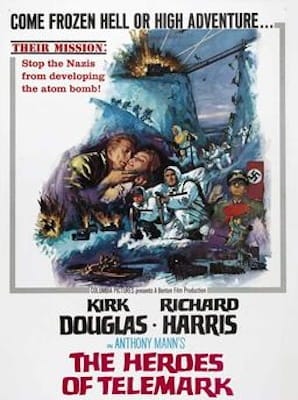
On a February night in 1943, a party of Norwegian commandos climbed down into the gorge below the Vemork plant in occupied Telemark, slipped inside, and destroyed the cells that produced the heavy water the German nuclear programme depended on. They fired no shot and killed no one. Britain’s own saboteurs judged it the most successful act of sabotage of the entire war, and a 1965 film, The Heroes of Telemark, made matinee heroes of the men who did it. Although the plant was producing again within months, and the heavy water was finally lost to Germany when saboteurs sent the ferry carrying it to the bottom of a lake.
However, when sabotage takes place in war, a country supports it and considers it legitimate if our side or allies are doing it, but when it is done against one of our own country’s corporations, the media is far from as supportive.
The peacetime version does sometimes work, and now and then the people side with it. Before dawn on a July morning in 1999, twenty-eight people in white boilersuits cut their way into a field near Lyng in Norfolk, locked the gate behind them and cut down part of a trial crop of genetically modified maize that the government and an agrochemical firm had planted there. They hid nothing; they had brought journalists. Their leader, Peter Melchett, ran Greenpeace and happened to be a baron, and he spent two nights in a remand cell for it. He and the other twenty-seven were charged with criminal damage and theft, and a Norwich jury acquitted every one of them, accepting that cutting the crop down was a lawful way to keep contamination off the land around it. The trials struggled on a few more years and then stopped, and no genetically modified crop has been grown commercially in Britain since. It was the same act McGowan went to prison for as a terrorist. A jury here looked at it and called it reasonable.
The two are the same act, but one is the worst eco-terror attack on record, the other the war’s most celebrated sabotage. The method does not change between them. Only the cause does, and the people keeping score.
It once seemed that the most sure way to secure access to the commons was to let the state take it. Nationalise the land, the utilities, the housing, and be done. But state ownership is still ownership, and what one government takes another can sell. The Soviet state took the land into public hands, and a later one handed it to oligarchs. Britain took the railways, water and energy into public ownership, then privatised the lot, and now we rent back what we already paid to build. Taking a thing into state hands is not recommoning it. It is changing the landlord. The commons has to be held by the people who use it, or it will be enclosed again. The only question is when.
So we need to be prepared to maintain and defend what we’ve reclaimed if we hope to keep it. The bully’s corner house is easy enough to walk into. The hard part is everything that comes after, when the candy is ours again and he is still living on the corner. That is where the second half of this begins: not the taking, but the holding. That is the subject of the next article in this series.
Previous articles in this series -
No posts
Comments
Nothing yet. Say the first thing.
Sign in to join the conversation.