
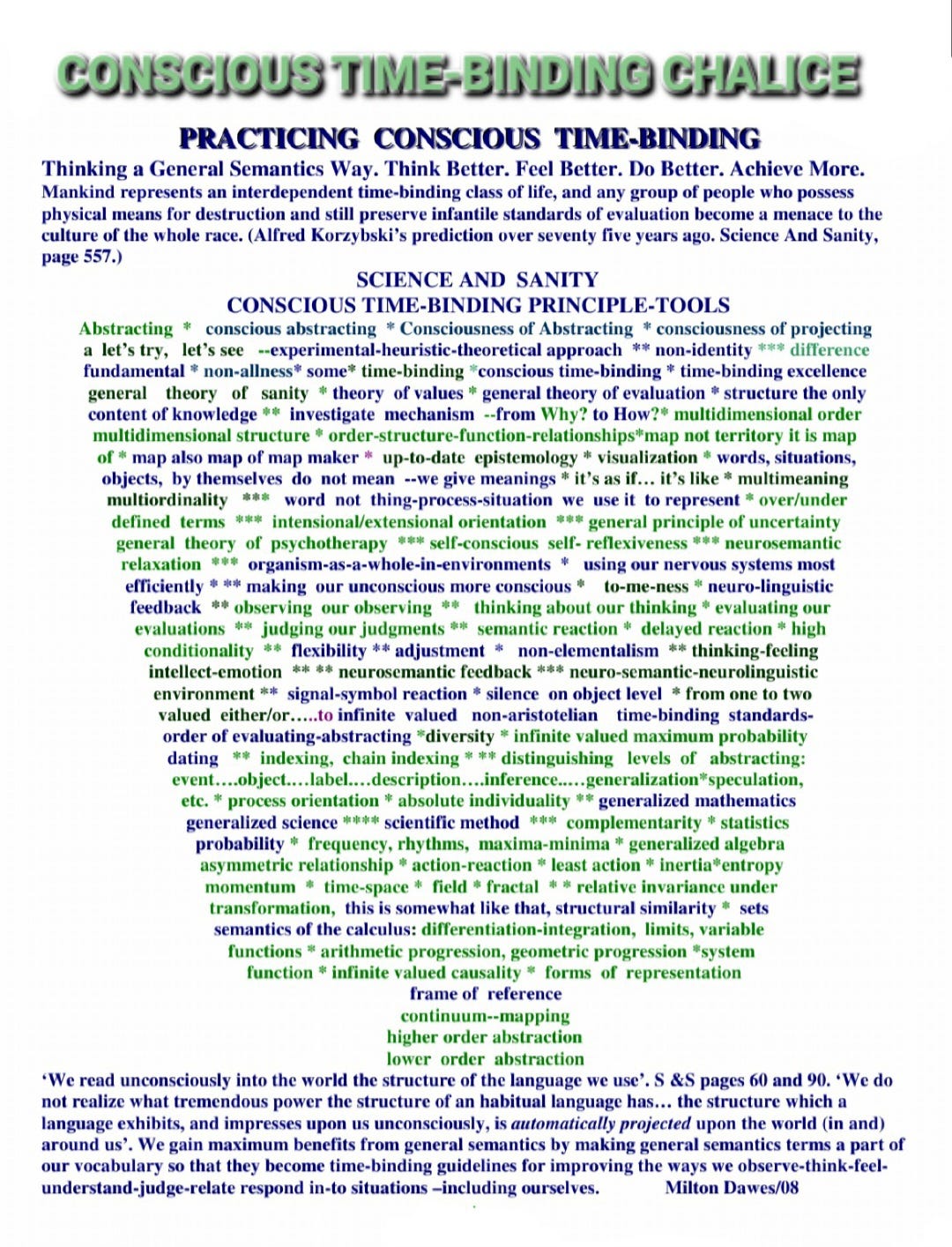
Chalice-Prime: A Syntropic Evolution of E-Prime for Conscious Time-Binding
Founding Document
Version 1.x
Released into the Public Domain, July 15, 2026
Author/Steward Lineage: JVS / timebinder collective synthesis (building on Alfred Korzybski, David Bourland, Milton Dawes, and others). No rights reserved.
,. = etc.
Abstract
As of July 15, 2026, this document offers Chalice-Prime as a practical linguistic discipline. It evolves David Bourland’s E-Prime by integrating Milton Dawes’ Chalice of Conscious Time-Binding and the non-Aristotelian formulation systems of Alfred Korzybski. The framework replaces static, identity-based language with process-oriented, extensional formulations characterized by explicit epistemic humility, dating, indexing, and multi-ordinal awareness. Chalice-Prime serves to operationalize conscious time-binding—the human capacity to receive, improve, and transmit evaluations across generations—by serving as a disciplined linguistic substrate for personal sanity and collaborative civilizational protocols.
1. Origins and Rationale
In Manhood of Humanity (1921), Alfred Korzybski identified humans as a time-binding class of life. Unlike plants (chemistry-binding) or animals (space-binding), humans accumulate, refine, and transmit achievements, ideas, and standards across generational time. When practiced unconsciously, time-binding transmits and amplifies errors, prejudices, and structural conflicts. When practiced consciously, it enables progressive sanity and structural adaptation.
Milton Dawes advanced this discipline through “Chalice”. The Chalice serves as a functional framework for holding and habitually applying general semantics principle-tools—shifting our neurological processing from passive, static nouns and absolute labels toward active verbs, relational dynamics, and operational behaviors.
E-Prime (English minus all forms of the verb “to be”) offers a powerful tool for disrupting identity statements (“X is Y”) and predication (“The rose is red”). However, used in isolation, E-Prime can result in syntactical awkwardness without necessarily training a speaker in the wider field of general semantics (such as dating, indexing, distinguishing descriptions from inferences,.). Chalice-Prime synthesizes these approaches, offering a balanced, highly applicable discipline for individual, institutional, and civilizational communication.
2. Theoretical Foundations
Chalice-Prime structures our linguistic habits to align with a dynamic world of processes, probabilities, and interdependent systems. It integrates three primary frameworks:
The Structural Differential (Korzybski): A model illustrating the process of abstracting—from the sub-microscopic, dynamic event level, through sensory/object recognition, to verbal descriptions, inferences, and high-level generalizations. Chalice-Prime enforces an awareness of these levels, preventing the identification of a description with the event, or an inference with a description.
“Chalice” Practice (Dawes): Actively “holding” General Semantics (GS) principles-tools as a unified, applicable set. This includes non-identity, non-allness, conscious abstracting, consciousness of projecting (the semantic understanding that “meanings” do not reside in words or things, but are generated by our nervous systems).
Extensional Orientation: Prioritizing specific, observable, dated, and indexed instances over rigid, static category definitions.
3. Core Principles and Practical Guidelines
The Primary Discipline
Prefer formulations that reveal process, context, temporality, epistemic humility,.
Typographical Convention:
To maintain semantic awareness, we default to the omission of “to be” forms.
When we consciously choose to utilize a form of “to be” to preserve essential clarity or historical phrasing, we shall indicate this deliberate exception by underlining or italicizing the verb (e.g., is, was, be) to signal
explicit linguistic consciousness to the reader.
Core Structural Elements
When formulating high-stakes evaluations, we seek to apply the following seven structural safeguards:
1. Dating: Apply timestamps to claims to reflect a changing universe (e.g., understanding_as_of_July_2026).
2. Indexing: Differentiate unique instances of a common label to avoid over-generalization (e.g., democracy_1 \neq democracy_2).
3. Etc.-Consciousness: Explicitly acknowledge the incompleteness of any statement or map using ...etc. to guard against “non-allness” (the assumption that we can say everything about something).
4. Process and Action Orientation: Favor active verbs, relational phrases, and operational descriptions over static nouns and adjectives of identity.
5. “To-Me-ness” / Owned Projection: Explicitly qualify evaluations to reflect that the observer’s nervous system is translating the event (e.g., “It appears to me,” “I evaluate...”).
6. Semantic Differentiation: Clearly demarcate descriptions of observed facts from inferences or high-level speculations.
7. The Somatic Pause: Pause before responding to a stimulus. Check your somatic nervous system state, allow a delayed reaction, and consult the Chalice before speaking or writing.
4. Illustrative Comparisons
Approach, Example Statement, Characteristics
Standard English: “China is a threat.”; High velocity, but projects a static, totalized identity.
Strict E-Prime: “China acts in ways that increase tension.”; Disrupts the “is” of identity, but still presents an un-dated, un-indexed allness statement.
Conversational Chalice-Prime: “The Chinese government’s actions this month appear to me to increase regional friction.”; Fast, conversational, uses a process verb, owns the projection (“appear to me”), and bounds the timeframe.
Formal Chalice-Prime: “Actions by the Chinese government, as of mid-2026, appear according to available indicators to increase regional tension with respect to Taiwan_instance... etc. This pattern differs from instances observed in 2015.”; Exceptional precision, explicit dating, indexing, owned projection, and etc.-consciousness. Highly suited for policy and diplomacy.
5. Connection to Syntropic Trends and Civilizational Application
As a linguistic framework, Chalice-Prime appears intended to support syntropic trends by providing structural checks against identification-errors. Proponents hypothesize that habitual application may alter communication dynamics in the following ways:
Signal-to-Noise Ratio: By requiring explicit context, indexing, and dating, the discipline may reduce semantic disturbances (“epistemic noise”) resulting from unexamined multi-ordinal projections.
Evaluation Latency: Transitioning from static labels to operational verb forms may lower structural rigidity, potentially decreasing the time required to update organizational behaviors relative to environmental shifts (“governance lag”).
Inter-Generational Evaluation: Explicit dating structures may enable cleaner evaluation of past formulations, preventing the uncritical transmission of obsolete semantic reactions across generational intervals.
6. Limitations and Future Directions
→ Learning Curve: The discipline requires deliberate, conscious practice; initial application may feel effortful or unnatural.
→ Contextual Flexibility: Users must scale the discipline appropriately, using conversational variants for daily life and formal structures for legal, scientific, or policy environments.
→ Empirical Validation: Systematic evaluation of Chalice-Prime's impact on group decision-making, conflict resolution, and cognitive bias reduction remains a key requirement for its continued development.
7. Public Domain Declaration
This entire document and the Chalice-Prime framework it describes are released into the public domain. You are invited to use, adapt, teach, translate, critique, and improve it. Every conscious time-binder operates as an active participant in the transmission and refinement of human symbolic environments. Begin with your next evaluation.
Primary References and Lineage
Korzybski, Alfred. Manhood of Humanity: The Science and Art of Human Engineering (1921); Science and Sanity: An Introduction to Non-Aristotelian Systems and General Semantics (1933).
Dawes, Milton. Practicing Conscious-Time-Binding (2008); “Chalice” (2010); “On Time-Binding Consciousness.” ETC: A Review of General Semantics, vol. 62, no. 4, 2005.
Bourland, D. David, and Johnston, Paul Dennithorne (Eds.). To Be or Not: An E-Prime Anthology. International Society for General Semantics, 1991.
End of Founding Document.
General Semantics Organizations:- Institute for General Semantics: https://generalsemantics.org
- New York Society for General Semantics: https://www.nysgs.org/
No posts
Comments
Nothing yet. Say the first thing.
Sign in to join the conversation.