
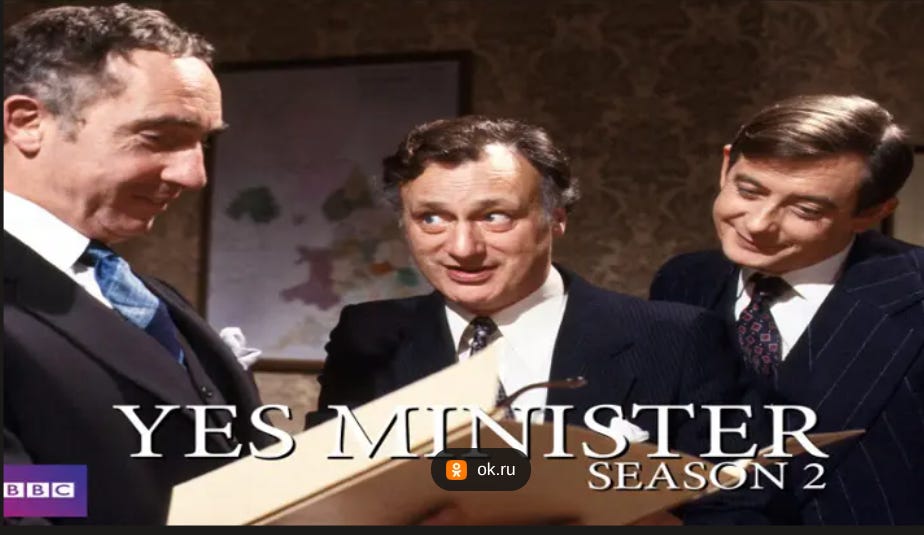
I grew up watching most episodes of Yes Minister and Yes, Prime Minister. My school had the tapes. It shaped how I thought about institutions in a way I couldn’t have articulated at the time: something about how the gap between what governments say they’re doing and what they’re actually doing is more load-bearing than accidental.
I had no idea the writers had built the show on public choice theory. I found that out years later, and it reframed everything.
Yes Minister (1980-1982) and its sequel Yes, Prime Minister (1986-1988) were written by Antony Jay and Jonathan Lynn. Jay was explicit about the intellectual foundation: the show dramatized public choice theory. He had read Buchanan and Tullock. He had read the work coming out of the Institute of Economic Affairs. He wanted to show what self-interest inside government institutions actually looks like when it operates without constraint.
Public choice theory, for those who came to this publication through other routes, makes one observation that establishment economics spent decades resisting: politicians and bureaucrats are people. They respond to incentives the same way everyone else does. They pursue career advancement, budget expansion, reduced workload, and status. They do not transform into selfless servants of the public interest the moment they take office. Buchanan won the Nobel Prize in 1986, the same year Yes, Prime Minister began airing. Both were making the same argument.
What Jay and Lynn added was the texture. Buchanan gave you the mechanism. The show gave you Sir Humphrey.
Public choice theory explains why bureaucracies expand. The narcissist state framework catalogs what they do to you when they’re expanding.
These are different levels of the same analysis, and understanding the relationship between them matters if you’re trying to maintain any clarity about what’s actually happening when institutions push back against your attempts to exit their orbit.
Public choice is the structural layer. It tells you that Sir Humphrey opposes reform not because he has calculated that reform would harm the public, but because reform threatens his department’s budget, his tenure, and the network of relationships that constitute his career. It tells you this behavior is predictable, systematic, and will recur regardless of which minister sits across the desk. It tells you the mechanism.
What it deliberately brackets is the subjective experience. Buchanan was not interested in what it felt like to be Jim Hacker. He was interested in what incentive structures produce what institutional outcomes. That was the right methodological choice for his purposes. It is also why public choice, by itself, leaves exit practitioners somewhat underequipped.
When your accountant looks at your tax minimization strategy and says “Are you sure you want to do this?”, you do not need a refresher on regulatory capture. You need to recognize, in real time, that you are being subjected to manufactured doubt by someone whose professional identity is structured around compliance. That is a different kind of knowledge. That is what pattern recognition provides.
The show identified six mechanisms that map almost perfectly onto the narcissist state framework. The writers were working from observation, not theory.
Gaslighting. Sir Humphrey’s preferred instrument. When Hacker points to an anomaly in departmental spending, Humphrey does not deny the anomaly. He reframes it as evidence of Hacker’s misunderstanding. The figures are correct. The minister simply lacks the context to interpret them. This is gaslighting at institutional scale: not fabricating reality, but systematically pathologizing the perception of anyone who notices things they were not supposed to notice. The show played it as comedy. The mechanism operates the same way at scale.
Manufactured dependency. There is an episode where Hacker attempts to reduce civil service headcount. By the end of the episode, he has not only abandoned the plan but become convinced that the current headcount is insufficient. He has been walked through a series of catastrophic scenarios, each one requiring more civil servants to manage. The department has manufactured its own necessity. “Without us, chaos” is a systematic rhetorical strategy Humphrey deploys with surgical precision, not an accidental byproduct of the conversation. The show named the pattern before the framework did.
Intermittent reinforcement. Hacker wins occasionally. Not often, not on anything that matters, but occasionally. A press release goes out under his name. A minor policy adjustment gets attributed to his initiative. This is not generosity. It is maintenance. Occasional wins keep him engaged, keep him hoping the next one will be larger, keep him inside the system rather than questioning whether the system is worth being inside. The show understood this intuitively. Buchanan explained why it is structurally inevitable.
Triangulation. When Hacker builds momentum on an issue, Humphrey does not oppose him directly. He introduces a competing concern. The Foreign Office has reservations. The Treasury has run different numbers. There is a backbencher with strong feelings. Hacker finds himself managing conflicts between people who, from the outside, appear to have opposed interests but who are all, structurally, invested in the same outcome: no change. The manufactured conflict prevents the unified recognition that would threaten the system.
Deny, attack, reverse. When Hacker occasionally catches Humphrey in something genuinely problematic, the sequence is reliable. First, the denial: the characterization is unfair, the minister has been misinformed. Then the attack: it is troubling that the minister would raise this, it suggests a breakdown of trust that could damage the department’s effectiveness. Then the reversal: the real concern here is the minister’s judgment. By the end, Hacker is apologizing. The writers understood this sequence precisely. They built entire episodes around it.
Narcissistic rage. This one the show handles more subtly, because overt rage from a senior mandarin would be unbroadcastable and also unnecessary. What the show depicts instead is the quieter version: the withdrawal of support, the sudden discovery of procedural obstacles, the memo that does not get sent, the briefing that occurs without the minister’s knowledge. When Hacker pushes too hard on something that genuinely threatens institutional interests, the system does not get angry. It simply stops working for him. Disproportionate, coordinated, designed to establish that certain subjects are not pursued. The delivery is quieter than IRS criminal prosecution for legal tax minimization. The underlying structure is the same.
Jay and Lynn were not writing about narcissism. They were writing about public choice. But the mechanisms they identified, drawn from their observation of how British government actually operated, are the mechanisms the framework catalogs. Two independent lines of analysis ending at the same list of behaviors is worth something.
Public choice approached from the outside, using incentive structures and institutional design. The show approached from the inside, using observed behavior and dramatized pattern. The narcissist state framework approaches from the position of those being subjected to the behavior, using the clinical literature on how these mechanisms are deployed in systems that prioritize role stability over individual autonomy. All three arrive at the same mechanisms.
So: did the show go far enough?
Yes Minister is ultimately a comedy about reform failing. Hacker wants to change things. Humphrey prevents it. The audience laughs because the futility is recognizable. The implicit message is that reform fails because bureaucrats are smarter than politicians, or more patient, or better positioned. The show is a diagnosis without a prescription.
The framework’s prescription is not reform. Reform is intermittent reinforcement. Reform is what Humphrey allows when he needs to keep Hacker engaged. The question the framework asks is why you’re still trying to win against Sir Humphrey at all.
The show’s framing keeps you inside the system, rooting for the minister. That is the frame the system provides. The energy goes to hoping the next Hacker will be cleverer, the next minister more persistent. It stays inside the game. The audience watches forty years of brilliant television about institutional futility and comes away thinking: we need better ministers.
The narcissist state framework’s contribution is the exit orientation. Once you’ve satisfied yourself the mechanism is operating systematically, the question shifts from how to beat it to whether engaging with it is worth anything at all.
Buchanan explained why the system behaves the way it does. Jay and Lynn showed you what that looks like in practice. The framework asks what you do once you’ve seen it.
Sir Humphrey was not the villain of the show. He was the system, personified. Brilliant, affable, operating entirely within his incentive structure, defending institutional interests that preceded him and would outlast him. He did not need to be malicious. The structure provided everything malice would have added, and more reliably.
The mechanisms do not require intent. They require roles with dependencies, incentive structures that reward their use, and an audience that keeps engaging.
Two of those three are outside your control.
The third is not.
No posts
Comments
Nothing yet. Say the first thing.
Sign in to join the conversation.