
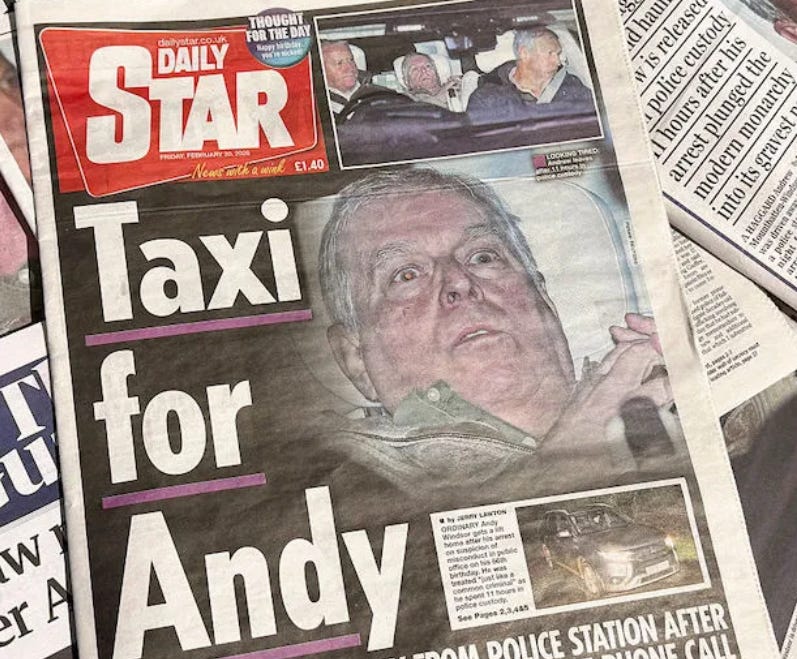
He looks hollowed out. Frightened. And the internet, from what the Spectator‘s Brendan O’Neill describes, is lapping it up. Not justice. Glee.
If you’ve been watching how the system actually operates, that photograph tells you something specific. Not about Andrew, and not about whether he’s guilty of anything. It tells you about how the Narcissist State handles a liability.
Let’s map it.
First, a clarification that makes the whole story sharper.
The Royal Family isn’t the narcissist in this framework. The State is. The monarchy is a vehicle the State uses, one of its most elegant ones: centuries of pageantry, soft power, national identity, the “we’re-different-from-republics” legitimacy signal. The Royal Family earns its keep by functioning as a perpetual Golden Child cluster. Elevated, protected, interests prioritized. Their role is to project that the system is ancient, stable, and worth belonging to.
That’s the normal arrangement. And it mostly holds. The State protects its royals because the royals serve State legitimacy.
When a royal becomes a net liability rather than a net asset, the State sacrifices him without hesitation. The institution running the arrest isn’t the Palace. It’s the Metropolitan Police. The Crown Prosecution Service. The State apparatus. The family would probably prefer this quietly disappeared. The State decided otherwise.
Andrew spent decades as a functioning part of the monarchy’s Golden Child display. “Randy Andy,” the Falklands war hero, the trade representative, the HRH that survived his divorce. Protected because he served the image. Then the Epstein connection made him radioactive, and the BBC Newsnight interview was a disaster no amount of Palace PR could contain.
It wasn’t the Palace that moved against him first. It was the State withdrawing protection. The titles went. Then came the arrest.
That’s role reassignment. When the vehicle starts damaging the system’s credibility, the system reclassifies the vehicle’s most embarrassing part. Andrew stops being a protected asset and becomes the Scapegoat who proves no one is above the law. The role exists regardless of who occupies it. Someone has to carry the blame when the legitimacy narrative needs reinforcing. Andrew is available, already sidelined, and the return on sacrificing him exceeds the cost. Right on schedule.
O’Neill points to King Charles’s “perfunctory” remarks on his brother’s arrest and calls it unbecoming. From a family ethics standpoint, he’s right.
From the framework standpoint, it’s completely legible. Charles’s job is to keep the monarchy functional as a vehicle for State legitimacy. The monarchy gets protection, funding, and deference as long as it delivers what the State finds useful. The moment a royal threatens that utility, the King’s structural loyalty isn’t to his family member. It’s to the arrangement that keeps the whole institution viable.
So Charles isn’t failing a brother. He’s signaling to the State and its audiences that the monarchy won’t obstruct accountability, that it can be trusted to self-police. The Enabler sacrifices the individual to preserve the whole arrangement. And what he’s enabling isn’t the family. It’s the narcissistic system that keeps the family in business.
This is where it gets directly relevant to anyone practicing exit right now.
You don’t need a state apparatus to destroy someone’s reputation. You need a crowd that believes it’s doing justice. O’Neill describes “social media was a riot of malicious glee” following Andrew’s arrest. Comics whipping followers into medieval jeering. Meme after meme implying depraved conduct for which Andrew has never been charged.
That’s Flying Monkey behavior at industrial scale.
Flying Monkeys don’t think of themselves as enforcers. They think they’re righteous. Worth noting: most of the crowd isn’t defending the monarchy. Many are actively hostile to it. Anti-monarchists, Epstein obsessives, people who’ve despised inherited privilege their whole lives.
But they’re flying the flag for the State’s accountability narrative, whether they realize it or not. “No one is above the law” is one of the State’s most powerful legitimacy claims. When the crowd piles on Andrew, demanding consequences, reveling in his downfall, they’re reinforcing exactly the story the State needs told right now. They think they’re challenging power. They’re actually servicing it.
The State doesn’t need its Flying Monkeys to be loyalists. It just needs them pointed at the designated target. The crowd’s genuine hostility to aristocratic privilege makes them more effective enforcers, not less.
Role allocation doesn’t require a memo. When the State signals someone is no longer protected (through arrest, through stripped titles, through the Palace’s conspicuous silence) the crowd reads the signal and moves. They do the enforcement work without being asked, and they feel good doing it.
When someone says “everyone thinks you’re being irresponsible” for homeschooling, or “your whole family is worried about you” for opting out of conventional financial systems: that’s the same mechanism. The State doesn’t need to reach you directly. It has people around you who’ve internalized the enforcement role. They genuinely believe they’re helping. The sincerity makes them more effective, not less.
Recognizing Flying Monkey behavior doesn’t require proving malicious intent. It just requires seeing the pattern: someone delivering social pressure on behalf of a system they’re identified with, in a way that leaves the Scapegoat feeling isolated and wrong.
O’Neill’s piece is genuinely good. He’s defending due process, refusing mob logic, pointing out the slander and the false Epstein equivalence. These are real things worth defending.
But his frame stays inside the system. His complaint is that the mob is doing this wrong, that the Crown is behaving coldly, that Republic is betraying its own principles. The implicit hope is that better behavior from these actors would produce a better result.
The Narcissist State framework sees it differently. This isn’t a malfunction. It’s the mechanism.
The Royal Family didn’t do this to Andrew. The State did. The Metropolitan Police made the arrest. The Crown Prosecution Service is running the investigation. The Palace is watching this happen to one of its own and there’s essentially nothing it can do about it. That’s the narcissistic system asserting priority over one of its own vehicles. The vehicle serves the system, not the other way around.
The Scapegoat’s guilt or innocence is almost incidental to the function. What matters is that someone carries the blame at the moment the State needs blame carried. Andrew is available. Protection has been withdrawn. The machinery runs.
When you practice exit from fiat currency, from conventional schooling, from tax maximization, you will at some point get positioned as the problem. Not because you’ve done something wrong. Because someone in your social circle, or your family, or your workplace, needs a Scapegoat at that moment.
When someone says “everyone’s worried about you” or “you’re being selfish” or “you’re putting your kids at risk,” they’re not necessarily lying or consciously manipulating. They’ve identified you as the available liability. The system has taught them to feel virtuous about the enforcement. They’re Flying Monkeys who think they’re helping.
The crowd’s behavior follows a predictable structure regardless of guilt. That structure operates at every scale, including the scale of your own social network.
When they try to make you the liability in their story, you’re watching the same mechanism. The face in the car. The mob logic. The institutional cold shoulder. The enforcer friends who are absolutely sure they mean well.
See it for what it is. Name it. Disengage. Preserve the energy for building.
The Narcissist State framework maps the manipulation tactics exit practitioners face. Not therapy. Pattern recognition.
No posts
Comments
Nothing yet. Say the first thing.
Sign in to join the conversation.