
A short video. A large auditorium. A national anthem playing. Almost everyone standing. One young man, seated, lanyard around his neck, expression elsewhere. Vladimir Putin walks past, pauses, communicates the instruction through a look alone. The man stands. He looks guilty. He looks confused. He looks like he is trying to remember what he did wrong.
He didn’t do anything wrong.
The State’s claim to legitimate authority over voluntary individuals has no genuine structural basis. It rests entirely on people performing roles that validate it, continuously, publicly, and without visible gaps. The man who stands for the anthem is not just showing respect for a piece of music. He is participating in the collective performance that makes the authority of the person at the front of the room seem real. Every standing body in that auditorium is doing work the system requires.
This is why the seated man was so threatening despite posing zero material harm to anyone. He didn’t challenge Putin. He didn’t protest. He simply stopped performing for a moment, and in doing so created a visible gap in the collective validation the myth runs on. The correction had to happen not because sitting during an anthem causes any damage, but because an unaddressed gap in role compliance makes the myth legible as myth. The system cannot afford that.
Context determines everything in a narcissistic system. The same behaviour, sitting down, carries entirely different weight depending on who is watching, what role is being performed around it, and what the system needs at that moment. Had the young man been sitting in an empty corridor, nothing would have followed. It was the context, Putin walking past, an auditorium of observers, a national anthem, a public stage, that made his inattention available as a transgression.
This is gaslighting at institutional scale. Not the distortion of a specific fact, but the distortion of the relationship between behaviour and accountability. The rulebook is never fully published because an unpublished rulebook is more effective. When rules are explicit they can be followed, challenged, or negotiated. When they remain implicit, the system retains permanent authority to declare any behaviour a violation at the moment of enforcement. The young man cannot appeal because there is nothing to appeal against. He was not told to stand. He was simply corrected for not standing, and the correction carried its own justification.
The guilt on his face is not evidence of genuine wrongdoing. It is evidence the mechanism worked.
The crowd is doing something important in this clip. Row upon row of people who almost certainly registered the interaction. They look forward. They say nothing.
Their standing is not incidental. It is the performance of their own assigned position, and acknowledging what just happened to the young man would require stepping outside that performance. So they don’t.
Every person in that room now understands, without being told, that their own posture is being read. The young man’s correction is simultaneously a message distributed to everyone present, and via the viral clip, to everyone watching. The system does not need to correct everyone. It corrects one person in front of everyone. The rest of the enforcement distributes itself.
The caption accompanying the video: “President Putin politely reminded the guy that the Russian anthem is not something you listen to while sitting.”
This is DARVO applied before any alternative framing can take hold. A public correction delivered through the implicit threat of institutional position becomes courtesy. An act of care. The powerful figure wasn’t enforcing compliance, he was educating. What disappears in that single word, “politely,” is the power asymmetry, the public staging, the absence of any private alternative, and the fact that the young man now carries that moment in front of an entire auditorium.
There is a famous photograph from Hamburg in 1936. A crowd of workers at a Nazi rally, arms raised in salute. One man, arms folded, not saluting. He is widely believed to be August Landmesser, who had been expelled from the Nazi Party for his relationship with a Jewish woman, Irma Eckler. The photograph circulates today as a symbol of quiet defiance. What it rarely circulates with is what followed. Landmesser was jailed for “dishonoring the race.” Irma was sent to Ravensbrück concentration camp and murdered in 1942. Landmesser was drafted into a penal military unit and killed in Croatia in 1944.
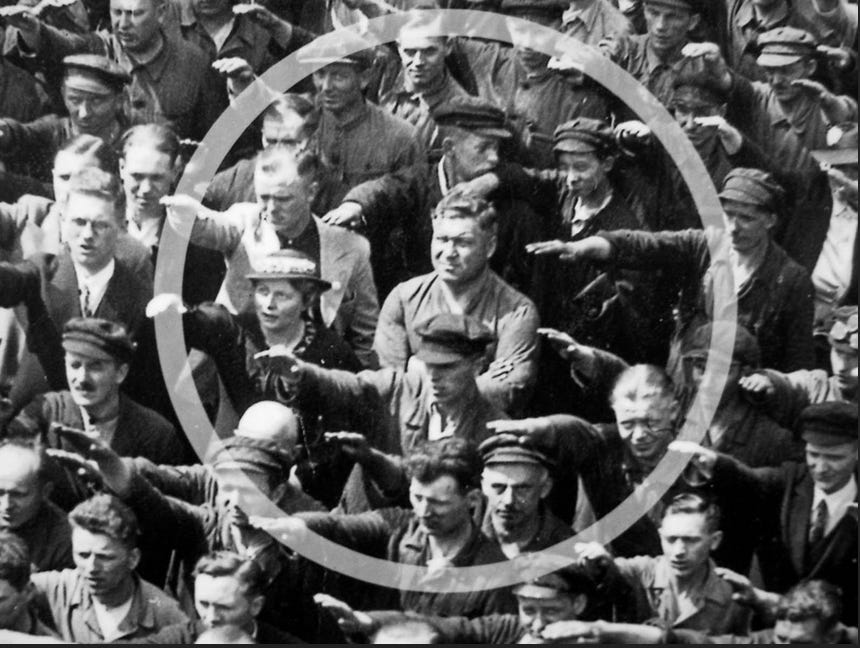
The word “politely” becomes something different when you hold those two images together. The Moscow correction and the Hamburg photograph are not the same moment on the same scale. But they are the same mechanism, and the mechanism has a direction of travel. What begins as a look and a pause, a public reminder to stand, a caption that reframes coercion as courtesy, is the same structure that ends with Irma Eckler. The difference is degree, not kind.
Anyone who describes the Moscow correction as something other than enforcement is positioned as the unreasonable one, misreading a kind gesture. The correction becomes a gift, and questioning it becomes the aggression. Landmesser’s folded arms show where that logic, followed to its conclusion, leads.
The @narcissiststate reply: imagine the rage and DARVO had he done so.
Had he stayed seated, the response would have been disproportionate, and the narrative would have shifted instantly to deliberate disrespect, provocation, an ideological statement. The original behaviour expands to fill whatever the institutional response requires. This is narcissistic rage at role defiance. Disproportionate enforcement is not a failure of the system. It is the system working as designed, using one case to regulate everyone observing it.
The young man’s compliance is not the resolution of the moment. It is proof the mechanism is functioning.
It would be a mistake to read this as a story about Russia, or about Putin, or about authoritarian regimes in some distant elsewhere. The same structural mechanism operates across every narcissistic system, scaled to context.
When a schoolteacher singles out a child in front of the class for a minor infraction no one else noticed, the correction is not primarily about the child. It is a role compliance message delivered to thirty other children simultaneously. When a manager publicly contradicts a team member in a meeting rather than raising the issue privately, the target is not the only audience. When a politician responds to a journalist’s question by questioning the journalist’s motives rather than addressing the question, the DARVO pattern is visible to anyone who knows what to look for. When a border agent makes a traveller explain themselves at length for no procedurally necessary reason, the disproportionality is itself the mechanism.
The implicit rules that can never quite be pinned down, the public correction that doubles as a broadcast, the reframing of coercion as care: these are not features of authoritarian states specifically. They are features of any system whose continuity depends on role compliance rather than genuine legitimacy. They appear in workplaces, in families, in institutions, wherever the myth of authority requires constant performance to stay intact.
Pattern recognition starts here. Once you see the mechanism in a two-second clip from a Moscow auditorium, you start seeing it in the meeting room, the classroom, the border crossing, the family dinner. Which is most places. Which is every day.
He sat down for a moment. He briefly stopped performing his assigned role. And in that brief gap, the structure that runs not just Russia but most of the institutions people move through daily became visible. Not through force. Through a look, a pause, a guilty expression, and a crowd that kept its eyes forward.
Recognizing the mechanism is what makes withdrawal possible. Every person who stops performing their assigned role, however quietly, however incrementally, drains the energy the myth of authority requires to stay intact. The crowd in Hamburg mostly kept their arms raised. One man didn't. The system's response to that single gap tells you everything about how much the performance matters, and how little it would take, at scale, for the myth to become unsustainable.
Thanks to Mark Maresca and Jason L for their helpful input and contributions to this article.
No posts
Comments
Nothing yet. Say the first thing.
Sign in to join the conversation.