
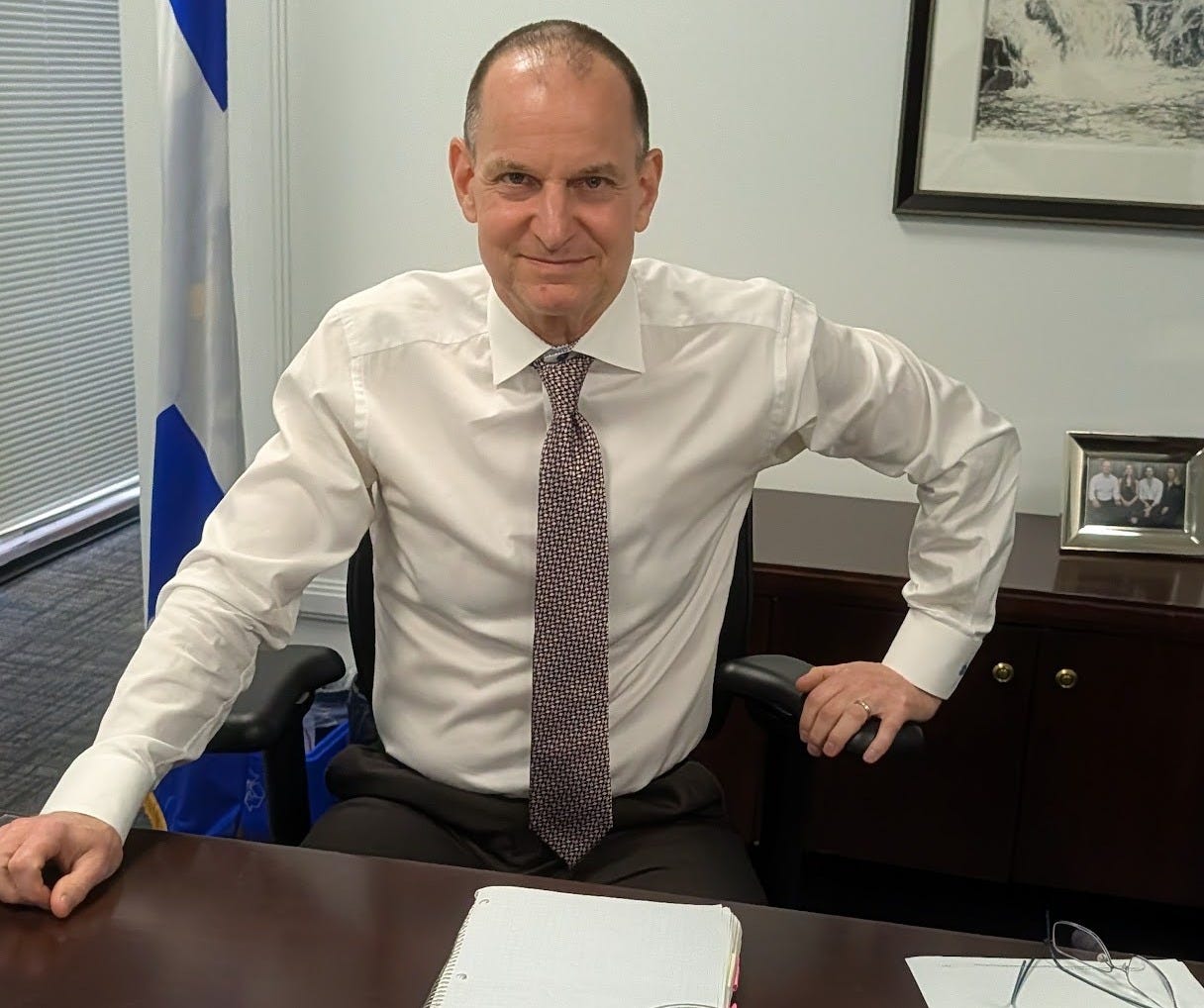
I first met Éric Girard, the finance minister in Quebec’s incumbent Coalition Avenir Québec government (centre-right, nationalist-but-federalist), on the second day of the 2022 election campaign. He reads this newsletter and is used to seeing me comment on Radio-Canada’s national TV newscast, Le Téléjournal. He’s been a member of the National Assembly since 2018, when the CAQ swept to power with François Legault’s first majority government. Before that, in 2015, Girard ran as a candidate for the federal Conservatives under Stephen Harper, a tough year for Conservative rookies. Before that he spent 25 years in senior roles at the National Bank of Canada.
When I went to his downtown Montreal office on Wednesday to interview him about the effects of Trump tariffs and stalled Canada-US trade talks, I didn’t yet realize Girard’s new boss, Premier Christine Fréchette, would call an election today, Thursday. So this interview is timelier than I expected.
Polls suggest the CAQ is in trouble in this election, with the Parti Québécois poised for a big comeback and perhaps a majority government. But every party in Quebec has been going through different kinds of turbulence, so nobody has the luxury of assuming they know how the election will turn out. In the meantime, until the voters weigh in, Girard remains the finance minister of Canada’s second-largest province, and we had a lot to discuss. This transcript was translated by me from an interview in French and has been edited for length and clarity.
Paul Wells: Since Friday night everyone’s on a kind of sugar high, but we’re in a difficult situation nonetheless. I’d like to know what you make of the situation since the collapse of trade talks.
Éric Girard: Quebec, British Columbia and Ontario are definitely the provinces most affected by the crisis. It really started in February 2025. We’re now 18 months into the impact. There’s no improvement in sight. In fact it’s deteriorated since Friday night. Quebec is the province where the manufacturing sector has the largest share of the economy. And since we’re Canada’s aluminum manufacturer, it’s very significant. And it’s happening at the same time as other events in the world that are connected to the same person. The war in the middle east: Quebec is a net importer of fossil fuels, as is Ontario. So that’s an added difficulty. And there’s also, because we had fast immigration growth, a loss of control over temporary immigration in 2023 and 2024. Now there’s a tightening of work permits which is slowing the growth in the number of workers.
In short, the cumulative impact of all that is very significant for Quebec. I estimate that at the end of 2027, we’ll be at least 2% lower in GDP than where we would have been in normal conditions. Now, we haven’t seen many normal conditions since we came to power in 2018 because there was the pandemic, the invasion of Ukraine by Russia, which caused inflation and interest-rate increases. Then there was the trade war, the conflict in the Middle East. There haven’t been lots of normal conditions. But we had Bank of Canada estimates that the impact of the trade war could take four or five per cent off the GDP we could have had. I think we’ve already seen about half of that impact. And that’s if nobody withdraws from CUSMA. If this escalates to where the US pulls out of CUSMA, we get into scenarios of recession across North America. This is big, what’s happening.
PW: In other words, if President Trump withdraws from CUSMA, he’d be shooting himself in the foot.
Girard: Lots of people say the impact is smaller in the United States. That’s because for them, all this is happening at the same time as an exceptional boom in capital investment on AI. They’ve got the wind at their back, they’re the country that’s making the largest capital investments. We’ll have to see what all that investment amounts to later. But right now the US is growing at 2%, Canada at less than 1%, and the rest of the world has problems too because of what’s going on in the US. But in the US, tariffs are reducing production, increasing costs, but at the same time there’s this boom going on.
There’s also the famous wealth effect. Last year the federal government and all the provinces had much more revenue than expected in 2025. What’s that? It’s the wealth effect. The Canada stock market index went up by 30% last year. We had a lot more corporate capital gains. Public finances are in good shape. The deficit is less than 1%, it’s the third consecutive year we’ve lowered our deficit, and there’s also the fact that Quebec is a gold producer and gold went up 44% last year. So there’s this whole dichotomy between the real economy, where people have trouble paying their groceries, and those with financial assets who had exceptional stock-market performance. That’s related to the performance of a very few companies that dominate in AI.
As far as the US is concerned, they have less growth and more inflation because of their tariffs. But they still have lots of growth. It’s the contrary in Quebec and Canada: We don’t have much growth.
PW: Could the feds have played their relations with Trump differently?
Girard: The answer is yes. But do I think that I, personally, would have done better in the room? No. Mr. Blanchard [Marc-André Blanchard, Carney’s chief of staff, with extensive connections in Quebec business and politics] was there. Regardless of what people say, or whatever the perception is, we had excellent communication. I talk to Mr. Champagne frequently. Our special envoy, Mme. [Louise] Blais, speaks to Ms. Charette. Ms. Fréchette’s chief of staff talks to Marc-André Blanchard, who was in the room. Mr. Drainville talks to Mr. — …the communications are good.
From the start we knew the president wanted to bring manufacturing back to the US. Well, what’s the obvious manufacturing? It’s the automobile sector. So it’s no surprise that in the negotiations, cars were a big problem. If it’s true that they proposed that we make only small models, when we all know everyone’s buying SUVs, I can see why that wouldn’t be in Canada’s interest.
So could it have been played differently? The problem is that we don’t have the President’s attention. He’s caught up in his Middle East conflict. It’s obvious that’s not going the way he expected. In the Middle East they thought it would take two weeks, they’d change the Iranian government, the Iranian people would applaud. It’s a bit naive. It’s like the story of George W. Bush in Iraq. And it’s not settled. So we don’t have the President’s attention. His attention is on midterms, the primaries. He seemed to want a deal, because he announced one on Tuesday.
So I have no lessons for the Canadian government, to say “You could have done this better.” I wish we could get along and CUSMA could be renewed and goods and services could travel freely between Canada and the US. But in no way do I claim that I could have negotiated that.
The only thing that wasn’t tried — and I say this jokingly but there’s some truth to it — is that maybe Mr. Carney should have done like the Japanese PM and played golf with Trump more often. Eighteen holes lasts four hours. You have time to chat. But I’m not sure Japan is any happier with the way trade is going.
PW: Well, that’s just it. I’m looking for a country that’s doing well out of all this, and I don’t see any.
Girard: I often go to the US to give talks, because we issue debt and I have to go to New York, Chicago, Washington. I always say we should keep in mind the distinction between Americans, the United States, and the Presidency. Every time I go to the US, I’m well received, people are nice. Of course we ultimately want better relations. What Mr. Carney keeps telling us is that the situation has changed. The presidency doesn’t want better relations.
PW: He often draws a distinction between what we can control and what we can’t. What we can’t control is named Donald Trump; what we might, in theory, control better is the Canadian interior market and third countries. How’s it going in those two arenas?
Girard: It’s going well. It’s just that the dividends from the interior market aren’t as high as people said. I think we overestimated the dividends from the interior market. The low-hanging fruit is labour mobility, construction and transport. We made a lot of progress in transport, we made some in labour mobility, we haven’t made much in construction. We don’t yet see enough Ontario companies coming into the Quebec market. We know labour mobility in construction is complicated. But we’re not going to boost Canada’s GDP five points with direct delivery of wine from Niagara-on-the-Lake across the country. That’s just symbolism.
So I’d say the progress is real, but the dividends aren’t as high as people think. This doesn’t replace access to American consumers. The American consumer is the Number 1 consumer in the world. He consumes the most, he has the highest purchasing power. Today the United States is 300 million inhabitants. The market is 500 million, with Canada and Mexico. Canada alone is 40 million. So even if we had total liberalisation in the market of 40 million, it won’t replace access to 500 million.
Market diversification is going well too. Last year we saw a decline of 7% in our exports to the US. That’s major. And an increase of 10% in our exports to other markets. The problem is that the minus-seven is on 75% of our exports, and the plus-ten is on 25%. So it nets out to 3% less. And those other markets are difficult for Quebec.
So it’s going well, but what we had was a state of complete freedom of movement of goods and services (across North America). Quebec is a small open economy. Canada is a small open economy. And the reality is, we benefitted enormously from NAFTA.
PW: Business capital investment in Canada has declined for five consecutive quarters. And it was already in bad shape. People aren’t in a mood to invest.
Girard: That’s to be expected. There’s too much uncertainty to take a big risk. To take risks and make capital investments, you need confidence and certainty. The whole climate we’re in is a climate of uncertainty. It’s not favourable for investment. Confidence, certainty: investment. No confidence, no certainty: no investment. It’s completely rational, what’s happening.
PW: You’re going into an election as early as next week…
Girard: I don’t want to give you a scoop, but I think it’s this week.
PW: It’s not a favourable environment for big promises. What can an incumbent governing party offer Quebecers?
Girard: You have to remember, the President was elected in November, sworn in in January, and right away he started saying Canada would be the 51st state, there’d be tariffs, the Gulf of America and so on. In our 2025 budget we made a decision, me and Mr. Legault. We said, “What can we do for the Quebec economy that will provide short-term benefit and long-term benefit, in the face of this threat?” And we said, we’ll invest in infrastructure. And we pushed infrastructure investment past the tolerance of S&P. Rating agencies have their ratios. They say, if you have $170 billion in revenue, you shouldn’t spend more than 10% on capital investment. For them, Quebec could only afford to pay $17 billion for infrastructure. In this crisis, we decided to spend $20 billion per year on capital investments. That led to the credit downgrade. But to this day, Mr. Wells, everybody has criticized the Quebec government for the downgrade — but nobody has criticized us for the infrastructure spending. And every week somebody asks us to spend more.
So what can we do? Because businesses aren’t making capital investments, the government has a role to play by making capital investments, which means infrastructure investments. And what’s interesting is that, since Mme Fréchette came along, we’ve had more cooperation with the federal government. Hence our $10 billion infrastructure agreement [over 10 years] with them. So this year we were going to spend $19 billion on infrastructure; with the feds we’ll spend $20 billion.
What we’re seeing is, we invest in roads, hospitals, schools. The federal government does what? Military spending. They’re going to make icebreakers, an $11 billion contract at Lévis. The Quebec government had to put in $500 million into the shipyard to modernize it in 2023 so it would be ready to make those icebreakers.
Basically the federal government is saying the same thing we did in our 2025 budget: because private business isn’t investing in capital, we have to. We put the money into public infrastructure, the federal government puts it into defence. And Quebec is extremely well positioned to benefit from the federal effort, because the aeronautics industry is here.
So what we have to do is support the economy during this difficult time. At some point we’ll be in a better environment, businesses will invest and hire more, and we’ll be able to step back.
No posts
Comments
Nothing yet. Say the first thing.
Sign in to join the conversation.