
“You have to dominate,” President Trump told governors on a conference call. “If you don’t dominate, you’re wasting your time. They’re going to run over you. You’re going to look like a bunch of jerks.” It was June 1, 2020, when protests erupted across the country after the murder of George Floyd in Minneapolis. Trump explained his belief that the protests had to be put down with a maximum degree of violence so everyone would know who was in charge and the troublemakers would learn their place. “The word is dominated,” he reiterated. “If you don’t dominate your city and your state, they’re going to walk away with you.”
This is one of the central pillars of Trump’s worldview: Every interaction, whether between individuals or nations, is a contest of strength with a winner and a loser. Yet ironically, his stubborn pursuit of dominance blinds him to everything about economics, politics, international relations, and human nature that might actually enable him to succeed.
In other words, Trump’s obsession with dominance is what is now making him such a loser.
This is how he believes conflict, or really any relationship, works: There is a stronger party and a weaker party; the stronger party shows they’re stronger by threatening or hurting the weaker party; and the weaker party capitulates.
When it doesn’t actually work that way — because people, systems, and nations are more complicated than that — he’s at a loss. The only thing he can think of is to do the same thing, only harder. That’s what we’re seeing with Canada and Iran.
Trump has now initiated a new trade war with Canada, for no reason that anyone can discern. This has been happening off and on since he took office in 2025, when he apparently decided that since Canada is a loyal friend and partner to the United States, and Americans think warmly of their Canadian neighbors, it was important to do everything in his power to destroy the two nations’ mutually beneficial relationship. And the particular way he did so could not have been more perfectly calibrated to produce maximum resistance from Canada.
Because Trump is caught in his we’re-strong-you’re-weak paradigm, it wasn’t enough to impose a bunch of new tariffs on Canadian goods; he had to do it while saying again and again that Canada should become the “51st state” and repeatedly portraying it as a vassal of America. There is literally nothing he could have said that would be more insulting to Canadian identity, and inevitably produce exactly the reaction we’ve seen. Precisely because they live in the shadow of the global hegemon and share so much language and culture with America, Canadians are fiercely protective of their sovereignty and distinctiveness.
When Trump talked about Canada that way, the political fallout was predictable: The Conservative Party, which had been moving toward a kind of Canadian Trumpism, plunged in popularity, and the Liberals won an election that just a few months before they seemed doomed to lose badly.
But that was only the beginning. While the country faces plenty of challenges that have nothing to do with the U.S., Mark Carney’s tenure as prime minister is being defined by his willingness to stand up to Trump. When Trump makes a new attack on Canada — either rhetorically or in trade policy — Carney must meet it with a response that demonstrates the country’s strength and resilience. That’s what he’s been doing, and that’s why he remains popular.
In the current round of trade talks, Trump’s representatives made demands that struck directly at Canadian sovereignty. As the New York Times reported, “The United States wanted Canada to apply U.S. tariffs to other countries, particularly when it came to steel, now and in the future: If the United States changed policy and place higher tariffs on certain goods from a third country, Canada would need to do the same, even if it already had a trade agreement in place, a Canadian official said.” In other words, Canada would be essentially barred from making its own trade agreements in its own interests, and would have to simply do whatever the U.S. told it to.
Trump believes that as onerous as those terms might be, Canada will have no choice but to accept them. After all, we’re bigger than they are, and our economy is many times the size of theirs; if the “dollar for dollar” retaliatory tariffs Carney is promising come to pass, surely the U.S. will be better able to absorb the pain than Canada.
But here’s what Trump misses: Absorbing the pain isn’t just about percent of GDP; it’s also about psychology and identity. Carney even told his constituents what Trump never would: that “some of these measures will raise costs and reduce choice for Canadians,” but it’s necessary because they must stand up for themselves. One poll showed three-quarters of Canadians supporting the Carney government’s decision to walk away from the negotiations.
I’m sure Trump just doesn’t get that. We’re strong and they’re weak, why aren’t they giving in? Here’s a useful explanation from Stephen Marche:
While the prime minister’s approach is certainly new, it emerges from deep reservoirs of the Canadian spirit. For nearly a decade, I was a columnist at Esquire magazine. During that time, one of the greatest discrepancies I noticed between Canadians and Americans — and Canadian and American men in particular — was in their basic idea of what earned respect. For Americans, the capacity to project power, the ability to make things happen and to win are the primary virtues. For Canadians, the defining virtue is toughness, the capacity to endure.
Canadians will endure some economic pain, because to not do so would be an affront to their identity. Meanwhile, Trump will force Americans to endure economic pain, and for what? What reward will any of us here in the United States gain from this deranged trade war? Nothing.
Faced with that resistance, Trump is so flummoxed that this is the best he can come up with in response:
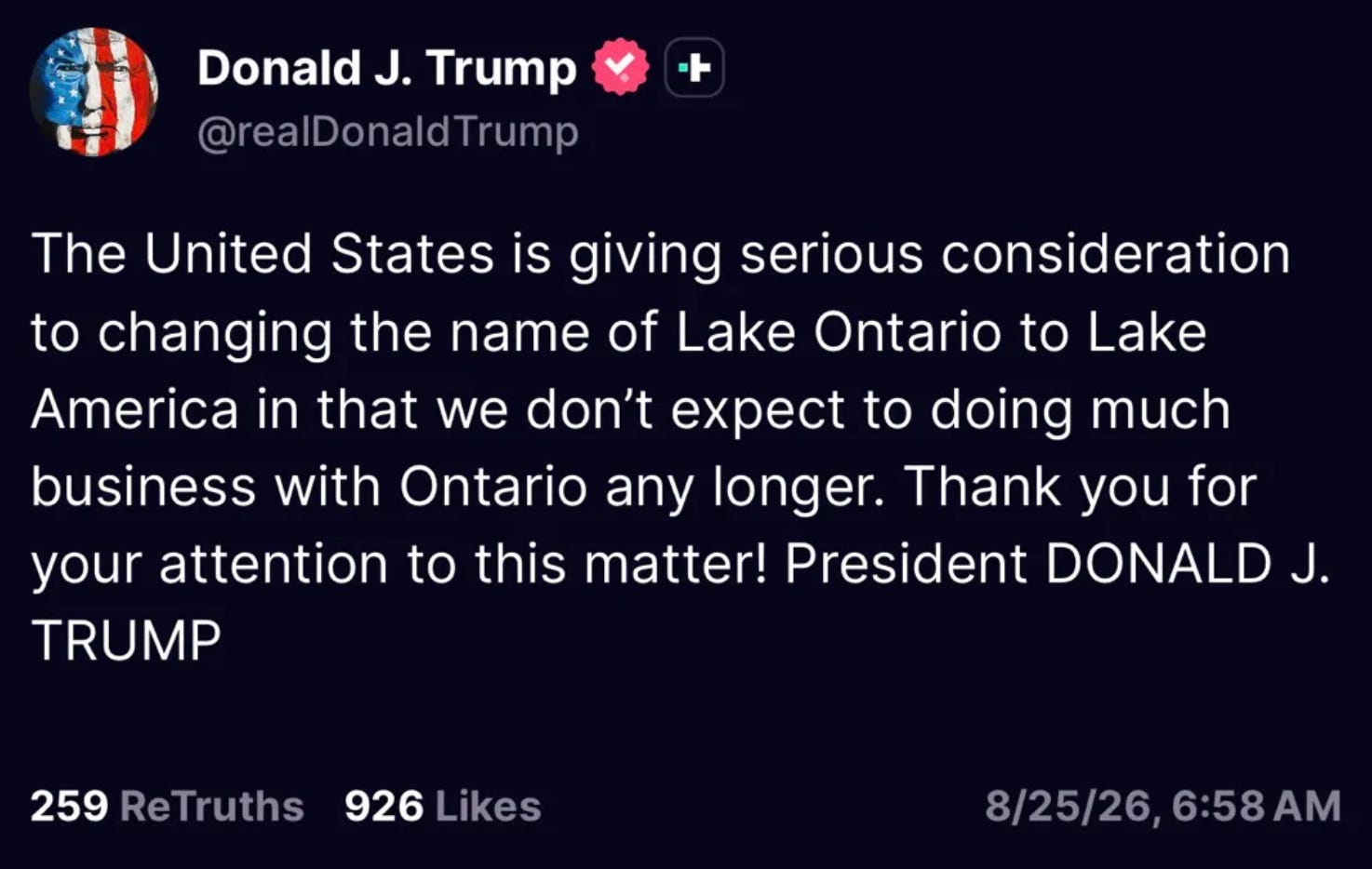
That is absolute loser stuff, the bleating of someone who wants everyone to think he’s strong but has had his weakness revealed.
The Iran war played out the way it has for the same reason: Trump assumed that because America has the world’s biggest military, he could pound Iran for a while, then its leaders would come on their knees before him and submit to all his demands. In fact, he keeps saying that’s exactly what’s happening, even though it plainly isn’t. “They are begging to make a deal. Not me. They’re begging to make it,” he said. “The reason they want to make a deal is they have been just beat to shit.” That was in March, five months ago, and since then he has said the same thing again and again (“They want to make a deal so badly”).
But they clearly aren’t begging to make a deal — at least not the kind of deal Trump demands, in which they give up everything and we give up nothing. Just as for Canadians the trade conflict is about sovereignty, for the Iranian regime the war is about survival. The regime is willing to tolerate an almost unlimited amount of suffering on the part of the Iranian people, as long as it does not threaten their hold on power. That willingness, added to the realization of just how potent control of the Strait of Hormuz can be, has left the regime feeling that they are the stronger ones.
So now, having drastically depleted our reserves of munitions and all but run out of targets in Iran to blow up, Trump announced “the MOST CRUSHING ECONOMIC OPERATION EVER TAKEN AGAINST ANY COUNTRY!” Is that going to lead the Iranian government to finally surrender, or will it retaliate in ways that will hurt the United States and the world economy? Everyone except the president knows the answer.
Where has this quest for dominance gotten Trump and his party? The Iran war is a disaster, pushing gas prices higher and Trump’s approval lower. The trade war on Canada will likely hurt Republicans in the midterm elections, especially in the Midwest. America’s military and economic primacy in the world now look shakier than they have in decades.
And the man whose entire life has been an endless, desperate quest not to be seen as a loser? He has never looked weaker.
Thank you for reading The Cross Section. This site has no paywall, so I depend on the generosity of readers to sustain the work I present here. If you find what you read valuable and would like it to continue, consider becoming a paid subscriber.
Comments
Nothing yet. Say the first thing.
Sign in to join the conversation.