
It is the artist’s vocation to pick up a story, a theme, a trope, and give their unique telling of it. The really great ones transform and challenge our ideas of what those stories, themes and tropes mean in the first place, how they relate to one another, and what the rules of the game really are. Christopher Nolan is one of the greatest of these convention-breakers.
For millennia, the artistic voices taken most seriously were those that came from a particular kind of well-heeled, highly-educated, white, male, usually cis and straight, figure, who would pick up the baton from the people who looked and sounded like him. We all have finally started to agree in the last hundred or so years, but especially the last 15-20, that if you are not from a particular background, you’re going to struggle - if not outright fail - to properly encapsulate that same demographic’s experience in your art. So we’ve invited people in to our processes, empowered to have a voice and to provide much-needed input. In the best cases, we’ve handed over the duty of storytelling to those people entirely.
Thanks to this progress, in the battle for representation the fight has largely been won that: first, the people who the story is about should be prioritised in the telling, and second, all stories are served well by having as diverse a group of storytellers as possible assembled to tell them. We have recognised that people from marginalised backgrounds usually struggle to rise to the status required to prominently tell these stories, so we’ve taken great pains to ensure we make room. And so using race as as an example: we don’t just ensure that there is no more blackface or yellowface on our screens, we also ensure that people from diverse cultures are involved in every stage of the process, including by casting them in roles where the character’s race isn’t an inherent part of the narrative (noting that assuming a non-race-specific character is white is perpetuating an inherently racist normativity).
I’m not going to spend this post raking back over all the reasons why Greeks feel betrayed by modern approaches to inclusion. I have written twice before about it: first comparing Greece’s modern history and identity with theatre’s failure to apply contemporary practice to it, and second on the wider-ranging and longer-reaching appropriation of Greek cultural heritage.
As I see it, there are two problems at play. First, that Greeks are perceived as privileged, white, European Westerners who aren’t in need of so-called “EDI“ attention - something my first post tried to dismantle and my second reiterate. Second, that these stories have been the preserve of the same white, wealthy men empowered to lead the artistic world for so long that not only is their birthplace familiar enough to us that we don’t feel we need further education on the telling, we also feel that those who previously told the stories need to get out of the way to make room for a new breed of storyteller. For whatever reason, Greeks are assumed to be part of that storytelling class by virtue of the origins of the myths and there appears to be an assumption that the Greek version of the stories will be just like the familiar versions. As I’ve tried to outline in my second post, that these stories have been mainstreamed by the ‘traditional’ class of artist has little to do with Greeks. Rarely present in this intertextual discourse, especially since the Ottomans took over Greece in the 15th century, are Greeks and their perspectives.
This post assumes that you’re aware of all this, so by all means go back and give the others a skim if you haven’t read them.
And so, to The Odyssey.
There are 53 actors listed on IMDB as starring in Christopher Nolan’s latest epic. Exactly one of them has a Greek name.
His role is so vital to the plot that it goes unnamed, he hasn’t appeared in any of the press junkets, had any newspaper features or been on any magazine covers. He’s not noticeable in any trailers, he isn’t in any production stills. I’m not naming him because none of this is his fault.
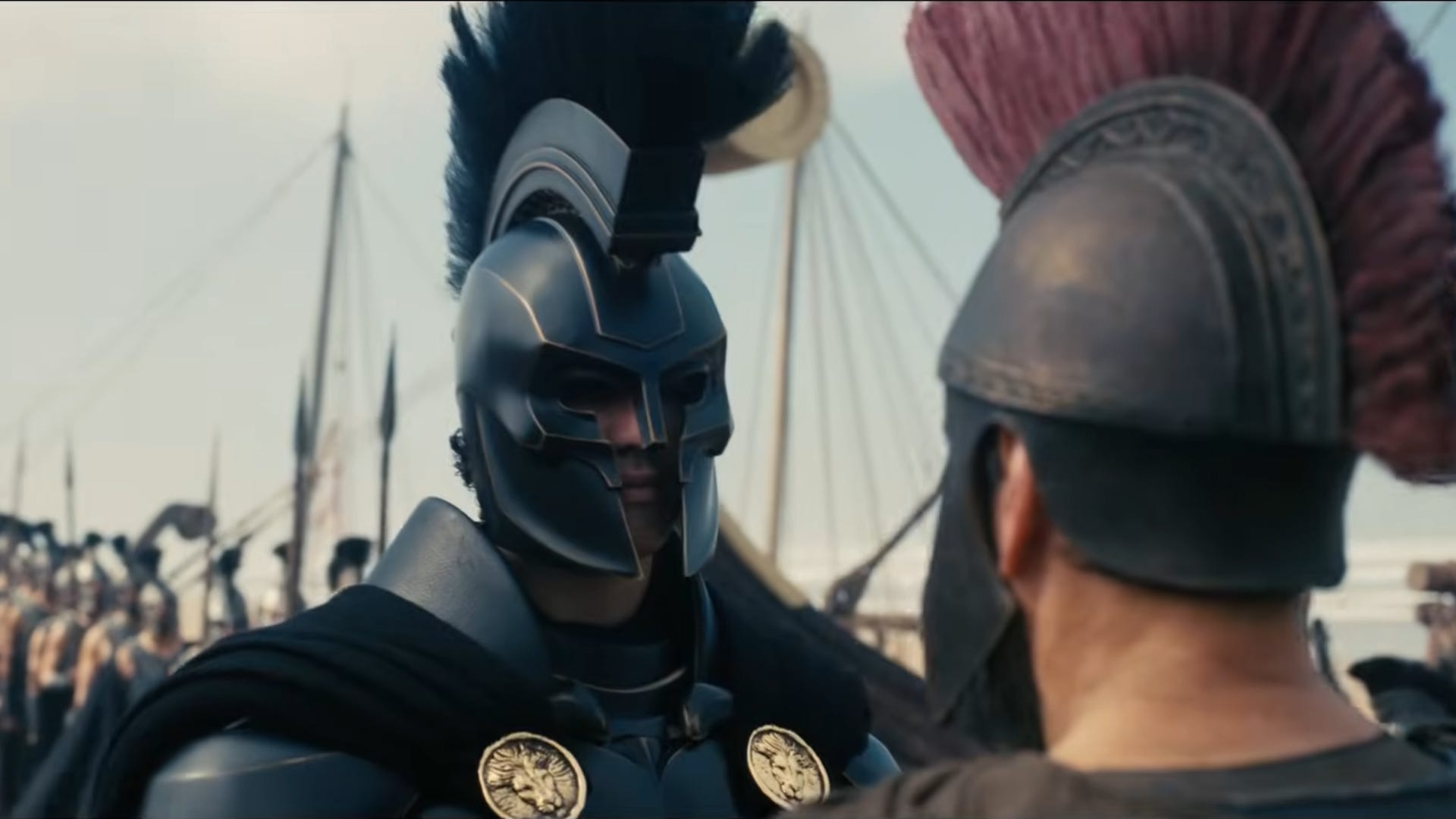
Of the very many credited creatives, there is also one Greek. You might have heard of him - his name is Homer. There were supposed to be two, but legendary metallurgist Dimitrios Katsikis was unceremoniously dropped after first being approached to make the armour for the movie.
In fact, aside from local hires for scenes shot in Greece, there are almost no Greeks involved in the movie at any level.
Now obviously you cannot derive someone’s identity purely from their name. Theo James doesn’t use his surname (Taptiklis) professionally. Jennifer Aniston and Billy Zane both have anglicised names. Tina Fey’s heritage is on her mother’s side. So it’s impossible really for anyone to know for sure how many Greeks were or were not involved. What is pretty clear, though, is that hiring Greek talent was not a priority. Not a single named role is played by anyone with known Greek heritage and despite great efforts made to ensure a breadth of diversity in on- and off-screen talent, extending that diversity to the people from the place the story is about was apparently not deemed relevant or necessary.
This has proven something of a thorny issue to discuss, because the far-right has chosen the film as its latest target for its exhausting, eye roll-inducing ‘woke gone mad’ discourse. The racist hatred directed primarily towards Lupita Nyong’o, but also to the other actors of colour, has been devastatingly unfair, entirely missing the point of the casting concerns that were first raised by Greeks some time ago. Truthfully, Nyong’o is excellent casting for Helen (who hardly appears in the story anyway), and while Helen portrayed as Black is unlikely to be historically accurate for a Spartan royal, historical accuracy has proven to be a distraction from the core issue.
This is one of the wider problems with The Odyssey. It is just so big a blockbuster of a movie that it has attracted ire from a number of different directions. Classicists and archaeologists have been skeptical of the movie ever since it first became clear that it wasn’t really trying to be historically accurate. The racists jumped on the bandwagon as soon as there was a sniff of something to be racist about. Casual appreciators of the source material have complained that it doesn’t seem to reflect whichever translation or version of the story they know best. Nolan haters have been quick to join in.
’Twas ever thus, but this time what might feel like a legitimate concern of a small minority of the global population is entirely drowned out by the cacophony. Greece is a country of under 10 million people, with around another 5 million in the global Greek diaspora. That is to say, it is slightly smaller than the global Jewish population, and roughly the same size as the population of the London metropolitan area. It is not an economic powerhouse, capable of creating a movie like this in its own right. There really aren’t all that many of us, and being heard is becoming increasingly difficult.
Yet this isn’t entirely true in Hollywood. I’ve already mentioned Jennifer Aniston, Billy Zane and Tina Fey. Other notable figures who can claim Greek ancestry include John Stamos, Nicholas Galitzine, Zoe Kazan, Mena Suvari, Theo James, Nia Vardalos, Zach Galifinakis, Hank Azaria, Jason Mantzoukas, Jessica Chastain, Rita Wilson and Cleo Roccos. These are just a handful, of course, there are many more. It is hard to believe that not one of them could have been appropriate casting for one of the leading roles, and that’s before you even consider the leading lights of Greece’s own film and television industries on- and off-screen (from which, of course, we now have Yorgos Lanthimos).
Should they have been? If you, as I do, believe that it’s important that the film included people from a range of backgrounds like Himesh Patel, Zendaya and Lupita Nyong’o - all well-cast, magnificent actors - it’s hard to argue that the film shouldn’t have also included at least some Greeks.
Of course, every artist should be enabled to find their spin on material, especially 3000-year-old material. So it isn’t necessarily a complaint that costumes aren’t accurate, that the language doesn’t conform to historic ideas of what traditional stories should sound like, or that episodes of the original poem are merged or missed out for time. It isn’t that the armour uses materials not available in the Bronze Age, nor that the ships are closer to Viking boats than Greek ones, that that many soldiers couldn’t have fit into that horse. All of this is a shame, but it is part of the reviving and retelling of old tales.
It’s the seeming lack of care or interest anyone involved in the movie seems to have with Greece. If you listen to the press junkets, you hear an incredulous Lupita Nyong’o asking Homer what he thinks of the treatment of women in the film, failing to recognise that not only did Homer pay so much attention to women in The Odyssey that people have speculated the writer may have actually been a woman, but that Ancient Greek mythologies very often spend an unusually large amount of time focusing on women. It betrays a complete lack of curiosity or interest about the actual background. Numerous actors have admitted they’d never read Homer, or weren’t familiar with classical mythology, before taking on the movie. There was no Athens premiere for the film, despite the significant amount of time spent filming in Greece and the subsequent tax breaks the movie benefitted from. It is of course the case that all the people who say that none of this is that important are people whom it doesn’t impact. Once again, like the academics in my previous post, Greeks are spoken down to and told to get back in their box.
Most of all, it’s about the recasting of Odysseus as the modern action man, the transference of him from pinnacle of Greek polytropos antihero to a perfect Hollywood three-act structure hero’s journey. It’s the discarding of all cultural context in favour of the version that is most amenable and versatile for modern tastes. In itself, this is a valid use of a 2,500 year old text, but it is a use we have seen time and time again and which stands at odds with how we understand our own story.
I think it’s fair to say that the film is presented as a not-quite-faithful adaptation of the source material, utilising anachronistic imagery and language on purpose as a way to draw the reader in with familiarity. Yet without much other context given, the filmgoer anticipates a Bronze Age epic story, set in Greece, telling a story of a Greek and his journey home. What they are getting is a Hollywood regurgitation of some of the core broad brushstrokes, which has as even less in common with Greek culture than Ayia Napa.
For all the context that surrounds it - and I don’t think you can separate the context from the art, no matter how hard you try - nothing about it feels like a sincere adaptation of the mythology. It feels like Los Angeles one percenters cosplaying as Greek, placing huge marquee names in roles that are even more famous and well-known than they are. The film uses many of the same filmmaking tropes that have gone before when addressing the ancient Greeks - it exists in the same part of the Venn diagram as Brad Pitt in Troy, Kirk Douglas in Ulysses, and Elizabeth Taylor in Cleopatra, with its evolution of the form being to utilise modern, American vernacular. The question Greeks ask is: did we really need another one of those?
Greece - the place, its people, its stories - has been a subject for so many writers in so many media, whether engaging with the ancient or the modern, that Christopher Nolan choosing The Odyssey for his latest project is no real surprise. An auteur was bound to turn his attention to it sooner or later - it’s been a while since we got a Trojan epic on-screen. Yet coming as it does in 2026, it feels to Greeks that times have changed. No longer is it acceptable to us to watch our stories being told back to us by other people without any whisper of inclusion in the creation. The movie has caused earthquakes of uproar in Greece and the Greek diaspora. The Greek City Times has published an open letter. Parliamentarians have railed in debates (yes, some of them were racist, no, I don’t condone that). Literally hundreds of creators are on TikTok and Instagram talking about it. We haven’t had a peep from the team behind it.
This LA-does-Greece schtick comes off as cheap and thoughtless, and expands past the film into the cultural moment it has created. From wearing ancient, stolen jewellery to premieres, to the Greek-inspired couture outfits designed by non-Greek designers, to drone shots of filming in Greece that never seem to show anyone Hollywood interacting with anyone Greek. Every piece of art has an obligation to the people the story came from to pay attention to their input. But the bigger the stage and the larger the budget, the fewer barriers there are to making sure inclusion happens, the greater the onus on you to do something about it. Miss Saigon famously messed this up with Jonathan Pryce, but it simultaneously got it so right with Lea Salonga, utilising the resources of its producer to undertake a never-before-seen casting search to ensure they cast Kim well. They did it with Slumdog Millionaire.
The Odyssey had so much more available to it with those Hollywood names, and hasn’t even seemed to try.
And here Greeks feel like we don’t count. Because no matter how loudly we shout about it, nobody seems to be paying attention. There has been no mention of any of this from those sent out to publicise the film. Where it has been picked up, it has accused Greeks of racism. It is smash-your-head-on-the-desk kind of stuff.
In fact the only major article in a British newspaper I seem to be able to find about it that isn’t written by a Western classicist or film critic is this in the Guardian from Chris Cotonou, weeks ago. (I’m happy to be corrected with other examples). It’s a marvellous piece, but relegated as it is to the comment section, I doubt many people at all have read it.
If you’ve been paying any attention to the World Cup, you will have encountered, online or in-person, vast swathes of Americans engaging with the beautiful game for the first time. Discussing football - sorry, soccer - with an American can be jarring to anyone who grew up in the UK. Those Yanks don’t quite manage to get their mouths around the terminology properly. (A “penalty kick”? Someone was “offsides”? What happened in the “third quarter”?).
This is how Greeks feel when we hear Westerners telling us about Ancient Greece. There is an element of the uncanny. Speaking to a non-Greek about the ancient myths is a little like singing Happy Birthday with a large group of people: you start in different keys, and as the song goes on, you struggle to all line up to the same one as you criss-cross past each other, made worse by that one really loud tone-deaf friend who refuses to bend to the group.
Americans have grown to appreciate and enjoy football but it isn’t ingrained in their psyche. Here in the UK, football is where we start when we learn about sport. Whether you like football or loathe it, you’re going to spend most of your school career surrounded by it, playing it, watching it. For those who actually care about it, the ease of simply grabbing a ball and dropping a couple bags to form a goal makes it extremely accessible for most able-bodied people. It is inescapable.
In Greece, you can’t move for the ancients. Ancient Greek is a required subject at school, wherever you go you are retracing the steps of some legendary figure. Every town and city has a museum or gallery devoted to ancient history, most major settlements are near to some ancient archaeological site, many places still bear the ancient names. You will spend most of your academic career crossing paths with Euripides and Socrates, studying Homer, engaging with Plato or Aristotle.
The same way that few Brits need anyone to explain the overarching concepts of football to them, exposed and immersed as we are, few Greeks need anyone to explain the heart of the mythology to us. You don’t need to be able to name Arsenal’s starting XI to understand why hydration breaks mess with the flow. You don’t need to be able to recite the Homeric Hymns to be able to understand their perspectives. I don’t need an American to tell me the ‘offsides’ rule. I don’t need anyone to explain what philoxenia is. To assume university study of classics is a good enough replacement for this sort of immersion is a fallacy on the level of assuming Duolingo will make you fluent in French without you ever going to France.
Somehow over three or four millennia, the Greek people have survived. Through repeated, cyclical occupations, famines, and genocides, there is a steady line from Homer - whoever they were - to Paul Virides (well, probably). The language, the culture, the art, and most of all, the stories. Almost squeezed off the map by the Ottomans and then the European fascists, somehow Greece emerged in the late 20th century as a modern, cosmopolitan country.
That country has taken these stories forward. They continue to be taught, and acted, and told to children. They are studied in great depth in schools and universities. People are named after heroes and gods. Ithaca still stands proudly in the Ionian Sea. Knossos remains on the fringes of Heraklion. Athena’s temple in the capital stands proudly above all the people, slowly being restored.
What you might call myths are to modern Greece its very lifeblood. I have racked my brain and I cannot think of a single equivalent in British culture - King Arthur and Robin Hood pale in comparison because they simply aren’t as prolific. You can walk dozens of miles through London without encountering them. You can hardly turn a corner in a Greek town or city without some reminder of things that happened 2,000 years ago.
It should be enough for Greeks to say “please include us when you talk about us.” For some reason it is not. So it should come as no surprise when we sneer at having our histories lectured back at us.
It seems inevitable by now, the reviews flooding the airwaves, the cinemas opening for business, that The Odyssey will prove to be another Nolan smash hit. Some are calling it his magnum opus, the greatest achievement of a filmmaker at the height of his powers, who could only have created this now with all his experience.
I have no doubt that, on its own merits, in isolation, the film will be breathtaking. As a piece of entertainment and art, I’m sure it stands above. There’s a strong chance it sweeps the Oscars next year.
At what cost? What does it say when inclusion and diversity only extend as far as is popular, instead of as far as is moral or ethical? What does it mean when Hollywood profits from the traditions and stories of a foreign land without investing that money back into the people it came from?
In the end, Greeks can shout as loud as we like. It won’t change anything until those gatekeepers invite them in. So with yet more announcements in the last few weeks of theatre projects using ancient myths but working with zero Greeks, I return to my industry: when is something going to give? When are we going to treat Greeks with the same dignity we treat other communities? Why are we having to kick up a stink to be heard?
Or was widening diversity never really about ethical inclusion, and all about managing PR?
Comments
Nothing yet. Say the first thing.
Sign in to join the conversation.