

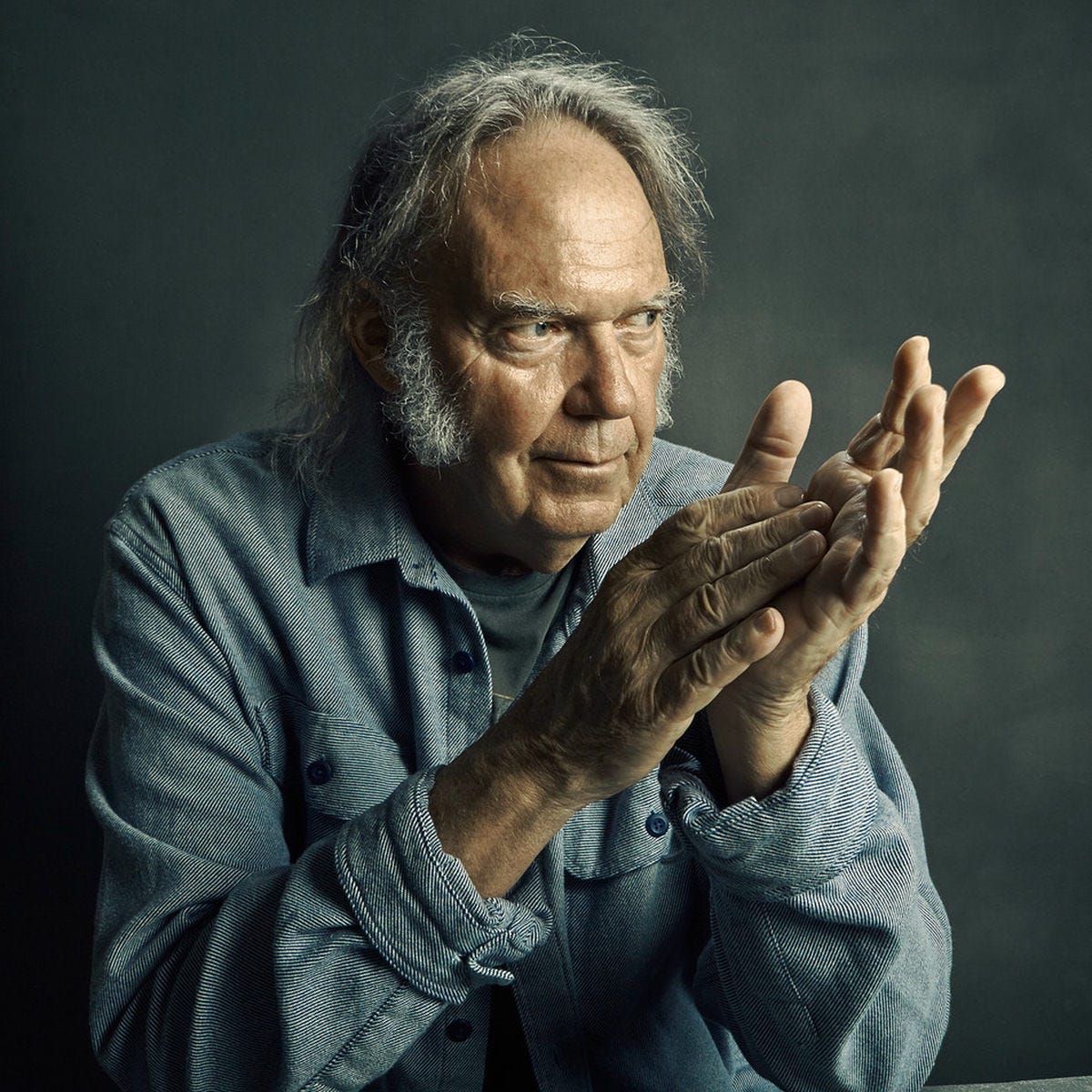
Neil Young is now a crazy old man, which shouldn’t come as too much of a shock to loyal Neil Young fans, since he started behaving like one well before he found an AARP application waiting in his mailbox.
I don’t want to turn this into a discourse on the lazy-ass albums Young has been recording for the past twenty-something years, because I’m a huge admirer of his best music and I listen to him a lot.
Understand that. I take no joy in talking about the crap.
For the purposes of this particular article, though, I have to examine the meandering slop merchant Young has turned himself into, if you don’t count the vastly more commendable, long-ago recorded albums he’s been releasing via his Archives series for the past several years.
There was a time in the 1970s, and then again for a few years in the late 80s and early 90s, when a new Neil Young record was a big deal for music fans. People bought the thing to hear what one of the true legends of rock was up to, and the albums were often both powerful and uniquely offbeat.
Young has always been quirky, but it used to be to his listeners’ benefit. Take, for example, the brilliant “Pocahontas” from Rust Never Sleeps.
That startling appearance by Marlon Brando gives the tune a potent Young-ian twist by linking this country’s centuries-long abuse of Native Americans to the pathetic nature of a windbag movie star trying to raise awareness of the horror all by his lonesome.
That’s the kind of quirky Neil Young used to be.
Since around the early 2000s, though, Young has repeatedly released apparent jam sessions with lyrics that couldn’t have been labored over for much longer than it takes to play the songs themselves, as well as oddball concept albums like 2009’s Fork in the Road, which is largely about the advantages of mass conversion to electro-hybrid automobiles.
There are no tin soldiers, and Nixon ain’t comin’.
It appears the only thing Young is after these days is for people to say, “Jesus, you just can’t pin down that wacky Neil Young!” Then, once he gets the response he’s looking for, he tosses off another album that’s batty and barely listenable but from an entirely different angle. Or maybe he stars in a laughable-mystical HD video Western directed by Daryl Hannah.
He’s done that, too, in case you didn’t hear.
Young has bounced back from too-much kooky before, though, so there’s still a glimmer of hope. In fact, he reached his peak for inscrutable behavior over forty years ago, when he signed with future mogul David Geffen’s hot new label, Geffen Records.
And a hilarious peak it was.
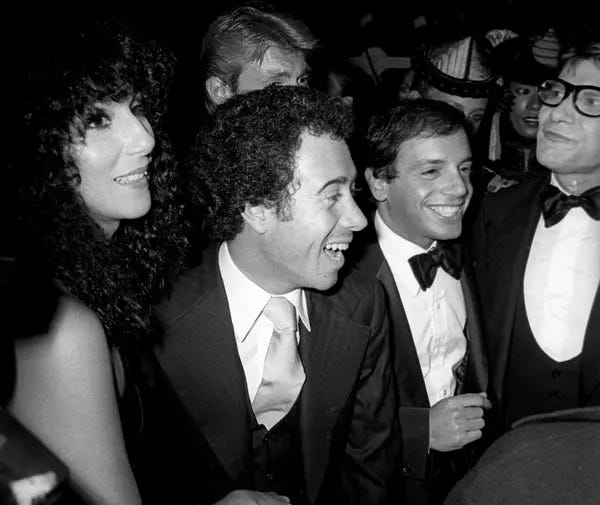
Geffen—seen here with Ms. Cheryl Sarkisian and Steve Rubell at Studio 54, before Rubell was forced to party in prison—has become, of course, one of the richest, most powerful men in the entertainment industry, through both music and film production. And he didn’t get that way by having the people he works with use his money as a public launching pad for their personal eccentricities.
But that’s precisely what Neil Young did with David Geffen’s money in the early 80s, to the tune of a million bucks per album.
That Geffen eventually tried to sue his new act for not sounding enough like himself is one of the more comical developments in rock music history, arguably the most Neil Young thing that’s ever happened to Neil Young. And that’s saying something.
Young’s first release for Geffen Records, an album called Trans, came from so far out of left field—like waaaay back on the warning track—even his most committed fans couldn’t wrap their heads around it.
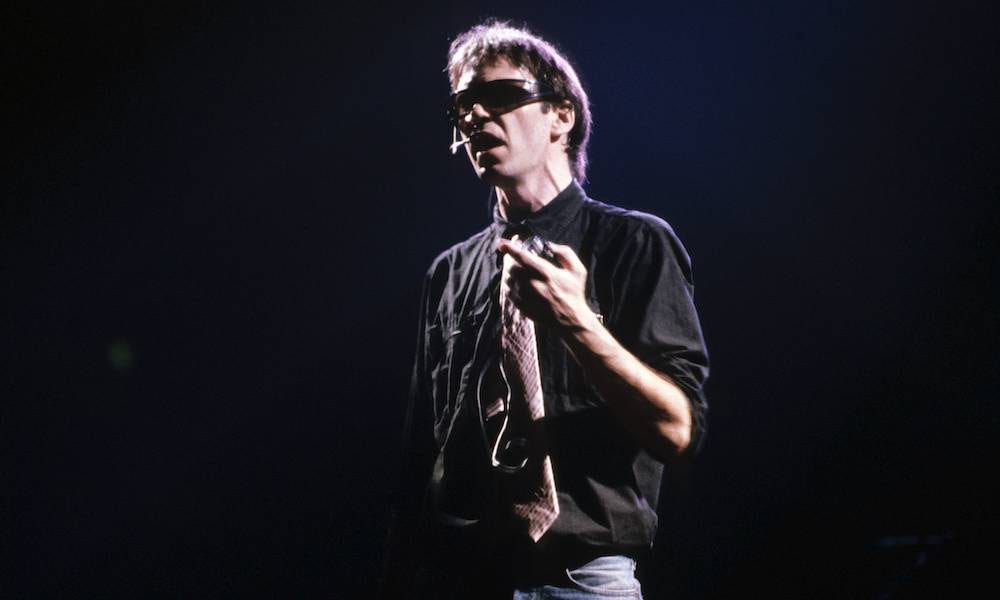
After years of Young building his persona through records that were either folk, MOR country, or rip-snorting rock (or mixtures of the three), Trans sounded like a salami-before-bedtime nightmare in which he was suddenly trapped inside of a third-rate Kraftwerk album. He even temporarily took to dressing all “New Wave” (see the photo) and singing through a Vocoder to give his voice a newfangled technological wrinkle that nobody on earth was ever hoping to hear.
Mr. “Heart of Gold” suddenly sounded like a cyborg who was breathing helium, as opposed to his usual quavering Canadian songwriter fighting off a nervous breakdown.
This is “Transformer Man,” from Trans. It’s emblematic of most of the songs on the album, if you can believe it.
I would have loved to have been sitting there when Geffen first heard that!
Young later explained that Trans was an attempt to express the possibility of his son, Ben, who was born with severe cerebral palsy, learning to communicate with his father through computers. So Young had a poignant connection to this music, and it often leads diehard fans to defend the album on his stated intent rather than the actual results.
They’ve only listened to the record once, mind you, because they don’t like it. But they get really offended if you don’t like it.
Personally, I don’t want to have songs explained to me so I’ll feel morally compelled to endure them. The sad part is that there are some really good tunes on Trans whose strengths are totally destroyed by the bewildering digitized arrangements.
Listen to this gorgeous version of “Transformer Man” that Young played several years later on MTV Unplugged.
That’s a superb song, and its deep emotion is right there for the taking. It’s genuinely moving. Wouldn’t it have been better to record the tune this way, or at least something close to it, instead of making it sound like an earworm that’s bugging the robot from Lost in Space?
Everyone was taken aback by Trans, including Young’s racket-raising backing group, Crazy Horse, who played on the album’s original sessions before Neil invented a theme that only he could grasp, then started reworking the tracks accordingly.
Or, as Crazy Horse guitarist Frank Sampedro summarized it, “Next thing we knew, Neil stripped all our music off, overdubbed all this stuff, the Vocoder, weird sequencing, and put the synth shit on it.”
Well put, Frank.
Geffen, of course, was livid. This, after all, wasn’t what he was paying Neil Young to do!
Or was it?
One could argue that whatever Neil Young writes and records for official release is a Neil Young album. What else could it be? I’m sure that’s where Young was coming from when he handed Trans over to Geffen. But he had to have known that his new label would not be dancing a techno jig over this particular piece of work, and neither would the vast majority of his fans, who had never heard from Kraftwerk and didn’t care to.
I mean, how myopic could he possibly be? If he honestly thought Trans was about to be his big new hit, the bales of pot he’d smoked over the years had finally kippered his cerebral cortex. This wasn’t just something kinda different. Young had never even remotely juked toward this type of music in the past.
But there it was anyway.
It wouldn’t have been any more bizarre if Bruce Springsteen had handed Columbia Records a labored-over collection of foxtrots.
After a heated “debate”—there was yelling—Geffen finally relented and issued Trans to, at best, perplexed but accepting reviews and, at worst, extremely hostile ones. But Geffen also made it clear to Young that his next album had to be a rock & roll album, not more of this fucking automaton bullshit!
Or something like that. I’m just making up the dialogue.
However Geffen phrased it, Neil was a big boy and didn’t appreciate being told what to do. His next record for the label was far more listenable and vastly more entertaining than Trans, to be sure. But, in an act of what could best be called faux acquiescence, it was also a snotty, thoroughly calculated mockery of what Geffen was demanding from him.
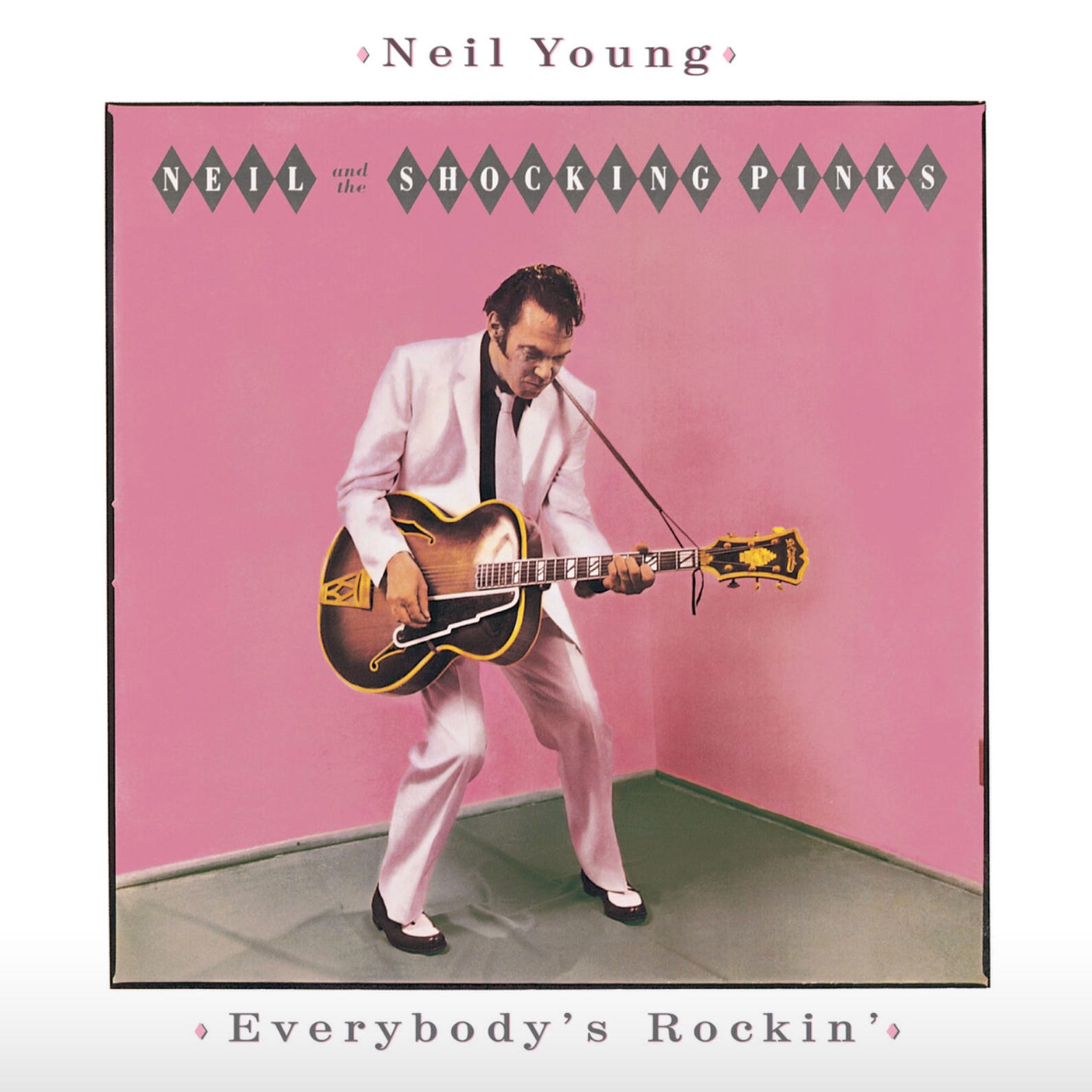
Get a load of our boy posing through the pomade on the cover of his next Geffen-bankrolled undertaking, Everybody’s Rockin’. That’s about as tidy as I’ve ever seen him!
Everybody’s Rockin’ is an undeniable rock & roll record, just as the boss commanded. In fact, it’s such a rock & roll record it sounds like it was written and recorded by a bunch of high schoolers in 1956. It’s one of the funniest things I’ve ever heard, and whenever I return to it after forgetting about it for a couple of years, it gives me chuckle fits all over again.
Here’s a sample track, a big favorite of mine called “Kinda Fonda Wanda”.
That’s right, guys. Wanda always wanna wanna wanna. (I absolutely love that single-fingered piano workout! I laugh both with it and at it, so that’s two mints in one!)
“I almost vindictively gave Geffen Everybody’s Rockin’,” Young later said. “Geffen wanted more rock & roll. That was the key phrase. ‘Well, you want some fuckin’ rock & roll do ya? Okay, fine. I can do that. As a matter of fact, my uncle was a rocker, and I’ll be him.’”
Geffen, right on cue, went ape.
As I’ve explained here and here at The Cool Stuff, I am fully capable of digging the shit out of simple rock & roll, and if it’s rampant with overt stupidity, it’s even more enjoyable. And there’s overt stupidity, albeit of an intentional sort, all over Everybody’s Rockin’.
Rock & roll in its nascent form—the type that Neil and his buddies are playing here—was the fanfare of the common teenager. The whole idea was that anybody with a guitar and the ability to strum two or three chords in the proper sequence could play it, and sometimes some sleazebag businessman would even let you record it. Parents didn’t get the point, but that’s because they were parents! Of course they didn’t get the point! That was the point! (if you can follow that.)
The songs were all over in a couple of minutes anyway.
True to the original form, Everybody’s Rockin’ runs a cool 24 minutes and 36 seconds in its entirety! It’s almost certainly the shortest album I’ve ever purchased, and I’m sure Young kept it hyper-concise to even further piss off David Geffen.
When you consider the million bucks per album Geffen was paying him, Young pulled in a cool $41,667 for each minute of music on Everybody’s Rockin’, which qualifies as exceptionally nice work if you can get it. Granted, he may have spent close to three hours writing the tunes, but that’s where it stood as a piece of vinyl.
Now let’s listen to the album’s towering title track, shall we? Of course we shall.
Again with the piano. (Note that Neil, for sheer comic effect, has Ron and Nancy boogying on the White House lawn. Back in the day it was possible to make the president and first lady seem even more ridiculous than they actually were, kids! Crazy, I know.)
Everybody’s Rockin’ climbed all the way to number 46 on the Billboard albums chart, proving that at least some of the record-buying public had a sense of humor. Not enough for David Geffen, mind you. But a few, anyway.
Even the video Young shot to promote the record’s first and only single, “Wonderin’,” is a hoot. For some reason, it’s always been impossible to find a clear copy of this thing anywhere on the Internet, but it’s just too good for me to not post it.
I’m not sure how he did it, but it looks like Young cut out several frames of footage per second to give the proceedings a thoroughly pointless herky-jerky quality. I went nuts the first time I saw this on VH1, years after the fact.
Don’t go telling me Michael Jackson doing pelvic thrusts with a bunch of zombies is better than that!
As for that lawsuit.
Geffen eventually attempted to sue Young for making albums that were “uncommercial” and “uncharacteristic of his previous work,” which certainly seems like a cut-and-dried case if it weren’t for the fact that we’re talking about the creative impulses of a human being.
If you knew precisely what Neil Young, or any other musician for that matter, was going to do next, he wouldn’t be an artist anymore. Good, bad, or mediocre. It’s not like he’s dispensing frozen yogurt.
Young sued Geffen right back for $21 million, saying his contract gave him complete artistic freedom, which it did.
Geffen finally withdrew the lawsuit and later admitted it was all a huge mistake. Neil then submitted three conventional, rather middling Neil Young-style albums to the label before returning to his old home, Reprise Records, where he should have stayed all along.
Lesson learned the hard way, but you have to wonder if David Geffen is currently looking into this newfangled AI music he’s been reading so much about.
No posts
Comments
Nothing yet. Say the first thing.
Sign in to join the conversation.