
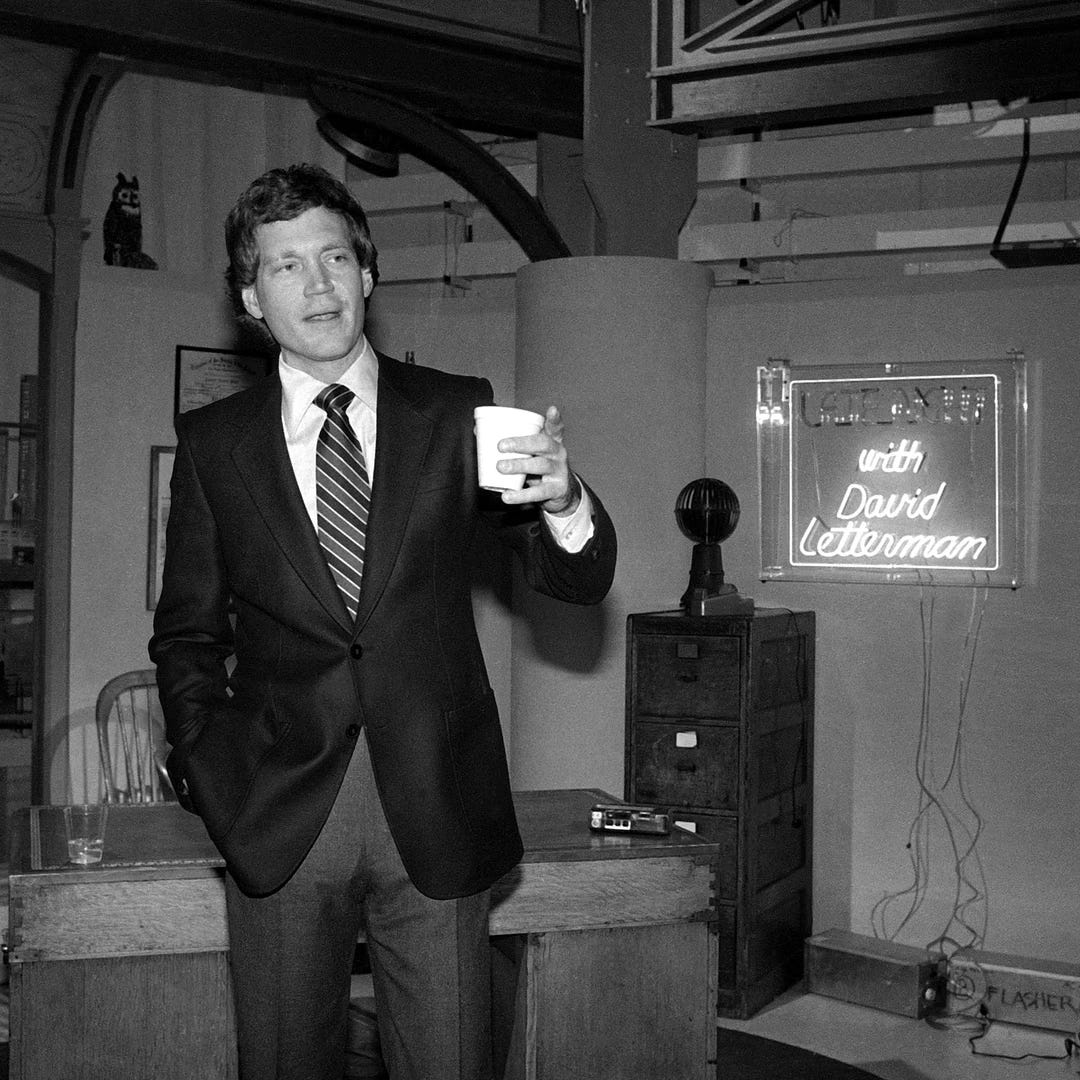
Now that late-night TV talk shows are something of an afterthought in the grand scheme of things (unless our sociopathic crybaby in chief is trying to force one off the air), it’s easy to forget the impact David Letterman had on the American public’s sense of humor when NBC launched Late Night with David Letterman in early 1982.
Those of us in the right age and cultural bracket were dazzled when Letterman first wrestled the late-night airwaves into submission.
If you only know him from his CBS gig, where he abandoned Late Night’s slapdash “Look, Ma! We’re doing a TV show!” approach, you didn’t experience pupal-stage Dave, which was vastly more adventurous and consistently hysterical than the repetitive, ground-down broadcast veteran he later became.
This is not to dismiss the fitful brilliance of The Late Show; any Letterman fan can reel off a handful of genuine CBS highlights. Dave manning the drive-through at a Taco Bell in New Jersey springs to mind for me, and his takedown of a faux-discombobulated Joaquin Phoenix is one of the defining incidents of Letterman’s late-night career.
But that was still just a celebrity interview via verbal scalpel, as opposed to Dave totally winging it with strangers out on Broadway or getting stuck half-way up a wall while wearing a Velcro suit.
Lyle Lovett once suggested that Letterman back in the day was the most impersonated man in the country. Suddenly, being the mocking wise guy was a badge of honor, provided you were actually funny while you mocked.
Even by my freshman year of college, when Late Night debuted, I was already a seasoned mocking wise guy. So, for me, Dave was a veritable Statue of Liberty of sarcasm, a torchbearer lighting the way for millions of people who had long been thinking, “Can you believe these idiots?!”
I was busy filling shipping drums with nickel nitrate flakes in a greasy chemical factory when Letterman’s first national TV foray, his morning show at NBC, sparked and fizzled out in a mere four months, so I never even saw it. But I remembered him from his comic segments on a temporary 1977 summer replacement show starring...Jesus...the Starland Vocal Band, and that alone was enough to turn me into a fan.
By the time Late Night went on the air, my new college buddies and I were primed for it. I know for a fact that I watched every one of Letterman’s first one hundred Late Night episodes, and I missed very few of them thereafter, at least while I was still in school.
This wasn’t a mere TV show. It was hanging out in Dave’s apartment and laughing my ass off for an hour to wrap up a hard day. I felt like I knew the guy, and Late Night’s low-budget mis en scene only bolstered the illusion.
If not for Letterman, I never would have recognized the serenity I could get out of crushing a tomato-filled Barbie dollhouse with an 80-ton hydraulic press.
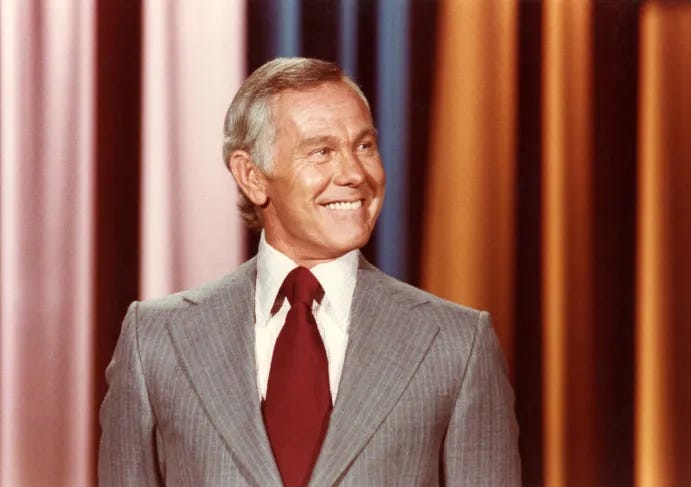
It’s not exactly a shock that Letterman idolized Johnny Carson. By the time Late Night kicked into gear, Johnny had been doing his thing on The Tonight Show for almost twenty years and was a TV legend. Like every other comedian in the country, Dave was largely launched to stardom by making Johnny laugh in front of millions of viewers.
But the burnished glow of selective memory, and a soft spot for Johnny himself, suggests that the guy was knocking it out of the park with his comic inventiveness for way longer than he actually did.
By the late 70s, Carson was still a marvel at interviewing guests. No one outside of Dick Cavett has ever done it better, but Cavett’s show was a vastly more intellectual pursuit than Carson’s.
Luckily for Johnny, a casual Midwestern manner and lightning-quick verbal reflexes papered over the fact that The Tonight Show’s skits and monologues were, at best, Catskills mugging that only seemed au courant because he dropped phrases like “mood ring” or “Billie Jean King” or “G-spot” into them.
For years on end, the majority of Carson’s non-interview laughs came from his paid inebriated flunky, Ed McMahon, or as a secondary response to the audience groaning at how bad the writing was— “May the bluebird of happiness fly up your mother’s nose” and all that shit.
After a while, Johnny never even tried to think outside the box of his own making. And he probably never would have, either, even if he’d kept going at it until he finally died right there onstage.
Letterman, who is almost chronically self-deprecating, has long argued that his career hinged on doing a half-assed Carson impersonation, but that seems like the oversimplification of somebody who’d rather not discuss it.
In fact, Dave was breathing badly needed new life into the late-night form, or at least he was until CBS and huge-money pressures sucked the free-range get-up-and-go out of him.
Not every inch of what he was doing was new, though. As in most things showbiz, there were precedents, if you wanted to look for them.
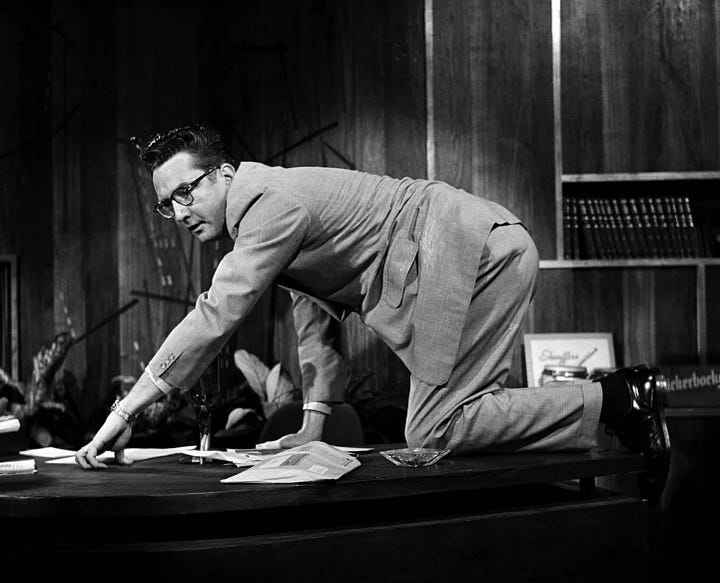
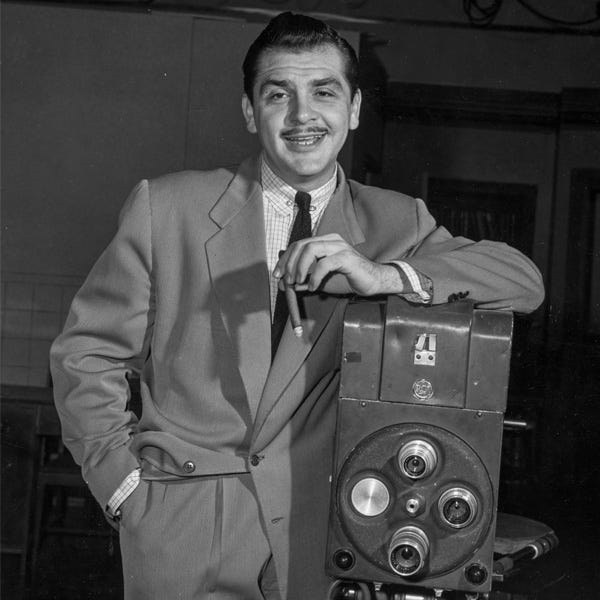
Letterman freely admits to having lifted popular elements of his schtick from Steve Allen, who hosted The Tonight Show from 1954 to 1957 and had a bent for regular-guy oddities. There was actually way more Allen than Carson in Letterman, as well as a substantial sprinkling of the Golden Age surrealist Ernie Kovacs.
These TV pioneers could see that the post-war American gyroscope was spinning off-center. There were elements of our existence that badly needed to be laughed at by the time television overtook this nation’s lives and living rooms, and somebody had to point out the madness.
But, even then, Dave took the ball that Allen and Kovacs inflated twenty-five years earlier and ran with it. Carson’s bluebird of happiness rarely entered into the conversation.
Late Night’s peak years ended in 1986, when head writer Merrill Markoe, who had also been Letterman’s live-in girlfriend, left the show.
Before then, Markoe created Dave’s sturdiest recurring segments, including Stupid Pet Tricks, where people would haul in their doggie, bird, or piglet to show off a useless talent; and Stupid Human Tricks, where people would haul themselves in and do the exact same thing.
Markoe also produced a wide assortment of remote segments that featured Dave, who was not yet an immediately recognizable face, interviewing everyday New York pedestrians and shopkeepers while they solemnly made fools of themselves.
These, for me, were the show’s real reason for being. There are 8 million citizens in this fine city that I now call home. So, based on national percentages, that’s around 4.7 million fools to stumble upon.
All Dave had to do was step out on the sidewalk to find them.
When Dave Met Colleen
Perhaps my favorite of these remotes, however, led Letterman all the way to the wilds of Long Island to meet a charmingly stunned, not especially foolish young fan who wrote him a letter questioning his penchant for wearing sneakers with his suit.
Years later, Colleen said in an interview for Letterman’s website that her manager at Sears was unhappy when Dave showed up with cameras in tow because she was afraid he was making fun of Sears itself. But when she found out he was only making fun of Colleen, she was okay with it.
This says everything you need to know about working retail.
Dave and the Attack Monkey
Just like Carson, Letterman was amusing with animals, especially when the animals didn’t want to cooperate with him (thus the triumph of the Joaquin Phoenix interview.)
In this memorable segment, the woman handling the monkeys also doesn’t seem too interested in dealing with Dave. Notice his exasperation when she barrels right past him after her introduction and falls into rote stage patter that she could probably have delivered while doing a crossword puzzle.
She has zero intention of mixing it up with the host of the show that’s promoting her dated routine to a national audience, and she appears to care even less about his physical well-being.
Honestly, if that monkey had killed Dave, you get the feeling the woman would have simply stepped over his body, grabbed up her co-stars and props, and hopped the next flight back to Vegas.
The Official General Electric Handshake
There were a lot of reasons why NBC passed over Letterman in favor of that unctuous, boot-licking weasel, Jay Leno, to host The Tonight Show when Johnny retired. But “just poking fun at the big guys” behavior like you’re about to witness from Dave reportedly played a significant role in the network’s decision.
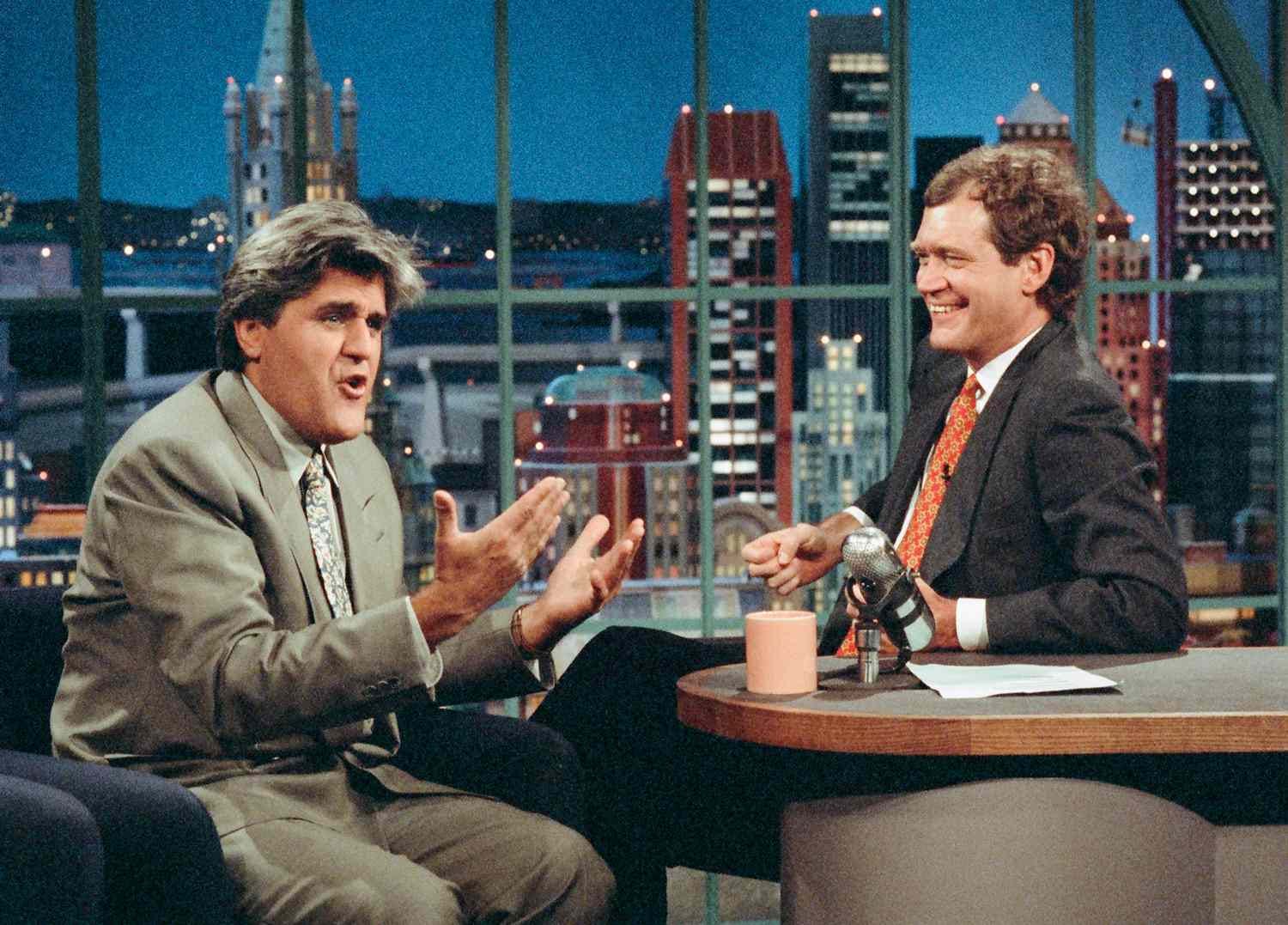
Leno was actually Letterman’s top recurring Late Night guest—he was a scream every time he appeared—until Dave’s favorite smelled vast power and riches in the air. Then he thoroughly defanged himself lest he offend anybody in Iowa and pissed on Dave so he could buy a bunch of antique cars and store them in an airplane hangar. Take my word for it, kids— not even Rod Stewart sold out as enthusiastically as Jay Leno did.
Dave, on the other hand, was not the boot-licking type.
When General Electric purchased NBC’s parent company, RCA, Letterman immediately started doing defective GE lightbulb and microwave gags, which apparently were too much for his sensitive new overlords to take. So, in a gesture of faux goodwill, Dave decided to visit GE’s corporate offices with a nice fruit basket in tow as a peace offering.
It did not go well.
You can tell Letterman gets nervous when the head security guy approaches him with his goon-like personage and can’t-do attitude. Dave’s more than happy to hand him off to his loyal director, Hal Gurney...who Dave forever referred to on the show as “Hal Gertner,” for some reason.
Letterman milked that official General Electric handshake for all it was worth in the wake of his rejection. For a long time afterward, it would appear as a quick finale at the tail end of Late Night’s credits.
That’s how you receive a negative work review and find yourself transferred to the Ed Sullivan Theater after years of committed service.
Larry “Bud” Melman at the Port Authority
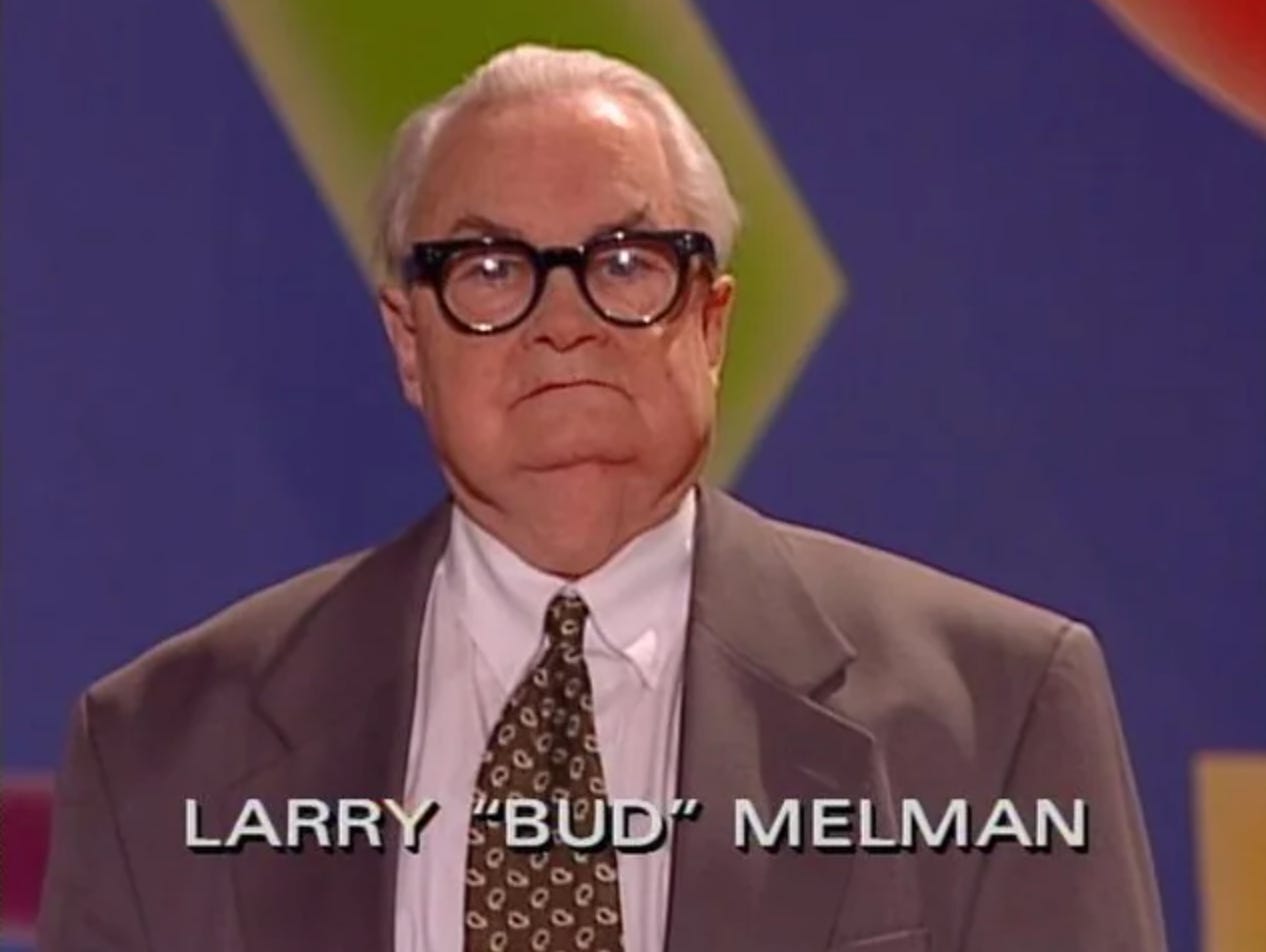
And now we come to Larry “Bud” Melman. God help us.
It’s hard to accurately explain what Larry Bud did on Late Night, even after you’ve sat there and watched him do it. I’ve seen him referred to as a walking punchline, which seems fair enough, but Larry Bud was damn near close to Dada. Letterman would just hand him the keys, then sit back and watch in amazement while he wrecked the car.
Larry Bud delivered his dialogue as if he were shouting nonsense syllables at someone on the other side of a canyon. And during those countless moments when he fell into a flop sweat, he looked for all the world like a man drowning in oxygen.
Letterman dabbled a bit in Larry Bud when he moved to CBS, but he had to refer to him by his real name, Calvert DeForest, at that point due to NBC’s contention that they had “intellectual rights” on Larry Bud, which is pretty hysterical if you consider there was absolutely nothing intellectual or right about the character.
Still, you had to admire the fact that Larry Bud never gave up and bailed on a skit, no matter how bad things got. He seemed to be simultaneously in on the joke and utterly incapable of comprehending that the joke was him.
This produced an almost David Lynchian conceptual fissure. Larry was funny as hell, but if you took a few steps back and really considered things—or maybe if you were high—he was also close to terrifying.
What follows may well be my favorite David Letterman segment, the one that I think best illustrates the misshapen magic of Letterman’s time at NBC. Larry Bud welcomes incoming visitors to New York City at the Port Authority bus terminal on beautiful W. 42nd St. and offers them hot towels after their long journeys from Philadelphia and Hoboken.
Seems easy enough. For a normal person.
I nearly peed my pants laughing when I watched this during its original broadcast. Listen to Dave fall into hysterics and finally just squeal to himself as Larry Bud repeatedly transforms himself into a living ball of confusion and totally screws the pooch. The absurdity grows deeper by the moment.
Enjoy.
Paul Shaffer, Letterman’s trusty sidekick and bandleader, said that when Bob Dylan was on the show in 1984, the only thing Dylan said to him was, “Paul, do you think you could introduce me to Larry Bud Melman?'“
Surely, this explains the stretch of albums Dylan released in the mid-1980s.
Tom Hanks Nails The Landing
I think Letterman took way too much grief for supposedly being a jerk during interviews. Sometimes there’s just heat in the kitchen.
Cher, for instance, famously told him, live on the air, that she refused to appear on his show for years on end because she thought he was an asshole. And maybe Dave was an asshole when it came to skin-tightened, blow-dried showbiz mannequins who rarely behaved like authentic human beings.
I can’t really blame him there. If they had it coming, Dave would happily give it to them. He was willing to do God’s work, as far as I’m concerned.
But when he was dealing with someone who knew the point was to just loosen up and divert people at bedtime, he had a blast. Teri Garr and Steve Martin always scored big, and yes, so did Leno before The Great Unraveling. Dave also gave Andy Kaufman and Pee-wee Herman enough rope to do whatever it was they thought they were doing, and he always delighted in their antics.
Nothing was better than laughing along with Dave when things were cracking.
I’ll be closing this, then, with one of the best interviews Letterman ever conducted on Late Night, and, rather remarkably, it was the final one in the show’s history! The guest is Tom Hanks, and Hanks, who was always great with Dave, achieved casual talk show perfection on this particular night.
One anecdote after another scores. There are five or six laugh-out-loud moments here. Then, at the end of the episode, Springsteen came out and played “Glory Days!”
Not a bad way to slam the lid shut.
On those very rare occasions when I’ve stumbled upon footage of Slappy White since then, I can’t help but think, “Stop bendin’ the shafts!!” If it weren’t for that, I wouldn’t have anything to think about Slappy White at all, except maybe to remind myself that he wasn’t Nipsy Russell.
No posts
Comments
Nothing yet. Say the first thing.
Sign in to join the conversation.