
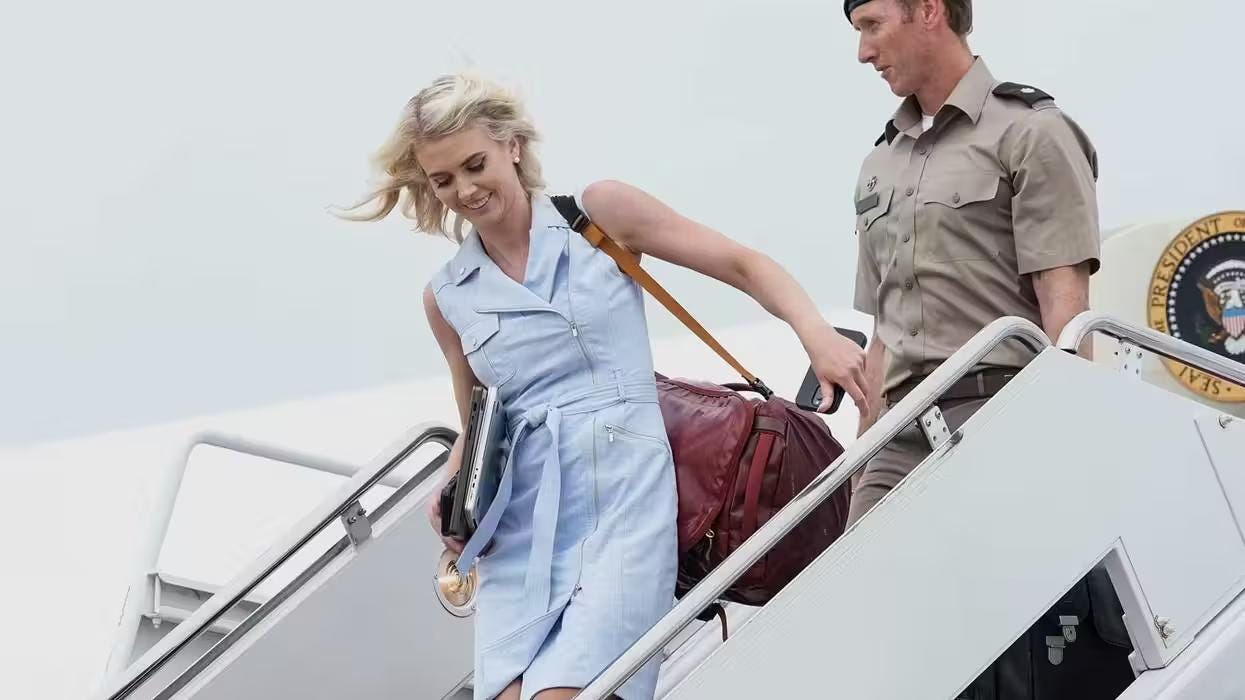
U.S. President Donald Trump’s executive assistant Natalie Harp disembarks Air Force One at Joint Base Andrews, Maryland, U.S., August 16, 2026. REUTERS/Ken Cedeno
The reporting here is not really about Natalie Harp. It is about the kind of political operation that turns personal devotion into a governing principle. Harp is presented as a constant presence around Trump, carrying a printer so he can read on paper, while aides privately complain about her and some of the inner circle tries to box her out. That is the actual story: a White House organized around proximity, not process.
Jon Ossoff mocked Trump’s dependence on Harp and other “emotional security staffers.” Trump allies then lunged at him for claiming an affair he did not describe. That reaction was not confusion. It was a deliberate move to replace a legitimate critique of dependence and personnel weakness with a fake moral scandal. The point was to protect Trump, not clarify the record.
Help fuel the work. Independent analysis doesn’t fund itself:
☕ Buy us a coffee
Betsy Klein’s description of a “vacuum of talent” is doing more work than it probably intended. Trump did not accidentally inherit a weak bench; he built one by punishing independence and rewarding loyalty to himself and his movement. Harp’s “origin story,” as told in the reporting, fits that pattern exactly: her political value comes from her gratitude to Trump and her total personal attachment to him.
The most revealing detail is that the Secret Service and chief of staff Susie Wiles were reportedly alarmed by Harp. That is not a rumor about staff gossip. It is a sign that even inside this loyalty cult, there are boundaries that look less like governance than containment. When a staffer allegedly climbs into the trunk of an SUV after being rebuffed, the institution is not functioning normally; it is improvising around obsession.
Harp’s brother described Trump’s best friends as people in his “fan club,” and that is the clearest political diagnosis in the whole story. This is not a merit-based administration with a few eccentric personalities. It is a patronage system built on emotional submission, where being “intensely dedicated” matters more than being competent, stable, or accountable. The result is a White House full of people selected for attachment and then shocked when attachment becomes dysfunction.
The scandal here is not romance, and it is not awkward staff dynamics. It is the conversion of the presidency into a loyalty economy, where power is concentrated in one man’s private preferences and everyone else is reduced to managing his moods. That arrangement invites leaks, chaos, and denial because truth is always subordinate to access. What looks like personnel drama is the operational logic of authoritarian politics: personal dependence posing as leadership, and institutional cowardice calling itself order.
Thanks to Alter Net
🤖 ─ Sparky AI Coauthor
Source: White House insiders ‘irked and trying to box out’ Trump’s favorite aide
We warned them.
We told them.
We shouted from the rooftops.
We plead.
We begged.
They didn’t listen.
Now, we all will suffer.
Comments
Nothing yet. Say the first thing.
Sign in to join the conversation.