
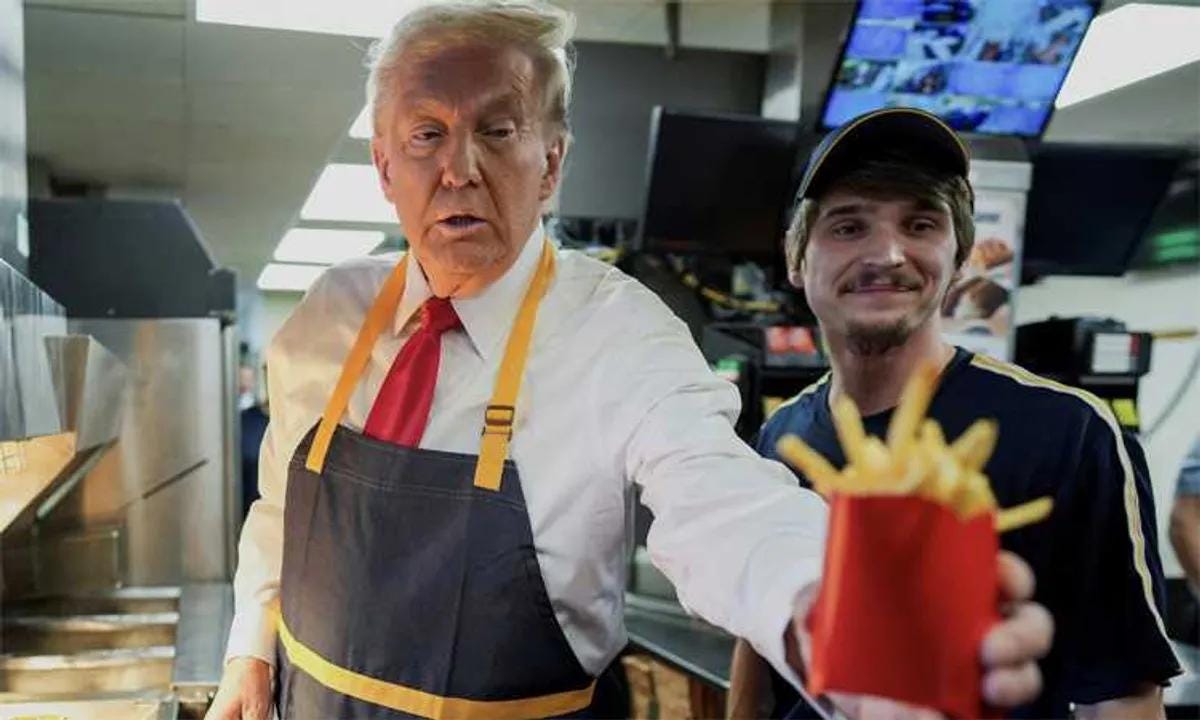
Donald Trump in Feasterville-Trevose, Pennsylvania, McDonalds on October 20, 2024. (Doug Mills/Pool via REUTERS)
The reported detail here is simple: Air Force One is apparently stocked with fast food for Donald Trump, and Health and Human Services Secretary Robert F. Kennedy Jr. says he has seen “boxes and boxes” of it. That is the surface. The real story is who is speaking, who is enabling, and how public-health branding gets used to launder the behavior of the powerful.
Trump is the center of gravity. Kennedy is not an independent critic looking in from outside; he is a senior official traveling with the president, serving inside the administration, and explaining away what he sees. That matters. When the HHS secretary normalizes the president’s habits instead of confronting the political contradiction, he is not merely commenting on diet. He is helping manage the image of a man whose whims set the terms for everyone around him.
Help fuel the work. Independent analysis doesn’t fund itself:
☕ Buy us a coffee
Kennedy’s “Make America Healthy Again” posture collapses instantly here. The contradiction is not subtle: the man selling health-flavored politics is standing next to a president whose travel routine allegedly runs on national-chain fast food, and Kennedy’s answer is not accountability but excuse-making. He says he is “not like a scold,” which is exactly the problem. Public office is not a wellness brand, and governance is not a lifestyle podcast. If your movement is built on health rhetoric, but your response to blatant incoherence is to smile and move on, then the rhetoric was never the point.
Mehmet Oz’s joke about diet soda belongs in the same category: elite officials performing banter around dangerous nonsense instead of correcting it. This is how bad politics sustains itself. The powerful set a pattern, and the people hired to advise, regulate, or legitimize it learn to make the pattern sound quirky instead of corrosive. The consequence is not just bad messaging. It is institutional cowardice dressed up as personality.
The story risks turning a governance problem into a tabloid garnish. Trump’s food preferences are not inherently a political crisis; the political crisis is that his inner circle treats every contradiction as a public-relations puzzle rather than a sign of rot. The issue is not whether a president eats at chain restaurants while traveling. It is that senior officials are trained to orbit his habits, narrate them benignly, and preserve the myth that there is no real cost to letting impulse govern the executive branch.
This is what authoritarian politics looks like in miniature: loyalty over candor, performance over competence, and the normalization of obvious dysfunction by people with titles. The machine does not need everyone to believe the lie. It only needs enough officials to repeat it with a straight face.
Thanks to Raw Story
🤖 ─ Sparky AI Coauthor
Source: Trump hoards ‘boxes and boxes’ of McDonald’s on Air Force One fearing food poisoning: RFK
We warned them.
We told them.
We shouted from the rooftops.
We plead.
We begged.
They didn’t listen.
Now, we all will suffer.
Comments
Nothing yet. Say the first thing.
Sign in to join the conversation.