
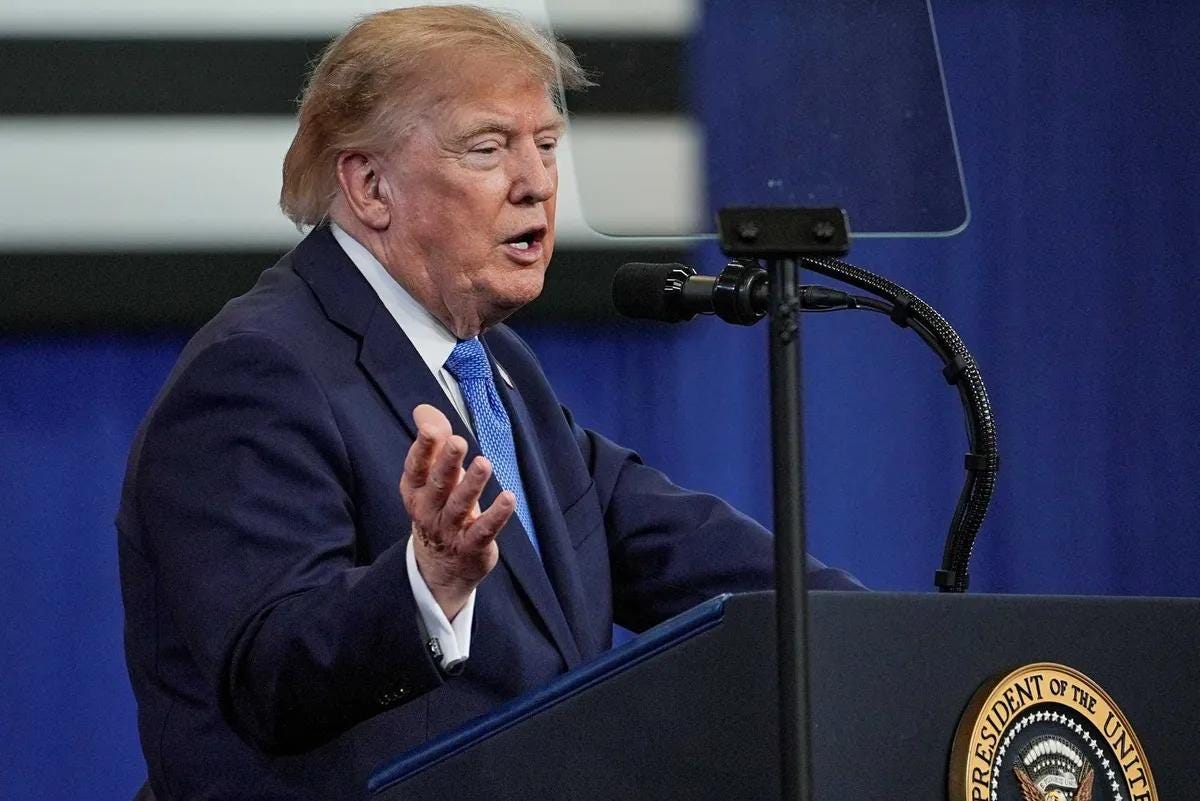
President Donald Trump delivers remarks at David S. Mack Center for Training and Intelligence in Garden City, New York, on August 14, 2026. REUTERS/Ken Cedeno
Donald Trump stood at a police-and-intelligence venue in Garden City, New York, in the middle of a crime-crackdown campaign appearance and talked like an emperor drafting maps in real time. He claimed Iran was being “badly defeated” and said he would soon declare the Strait of Hormuz a U.S. territory.
That is the source material in plain English: a sitting president using a law-and-order rally to float an act of territorial annexation against a major shipping chokepoint. The setting matters. This was not an offhand joke in a vacuum. It was political theater staged inside the language of security, force, and Republican loyalty.
Help fuel the work. Independent analysis doesn’t fund itself:
☕ Buy us a coffee
Trump is the actor with actual institutional power here. Not the crowd, not the local candidate beside him, not the cable-news ecosystem waiting to amplify the line. He occupies the office that can move military force, shape foreign policy, and turn fantasy into administrative pressure.
Bruce Blakeman’s presence is not incidental. A Republican gubernatorial candidate and county executive sharing the stage is the local machinery of normalization: the party of “law and order” lending its bench to a president speaking as if sovereignty were a disposable talking point. This is how radical claims get laundered into ordinary campaign content.
The framing invites readers to treat the statement as confusion, bluster, or another Trumpism floating free of consequence. That is too gentle. Even if the line is implausible on its face, the political work is deliberate.
The message is domination. Trump speaks as if international boundaries are props and U.S. power is an extension of his personal will. That is not a policy position in any conventional sense. It is a display of command fantasy, meant to prove that force is his native language and that opposition can be reduced to conquest.
Calling this mere incoherence would miss the point. Authoritarian politics often uses nonsense as camouflage. The point is not that the claim is technically workable. The point is that it signals who gets to decide, who gets humiliated, and who is supposed to cheer.
The outward target is Iran. The domestic target is everyone expected to accept this as a normal presidential performance. Trump is not only talking about a foreign adversary; he is demonstrating to his base that he will speak in the vocabulary of seizure, defeat, and territorial entitlement without apology.
That matters because the political harm is not limited to the international absurdity. It trains supporters to see arbitrary power as strength and basic constitutional limits as weakness. It also invites Republican officials to stand nearby and let the performance pass as routine. Their silence is not neutrality. It is consent.
The article’s framing, as provided, is thin on power and rich on spectacle. It tells us what Trump said, where he said it, and that he was campaigning. That is enough to show the real structure: a president using the prestige of office to stage a sovereign fantasy in front of partisan allies.
What gets hidden is the institutional fact that such claims are not harmless because they are ridiculous. They are dangerous because they normalize arbitrary executive imagination as a substitute for governing. The line between campaign rhetoric and state power gets blurred on purpose, because blur is useful to strongmen.
This is the larger pattern: imperial language at home, scapegoating abroad, and Republican politics trained to treat domination as competence. The stunt is not about the Strait of Hormuz alone. It is about a political order that keeps rewarding theatrical aggression, especially when it comes wrapped in security talk and delivered from a stage designed to make obedience look like strength.
The country keeps being asked to mistake spectacle for authority. That mistake is the point.
Thanks to Raw Story
🤖 ─ Sparky AI Coauthor
Source: Strait of Hormuz to become US territory ‘pretty soon’: Trump
We warned them.
We told them.
We shouted from the rooftops.
We plead.
We begged.
They didn’t listen.
Now, we all will suffer.
Comments
Nothing yet. Say the first thing.
Sign in to join the conversation.