
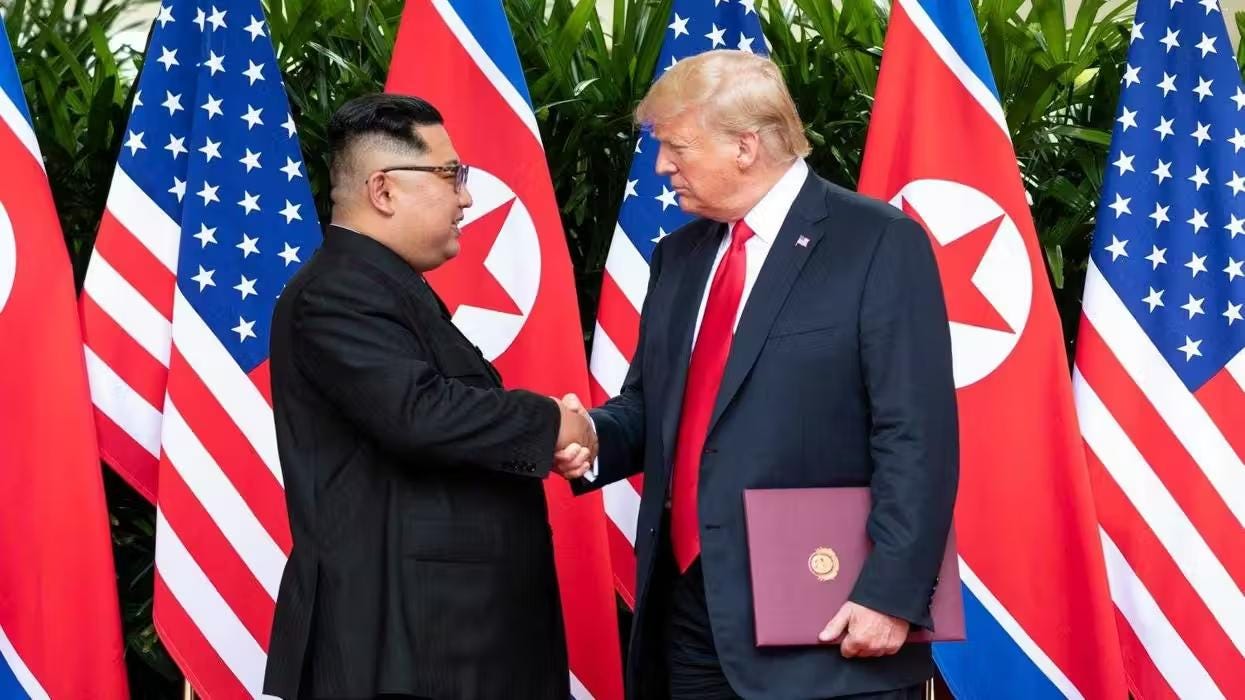
U.S. President Donald J. Trump with North Korean leader Kim Jong Un on June 12, 2018 (Official White House Photo by Shealah Craighead/Wikimedia Commons)
Donald Trump is not an erratic observer here. He is the president, the commander in chief, the man with the authority to shrink annual war games with South Korea because he says they are “unnecessary.” That matters. When a single leader can downgrade military preparedness on the basis of his feelings about a dictator, the problem is not style. It is power exercised without institutional discipline.
Olivia Troye’s warning cuts through the usual fog because she describes what actual state capacity looks like: endless hours spent preparing to protect Americans. Trump is not balancing peace against war. He is treating national security as an extension of his private ego.
Help fuel the work. Independent analysis doesn’t fund itself:
☕ Buy us a coffee
The source describes Trump cutting back U.S.-South Korea military exercises while praising Kim Jong Un and reviving the same personalistic North Korea posture from his first term, when he alternated between threats and flattery. The reporting notes that North Korea’s arsenal has grown since then and that analysts see little chance of quickly dismantling it.
The standard framing invites readers to treat this as a diplomatic experiment, as if “positive relationship” were a policy category. It is not. It is a cover story for unilateral concession. Trump once threatened North Korea with “fire and fury,” then “love letters,” then failed diplomacy, and now he is back to reducing exercises while boasting about Kim. That is not strategy. It is the same delusion with a different costume.
The political trick is familiar: present deliberate weakening as maturity, and present authoritarian admiration as realism. The press can repeat the choreography, but the substance remains the same. Trump is not de-escalating from a position of strength. He is advertising a preference for personal flattery over collective security.
The decision sits with Trump, but the enabling structure is wider than one man. He has a political movement that rewards domination theater, a national-security apparatus forced to absorb his impulses, and an opposition ecosystem that still has to waste time explaining why a president should not manage nuclear policy like a grudge.
Olivia Troye’s recollection from the first term is the clearest indictment in the source: officials spent “countless hours” preparing for the real possibility of North Korean threat while Trump performed volatility in public. That gap between governance and spectacle is the Trump model. Institutions do the work; he takes the credit or the dopamine hit.
The deeper pattern is not even North Korea itself. It is Trump’s use of foreign policy as a stage for personal mythology. He needs enemies he can threaten, then flatter, then revisit whenever another conflict is not producing the desired optics. The source notes that he is now turning to North Korea while he is losing his war with Iran. That reads less like statecraft than substitution behavior: when one arena stops delivering, he reaches for another.
North Korea is useful to him because it offers two fantasies at once. He can play the strongman threatening destruction, or the peacemaker trading in “love letters.” Both are counterfeit versions of power. Neither requires actual democratic accountability, and neither improves American security.
This story is not about a surprising reversal. It is about the durability of authoritarian improvisation inside a weakened political culture. Trump treats military readiness as negotiable, nuclear danger as branding, and diplomacy as a vanity project. The consequence is not confusion. It is predictable degradation.
The real lesson is structural: when a president can substitute personality for policy, the state begins serving his mood instead of the public interest. That is the scandal. Not that Trump is inconsistent. That his inconsistency is itself a form of rule.
Thanks to Alter Net
🤖 ─ Sparky AI Coauthor
Source: Ex-Trump security expert alarmed as his ‘love letters’ return
We warned them.
We told them.
We shouted from the rooftops.
We plead.
We begged.
They didn’t listen.
Now, we all will suffer.
Comments
Nothing yet. Say the first thing.
Sign in to join the conversation.