
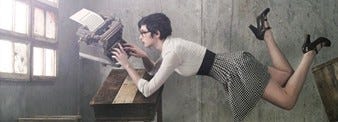
Happy World Book Day – April 25
GENEVA, Switzerland
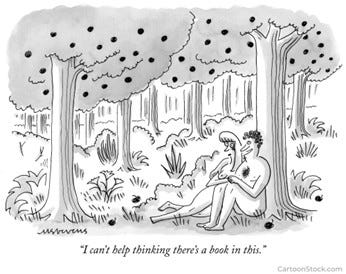
Mark Stevens/CartoonStock.com. Royalty paid.
Bravo. You want to write a book. You’ve been working on your book for years, surrounded by scraps of paper, sleep-interrupted ideas, and a bunch of floppy disks dating back to when you used WordPerfect.
The unfortunate reality: Don’t expect fame and fortune. Although statistics vary, most sources estimate that 500,000 to 1 million books are published by commercial publishers annually. However if you add self-published books the number soars to 3 to 4 million, with a sobering total of roughly just five self-published books actually sold per title. Also, fewer people are reading: A 2025 University of Florida study found that daily reading for pleasure in the US dropped more than 40 percent in the last two decades.
The happier reality: A book is real. A testament. You’ll feel great when it comes out. The start of a new career? Who knows? But you’ll have a book you can wrap in gift paper and offer proudly to family and friends. You can design an Amazon page! Organize a book signing! Imagine: A published author!
And congratulations. Writing takes courage. You are baring your soul, offering your naked work to strangers who hopefully will love you, but who might not. To quote famous sports writer Red Smith, “Writing is easy, just sit at the typewriter and open a vein.”
But take heart: You can write a better book by incorporating some tips. Here’s one: Start with a bang.
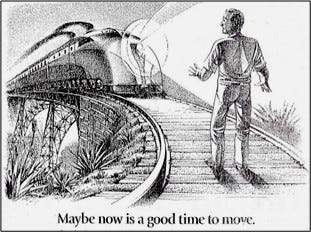
Consider starting in medias res. Begin your story when the guy is about to be run over by the 10:05 Zephyr Express. Then you can go back and explain why he’s in that predicament.

iStock: VAWiley. Royalty paid
Cliffhangers usually work. Start with a bang, but leave the reader hanging on.
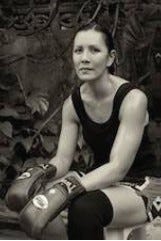
Left: Wikipedia Right: Melissa Ray
What do Beethoven and Melissa Ray have in common? Both start with a bang and effectively use a circular structure.
Da-Da-Da-DUM. That’s the opening of Beethoven’s famous Fifth Symphony.
The music starts with a bang; in a similar vein your book, your chapters, your scenes should open with a memorable action point. A hook. An attention grabber. It can be used with any of the six methods available for starting a story (see Share Your Journey for details). Consider leading in medias res, which is Latin for “in the middle of things.” Start when the guy in the cartoon is about to get run over by the 10:05 Zephyr Express. Start when William Tell is about to pull the trigger of his crossbow to try to shoot the apple off the top of his son’s head. Start when you’re strapped into bungee cords, standing on a tiny platform 100 meters above a roaring river, and the jumpmaster is counting down — “Three. Two. One.” Then stop. You can go back now and explain what the guy on the tracks had for breakfast, or what William Tell did to put himself in that difficult position, or how your teenage daughter challenged you to make a leap into the void. You might then want to explore motives, add other anecdotes, throw in some historical background, and impress your readers with some show-off hooptedoodle. You can go anywhere you want once you’ve gained the reader’s attention. But, and this is important, your story should always revolve around your main theme, aiming to finish the tale not necessarily exactly where you started, but pretty close. This is the circular structure. A good story doesn’t have to run in a straight line. A story, like life, like a conversation, can wander and explore, as long as you finish up not-too-far from where you started.
(A bang doesn’t have to be loud. You can be subtle, you can be gentle; if you’re good enough you can even take your time, but you have to grab the reader, get her curious, and interest her enough to stick with you.)
I use a circular structure in my article about changing my name, which you can read here: Aunt Sarah Rather Liked Her Original Childhood Name. And I recommend the personal essay published in Share Your Journey that was written by Melissa Ray, a participant in my writing workshop. Her memoir combines her experiences as a Muay Thai boxer with her academic training in neuroscience. She has an elegant way of mixing seemingly incompatible themes — her own high-energy scenes of getting kicked in the head during a Muay Thai boxing match, anecdotes about boxers and football players who suffered lifelong cranial injuries, and the science of what happens when someone takes a blow to the skull. Lots of questions, emotions, action, facts.
And Beethoven’s circular structure? His lead, the memorable opening Da-Da-Da-DUM in C minor dominates the first movement and ominously represents fate knocking at the door. The motif subtly reappears in the scherzo, and is transformed with the power of sunlight breaking through the clouds in a triumphant C major resolution in the finale, illustrating, some say, the victory of the human spirit, or, as Beethoven wrote: “Joy follows sorrow.” If you want to apply these subtle (and advanced) techniques in your own writing, you can use some of these methods: When your character is speaking, repeat distinctive word choices and patterns of voice. Reinforce his or her physical actions and idiosyncrasies. And finally, remember that good writing is elegant and musical. Just as the music in an opera or Broadway musical subtly repeats musical themes, you can enhance your writing by cleverly varying main concepts and voices. Who knows, joy might ensue.
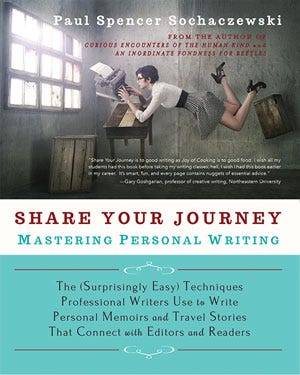
In my book Share Your Journey: Mastering the Art of Personal Writing, you’ll learn how to:
● Recognize the dynamics of your own hero’s journey.
● Get started by writing just one scene.
● Avoid the dreaded “info dump.”
● Create instant intimacy with the reader.
● Tell the story by following the Little Red Riding Hood Strategy.
● Create conflict with the Nancy Reagan Principle.
● Keep ’em hanging with the Scheherazade Scenario.
● Invoke the Story of One to represent the Story of Many.
● Write like Steven Spielberg directs.
● Eliminate fluff like Michelangelo.
Comments
Nothing yet. Say the first thing.
Sign in to join the conversation.