
IN THE RUSH OF 12 months, Fairport Convention made three trailblazing albums that all together birthed British folk-rock. Their recently recruited singer was a 21-year-old, rich with promise but little known at the point she joined them. A force of nature able to sing a hushed ballad like an angel, roaring rock with bruised guts like Janis Joplin. She was, too, loud, erratic, funny, needy, prone to veering mood swings. Her new bandmates, five nice, polite English lads from middle-class backgrounds, hadn’t encountered anyone quite like her, but then again, neither had anyone else.
Sandy Denny was born Alexandra Elene Maclean Denny, also into a comfortably off household in Wimbledon, South London on 6th January 1947. As a child, she took lessons at classical piano and violin. Her paternal grandmother, Mary, would sing for her traditional Scottish ballads she herself had been taught growing up on the Isle of Mull. Her father, Neil Denny, a civil servant, was Glasgow born, by all accounts a rather aloof and distant man. Mother Edna was sharp-tongued and chiding. She would routinely rebuke her precocious daughter over her weight, sowing seeds that festered throughout Sandy’s all too short life.
At Coombe Girls’ Grammar, Sandy was lead violinist in the school orchestra, but otherwise a restless, uninspired student. She found her calling on the local folk club circuit, just then enjoying something of a boom. As the young Bob Dylan and Joan Baez became required listening among British hipsters, folk clubs and folk nights sprung up along the River Thames and around Soho. At 15, Sandy discovered one such place, Kingston Barge, founded in 1961 on a converted coal barge.
The Barge was where another local lad, John Martyn, debuted and a visiting American, Paul Simon, did a regular turn. Sandy began there singing floor spots, most often rendering something by Dylan or Baez.
In the interim between leaving school and going to art school in nearby Kingston, she took a job as a nurse at the Royal Brompton Hospital in Kensington. Next-door to the hospital, on Old Brompton Road, was London’s self-styled ‘oldest folk club’, the Troubadour. Tuesday nights after her shift, Sandy would walk to the Troubadour and into a whole other world. She went on singing there, and once an art student, as well at a club on Soho’s Greek Street, Les Cousins, where the cream of new folk talent was bubbling up, Roy Harper, Ralph McTell, Al Stewart, and more.
Through the fullness of the next year, folk music as whole was launched to the forefront of pop culture. Across the Atlantic, Dylan plugged in, the Byrds jangled, and prodigal son Paul Simon, who’d shared a Les Cousins bill with Sandy on the night of 27th October 1965, hit paydirt with the second album he made with partner Art Garfunkel, The Sound of Silence. In Britain, 19-year-old Donovan broke out. For her part, Sandy started to pick up engagements out from London and across the country. Breaking up from her first year at Kingston Art School in the summer of 1966, she never went back.
“She was one of the best singers I’d ever heard in my life.” - Richard Thompson
BY EARLY 1967, SANDY was fronting for a couple of folk stalwarts, Johnny Silvio and Alex Campbell. With them, she cut her first two records. Both Sandy and Johnny and Alex Campbell and Friends were knocked out for ‘quickie’ specialist label Saga, live to tape, and neither made much of an impression. Her next move was to join a more established collective, the Strawbs.
Formed in 1964 as a bluegrass group, the Strawbs had shifted to a more English sound when their principal, Dave Cousins, spotted Sandy at the Troubadour. She was to spend a year singing with them, playing barely a handful of shows, but among them, a week-long residency in Copenhagen, the summer of ’67. In the Danish capital, Strawbs put down their debut album. Though it was to go unreleased for another six years, All Our Own Work contained a single outstanding song.
A graceful, lilting ballad, ‘Who Knows Where the Time Goes?’ was Sandy’s voice and guitar alone. The first song of her own she felt emboldened enough to share. In hindsight, it’s an almost unbearably poignant piece, like the weeping of a lost soul. Out of the Strawbs, Fairport loomed. They were then taking baby steps on London’s underground circuit, sharing bills with the nascent Pink Floyd and in thrall to the acid-rock sound blown in from the American West Coast.
She’d run into their manager, laconic, 25-year-old Harvard graduate Joe Boyd, on the London club scene. They were looking for a singer, having cut loose Judy Dyble, whose voice was pretty but insubstantial, and to team with their other vocalist, Ian Matthews. On 13th May 1968, Boyd arranged for Sandy to audition in the back room of the Eight Feathers pub in Fulham. Five other aspiring singers also turned up on the day, but Sandy was offered the job on the spot.
Ashley Hutchings, 23 then, Fairport’s bass guitarist and elder statesmen, recalled the occasion to me six decades after the event. “Sandy was head and shoulders above the rest,” Hutchings said. “She didn’t just want to sing for us. She wanted us to play for her, and to see if we were good enough.”
“One of the best singers I’d ever heard in my life,” noted Richard Thomson, Fairport’s serving lead guitarist.
That July, the new-look Fairport started up sessions for their second album with Boyd. At a stroke on What We Did on Our Holidays, they sounded more assured and forceful. Individually, Thompson, Hutchings, second guitarist Simon Nicol, and drummer Martin Lamble was each an excellent musician. With their new singer, they now had a vessel through which to channel their collective power. Sandy was one of them, but also apart.
“As a personality, Sandy seemed bubbly, insecure, short-tempered, and a lot of fun, all those things together,” Thomson described. “The immediate impact she had, I think, was that at last we felt we were a real band.”
“She was in a different culture to the rest of us,” said Hutchings. “She liked a drink, or ten, and took drugs, soft ones mostly, I think, and we didn’t. We weren’t ‘in’ with her drinking buddies, but we loved her dearly. Onstage, she was sensationally good. She would open her mouth to sing, say, a slow, gentle song, and you could hear a pin drop.”
“A lot of men loved and chased her, but they weren’t the ones she wanted. She wanted the unobtainable ones.” - Richard Thompson
THESE WERE HEADY TIMES, not a moment to catch breath. No sooner was their second album done than Fairport embarked upon their third, Unhalfbricking. Now, Sandy truly asserted herself. She gifted the band ‘Who Knows Where the Time Goes?’, nailing this new version in a single take, and weighed in with a second song, just as seductive, ‘Autopsy’. It was her suggestion, too, to re-imagine Dylan’s ‘If You Gotta Go, Go Now’ in French as ‘Si Tu Dois Partir’, their version going on to become a freak hit. They performed it on TV’s Top of the Pops, Sandy in a floral dress, the others in berets and hooped jumpers.
Ian Matthews featured on just one track, another Dylan cover, ‘Percy’s Song’. Once the record was in the can, they let him go. Even the album’s title and cover artwork bore Sandy’s imprint. ‘Unhalfbricking’ was a nonsense word she’d conjured during a game of Scrabble, a favourite pastime. On the cover, her parents were photographed posing outside of her childhood home, she and the other Fairport’s seen idling through the garden fence.
Her greatest contribution to the album, though, was to bring in a traditional song she’d picked up from the folk circuit. Fairport’s interpretation of ‘A Sailor’s Life’ unspooled over a bravura 11-plus minutes, Thompson’s guitar spiralling and the flashing fiddle of hired player Dave Swarbrick spiriting the listener off to more exotic, Eastern climes. Sandy’s vocal was a torch song masterclass.
Two months ahead of the album’s release, 11th May 1969, and driving back to London from a gig in Birmingham, Fairport’s designated driver, sound tech Harry Branham, fell asleep at the wheel, just north of Scratchwood Services on the M1. Their van careered across the motorway, struck a crash barrier, and spun off down an embankment, scattering the occupants.
Lamble, just 19, and Richard Thompson’s girlfriend, Jeannie Franklyn, died on impact. Hutchings was left temporarily blinded and with a shattered pelvis. Sandy happened to have gone on ahead with her new boyfriend, Trevor Lucas, whose band Eclection had opened for Fairport that night. Like the others, she was weighed down by a terrible sense of loss and survivor’s guilt.
Even still, Fairport didn’t stop. As soon as Hutchings was out of hospital, they retreated to rural Hampshire and the confines of a 19th century rectory, Farley House. Joining them Swarbrick, now enlisted full time, and Lamble’s replacement, Dave Mattacks.
“Privately, we grieved, but no-one had any counselling and so it came out in dribs and drabs,” Hutchings said of their trauma.
“In some says, all our actions and perspectives were warped by the accident,” said Thompson.
Summer passed into autumn, and on the other side Fairport emerged with a record delving back deep into the English song tradition, and to zoom it to an electrified present. Unloved at the time, simply too much of a jolt, Liege & Lief’s stature has grown exponentially over the years. Sounding at once ages old and newborn, on it, Sandy wrung pathos and drama from staples such as ‘Reynardine’ and ‘Matty Groves’.
“No-one before had ever played these songs with a rhythm section, so it was hard work,” Hutchings explained. “Sandy probably adjusted quicker than anyone else. All through the making of that record, she was like a breeze.”
Liege & Lief was, however, a last hurrah. Sandy had stockpiled her own songs, and didn’t want to tour apart from Lucas, not least because of his well-founded reputation as an incorrigible ladies’ man. That November, she served her bandmates notice she was quitting.
“Everybody could see that she wasn’t happy in herself.” - Dave Pegg
OFF THE BAT, JOE Boyd begged her to make a solo album, securing for her a £40,000 advance from A&M Records in the States. She flatly refused, using the money instead to fund the group she hastily assembled with Lucas, Fotheringay. The five-piece burnt through her advance, most wastefully on having an enormous PA built they were hardly to use.
Boyd produced their self-titled debut album of 1970, and which gloried in some of the most outstanding vocals Sandy was ever to commit to tape. They did just a smattering of shows to promote it, one an ill-starred headliner at the Royal Albert Hall that October when she seemed paralysed by nerves and they were blown offstage by their opening act, the young Elton John. They started a second album the year following but didn’t complete it.
Sandy turned to Richard Thomson to guide her through her solo debut, The North Star Grassman and the Ravens, recorded in the spring of 1971. It seems today a reflection of her state at the time, the songs, and her vocals, pensive and subdued. Not so with the guest spot she recorded over the same period, her bewitching rallying cry on Led Zeppelin’s ‘The Battle of Evermore’ (she’d known Jimmy Page from art school).
“Sometimes she would coast through a session,” said Thompson of his experience producing her. “She would know something was missing and be dissatisfied, but it was as if she had to have an absolute deadline to force her to produce the goods.
“Yet on the tour we did for that record, she was the most stable I ever saw her. When I think of Sandy now, it’s of her laughing and giggling. She could be great fun, and sometimes, performing onstage with her was a transcendent experience.”
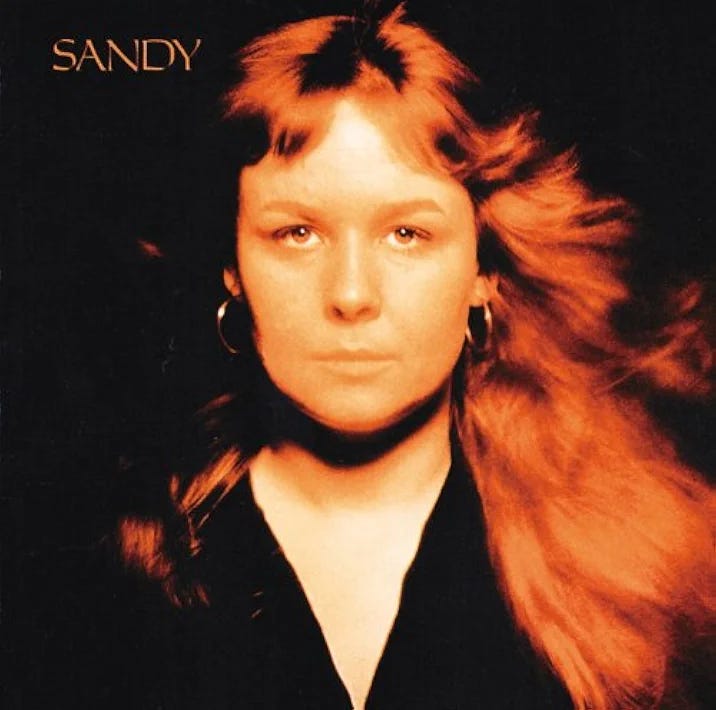
Her equilibrium didn’t last. Lucas took over as producer for her next record, Sandy, in 1972. An often-sublime collection, her label, Island Records, had high hopes for it, even going so far as to have David Bailey shoot her portrait for the cover, but it tanked.
Her relationship with Lucas, always on a knife-edge, got more fractious, more damaging. Nevertheless, they were married on 20th September 1973 at Fulham Registry Office. Appalled, her father refused to attend.
“Sandy was insecure about her looks, her appearance sometimes,” said Thompson. “I thought she was pretty, and a lot of men loved and chased her, but they weren’t the ones she wanted. She wanted the unobtainable ones.”
Once again with Lucas producing, she tried for a kind of sepia-tinted whimsy with 1974’s Like an Old Fashioned Waltz. Featuring two of her loveliest songs, ‘Echo’ and ‘Friends’, the latter inspired by an unconsummated liaison with Pete Townshend, it flopped.
She moved with Lucas out of London and into an old country cottage, The Twistle, in the Northamptonshire village of Byfield. At a low ebb, she accepted an offer to rejoin Fairport. Island paired them with Zeppelin/Rolling Stones producer Glyn Johns to make Rising for the Moon. An unyielding taskmaster, Johns got the best out of her, but the record peaked at a lowly 143 in the US. The tour they undertook for it was gruelling.
“Everybody could see that she wasn’t happy in herself,” said Dave Pegg, who’d taken over on bass from Ashley Hutchings. “There were nights she’d play bum notes on the piano. I remember one occasion, somewhere in America, she came off almost in tears.”
“I had a really bad feeling that a tragic outcome was on the cards.” - Richard Thompson
AFTER THE TOUR, SANDY bailed on Fairport again, and with her finances in a parlous state. Holed up at The Twistle, her drinking escalated, her mood often as not black. She made yet one more record with Lucas, Rendezvous. Her voice showed signs of the strain she was under, most especially on the cover of Elton John’s ‘Candle in the Wind’ she was coerced into by Island, but she was capable still of such a moment of wonder as the haunting closing track, ‘No More Sad Refrains’. The album sank without trace and Island let her go.
At the turn of ’77, Sandy found out she was pregnant. Her daughter, Georgia Rose Maclean, arrived on 12th July, three months premature. Motherhood didn’t settle her.
“When Georgia came along we all thought it was going to be great for her, and would make her happy, but it didn’t,” said Pegg, her neighbour down the road in Cropredy. “She and Trevor were having serious problems and that caused her an awful lot of grief. She’d be driving around Cropredy on pub crawls. Often, her car would end up in a ditch, and we’d have to get someone to come and fish it out for her.”
“Sandy was a mess,” appraised Richard Thompson. “I had a really bad feeling that a tragic outcome was on the cards.”
That November, Sandy managed one last tour of the UK. Attendances were erratic, so too her performances. The following March, she took Georgia to visit her parents at their holiday cottage in Mullion, Cornwall. One afternoon there, coming downstairs, she stumbled and fell, hitting her head on the flagstone floor. Afterwards, she told friends her mother had refused to take her to hospital, embarrassed to be seen in public with her wayward daughter.
Back in Byfield, Sandy began to suffer debilitating headaches. Her GP prescribed her a painkiller, Distalgesic, potentially fatal when mixed with alcohol. Whatever occurred during those next dark, desperate days, it was enough to convince Lucas to take Georgia away from her, the two of them flying to Melbourne on a one-way ticket. That same evening, Friday 14th April, distraught, Sandy called a friend, Miranda Ward, who came to pick her up and drove her back to London.
They spent the weekend together at Ward’s flat. On the Monday morning, Ward left for work at the Wandsworth school where she taught. She’d asked another friend, Jon Cole, a fellow musician, to look in on Sandy. Cole arrived to find her unconscious at the foot of the stairs, slumped across the toilet door. He called for an ambulance, and she was rushed to Queen Mary’s Hospital in Roehampton, in a coma. She was transferred from there to Atkinson Morley Hospital in Wimbledon, which specialised in brain injuries.
Her condition didn’t improve. She slipped away at 7:15pm on the evening of Friday 21st April 1978. She was 31. The subsequent coroner’s report recorded her death the result of a ‘traumatic mid-brain haemorrhage. Accidental.’
In the time since, Sandy Denny’s recorded works have been serially reissued and re-evaluated. The extent of her influence becoming ever more apparent, the appreciation of her talent grown so much greater. In life, she wasn’t able to climb out from the black pit she fell into. In death, her light is undimmed.
Ashley Hutchings last saw her on a summer’s day in 1977. A café bar in West London. The place was all bustle and chatter when he walked in off the street, but one voice stood out. There Sandy was, sat at a table with a bunch of other people Hutchings didn’t recognise, larger than life and, as so often she made herself, centre of attention.
“She’d been drinking, of course,” he told me. “And when she saw me, she said, ‘Oh, Ashley, come and kiss my hand.’ She held out a hand for me. I should have made a joke of it, she was just drunk, fair enough, but I walked away instead, rejected her. It’s haunted me ever since.
“No-one came near to Sandy. She was the best. She had that very special quality. When she sang a beautiful song, it broke your heart.”
No posts
Comments
Nothing yet. Say the first thing.
Sign in to join the conversation.