
Hey friend,
This week has been a wild one.
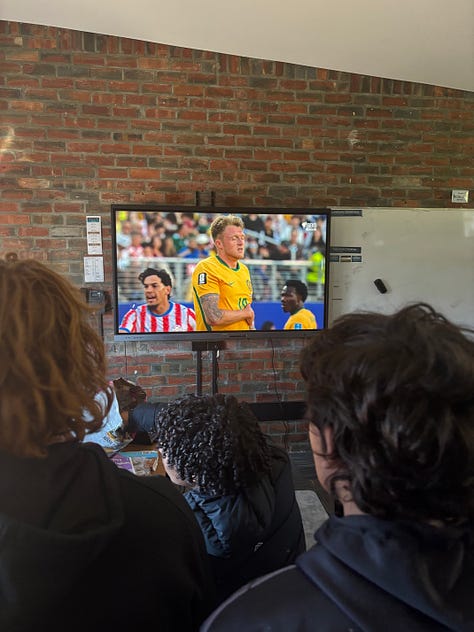
Australia played in the World Cup - we may even have caught the odd glimpse of the game during our lunch break. The whole school has football (yes - I’ve started calling it football…) fever. Due to my heritage, I’m also barracking for the Netherlands - they’ll probably do a bit better than Australia.
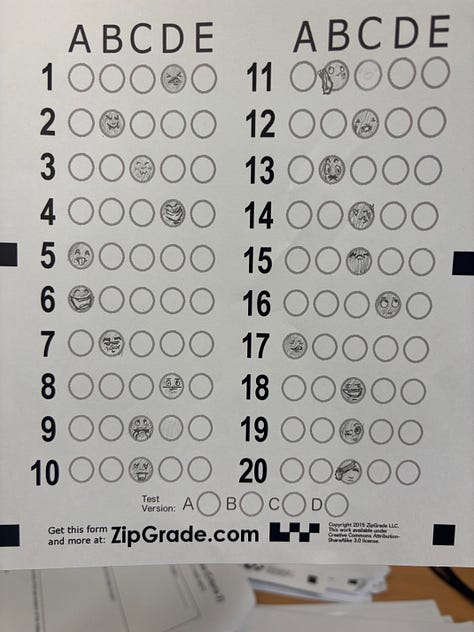
And, for the first time ever, I had a student draw an emoji on every single answer of her multiple choice quiz. Not too bad, considering she also got 100% correct!
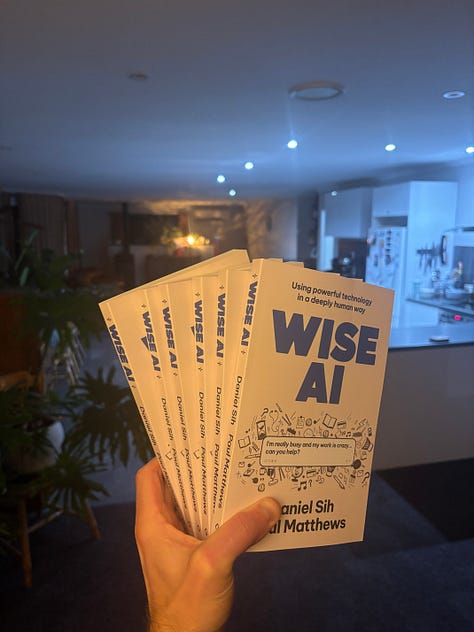
I also had the chance to ship out a bunch of copies of Wise AI - always so good to hear the books are being found useful within schools.
Now, let’s turn to the sunny topic of AI misuse.
Let me know what you think!
I’ve worked with more than 20 schools in the last year, and AI misuse has come up in every single conversation.
Every. Single. One.
When teachers survey their curriculum, they tend to see the same thing from one faculty to the next: tasks that once took a fortnight now take a fraction of the time, with a fraction of the learning. The essay still arrives on time and in good order but the thinking that was meant to happen on the way could well be missing in action.
I often read that the proper response is to redesign the task or revolutionise the system.
What if the future came in reimagining education?
Not the task and not the tool, but the thing a student actually sees when they look at their education. Because two students can sit in the same lesson, with the same laptop open in front of them, facing the same assessment, and genuinely see two different things. One student has a completion goal and sees only work to be completed. The other student has a formation goal, has personal formation as the purpose of education.
A student with a formation goal doesn’t misuse AI because it just doesn’t make sense. Misusing AI can produce the work, but it cannot produce the person.
My hope for my students isn’t that they find AI misuse impossible. It’s that they find it illogical.
A quick word: This is an essay about AI misuse. Not all student use of AI is misuse, and I’ve seen genuinely formative, beneficial uses of it that I’d happily hold up as models. But misuse is a phenomenon large enough to deserve its own focused treatment, so that’s where I’m pointing today.
Let me describe the first student properly, because I think we underestimate how reasonable his position feels from the inside.
For a student with a completion goal, the goal of school is to do the work.
In fairness, there is a strong tidal pull toward exactly this view. If we don’t deliberately articulate something higher and nobler, this is precisely where students drift.
There have always been students with a completion goal - perhaps it’s been the dominant paradigm in our schools - but in an AI world a completion goal is educationally lethal. Here’s why:
The minimum sufficient dose of intellectual investment has dropped to near zero. A prompt or two, a generic tool or a specialised one, and the task that was meant to occupy a week is finished in under a minute.
AI is the clear, logical, obvious answer to one particular question: how do I most effectively complete this task? If that is the question a student is asking, then AI is not the wrong answer. It is the right one, and any instructions from the teacher to the contrary are just a hurdle to be cleared.
The student forces the artefact and forfeits the formation, and from inside a completion goal, this looks like a bargain.
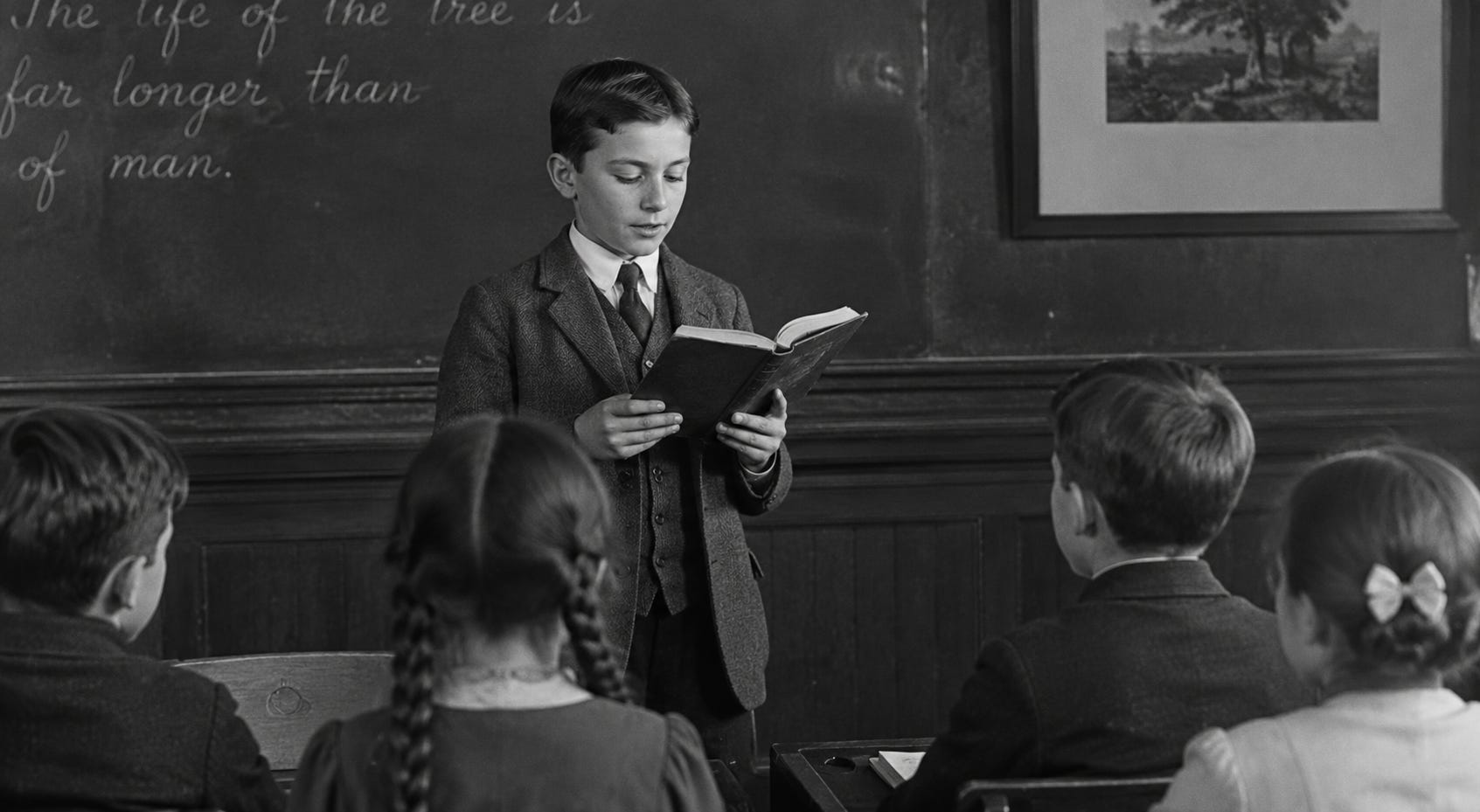
My students often default to thinking about school as just packing facts into their heads or preparing for work, I tell them this:
Education isn’t about information or occupation. It’s about transformation.
What I want them to recognise is that they themselves are what’s being produced. “Will this be on the test?” and “Is this actually assessed?” stop functioning as the load-bearing questions of their education, because the test or the assessment was never the point of the thing in the first place.
James K.A. Smith puts it better than I can. He writes that education is
“not primarily a heady project concerned with providing information; rather, education is most fundamentally a matter of formation, a task of shaping and creating a certain kind of people.”
A student who actually believes that inhabits a different world from the one his classmate inhabits; the student with a formation goal sees AI misuse as illogical. There’s nothing to be gained by handing the formation of yourself over to a machine.
And that is the whole point of what I’m arguing. My goal is not to make AI misuse difficult for my students. My goal is to make it illogical.
A common response to AI misuse is to consider redesigning our tasks. We might choose to move to a handwritten essay under exam conditions, a reflective journal, a spoken presentation, an ever more creative set of ways to force the work to happen somewhere AI can’t reach.
There is real value in protecting the conditions under which genuine learning can happen, and I’ll write more about how to do that well in a future piece.
But on its own, redesign is a bandaid.
The heart of the matter is the heart of the matter.
AI misuse is not fundamentally a design problem; it is a desire problem.
Redesign operates on what a student can do, building higher and cleverer walls around the task. Formation operates on what a student wants, and want sits a long way beneath anything design can reach.
If all we ever do is build higher walls, we inadvertently teach students that the wall is the only reason to do the work at all. Remove the wall, as we eventually must, and we’ve removed the reason along with it. The real work happens lower down, at the level of desire and affection, and that is the work I’ll come back to.
This is where I get the most pushback, and it usually takes the same form:
How can we possibly expect students to grasp something this lofty? Are they even developmentally capable of it?
My answer is a resounding yes. Absolutely.
In fact, I’d argue that they already think this way with great fluency. They simply do it in other domains.
Think about the gym. A student knows perfectly well that paying a mate to lift their weights only grows their mate’s arms, because the point was never the weight that got moved. The point was the body being built, and that can’t be outsourced.
Take sport, where no one bribes a teammate to go to football training on their behalf. They intuitively understand that training isn’t about getting a tick on the attendance sheet, it is about getting better. And this cannot be outsourced.
Or take music, where no matter how much little Johnny wishes it were otherwise, he understands that he can’t get his mum to do his piano practice and somehow emerge able to play. Again, that’s just not how that works.
Children already see the world through a formation lens, and they do it instinctively. We don’t need to install it in them.
We just need to help them turn it to face their education.
Next week we’ll get really practical. We’ll think about how exactly we instill this formation goal. But for now, it’s worth simply articulating this as our foundational principle.
Two students, the same lesson, the same laptop, the same task waiting to be done.
One sees work to be completed and reaches, quite reasonably, for the fastest way to complete it.
The other sees something the first has missed entirely: that the work was never the point, and that the person doing it is the thing actually being made.
Though the students are similar, they inhabit vastly different intellectual worlds.
For the first student, AI misuse is the logical answer to the question he's asking. For the second, AI misuse is illogical, because the goal of education is not to produce work, but to produce a person.
And that’s the difference we need to start with.
No posts
Comments
Nothing yet. Say the first thing.
Sign in to join the conversation.