
“WHY WOULD YOU WRITE A BOOK ON AI?? It will be out of date the moment it is printed!”
You’d be surprised how often I hear this when I talk about Wise AI.
But here’s the thing:
The tools have progressed, but I haven’t really updated my advice.
Not because I’m stubborn (or lazy). Because almost nothing that makes AI use good or bad has to do with the tool itself. Swap Copilot for Claude, swap Claude for whatever hits our browsers in October, the same principles get you good results regardless of the tool.
Think of it as grammar. English has changed enormously in four hundred years, and nowadays our vocabulary changes again every time a new video goes viral (I sound like an old grouch, don’t I?). But grammar is what holds a sentence together, and it holds together in Chaucer and in a text message. Grammar is what lets meaning survive the change.
That’s what these eight ideas are. Not tips or hacks. They are the basic grammar of AI.
Here they are.
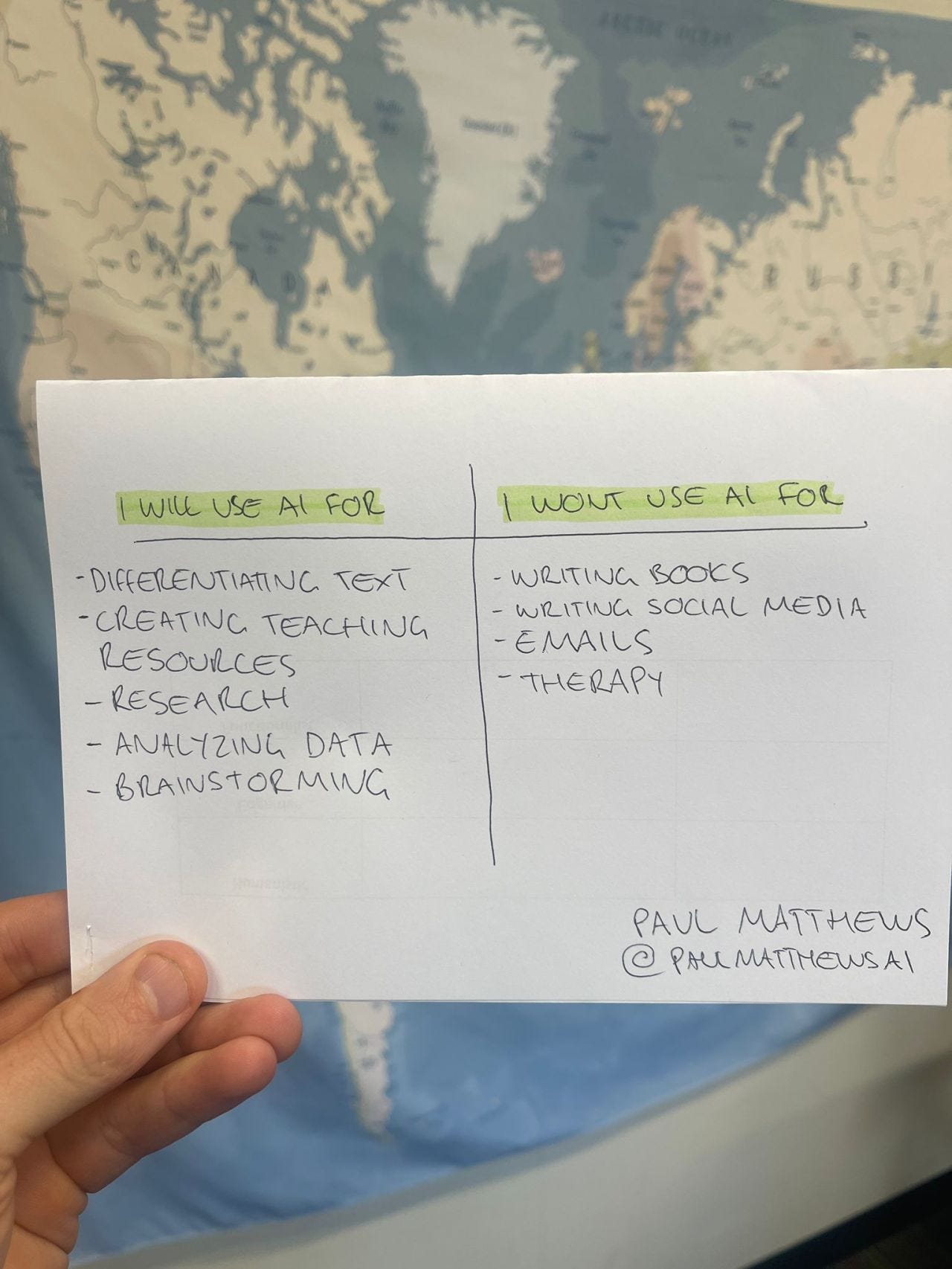
Part of using AI wisely is deciding where you will and won’t use it.
This is more important than it seems because we don’t often make good decisions in a time crunch with a looming deadline.
Decide now, in the cold light of day, where you will use AI and where you will leave it alone.
Below is an example of an exercise I often run in my AI training. It’s a simple 2-column table that helps us be clear about our moral, ethical, and practical boundaries.
Why not give it a go?
(Post it and tag me if you do!)
One of the big ideas in Wise AI is that AI will save you time but it won’t give you space.
Those are two different things, and the research is already grim on this point: a study of 164,000 workers found AI users spent more time on email and reactive tasks, and their deep focus time actually dropped. If not used wisely, AI actually makes our work busier - not the result we’d hope for from a “time-saving” technology.
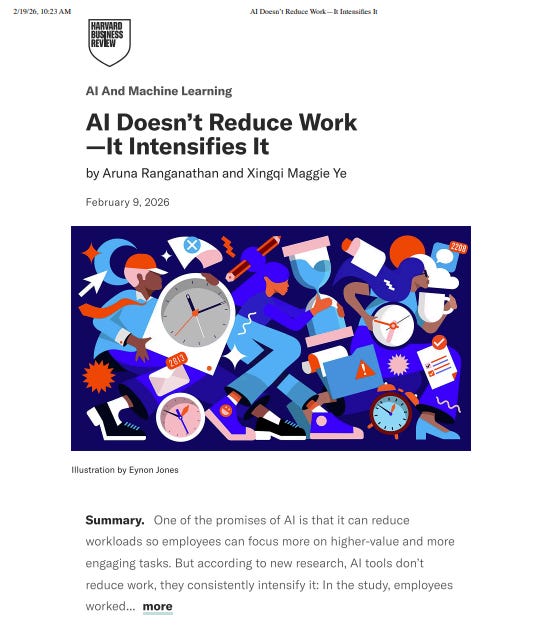
Without a clear answer to “what is this time for”, the saved time just gets eaten by more busy work, and you end up busier and no more rested than when you started.
In the book we suggest that saved time can be deployed in three different directions:
Deep work
Deep thought
Deep rest and relationships
All are great improvements over simply cranking up the busywork treadmill.
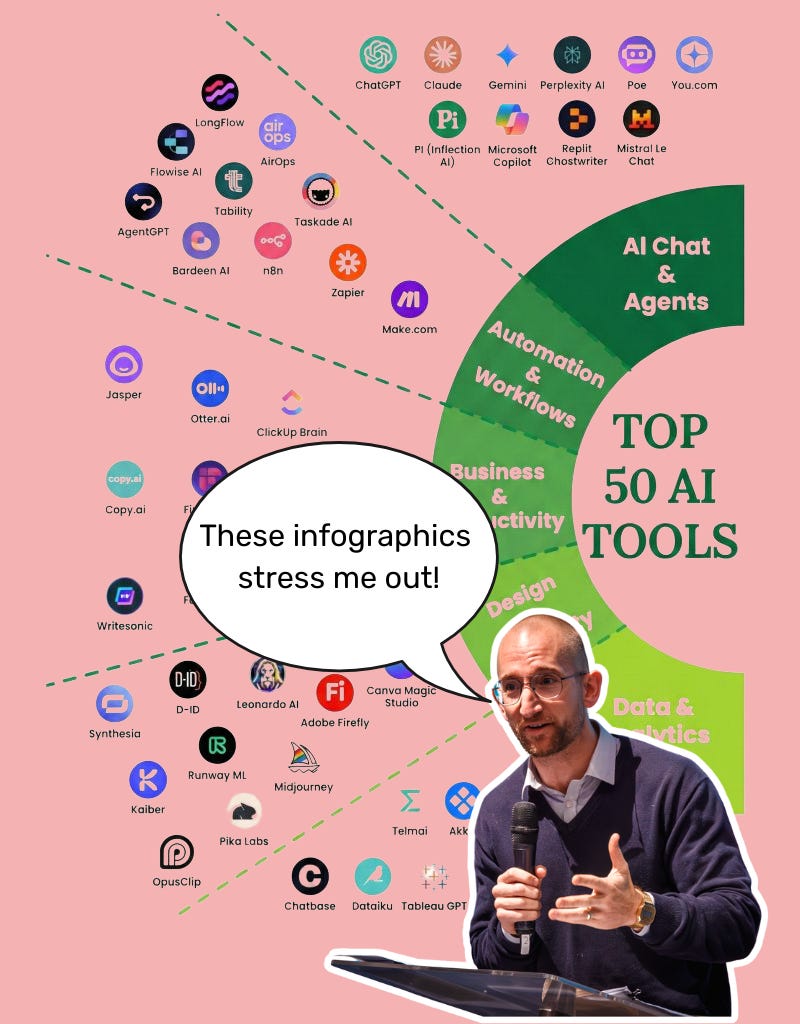
You’ve seen the posts: “Fifty AI tools that will change your life.”
They stress me out.
There are long lists of niche tools that often do little more than leave you with a thousand different logins and an ever-lingering sense of FOMO.
But here’s what I tell the teachers I work with: fluency in one tool beats a browser full of tabs you’ve only opened once. Going deep with a tool allows you to see limitations in the tool, figure out how to adapt and work around them, and understand the underlying processes at work within AI.
Learn one properly and you’ll transfer 90% of that skill to the next one anyway.
(For what it’s worth, I’m a Claude guy)
I often get the same critique of AI during my training:
"AI just gives bland, boring output!"
Here’s the harsh truth - bad output is the result of bad input. As the data scientists say, “Garbage in, garbage out”
Give it a Role, a Task, and a Format, and you’ve solved most of it before you start.
Consider this prompt for text differentiation:
Role: Act as an expert [YEAR LEVEL] [SUBJECT] teacher.Task: Rewrite the text below at a [TARGET GRADE] reading level. Use simpler words, shorter sentences, and literal language in place of idioms. Keep all key facts, ideas, and headings. Do not add new content. Keep essential subject terms, but add a short definition in brackets the first time each appears.
Format: Clear, well-spaced paragraphs in the same order as the original. At the end, if needed, add a short “Notes for the teacher” line flagging anything you found hard to simplify.
You can see how this is likely to yield far better results than simply “simply this text for me”.
And once you’ve put some time into writing a clear prompt, there’s no limit to the amount of use you’ll get out of it.
AI is an amazing tool but it’s not a “guess-what’s-in-my-head” machine.
I write prompts for a living and I rarely get what I want first try. That’s because there’s a lifetime of nuance, experience, and preference that lives in my head that isn’t fully expressed within my prompts.
This isn’t cause for frustration or nihilism (“what’s the point of using AI if it never gets it right!”), but it means we will likely have to tighten up the output through conversation.
It’s a chatbot - don’t be afraid to chat with it.
Every iteration brings you one step closer to having a resource that is matched to your culture, context, learners, and curriculum.
Part of caring for our students in this age is caring for their data.
I watched a manager at a conference explain, quite proudly, how he’d uploaded his staff files to write personalised Christmas messages. Full names, dates of birth, addresses, medical notes, performance reviews. Great intentions, terrible method.
The simple rule: never paste anything into an AI tool you wouldn’t be comfortable reading aloud in a staff meeting, because once the data toothpaste is out of the tube you don’t get to decide where it goes.
The cardinal sin within education is that excellence exists in silos.
I still remember running a workshop for a group of Science teachers at an Australian school. One of the teachers piped up and discussed how they’d been using AI to create interactive knowledge organisers and upload them to the Learning Management System.
While her colleagues were amazed (and a little jealous!), the teacher had no idea that what she was doing was special or could be beneficial to others.
So here’s my encouragement to any teacher trying this out with AI:
Share the prompt. Share the workflow. Share the thing that took you four hours to get right.
We’re all on the same mission, and this is a great opportunity to learn with and from each other.
Let’s talk about an undeniable truth:
Our tech shapes us.
When I use AI a lot I can become impatient and easily frustrated.
It’s almost as if the amazing power of AI is subtly training me to expect everything to be instant and easy. And then, when the printer doesn’t work, or a lesson isn’t coming together, or I’m sitting down to do my marking, I get frustrated if it’s not quick and easy.
This is why we always ask two questions when we use any tool:
What is it doing for me?
What is it doing to me?
If we forget the latter question we’re going to find ourselves shaped in ways we aren’t comfortable with. We’ve seen this with our phones. Let’s not repeat the same mistakes with AI.
So I put it to you that these eight habits are the basic grammar of AI. They are the basics that will remain true even as our tools change, grow, or are replaced.
Look again over these habits and notice what is missing:
Decide your no-go zones before you need them.
Know what the saved time is for.
Pick one tool. Go deep.
Give clear prompts.
Edit the output through the chat.
Keep the toothpaste in the tube.
Give away your best stuff.
Notice what it’s doing to you.
Not one of them requires a specific subscription. Not one of them depends on a model release, a feature update, or a system prompt. Every single one is a decision about you.
And that’s why they are such powerful habits.
The technology is going to keep getting better, and better technology without wise habits is simply going to leave us more tired, wired, and frustrated.
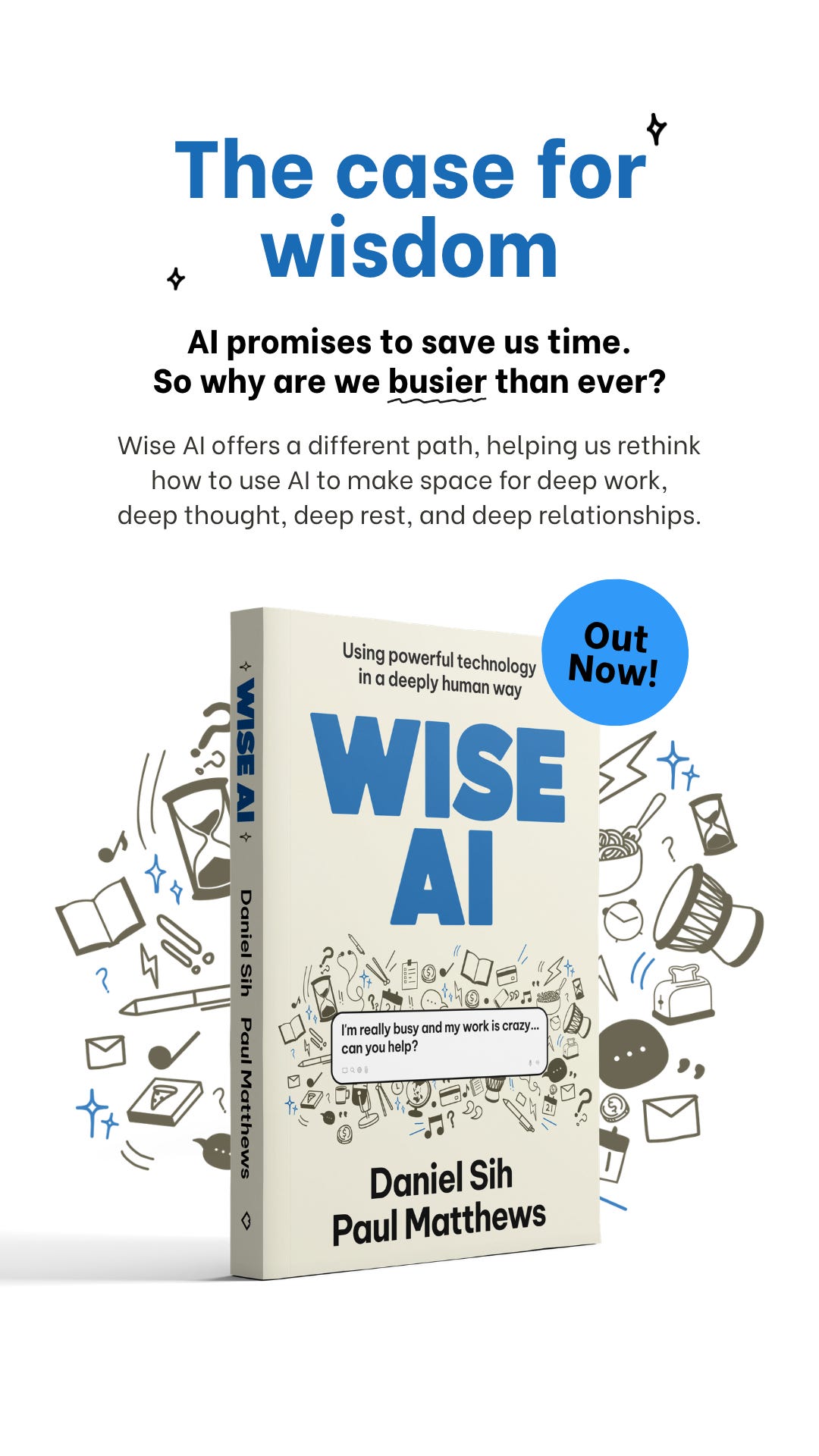
If you want to explore wise use of AI further, Wise AI is a great place to start.
And if you’re exploring assessment in an AI world, I’ve linked my upcoming PD below. There’s a timezone to suit everyone and I know you’ll find it an hour well spent!
So tell me this - is there another habit you would add to this list?
Let me know!
No posts
Comments
Nothing yet. Say the first thing.
Sign in to join the conversation.