
Note: Please read our disclaimer at the bottom of the article.
Hi, I’m Paul Mampilly, an American investor. 🇺🇲
Welcome to the Mampilly Research Substack — where we go against the grain to uncover emerging bull markets and early opportunities long before they become obvious.
Each Wednesday, I share how we’re positioning ahead of major market shifts to uncover big potential gains.
Substack 🥞 subscribers: 6.3K
Wall Street obsesses over earnings “beats” and “misses” — but they’re not telling investors what really matters.
Plus, your chance to ask Paul your questions live is coming this September, exclusively for Crown members.
How to look beyond Wall Street’s scorecard.
Every three months, Wall Street puts on one of its biggest shows.
A company reports earnings that beats estimates by a few pennies, and the stock jumps 10%.
Another company delivers what looks like a perfectly good quarter, but guidance comes in slightly below expectations and the stock gets crushed.
Within minutes, you’ll hear people explaining what it all supposedly means.
Great company. Terrible quarter. Strong fundamentals. Weak outlook.
And investors react accordingly.
But after watching this cycle play out for decades, including during my time on Wall Street, I’ve come to a very different conclusion:
Much of what investors call “earnings season” has very little to do with fundamental investing.
It’s a game.
And it’s one that Wall Street has become very good at getting everyone else to play.
As Q2 earnings season winds down, think about how much attention has been devoted to asking whether the company beat or missed Wall Street’s estimate.
That question has become so ingrained in investing that most people never stop to think about how strange it actually is.
A group of analysts creates an estimate. Traders spend weeks positioning around that estimate. The company reports its numbers.
Then billions of dollars can move because the result came in slightly above or below a number Wall Street created in the first place.
To me, that’s not fundamental investing.
That’s event trading.
And Wall Street loves events because events create volatility, which in turn creates trading.
And that trading creates opportunities to make money from spreads, fees, options, and rapid movements in stock prices.
There are entire hedge fund strategies built around this quarterly ritual.
That’s one reason you’ll often see a stock begin moving well before a company ever reports.
Funds can spend the two or three weeks leading up to earnings positioning themselves for the event.
Then the numbers come out, the stock reacts and, over the following week or two, those trades begin to unwind.
So when we see a stock suddenly surge or collapse around earnings, I like to ask whether the value of this business really changed that much overnight.
Sometimes it did.
But often, I believe what you’re seeing has as much to do with positioning, expectations, and the unwinding of trades as it does with the long-term value of the company.
That distinction matters because one of the biggest mistakes I see investors make is assuming a company that consistently beats estimates must be a great investment.
It sounds logical, but businesses don’t operate in 90-day increments just because Wall Street does.
Management teams know how important these quarterly expectations have become.
They know what can happen to their stock if they disappoint Wall Street, and they know what can happen when they deliver the numbers investors want to see.
That creates an obvious incentive to manage expectations and make decisions that look good over the next quarter.
The problem is, what makes Wall Street happy for the next 90 days isn’t always what creates the most value over the next five or more years.
I’d much rather own a company willing to invest aggressively in a massive opportunity — even if those investments temporarily hurt margins — than one sacrificing its long-term future just to beat an analyst’s estimate by three cents.
That’s why I’m asking different questions.
I want to know where the business is going.
Is its market getting bigger? Is demand likely to be substantially higher several years from now?
Does the company have an advantage competitors will struggle to replicate?
Is management investing ahead of a trend that Wall Street doesn’t fully recognize yet?
Those are fundamental questions.
Whether earnings per share came in at $1.04 instead of the expected $1.01 tells me far less.
And this is where the earnings game can actually create opportunities for us.
Some companies refuse — or simply fail — to give Wall Street exactly what it wants every 90 days.
Maybe they’re spending heavily to expand capacity or margins temporarily fall.
Perhaps they miss an estimate. Maybe their stock goes nowhere while investors chase whichever company just delivered the quarter’s biggest surprise.
Eventually, investors lose patience. The stock gets written off as a “dog,” a “bag” or simply not worth their time.
And that’s often when I become more interested because a stock Wall Street doesn’t want today isn’t necessarily a bad business.
Sometimes Wall Street is simply using the wrong timeframe.
And if I believe the business is becoming substantially more valuable while investors are focused on whether it beat an estimate this quarter, that disconnect can create exactly the kind of opportunity I’m looking for.
Now, I’m not telling you to ignore earnings reports.
There’s valuable information in them. I want to see revenue, margins, cash flow, demand, and what management is telling us about the business.
What I don’t care nearly as much about is the scoreboard Wall Street puts around those numbers.
As Q2 earnings season comes to an end, you’re going to hear plenty about which companies “won” and which ones “lost.”
Let Wall Street obsess over that.
They’re trying to figure out who won the last 90 days. I’m trying to figure out who can win the next few years.
That difference in timeframe is one of the biggest advantages I believe individual investors can have.
And right now, my team and I are looking for those kinds of opportunities across the Mampilly Research portfolios.
If you want to see where we’re putting our money — and which opportunities we believe Wall Street may be looking at the wrong way — take a look at what we’re buying now by clicking below.
Find the Opportunities Others Miss 💎
One of our biggest live events returns next month.
What would you ask Paul if you had him live?
Start thinking about it.
Because at the end of September, Paul’s going live for one of the events we hold only about three times a year:
The Crown Tier Market Analysis Webinar. 👑

This is one of the few occasions when Crown tier members don’t just get Paul’s latest research . . .
They get to interact with Paul directly. Live.
Paul will share his latest take on the market, what he’s watching most closely, and where he believes investors should be paying attention next.
Then, we open the floor to you.
Have a question about the market? A trend you’re watching?
Something Paul has been talking about that you want him to dig into?
Ask him live and hear his answer on the spot.
We’ll also be announcing the key topic Paul is preparing for this quarter’s event soon — so stay tuned.
The Crown Market Analysis Webinar goes live at the end of September (date and time to be announced soon), and access is exclusively for Crown Tier members.
So, if you want the chance to be there, hear Paul’s latest thinking, and put your own question in front of him, make sure you’re inside Crown before we go live. 👇
Join Crown Tier & Be There Live 💻
We look forward to connecting with you live and hearing what’s on your mind!
Some have joined for this new benefit alone.
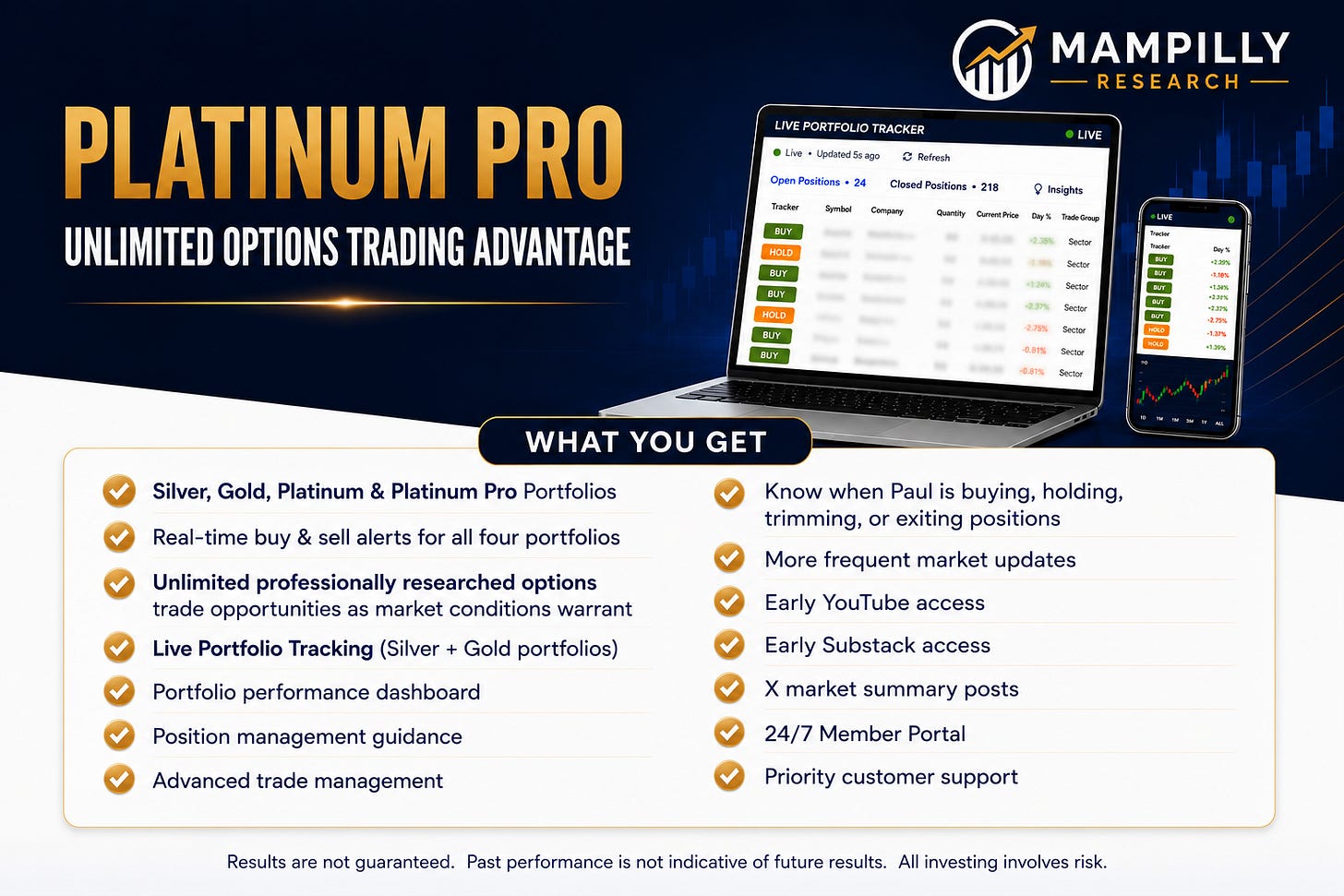
We recently launched a brand-new options trading membership level: Platinum Pro. ⚡
And it came directly from feedback from our members.
Some were looking for a more active, higher-level options strategy — one that could take advantage of opportunities more frequently as they appear.
So we built Platinum Pro.
Unlike Platinum Tier, which is limited to five new buy trades per month, Platinum Pro allows for an unlimited number of options trades.
That doesn’t mean we’re trading just for the sake of trading.
The opportunity still has to make sense — and so does the risk-to-reward setup.
We’re looking for trades we believe offer the best probability of a favorable result.
And when those opportunities present themselves, Platinum Pro gives us the flexibility to pursue those opportunities as often as they arise.
But options are only part of what makes Pro different.
Platinum Pro members now also get access to the Live Tracker for our Silver tier and Gold tier stock portfolios.
At any time, you can log in and see exactly where Paul currently stands on every open stock position in those portfolios.
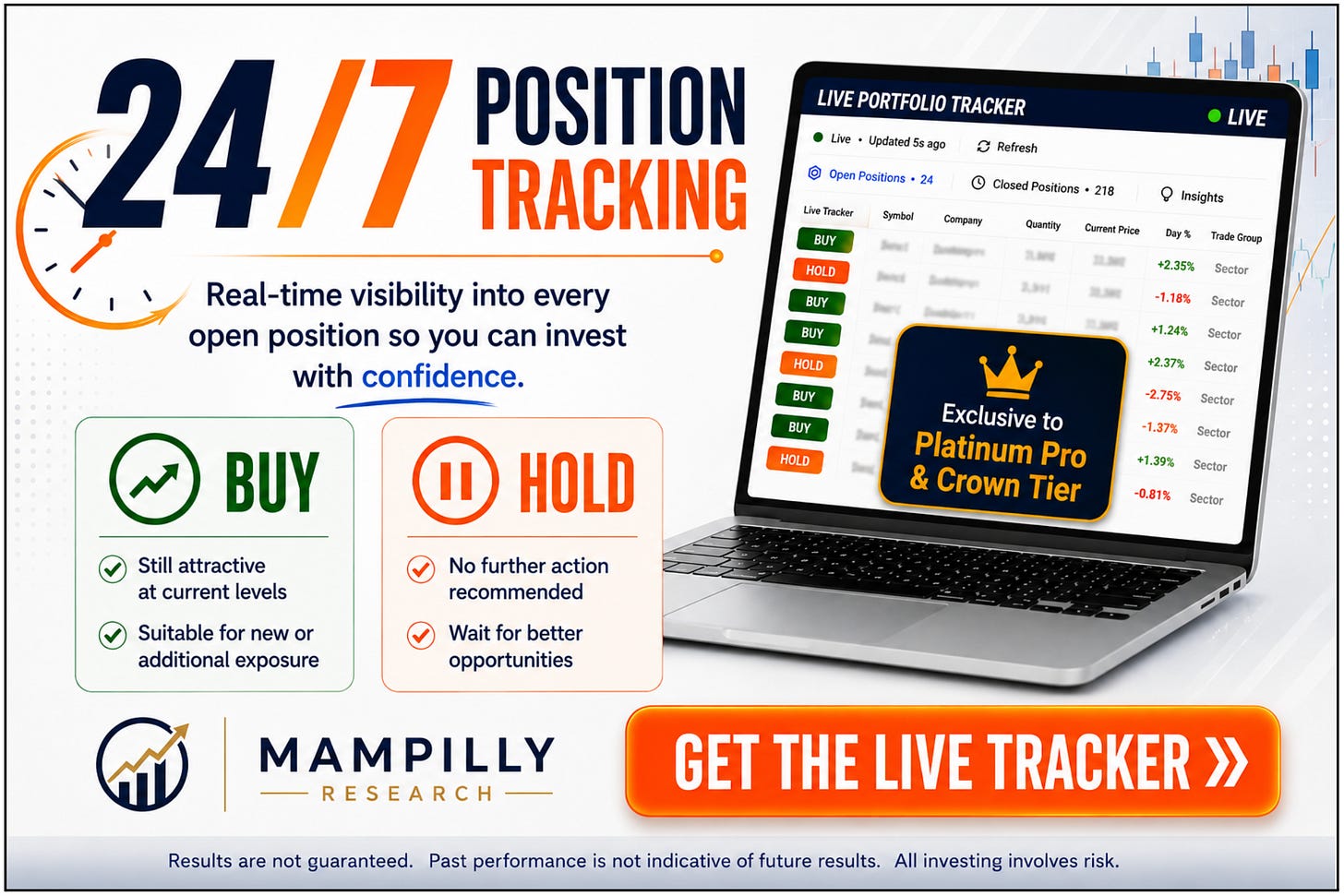
BUY means Paul currently believes the stock is attractive to buy at its current price.
HOLD means Paul believes existing shareholders should continue holding the position, but he would not recommend buying it at its current price.
So when markets move quickly, you don’t have to wonder whether Paul’s view has changed.
Open the Live Tracker in your member platform and you can see where he stands at a glance anytime:
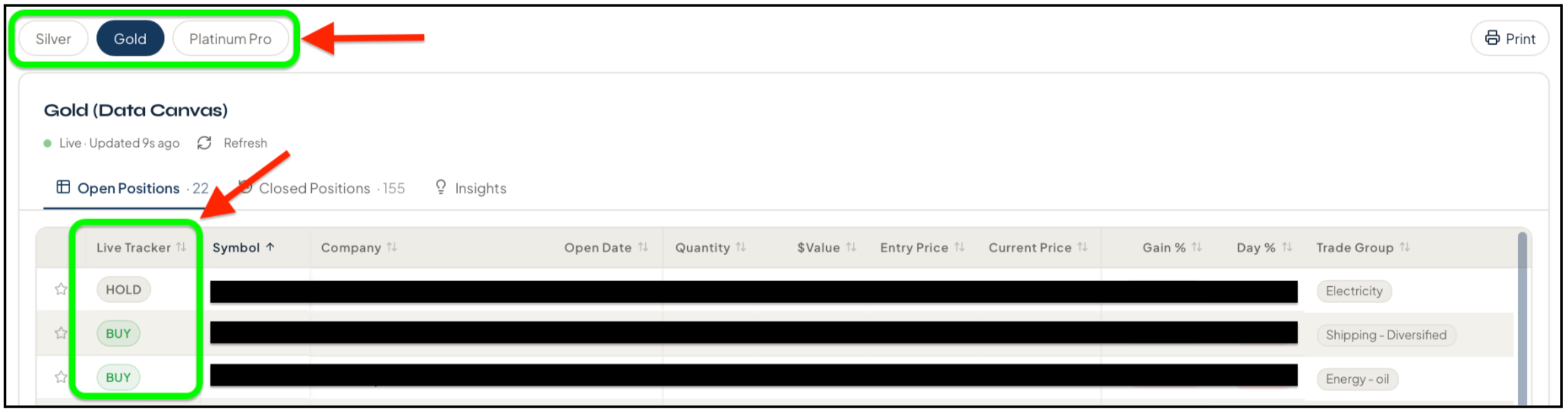
In fact, some members have told us they joined Platinum Pro for access to the Live Tracker alone.
That’s how valuable this added clarity can be.
Platinum Pro includes Live Tracker access for Silver and Gold Tier stocks.
Crown Tier members receive Live Tracker access across Silver, Gold, Diamond and Crown Select stock portfolios.
And we’re not finished.
Another exciting Platinum Pro feature is already in the works. 👀
We can’t share the details quite yet, but we’re excited about what’s coming next.
If you’ve been looking for more active options opportunities, Platinum Pro gives us the flexibility to act when the right setups emerge.
Plus, you get the clarity of knowing where Paul stands on Silver tier and Gold tier stock positions 24/7 — with even more on the way.
Click below to unlock access today. 👇
These signals are pointing to something bigger.
Something happened in the markets last week that caught Paul’s attention.
Not one move — but three.
And when Paul started looking into what was happening beneath the surface, he found something he believes investors should be paying attention to.
We won’t spoil it here.
Click below to watch Paul’s latest video to see how he’s connecting the dots and what he’s watching next. 👇
And while you’re there, give the video a like and tell us what you think in the comments.
We’d love to hear what you’re seeing in the markets too.
And make sure you’re subscribed to the channel with notifications turned on so you don’t miss Paul’s next market update.
Subscribe to Paul’s YouTube Channel 🔔
There’s never a shortage of headlines telling investors what to worry about.
The harder part is knowing what actually matters — and what to do about it.
Inside Mampilly Research, we cut through the daily noise to identify where risks are growing, where opportunities are emerging, and what it means for your portfolio.
Then we turn that research into clear guidance and actionable ideas to help you navigate what comes next.
If you’d like Paul’s research and perspective working alongside you, join us inside Mampilly Research. 👇
❤️ This Substack was made — by US, for YOU — with love. ❤️
Have questions or trouble accessing your account? Please reach out to us at info@mampillyresearch.com or schedule a call, and our Customer Support team will be happy to help.
You can also check our FAQ page on our website for an up-to-date list of questions and answers. Your question may have been addressed there.
*Please be advised that customer support calls are limited to 15 minutes and will strictly cover your membership subscription and billing needs only. Any calls that are disrespectful in nature may be subject to immediate termination.
This is OPINION only — not financial or investment advice. Treat it the same as content from your favorite author, YouTuber, or podcaster. We make mistakes despite our best efforts. Investing involves significant risk: You can lose money, there are no guarantees of profit, and past performance does not predict future results. Employees, contractors, and owners of Mampilly Research, operated by ATG Digital LLC, own, trade, and transact in the stocks, options, and crypto discussed in our alerts, updates, reports, and commentaries. We are not financial advisors and cannot provide personalized advice. Investment decisions — what, when, and how much to buy/sell — are your responsibility, based on your own financial situation, goals, and risk tolerance. Capital loss is possible. Carefully consider this risk and consult a qualified financial advisor before trading, speculating, or investing. It’s your money and your responsibility.
Comments
Nothing yet. Say the first thing.
Sign in to join the conversation.