
Note: Please read our disclaimer at the bottom of the article.
Hi, I’m Paul Mampilly, an American investor. 🇺🇲
Welcome to the Mampilly Research Substack — where we go against the grain to uncover emerging bull markets and early opportunities long before they become obvious.
Each Wednesday, I share how we’re positioning ahead of major market shifts to uncover potential gains.
Substack 🥞 subscribers: 6.3K
The biggest risk in today’s market may not be AI, interest rates, or the economy — it may be hiding inside portfolios that investors consider perfectly safe.
Meanwhile, Mampilly Research members recently had the chance to secure dozens of gains in just seven days as Paul moved decisively to lock in profits before conditions changed.
A contrarian look at where the biggest risk is forming.
Every market cycle creates its own mythology — and eventually, millions of investors get trapped by it.
In the late 1990s, it was internet stocks, and in the mid-2000s, it was housing.
Today, it’s something far more subtle.
It’s a buyer.
One so large, consistent, and widely trusted that most investors don’t even recognize it as a risk.
And that’s exactly why I think it’s dangerous.
The buyer I’m referring to is the index fund.
More specifically, it's the trillions of dollars flowing into products like the SPDR S&P 500 ETF (SPY), the Invesco QQQ Trust (QQQ), and countless retirement plans that automatically allocate money into them every month.
To be clear, index investing was one of the greatest financial innovations of the last 50 years.
When it emerged, it was a smart alternative to expensive active management.
It gave everyday investors broad diversification, low fees, and market exposure that was previously difficult to achieve.
But that was then.
Today, I think we’re dealing with something very different.
We’ve created a system where trillions of dollars flow automatically into the largest companies on Earth regardless of valuation, fundamentals, or price.
Every day, billions of dollars enter index products.
The fund doesn’t ask whether a company trades at 10 times earnings or 100 times earnings.
It also doesn’t ask whether growth is accelerating or slowing, or whether expectations have become impossible to meet.
It simply buys . . . and then it buys again the next day.
That’s not investing.
That’s a mechanism with a flaw, and the result is something I believe many investors are underestimating.
We’ve reached a point where some of the most popular index portfolios in the U.S. — including SPY and QQQ —are more concentrated than they were during the peak of the dot-com bubble.
That’s not an opinion. That’s math.
Today, roughly 40% of many major index portfolios sit in a relatively small group of technology and semiconductor companies.
At the height of the 2000 technology bubble, that concentration was closer to 25%.
The trade that millions of people believe is diversified is actually becoming increasingly dependent on the fortunes of a shrinking number of companies.
That creates a risk most investors never consider because concentration and valuation are two entirely different problems.
People can argue endlessly about whether AI leaders deserve their current valuations, which is subjective.
But concentration isn’t as it’s measurable.
And today it’s extreme.
Then there’s the issue of leverage.
Margin debt has climbed to record levels, and leveraged exchange-traded fund (ETF) assets have exploded over the past several years.
Whenever markets become convinced that certain assets can only go higher, leverage follows.
It always does.
The important distinction is that this isn’t 2008 because back then, the threat was inside the banking system.
Highly leveraged financial institutions owned opaque assets that nobody truly understood, and when one major institution failed, the entire system was threatened.
Today’s risk is different as the banks are stronger, the financial plumbing is healthier, and the vulnerability has moved to retirement accounts, 401(k)s, IRAs, pension funds, and brokerage accounts across America.
That’s where the concentration and automatic buying live.
And if the technology and semiconductor trade eventually unwinds, the impact won’t be confined to a handful of hedge funds.
Rather, it will be felt by millions of investors who believe they’re simply “owning the market.”
I understand this view isn’t popular.
Most investors remain overwhelmingly optimistic and many remain convinced that AI will justify every valuation.
Maybe they’re right.
Markets are ultimately voting machines before they become weighing machines.
But when I look around, I find myself in the company of investors who have earned the right to be cautious.
People like Warren Buffett, Howard Marks, and Michael Burry.
Investors who understand that risk is often highest when everyone believes it’s lowest.
That doesn’t mean I’m predicting an immediate collapse or that I’m abandoning innovation.
And it certainly doesn’t mean I’m bearish on technology itself.
I believe investors should stop confusing popularity with safety because the biggest risk in this market may be the assumption that the same stocks can absorb endless amounts of money forever.
History suggests otherwise, and I think it’s usually worth listening to.
If you’d like to see where I’m finding opportunity outside the most crowded trades on Wall Street . . .
And the trends I believe could outperform while everyone else remains focused on the same handful of stocks — join me below.
That’s where I share the ideas I’m putting my own capital behind today.
Why we locked in profits while staying bullish on the bigger picture.
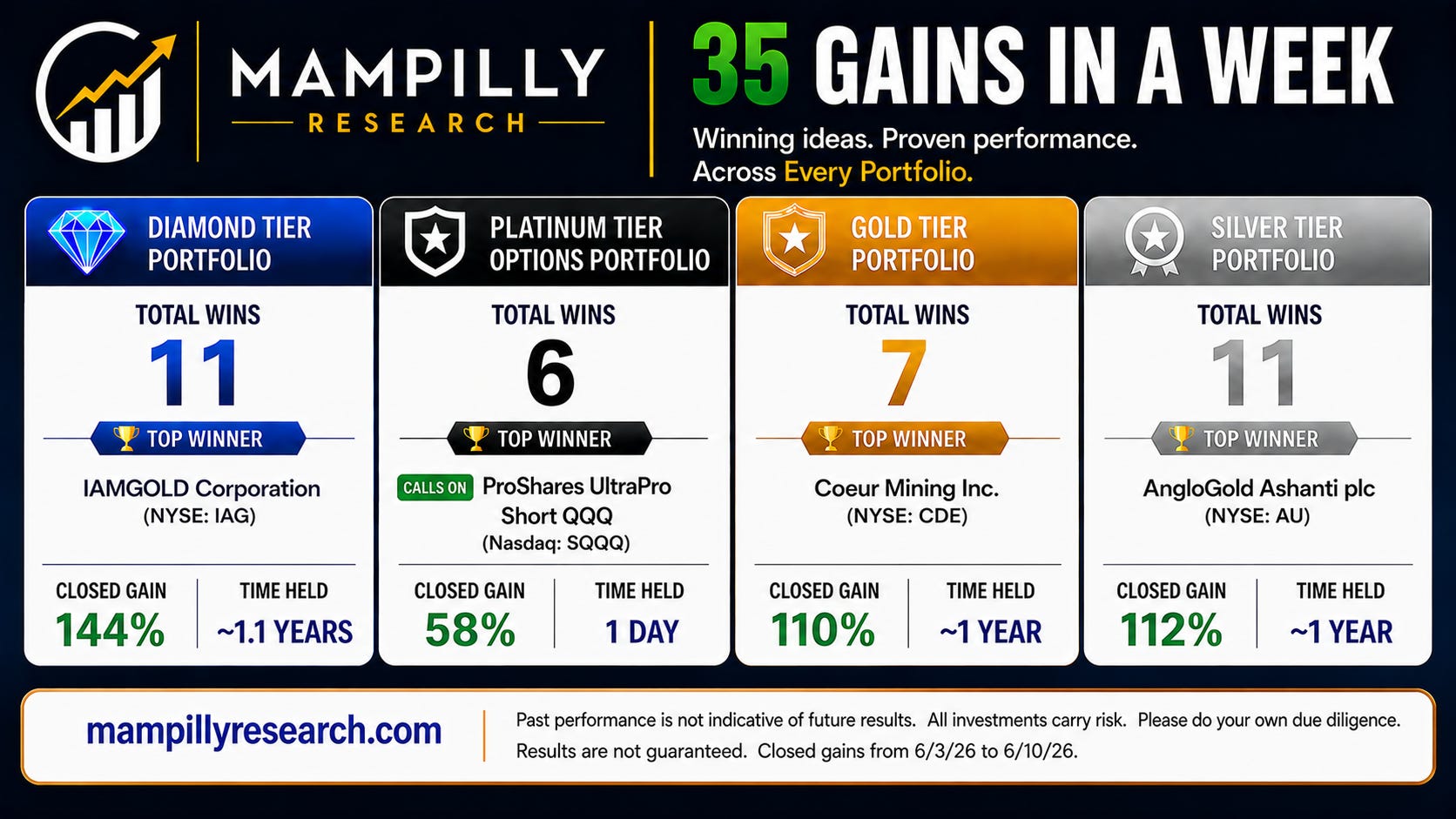
Over just seven days, Mampilly Research members received alerts that helped lock in profits across 35 winning positions.
Some gains reached as high as 144%, 112%, 110%, and 58% in a single day.
Here’s a look at some of the top wins:
These weren’t concentrated in a single portfolio.
The gains came from across our Diamond Tier, Platinum Tier, Gold Tier, and Silver Tier portfolios, reflecting opportunities captured across multiple strategies and market environments.
Successful investing isn’t just about finding great opportunities.
It’s also about recognizing when conditions change and protecting profits when the risk-reward equation shifts.
That’s exactly why many members were surprised to see a large number of sell alerts arrive at the same time.
A significant portion of the positions we recently exited were tied to two areas that have been among our biggest winners over the past year:
🏅Precious metals mining companies
🇯🇵 Japanese stocks
Paul’s long-term outlook on both themes remains positive.
The decision to sell wasn’t driven by a change in the fundamental story but by a change in the near-term environment.
As Paul recently explained in an exclusive Crown Tier update:
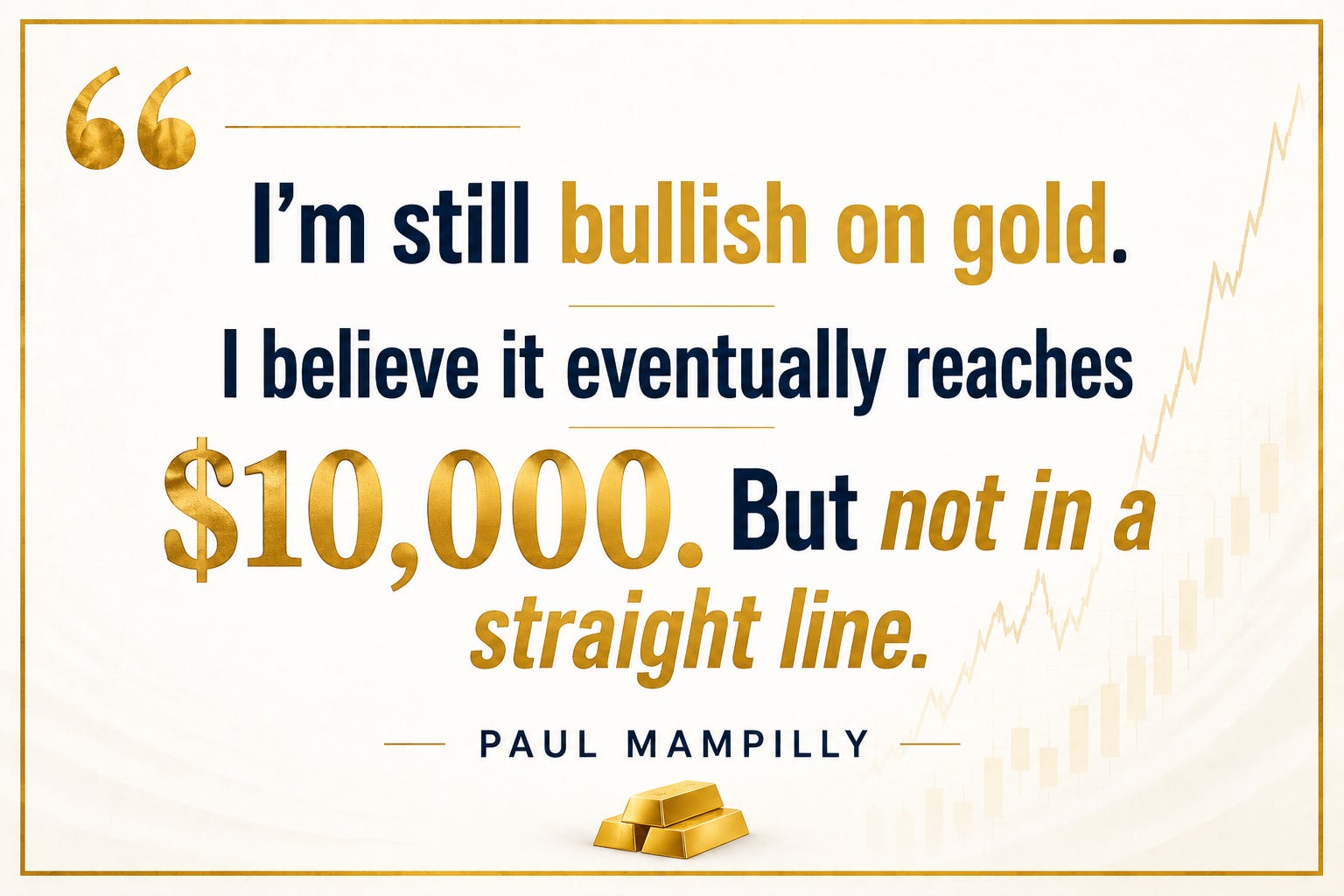
After the powerful run in gold and gold mining stocks throughout 2025, Paul believes rising interest rates could create a meaningful headwind for the sector over the coming months.
While he still expects gold and gold miners to move higher over the long run, he sees a growing risk that many investors could give back a significant portion of their gains while waiting for the next phase of the bull market.
The same logic applies to many Japanese stocks.
Following a strong multi-year advance, Paul believes rising Japanese interest rates and a strengthening yen could create temporary pressure on stock prices, even if the longer-term outlook for Japan remains attractive.
In both cases, the objective wasn’t to abandon these trends but to protect profits.
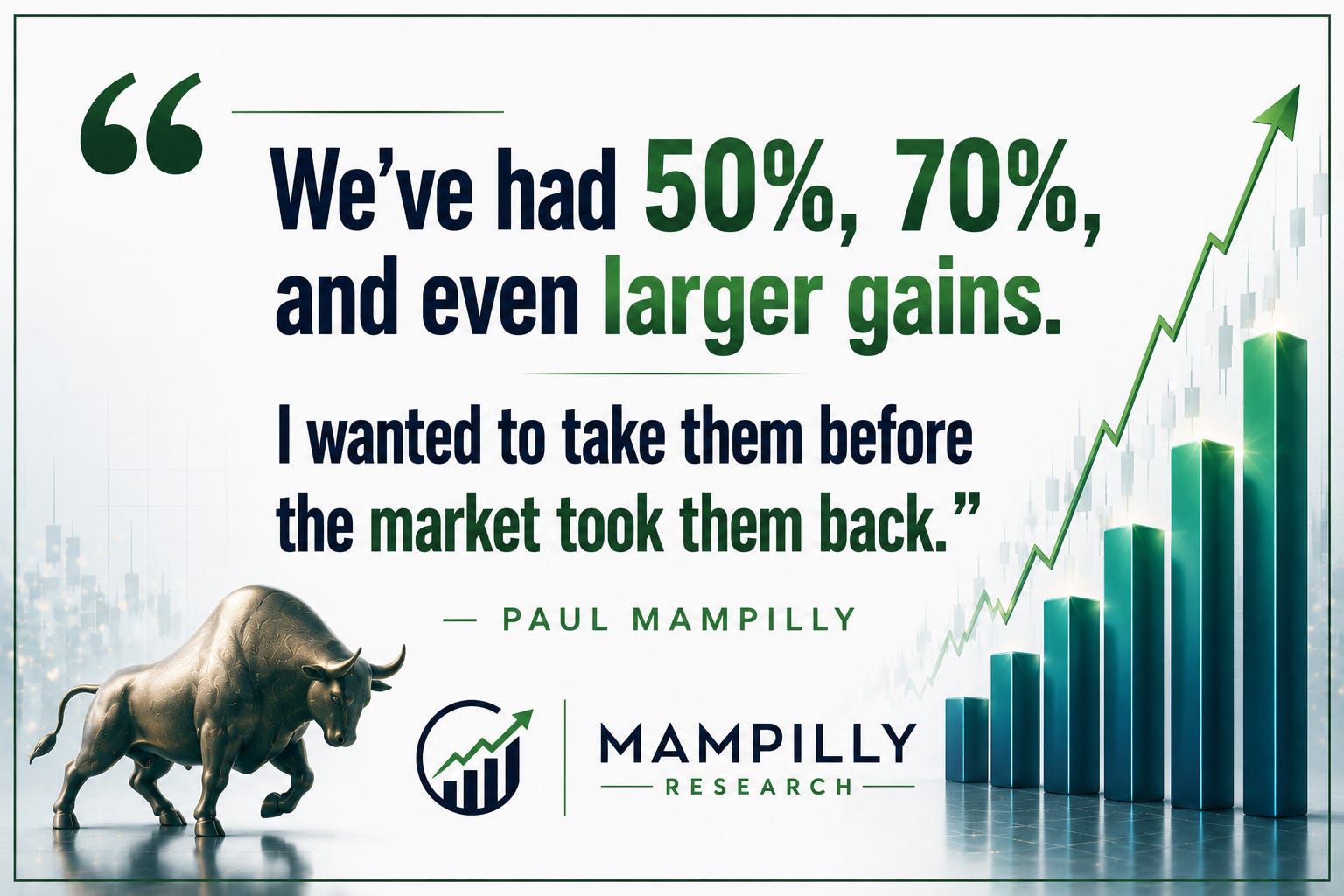
As Paul put it:
Anyone can buy a stock.
But knowing when to take profits — and when to step aside as conditions change — is where experience matters.
The real risk was watching gains of 50%, 70%, 100%, or more slowly evaporate while waiting for the market to catch up with reality.
That’s the outcome we intend to avoid.
At Mampilly Research, we’re constantly evaluating not only where opportunities exist today, but where risks may be increasing in the short-term.
Sometimes that means buying aggressively, holding through volatility, or securing profits along the way.
That’s active portfolio management.
And it’s one of the reasons our members continue to rely on Paul’s research, insights, and market experience.
The 35 recent gains are already in the books. The next opportunities are what we’re focused on now.
If you’d like access to the portfolios, alerts, research, and recommendations Paul and our team are tracking in real time, click below.
Get Positioned With Mampilly Research 🚀
How Paul evaluates the largest IPO in history.
The SpaceX IPO has investors dreaming big.
But before you get swept up in the excitement, there are a few questions worth asking.
In this video, Paul breaks down what’s really driving the SpaceX story, the opportunity most investors see, and the risk many are overlooking.
More importantly, he explains the one thing he’d want to see before putting serious money to work.
Click below for the full details:
Enjoying these insights?
Be sure to hit the “👍” button, leave a comment, and subscribe to the channel to get notified the moment Paul releases his next video.
Months in the making. Almost ready to reveal.
For years, Mampilly Research has focused on helping investors uncover opportunities, navigate markets, and build wealth with confidence.
But behind the scenes, we’ve been working on something much bigger.
Over the past several months, our team has been rethinking nearly every aspect of the member experience — from how research is delivered to how members access portfolios, alerts, educational resources, videos, and more.
The result is one of the most ambitious projects we’ve ever undertaken.
While we’re not ready to reveal everything just yet, we can say that some of the biggest improvements in Mampilly Research’s history are right around the corner.
Over the coming weeks, we’ll begin sharing more about what we’ve built, why we built it, and how it’s designed to help investors get even more value from their membership.
If you’re already a member, keep an eye on your inbox.
And if you’re not yet part of Mampilly Research, now is a great time to join us.
You’ll be among the first to see what’s next, and experience the biggest evolution of Mampilly Research yet.
Join Mampilly Research today and be part of what’s coming next.
Step Inside Mampilly Research ✨
Why investors should be most careful when something starts feeling risk-free.
One of the most dangerous psychological shifts in investing happens when people stop viewing an investment as risky because familiarity makes it feel safe.
The longer something works, the more comfortable investors become with it.
Over time, confidence slowly replaces caution, and questions that once seemed important stop getting asked.
At different points in history, investors viewed blue-chip stocks as virtually risk-free.
Housing was once considered a can’t-miss investment.
Before the financial crisis, many people believed home prices could only move higher over the long run.
In each case, the perception of safety became so widely accepted that investors stopped paying attention to the risks quietly building beneath the surface.
Once an investment earns a reputation for being “safe,” investors often become less sensitive to valuation, concentration, and changing market conditions.
They stop asking: “What could go wrong?” and start assuming: “This has worked for years, so why wouldn’t it keep working?”
Many investors have come to view index investing as almost beyond criticism.
And while indexing has been one of the most important innovations ever introduced for everyday investors, no strategy is perfect.
Every investment approach has strengths and weaknesses.
The problem begins when investors focus exclusively on the strengths and stop examining the vulnerabilities.
At Mampilly Research, we aim to avoid certain risks that most investors aren’t paying attention to.
Because successful investing depends on understanding where risk is increasing while everyone else is becoming more comfortable.
If you’d like to see where we’re finding opportunities beyond today’s most crowded trades, you can follow along inside the Mampilly Research portfolios.
Click the button below to explore what we’re focused on right now. 👇
The market produces an endless stream of noise: headlines, predictions, panic, euphoria . . .
Most investors get pulled from one story to the next.
At Mampilly Research, we focus on finding the signals that actually matter . . .
Emerging bullish trends, overlooked opportunities, and long-term shifts that can create meaningful wealth over time.
If you’d like access to our top research, insights, and opportunities we’re tracking right now, click below.
❤️ This Substack was made — by US, for YOU — with love. ❤️
Have questions or trouble accessing your account? Please reach out to us at info@mampillyresearch.com or schedule a call, and our Customer Support team will be happy to help.
You can also check our FAQ page on our website for an up-to-date list of questions and answers. Your question may have been addressed there.
*Please be advised that customer support calls are limited to 15 minutes and will strictly cover your membership subscription and billing needs only. Any calls that are disrespectful in nature may be subject to immediate termination.
This is OPINION only — not financial or investment advice. Treat it the same as content from your favorite author, YouTuber, or podcaster. We make mistakes despite our best efforts. Investing involves significant risk: You can lose money, there are no guarantees of profit, and past performance does not predict future results. Employees, contractors, and owners of Mampilly Research, operated by ATG Digital LLC, own, trade, and transact in the stocks, options, and crypto discussed in our alerts, updates, reports, and commentaries. We are not financial advisors and cannot provide personalized advice. Investment decisions — what, when, and how much to buy/sell — are your responsibility, based on your own financial situation, goals, and risk tolerance. Capital loss is possible. Carefully consider this risk and consult a qualified financial advisor before trading, speculating, or investing. It’s your money and your responsibility.
Comments
Nothing yet. Say the first thing.
Sign in to join the conversation.