
Note: Please read our disclaimer at the bottom of the article.
Hi, I’m Paul Mampilly, an American investor. 🇺🇲
Welcome to the Mampilly Research Substack — where we go against the grain to uncover emerging bull markets and early opportunities long before they become obvious.
Each Wednesday, I share how we’re positioning ahead of major market shifts to uncover big potential gains.
Substack 🥞 subscribers: 6.3K
The exact trigger for the next market crash may be hard to predict — but Paul believes the setup is already unfolding in plain sight.
Plus, don’t miss a new tool designed to answer one of our members’ most-asked questions: Would Paul still buy it today?
A contrarian take at where the market’s headed next.
If you asked most people what causes a market crash, they’d probably give you the same answer . . .
A recession, a financial crisis, or some unexpected event that nobody could have seen coming.
After 30+ studying markets, I’ve come to a different conclusion: Crashes rarely begin with bad news.
More often than not, they begin with too much good news.
That’s why I’ve found myself thinking about 1987.
While history doesn’t exactly repeat, markets are still driven by people.
And people have a remarkable habit of making the same mistakes generation after generation.
Most investors remember Black Monday because the Dow Jones Industrial Average collapsed 22.6% in a single day — still the largest one-day percentage decline in modern market history.
What far fewer people remember is what the market looked like before it happened.
It didn’t look dangerous. Quite the opposite.
America was optimistic. Ronald Reagan’s economic policies had restored confidence after a difficult decade, and deregulation was fueling business.
A weaker dollar was helping exports. Stocks had climbed more than 30% that year, and investors were convinced they were entering a new era of prosperity.
If that sounds familiar, it should.
Today, I believe we have our own version of that story called artificial intelligence (AI).
As I’ve clarified before, I’m not bearish on AI.
I believe it will become one of the most important technological revolutions of our lifetime. It will reshape industries, create entirely new businesses, and generate enormous wealth over the next decade.
But that’s precisely why I think investors need to be careful.
Markets have taught me that bubbles almost never form around bad ideas.
They form around great ones — such as railroads, the Internet, housing, and now AI.
This is the technology that eventually changes the world.
The mistake investors make is believing all of that future success should already be reflected in today’s stock prices.
That’s what happened in 1987. The week before Black Monday, the Dow quietly fell almost 10%.
There weren’t any catastrophic headlines, nor was there a recession, banking crisis, or event that explained why investors suddenly started selling.
But beneath the surface, the market had already become fragile.
Margin debt had climbed rapidly as investors borrowed against portfolios that had been rising for months.
When markets reopened on Monday morning, those losses immediately triggered margin pressure.
Then the mechanics of the market took over.
Many of the largest companies in America — including IBM, Exxon, General Electric and AT&T — couldn’t even establish opening prices because sell orders overwhelmed buyers.
Around 11 o’clock that morning, the Dow was already down roughly 9%.
A rally before noon briefly convinced investors the worst was over — except that it wasn’t
Selling intensified throughout the afternoon. Margin calls forced investors to liquidate positions, which pushed prices lower, triggering even more selling.
By the final hour, panic had completely replaced optimism.
The Dow lost another 13% during the last sixty minutes of trading alone, finishing the day down 22.6%.
The lesson here was that the market had become dangerously vulnerable long before anyone realized it.
That’s why I believe investors spend too much time trying to predict what will cause the next crash.
The trigger is almost impossible to know, but the setup is much easier to recognize.
Markets become fragile and risky when:
⚠️ Optimism becomes extreme
⚠️ Expectations become unrealistic
⚠️ Everyone owns the same trade.
⚠️ When borrowed money quietly fuels rising prices.
⚠️ And when investors begin believing that this time is different
Those are the conditions I see developing today.
These similarities I see are the result of several warning signs beginning to stack on top of one another — much like they did before previous major market breaks.
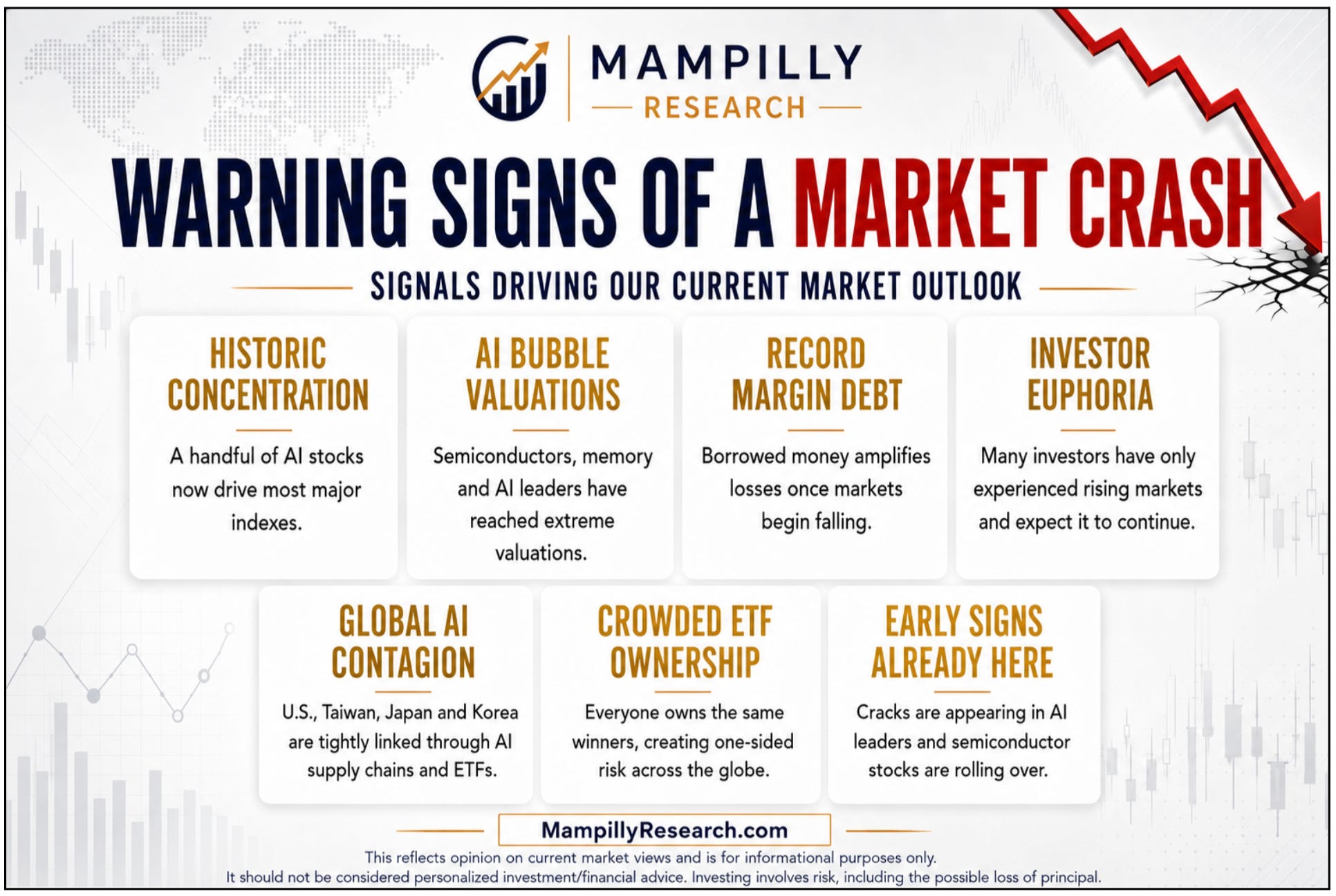
It’s worth noting that none of these warning signs, by themselves, guarantee a crash.
Neither did they in 1987.
It’s when they begin appearing together — while optimism is widespread and leverage is elevated — that markets become exceptionally fragile.
Today, a remarkably small number of companies account for an outsized share of the major indexes.
Semiconductor companies, memory manufacturers and AI infrastructure businesses have become the trade everyone feels they have to own.
Then layer leverage on top of that.
Margin debt has climbed to historic levels as investors borrow against portfolios that have already appreciated dramatically.
That strategy works beautifully while prices continue rising but becomes brutal when they don’t.
Leverage doesn’t simply magnify gains — it accelerates forced selling.
What concerns me even more is how interconnected today’s markets have become.
Back in 1987, “portfolio insurance” created a feedback loop that accelerated the selling. It was designed to reduce risk but ended up amplifying it.
Today, I see a different version of the same problem.
The AI supply chain stretches across the U.S., Taiwan, Japan and South Korea.
The same companies sit inside ETFs around the world, owned by millions of investors — many using borrowed money to increase their exposure.
When one market begins liquidating, those pressures spread.
That’s one of the reasons I’ve been closely watching developments in South Korea.
As policymakers there move to cool speculation, we’ve already started seeing cracks appear across parts of the AI supply chain.
Semiconductor shares have begun rolling over, and the first dominoes are starting to wobble.
No one knows if they will all fall.
But I’ve learned it’s far better to recognize a dangerous setup early and manage risk as it unfolds than explain it afterward.
That’s why I’ve been telling Mampilly Research members for months that this isn’t the time to chase every new high.
We’ve become more selective to manage risk and to hold more cash when appropriate.
We’re also securing profits sooner.
I often tell members there are moments when your priority shouldn’t be the return on your money — it should be the return of your money.
In my opinion, this is one of those moments.
Eventually, AI is bound to create extraordinary opportunities.
The only question is whether today’s prices already assume tomorrow’s success.
History suggests that’s where investors usually get into trouble.
Whether this unfolds as a healthy correction or something much more severe, our approach remains the same.
We invest based on probabilities, risk management, and decades of studying how markets behave when optimism reaches an extreme.
To see exactly how I’m positioning today — where I’m becoming more defensive, where I’m taking profits, and where I’m selectively finding new opportunities, join us by clicking below.
Position With Mampilly Research 🤩
This tool answers that question in seconds — exclusively for Crown Tier members.
Every investor eventually faces the same question:
“What should I do with the positions I already own?”
Especially in today’s volatile and increasingly uncertain market, that answer matters more than ever.
A stock that looked attractive a few months ago may no longer deserve additional capital today.
Other positions may still present compelling opportunities.
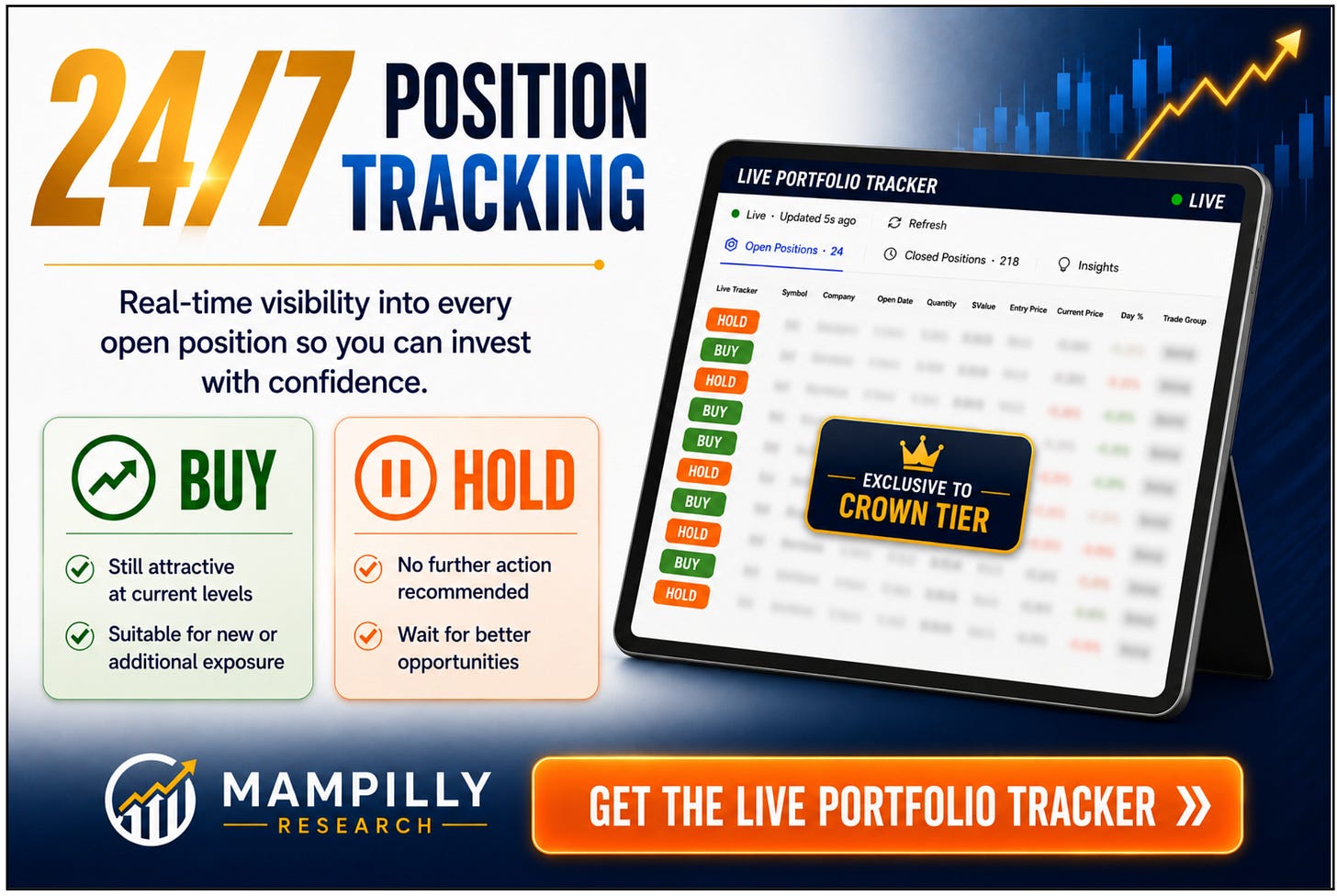
That’s part of why we built the Live Portfolio Tracker — a powerful feature members have been asking us to build for years that is finally available.
Instead of relying on old recommendations or waiting for the next portfolio update, Crown members can instantly see Paul’s latest Buy and Hold ratings across every open position.
If Paul still believes a stock offers attractive value at current prices, you’ll see Buy.
If he believes it’s better to stay patient and wait for a more favorable opportunity before adding more capital, you’ll see Hold.
But the ratings are only part of the story.
Every week, Paul and our analyst team publish an exclusive Live Tracker Status Update, explaining why ratings changed, the market developments driving those decisions, where they’re becoming more defensive, and where they’re uncovering new opportunities.
It’s become one of the most valuable benefits of Crown Tier because it helps members stay aligned with Paul’s latest thinking as market conditions evolve.
See Paul’s Latest Buy & Hold Ratings →
A timeless investing lesson that can change how you see every market.
Some ideas can change the way you invest forever.
Paul shared one of his favorite quotes — and how he believes it remains one of the simplest ways to understand market cycles, psychology, and investor behavior.
Take two minutes to listen below. 👇
0:00
-2:25
What’s one investing quote that’s stayed with you over the years?
Share it in the comments — and tell us why it’s one you’ll never forget.
See why the latest market shifts have our full attention.
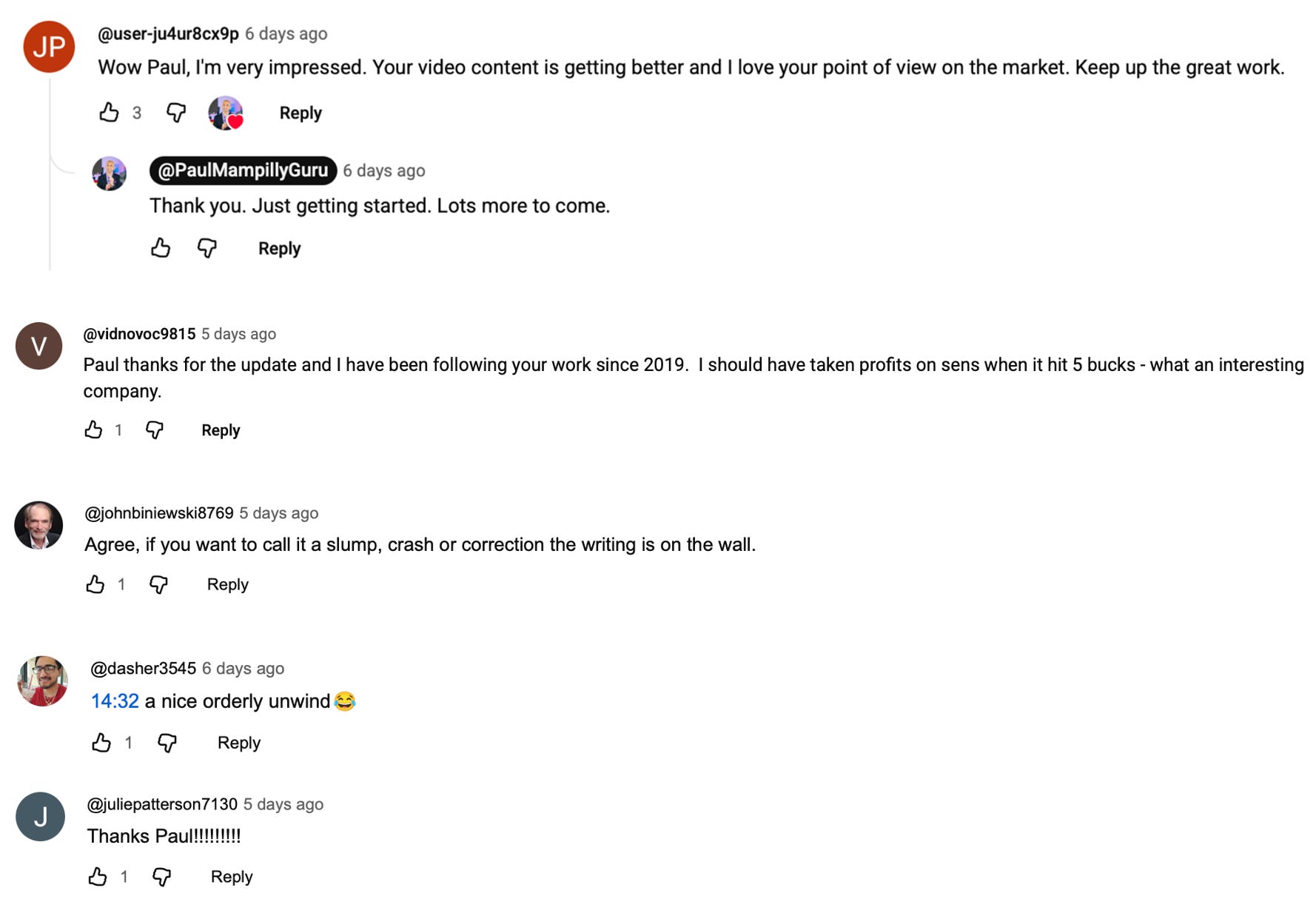
Did you catch Paul’s latest YouTube video?
This may be one of his most important outlook updates of the year, and viewers are already weighing in:
If you’ve been following the markets closely, this is one video you won’t want to skip.
Click below to start watching now.
If you’re enjoying these updates, remember to hit the 👍 button to let us know!
And be sure to subscribe to the channel and turn on notifications for new releases.
That way, you’ll be among the first to receive Paul’s latest market insights and timely investing ideas.
Let’s take a quick pulse check on our community.
The market may be the same, but investors are responding to it in very different ways.
We're curious where you stand.
Poll #1: Share your market outlook.
Poll #2: Tell us how you’re positioning your portfolio.
After you’ve voted, leave a comment sharing the thinking behind your answers.
We’d love to hear what’s shaping your outlook and how you’re navigating today’s market.
Next week, we’ll share the results here to see where you stand.
Bull markets create one kind of opportunity — while corrections and bear markets create another.
The key isn’t hoping for perfect conditions but recognizing where opportunity is shifting next.
That’s where our research is focused every day.
We’re constantly searching for the emerging trends, businesses, and asymmetric opportunities that we believe can create exceptional long-term returns.
If you’re ready to discover what we’re buying and selling next, click below.
Find Tomorrow’s Opportunities 🚀
❤️ This Substack was made — by US, for YOU — with love. ❤️
Have questions or trouble accessing your account? Please reach out to us at info@mampillyresearch.com or schedule a call, and our Customer Support team will be happy to help.
You can also check our FAQ page on our website for an up-to-date list of questions and answers. Your question may have been addressed there.
*Please be advised that customer support calls are limited to 15 minutes and will strictly cover your membership subscription and billing needs only. Any calls that are disrespectful in nature may be subject to immediate termination.
This is OPINION only — not financial or investment advice. Treat it the same as content from your favorite author, YouTuber, or podcaster. We make mistakes despite our best efforts. Investing involves significant risk: You can lose money, there are no guarantees of profit, and past performance does not predict future results. Employees, contractors, and owners of Mampilly Research, operated by ATG Digital LLC, own, trade, and transact in the stocks, options, and crypto discussed in our alerts, updates, reports, and commentaries. We are not financial advisors and cannot provide personalized advice. Investment decisions — what, when, and how much to buy/sell — are your responsibility, based on your own financial situation, goals, and risk tolerance. Capital loss is possible. Carefully consider this risk and consult a qualified financial advisor before trading, speculating, or investing. It’s your money and your responsibility.
Comments
Nothing yet. Say the first thing.
Sign in to join the conversation.