
Earlier this year, I replaced myself as CEO of Keeper - the company I founded, and was entirely consumed by since 2018.
My goal was to wean myself off of the drug of hyper-achievement, make more space for loved ones, and build a healthier personal life overall.
My search produced options ranging from co-founder roles at other startups, GMing growth-stage business divisions, or just being a PM in Big Tech.
The role I ended up choosing — senior IC in Big Tech (Google) — is the furthest possible extreme (between what I had been considering) from my experience at Keeper. If founder life is about being an adrenaline / achievement junkie, then this turned out to be the equivalent of going “cold turkey”.
Having never worked in Big Tech, my mental model I had for it is that it’s incredibly chill — that a founder used to dealing with existential startup threats can immediately choose to become Big Head from Silicon Valley.
Not so. I am very much going through withdrawal right now and it’s painful. Yes, technically Google has the characteristics of a beautiful all-inclusive rehab resort, but actually enjoying the amenities requires a complete mental model reset.
I say this with no shred of sarcasm: becoming Big Head is not easy. It requires extreme mental fortitude and jedi-like reality distortion. Big Head is actually a genius.

The profession value-system I had been developing over the past decade of working at fast-growth startups is completely wrong for this new environment.
Being a founder of a 25 person well funded startup is like organizing a field trip. Goals are clear, problems are solvable, morale is high. Sure, you can’t control the weather (i.e. PMF) but we’ve all got contingency plans. I had complete control, so my value system was to identify issues and resolve them as fast possible — either by delegation or by doing it myself. I could relax once I had squashed or delegated the last issue. It was like getting to inbox zero — and I had gotten used to always getting to inbox zero.
As a senior IC in a 50,0000 person organization, the analogy is more like surviving a forest fire. From an ex-founder’s perspective, everything feels like it’s on fire at all times. I constantly find myself in situations I’d describe as “I’d cry if it wasn’t so funny” — complete nonsense strategies, massive cultural red flags, mind numbing procedural duress. But that’s just normal, and it exists for a very good reason — because the incentive to fix it is not sufficient.
But here’s the trick: rushing to put out the fires is a direct path to burnout. You won’t be rewarded, you’ll make a ton of enemies, and you probably won’t succeed. The mistake is to think about things at a business / efficiency level while in reality 99% of these types of problems are actually interpersonal / people problems which are much harder and more painful to resolve.
Instead, the job is know which fires to let burn and where to draw the break line. You have to “let things burn” strategically, so that when they eventually burn out your house will still be there.
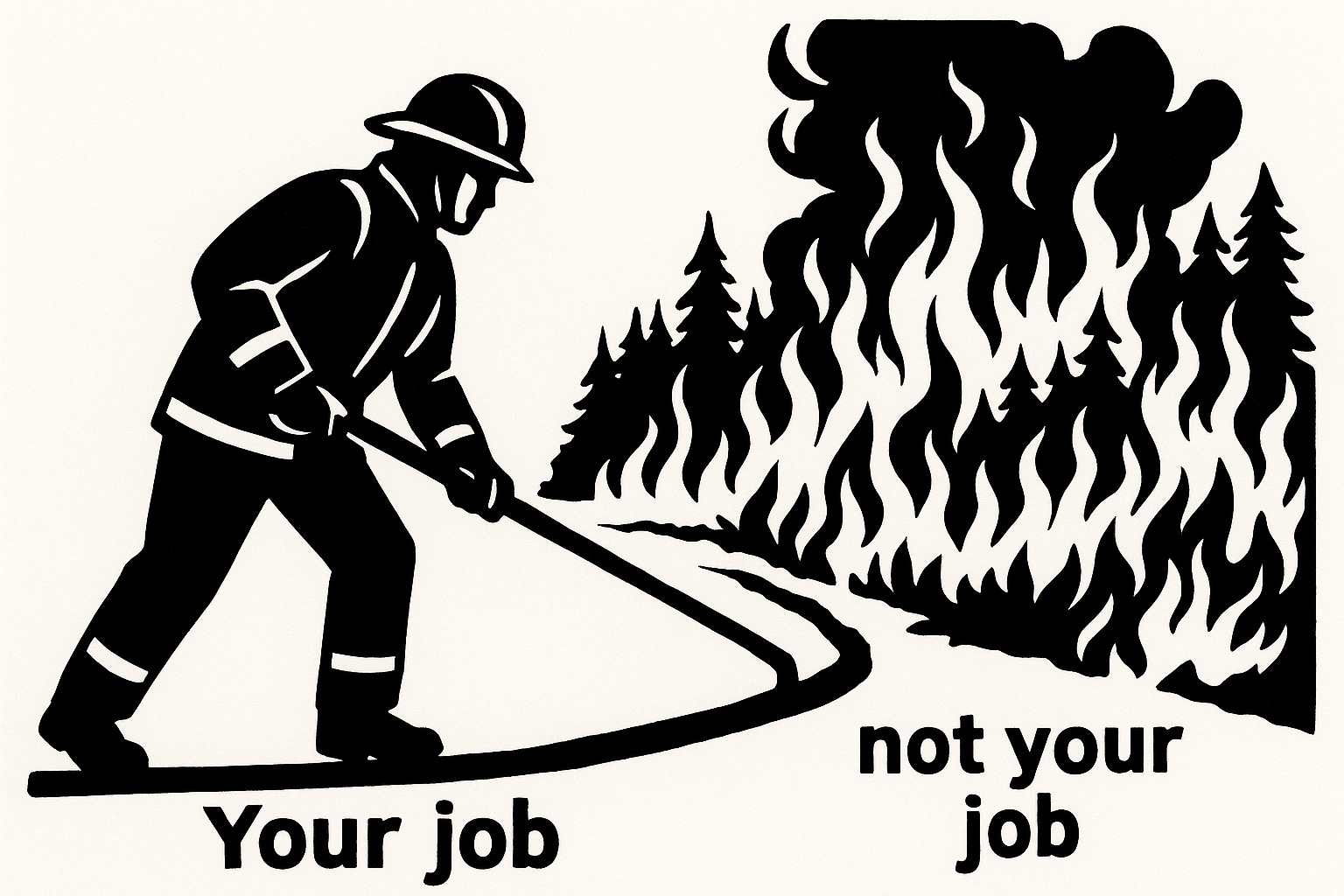
Google, like many orgs, has effectively been in a hiring freeze for the past 3 years. This means that any new job opening exists only because no internal transfer wanted it. That’s why they’re looking externally (and also the reason they have to pay so much).
As far as I can tell, most of the job openings right now are in AI — which is the organizational bonfire. It’s not that internal transfers don’t want experience with AI, or that they’re unable to convince management to give them a shot. It’s that most companies’ AI strategies are completely unhinged right now — management is blindly throwing in resources and priority, while the employee base is either completely apathetic, or trying to stay out of it. The open role will be at the intersection of these two forces, and the reason it’s open is because the last person got burnt to a crisp by them.
So your job will be to put out the fire, or at least to have it burn somewhere else. Unless you’re truly a master, like Bighead, this is not a chill job.
For other founders considering a big switch, I hope this is helpful. By no means, is going back to the corporate ladder some kind of Nirvana, but it’s a nice break from the existential stressors of founder life. Loved ones have commented on my relaxed demeanor and general increased patience. Complaining is cathartic - but it’s overall a good life.
No posts
Comments
Nothing yet. Say the first thing.
Sign in to join the conversation.