
Hello Chums!
This week, we’re going to look at some aspects of how a comic is lettered, but by no means can we cover every single part of this. I’ll do my best to give you an overview. If the lettering process is something you’re unfamiliar with, I think you’ll be surprised by the amount of work it takes to get this right.
For the sake of clarity, when I talk about “lettering,” I mean the printed words that you find on the page, which are generally juxtaposed against the art, overlaying some of it. A “lettered versus unlettered” section looks like this:
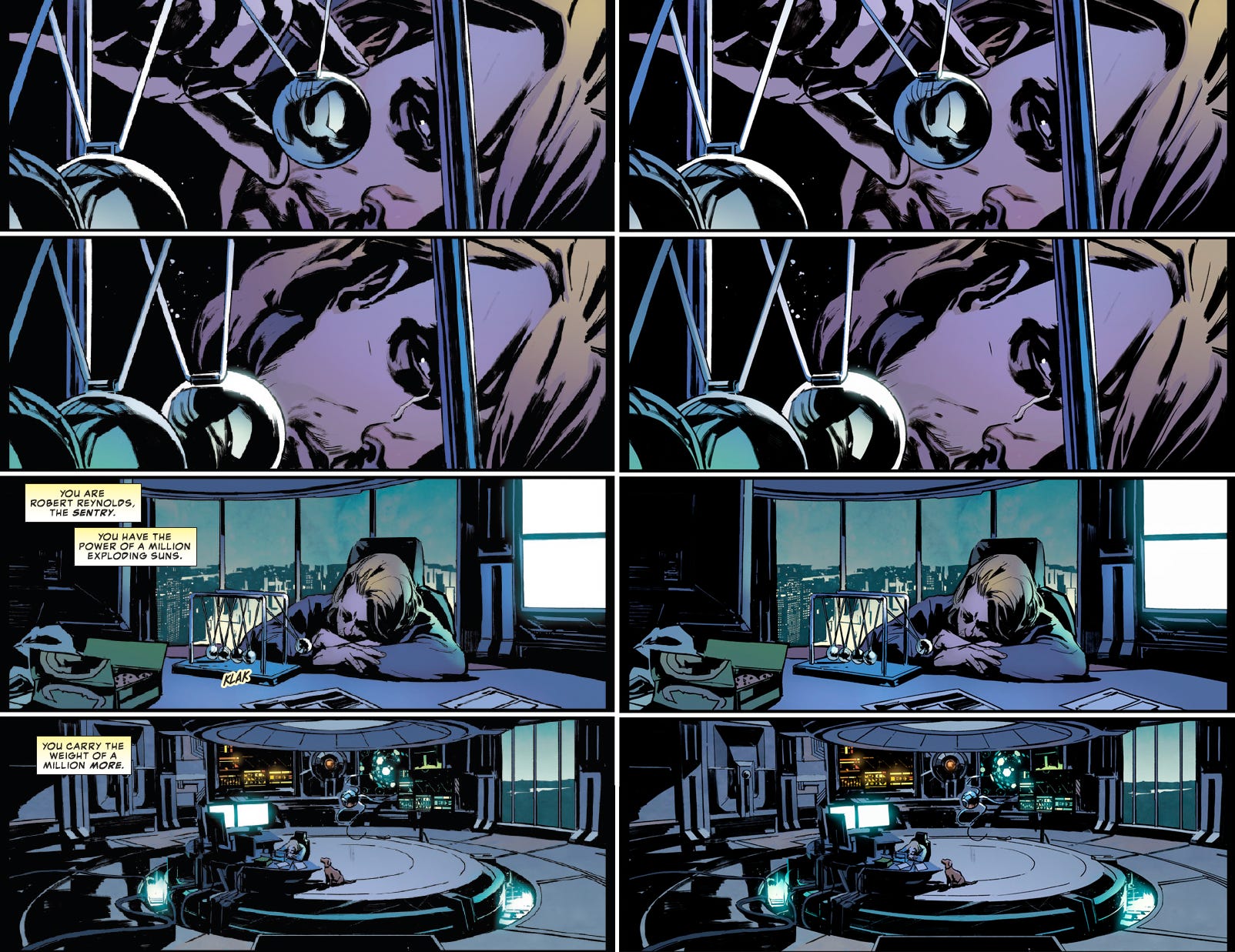
Now, I’m going to begin by paraphrasing my legendary-yet-mythical “college lecture” on the subject of lettering: Imagine I write the greatest script of my entire life. Then, I send it to the artist and when it comes back it’s even better than I could have imagined. Now, it goes to the colorist, and their work is so beautiful that grown men weep at the sight of the pages. Finally, imagine we send all of this to the letterer, and they send it back with some of the word balloons and captions put in the wrong places. Well, now we have a mediocre comic. You see, the best work of a letterer is like the best work of a sports referee - if you don’t particularly notice it, then they’ve done a great job.
That’s not to denigrate the artistic work of a letterer. It’s more to say that when your eye flows over the page smoothly, so you can read a little, check out the art that strikes you, come back and read a little more… that’s when the words are truly married to the pictures. For Sentry, that marriage of words and pictures fall on the shoulders of our esteemed letterer/wedding official, Joe Caramagna. And there is so much nuance to all of this: I’m going to take page 3 of Sentry #1 and do a comparison of a first draft of a lettered page against the final version. At this stage, I have seen the art and now I provide a first lettering pass. Since I’m able to see the art, I am already making some changes to my original script because a character’s facial expressions or body language might suggest a tweak or two:
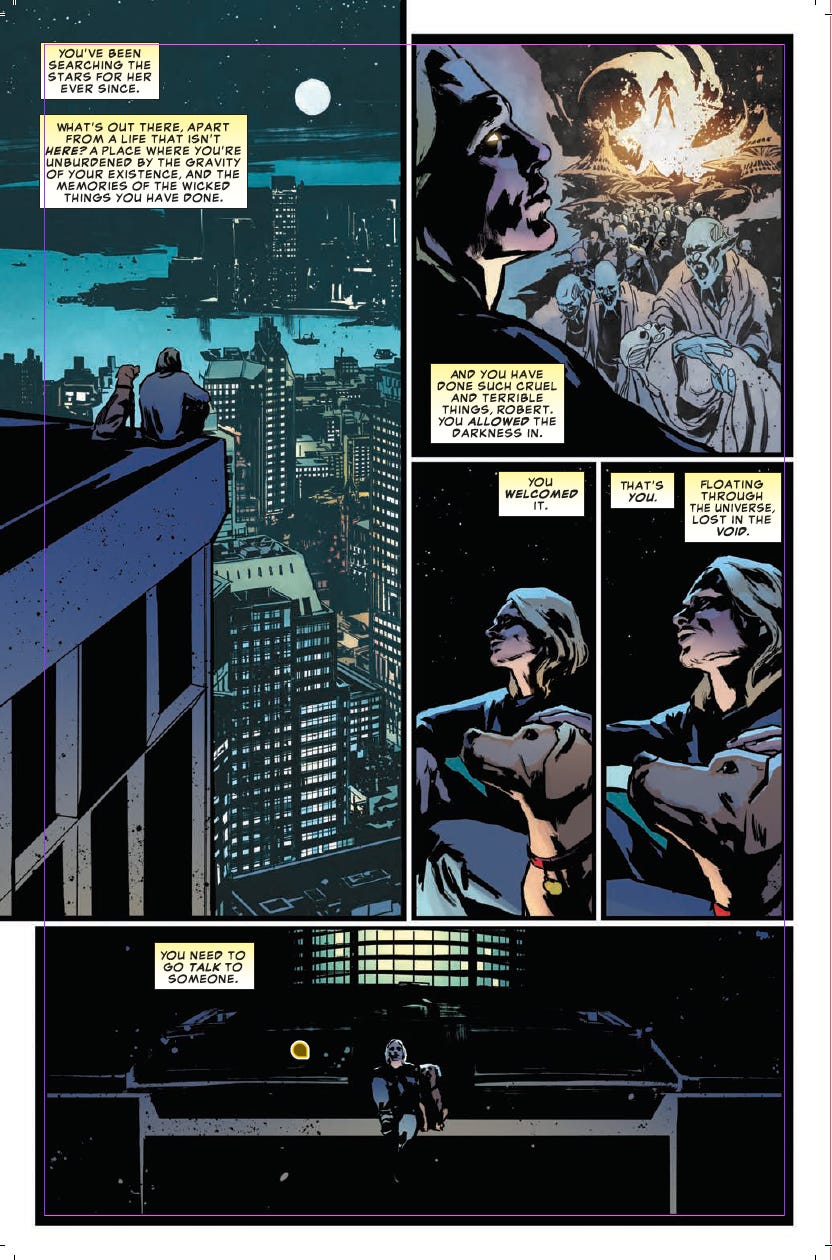
As soon as I saw this page, I could see a few changes needed to be made. I’m always worried about riding that line between being too wordy and not giving enough information. But I have learned a general rule of thumb: If possible, let it breathe. My concern here is that panels 3 & 4 both contain captions. But in panel 5, Bob resets as he realizes he is getting a little dark, and maybe he needs to talk to someone. That’s a mental reset for our main character, and coming on the heels of all those words in panel 4, everything is just too busy. To me, panel 4 needed to be silent - a moment of reflection where Bob Reynolds resets his thinking for a moment. This is what the page looks like with the revised lettering:
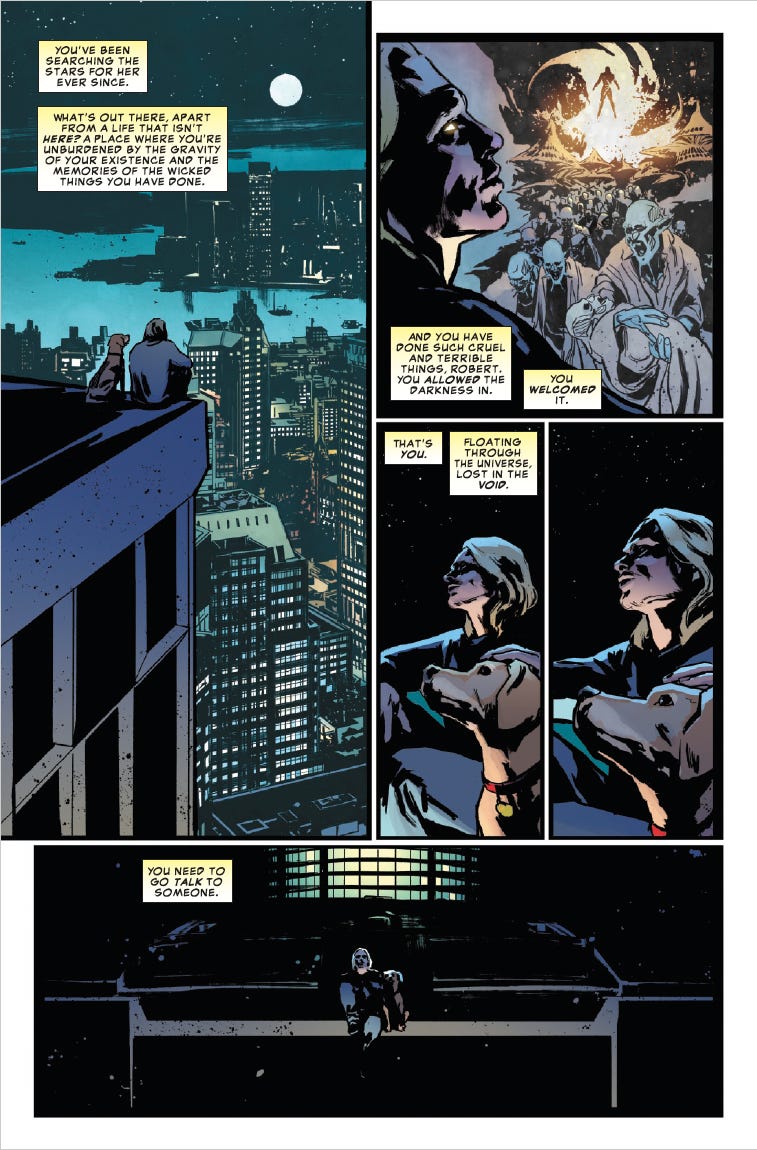
I mean, to me this reads so much better, though I sometimes wonder if I’m just driving myself crazy at times with being to much of a perfectionist. Do you see the difference? In the first version, the panels are too crowded. A simple change, and we have a better flow of story. We let Bob think for a moment as he puts his hand on his dog. It works.
Now, sometimes the lettered captions can trip on each other. there are times nowadays where I have a couple of statements and responses in a panel. That means the artist has to provide enough dead space, and the letters have to be read in the correct order: statement-response-statement-response. Here’s our fantastic letterer, Joe Caramagna, helping send your eye across the flow of an interaction between the Void and Kingpin:
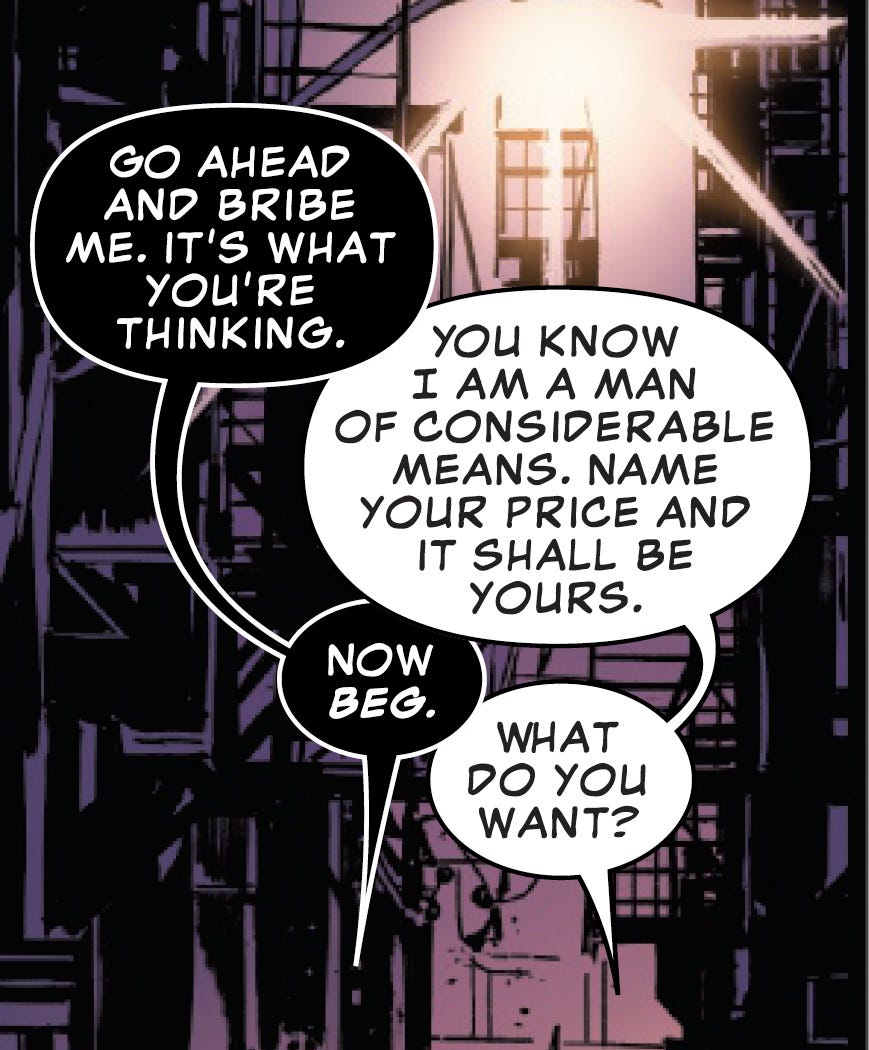
Think for a moment about which word balloons overlap each other, and why. There’s thought behind all of it. A word balloon might overlap another because the second person is interrupting the first, for example. There are so many nuances to how and why a balloon or caption is placed where it is.
And then, there are the sound effects. Now, I’ll be honest, I never, ever write them. I don’t particularly like them. But I’m willing to concede that so many other people do, and they can be a vital part of action in a comic. The most I will do in a script is write “SFX: (explosion)” as an indicator, and then hand it over to our letterer. But I think that letterers actually love making these things, so it’s a good trade. There’s nothing like a good KRAKA-THOOM! to make a letterer’s day. They are good, simple folk, like Hobbits.
In Sentry #1 there is a scene in which Bob starts the motion of a Newton’s cradle as he talks to CLOC. Our letterer added the SFX (sound effects) for the clacking sound of the Newton’s cradle. Is this necessary? I’ll let you decide.
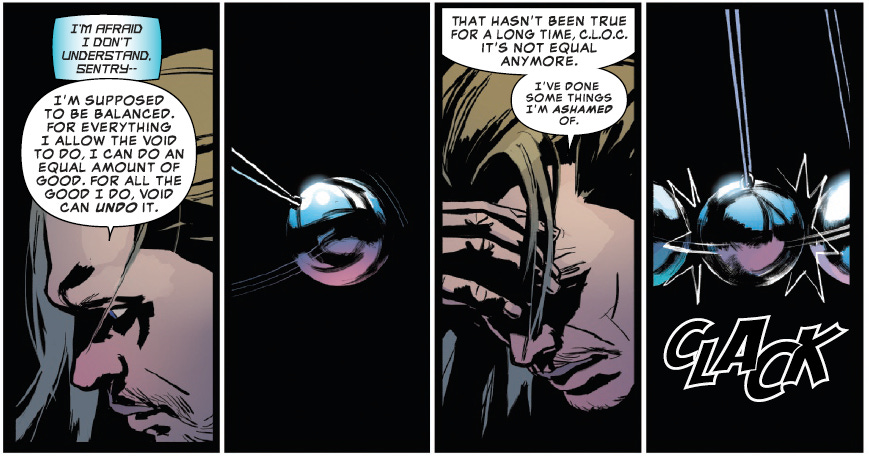
I suppose I can live with them if they advance the story. For example, if our main character turns because he hears a noise, then a SFX is useful. It’s all entirely subjective.
Okay, so… there you go: some of the basics of lettering and balloon placement. Joe will probably never forgive me for this, because I have omitted a ton of lettering-related issues. How do we do Locator Captions, for example (I fucking hate them!), how do we indicate a quieter or whispered comment (make the letters small), or a transmitted radio caption (possibly italics)? Like I said, there is nuance to all of this.
Tune in next time for my last in this all-too brief series, in which I show you exactly how much I hate locator captions, and how much bullshit my long-suffering editors have to deal with.
Finally, to give you guys a heads-up: if you have enjoyed this little insight, I have been considering for some time doing a full-on comics creation workshop, focusing on storytelling in all its many forms. Let me know if you might be interested in something like this. It would be very in-depth, to really try to give you the knowledge I’ve accumulated along the way.
Until next time!
No posts
Comments
Nothing yet. Say the first thing.
Sign in to join the conversation.