
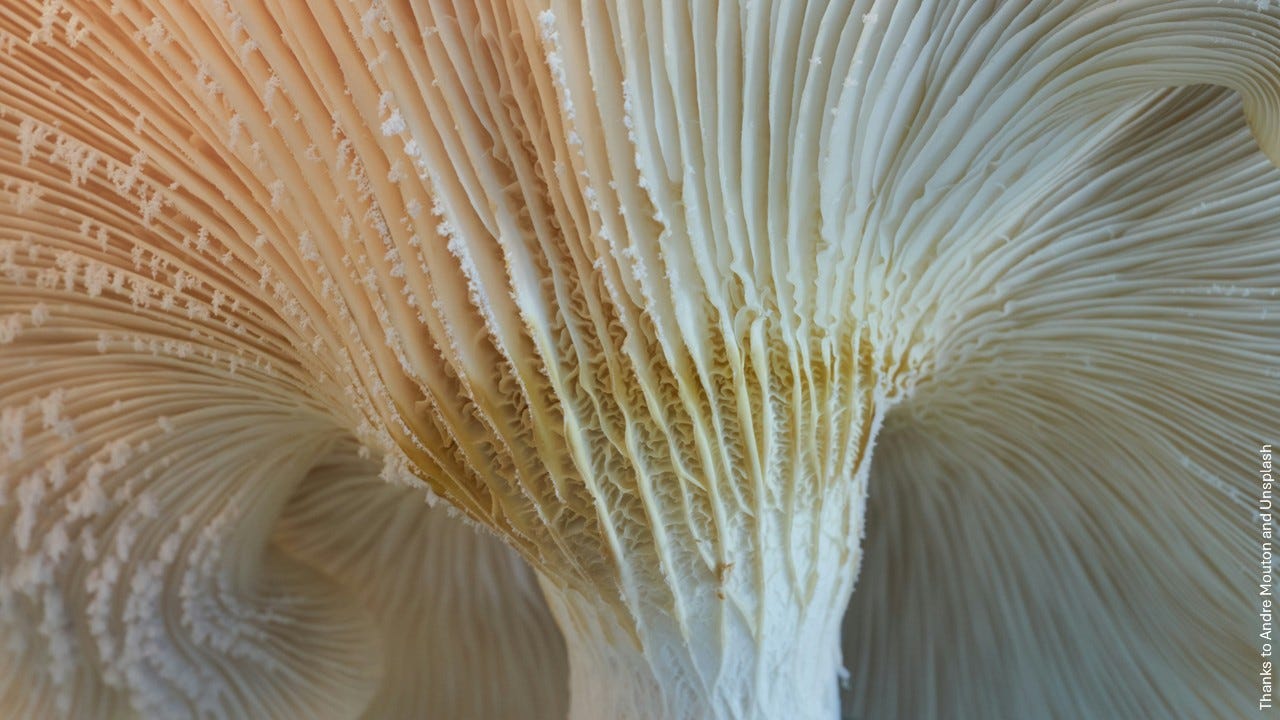
When I was fourteen I had several – maybe nine or ten – episodes of being completely and utterly awe-struck with wonder at the Earth. Walking to a music lesson on a November evening, sitting watching the sunset in the West of Scotland – I don’t remember these as religious experiences, but simply as a profound and absolutely overwhelming wonder at the inexpressible beauty of the Earth and creation. Not realising how fortunate I was to have these experiences, I thought that perhaps everyone got them. Later, in my late 20s I remember sitting in a busy staff common room reading The Self-organising Universe, a book about the unfoldingness of the Universe, and suddenly being overwhelmed by a sense of home coming – Ah here was the answer! This was a way to make sense of two profound things: the overwhelming beauty I had felt at 14; and all our hard-won understandings that begin to explain how the Earth comes to be this mystically magical way.
Sixty years later as the old world dies, I find I am still trying to understand how these same two paths - the one rooted in mysticism, the other in understanding – fit together in a time when capitalism and our late modernity have kicked the Earth out of the Holocene and into some deeply chaotic new geological regime. This is my own, very personal understanding of how both love (an impulse to union) and sentience (an impulse to understanding) might be embedded in matter itself.
Teilhard de Chardin, the philosophy of panpsychism, and scientists like Stuart Kauffman, Iain McGilchrist and the developmental biologist, Michael Levin, all seem to articulate something similar. But I am no expert in any of this, and this is very much my own homespun way of looking at the world. For me, it provides a way of seeing the sacred that makes at least some sense in these times of Earth destruction and, following from this, suggests ways of worship and witness, that within a Quaker context, help me understand how I can begin to live these times. If you make it to the end (I’d completely understand if you don’t get that far!) and have any thoughts do please share them.
How do we live these times? What does love require us to do for each other and for the Earth? Hope feels like a delusion when faced with the neolithic. Old answers simply won’t do any more. Capitalism, autonomy, humanism, freedom, Christianity, Islam, karma, politics - all were all forged in the old, energy-rich, times. And now, here we are in the new, waiting to find out whether death or rebirth awaits us.
If these are the end times for all the old ways, then is there a new way to think of ourselves and our place in the world that is coherent both with what we know from the last 400 years of discovery, and with the mystical and the ineffable?
To get anywhere with this question I think we have to go back to the beginning. Not to Genesis, or the palaeolithic, but right back to the big bang and the nature of matter. Our answers need to be coherent with what we know: that the Earth formed 4.5 billion years ago, that life started 3.5 billion years ago; and that it has gone backwards and forwards since then but always tending to get more complex, despite and within the iron logic of the second law of thermodynamics. And that all this sits within the most immense cosmos with billions of galaxies and trillions of stars.
One way of seeing this planetary and galactic journey is as a twin-fold path that is born along, unfolding as it goes. The twin paths are an ‘impulse to understanding’ that we call sentience and an ‘impulse to wholeness’ that we call love. I think these two impulses are buried in the heart of matter itself. They were part of what came out of the Big Bang.
I think every living organism of sufficient complexity experiences these two impulses. We humans, having words, call each a range of things depending on our culture. The impulse to understanding is what we know as sentience, consciousness, awareness. Science is a particular, formal, form of this impulse to understanding. The impulse to wholeness we call Love, God, the divine, the sacred, Allah, Yahweh, Atman, One-ness.
There is already evidence that sentience - the impulse to understanding, of which consciousness is one manifestation – may arise from the quantum nature of matter itself. Panpsychism is a well-recognised theory of consciousness that says that consciousness is inherent in matter but only manifests itself when matter becomes sufficiently complex – which for us means sufficiently complex biological systems.
There is no evidence that I know of to support the assertion that matter also has an impulse to wholeness1, not least because all statements about God or the sacred, are limited by the impossibility of words containing or describing the one-ness of an everything that includes the words needed to describe it. Nevertheless pantheism, the idea that ‘God is everything, and everything is God’ is a well-established idea going back at least as far as Spinoza.
Why might this twin-fold path might make sense of where we are now, and how are they coherent with what we know of Earth’s history?
The great expanses of geological time and immense distances of cosmological space have always bothered me in relation to any idea of the sacred or of God. What was ‘God’ ‘doing’ for the 13.5 billion years before humanity appeared? What was ‘God’ ‘doing’ overseeing the great extinctions like snowball earth or the dinosaurs? Along with obsessions about a body hanging on a cross, and smiting, and the tendency of humans to use arguments about different versions of God to slaughter each other, all this was why for most of my life I was an atheist. Why bother with all this religious claptrap? Sure, you were left with a universe that had little meaning, but you didn’t have to put up with the slaughter and the nonsense and wondering why God had it in for the dinosaurs so badly.
But at the same time I had had those experiences as a fourteen your-old - a sense of complete wonder and awe at the ‘unfoldingness’ of life, of its complexity, its immense beauty, of its totally awe-inspiring joy. And these feelings always seemed to me to be deeply related to what the mystics of any tradition speak of. So somewhere I remained a sceptical atheist and as I got older and as the 21st century unfolded, I spent more and more time trying to understand the emerging evidence across many branches of science, that ‘everything always and everywhere, becomes together’2. Things co-evolve. Collaboration is generally much more important than competition. Symbiosis is the rule, not the exception. Our obsession with competition is a reflection of capitalism, not reality.
And as the Earth crises have deepened, this idea that ‘I am because you are – and because the mouse, the thrush and the snake also are’ bore in on me. To the extent that we take a planetary view – and this is the view we now need – then there can be no ‘other’ – we are all part of this great, living Earth.
So I think this is the two-fold path: knowing and loving are a double helix enfolded somewhere, somehow, in the quantum nature of the universe. And when the conditions are right, both consciousness and an ability to know the full oneness of everything resonates into existence. You might call these two strands ‘biologically enabled panpsychism’ and ‘biologically enabled pantheism’
If this view holds at least some truth then if the conditions change – if the 80% of Earth’s richly wonderous web of life gets destroyed by an asteroid or an overly intelligent monkey – then both consciousness and the Earth’s sense of sacredness may be diminished.
For me, this enfolded, unfolding, reversible, twin-fold path makes sense of both the vast, aeons-long universe and what we as individuals can feel and think and know here on our singular blue planet. One strand is the root of what we call mysticism, the other of what we understand as science and knowledge. Since we are of them, both these strands are always within us – there is no escape from either.
And since they are always within everything else, there is the possibility that any living system that is complex enough is also manifesting sentience and sacredness, even if how they do this lies too far from our own ways of knowing to be accessible by us.
What are the implications of a twin-fold nature of matter enfolded in the universe
Ontological Implications:
§ If the power of Love (or God) is correlated to the complexity of the biological systems in which it manifests then God or Love is not equally present everywhere. To put it as a theologian would, God is not omnipresent across the Universe. Instead it easier to experience Love in complex biological systems like a forest, or a coral reef than in deep space. Nor is Love present equally throughout time. God emerges as complex systems emerge and then diminishes with mass extinctions. Love ebbs and flows over the aeons of intergalactic time, mirroring the ebb and flow of life.
· This impulse to unity is entirely immanent. There is no external God, nothing transcending this material reality, no ground of being from which everything else arises. God does not make matter, matter makes God3.
· This sense of God has no agency. There is no point praying for an external, transcendent God to intervene in the world. We are on our own, just us and the surrounding life systems which are the means that enable us to experience this impulse to unity and love.
· There is also no teleology in all this. There is no inevitable progress to some specified end point. We are not fated to reach the Rapture or the Kingdom of Heaven or Paradise. There are no eschatologies. If we destroy the capacity of the Earth to manifest Love, then that’s what we do and until the Earth recovers, Love will be a meagre shadow of what we know now. There is a bleakness to this because to the extent that the present mass extinction unfolds we lock ourselves out from further love. A vicious spiral where Love declines might have already taken hold, heralding a future of progressive damnation rather than redemption.
· On the other hand, by the same token, we do not yet know what Love would look like were our world to become even more biologically enabled. What if we are still near the beginning of life’s unfolding dance with these inter-twined impulses of consciousness and love? It seems entirely possible to me (if we don’t destroy the Earth) that life’s dance with consciousness and a self-knowing Love has many more realms to unfold into. These beckon us to a future where Love and life and sentience might lead us through multiple Omega points. Yes, there may be a vicious cycle leading down to less Love but there is also a potential cycle leading upwards to undreamt of understandings and fulfilments. One of the bleakest fears of our times is that we are destined to be lesser, that all our Promethean dreams are ending, and we are facing a future, of circularity and drudgery. But if we can escape the collapse of life systems, then the biological nature of this pantheism implies that God/life/Love could go on evolving and deepening in ways that encompass, but are not in any way limited to, all the science, and freedom and knowledge that our temporary dalliance with fossil energy has enabled.
· The inherent love that is held in matter itself, depends on the macro pattern of life around it. It is the whole not the parts that matter. The easiest way to live this is to always focus on relationships - not things, transactions, or power. It is the ensemble that matters, the dance not the specific dancers. The impulse to unity has its effect by acting through the whole ecology. If we have to see the impulse to unity in metaphorical terms then ‘God’ is not in the sky, and is not the ‘ground of being’, or a personal Jesus, or the Light, or the spirit. Rather we live in an ecology of Love. Love inheres across the whole field because the impulse to unity arises from everything around us. And while it in no ways determines outcomes (having no agency) nevertheless this impulse to unity is like sunlight for an ecology, or rainfall for a watershed – i.e. a field-wide influence.
· In an ecology there is no hierarchy, no one is in charge. Reality in an ecology is not so much about power but about being held, constrained and supported by a network of relationships each of which contains the potential of both light and dark. Ecologies advance as a wave-front, a dance, an ensemble, changing, becoming together, evolving. And ecological boundaries are porous, often fractal. Things wander into our valley, fire comes and goes, drought changes things and then recovery begins. There is no beginning and no end to ecologies, merely a changing evolving dance of matter and energy.
Implications for living
How might this twin-fold path of a biologically-enabled pantheism and a biologically enabled panpsychism help us live these times of Earth crises?
The belief that both Love and Understanding inhere in every atom in the Universe means that the things that we most value – both our spirituality and our consciousness – arise out of matter and depend on the web of life that surround us. This means that destroying the complexity of the Earth is not just stupid because we depend on it for so many things like food and a stable climate. Far deeper, a simpler, less complex Earth – a burnt out, flooded, warmer Earth – holds less Love and has less capacity for insight.
If true, this means that we are irrevocably linked by both love and sentience to all other beings. Our deepest being grows out of, supports, and is part of them. And this co-manifesting depends on the totality of life. We are not special. Humility is not virtue signalling, it is a necessary stance that reflects the reality of our lives. Complexity depends on us all. No exceptions. Bladderwort and bacillus – all needed, all necessary.
And both sentience and Love are likely manifested in all complex biological systems whether they include humanity or not.
All this expands the notions of the sacred. My very ability to sense the other (be it a person or an otter) as being part of an earth that is (currently) suffused with Love, depends on the web of life, not my innate humanity. Put me on Mars with as much (dead) equipment as you like, and in this view, I will be diminished and able to feel less love because I am no longer part of a rich and evolving web of living matter through which the innate spiritual element of the material universe can manifest itself.
We have always thought of the sacred as being synonymous with whatever it is that we call God in our local, cultural system. We have seen the sacred as a holiness that is largely ineffable. All this is still true. But when we see that both the sacred and our ability to sense the sacred arises from matter, we glimpse new ways of living in this world. Allow that forests really are as sacred and as sentient ourselves and our theology expands to dance in a bigger space. Our sense of being unfolds into new and different experiences of love and understanding. Our activism finds new courage, new reasons, new solidarity with the whole of life, human and other-than-human.
This twin fold view offers a new story of our relationship to the rest of life. We are the manifestation of the two things that we value the most – Love and Understanding – and at the same time these two capacities are not ‘ours’ but rather depend utterly on the biological complexity of the Earth systems around us. The totality of the Earth system gives birth to the sense of its own sacredness and its self-knowing.
In our times, perhaps the clearest example of the impulse to understanding is the James Webb telescope:
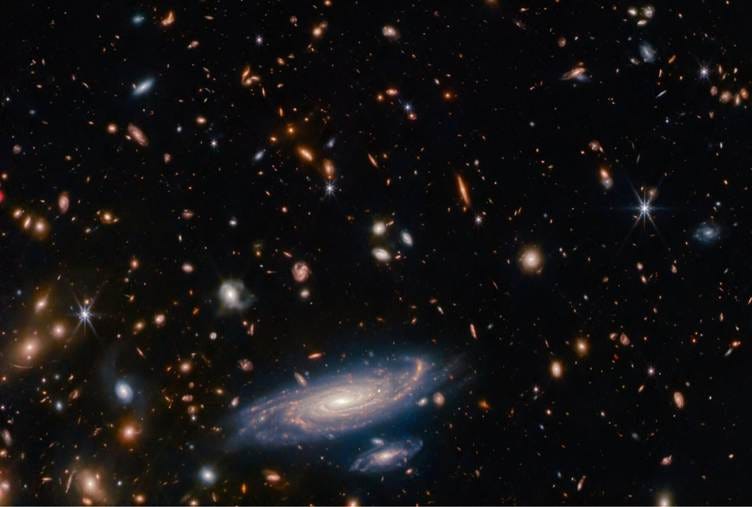
The large galaxy at the bottom of this picture is nearly one billion light years away from Earth. The James Web telescope that took this picture itself sits 1.5 million kilometres away from Earth.
If we destroy the Earth systems we clearly diminish the impulse to understand – in a climactically chaotic world we will build no more James Webb telescopes. But this twin fold view also suggests that such a diminished world could diminish the strength of what we feel as Love.
So often as we have struggled to become our next selves, we have reached for Promethean dreams – dreams of progress, fantasies of becoming Gods. Giving up these dreams can leave us feeling bereft – if our destiny is not to conquer the stars, then is the most we can hope for simply avoiding a return to the Neolithic? It is here that the possibility that in the future we might be part of countless ways for life to unfurl its sacredness - and with it, to unfurl us – holds deep comfort. If the buzzing, blooming complexity of life holds ever deeper levels of the sacred waiting to be discovered, then the future is not limited to what we can control and manipulate. Perhaps, in this planetary unfolding of life, consciousness, and love, we are, despite what we have done, not yet damned.
All this leads both up and down. Look down, and - in Christian terms - we catch ourselves in a daily re-enactment of the crucifixion, as again and again we nail Mother Earth to the cross of consumer capitalism. But look up, and we glimpse the possibilities of entirely new unfoldings of love and sentience. We are both at Calvary and at the same time, we are standing with Mary, speechless, awe-struck, at the mouth of the open tomb. This deep connection between despair and delight seems right for our times, and holding both feels like part of the soul work that is required of us right now. Perhaps this is what is means to be sung by the sacred as we make our way, reaching out with love and understanding, to whatever is coming.
[No AI was used in writing this post]
Although he probably would not see it this way, the work of developmental biologist Michael Levin, shows that within the immense complexity of developing biological organisms, there are many kinds of developmental journey that are best explained by a kind of neo-platonic teleological pull towards the destined form. For example the young human brain at some stages of its development is making 250,000 neuronal connections per minute. Clearly such waves of developing, coherent complexity cannot be controlled by genetics, codes, plans or reductive A causes B causes C kind of mechanism. Rather he interprets the evidence implied by this kind of development as saying that the whole system of the developing brain is drawn towards the desired result by an implicit field created by the developing organism itself.
The evidence that always and everywhere, everything ‘becomes together’ was most forcefully brought home to me by the eco-evo-devo revolution in biology. See Gilbert S, Epel D, Ecological Developmental Biology, Sinauer, 2015.
This is why this is a pantheistic rather than a panentheistic view of the universe: there is no ground of being from which matter and the universe arise. Rather the sacred arises if, as, and when, matter, in planetary systems pushed far from thermodynamic equilibrium by their local sun, becomes complex and entangled enough to manifest what we call sacredness and knowingness.
No posts
Comments
Nothing yet. Say the first thing.
Sign in to join the conversation.