
This is a long post from midsummer 2022. I think I was trying to ‘feel it all’ - to see and understand my situation, our predicament and the Earth’s turning, while not trying to create an all-seeing overview. The politics feel quaint - would that things were so simple now - but this mixture of witness and entanglement has stayed with me as an important way of being, and seeing. A stance worth valuing.
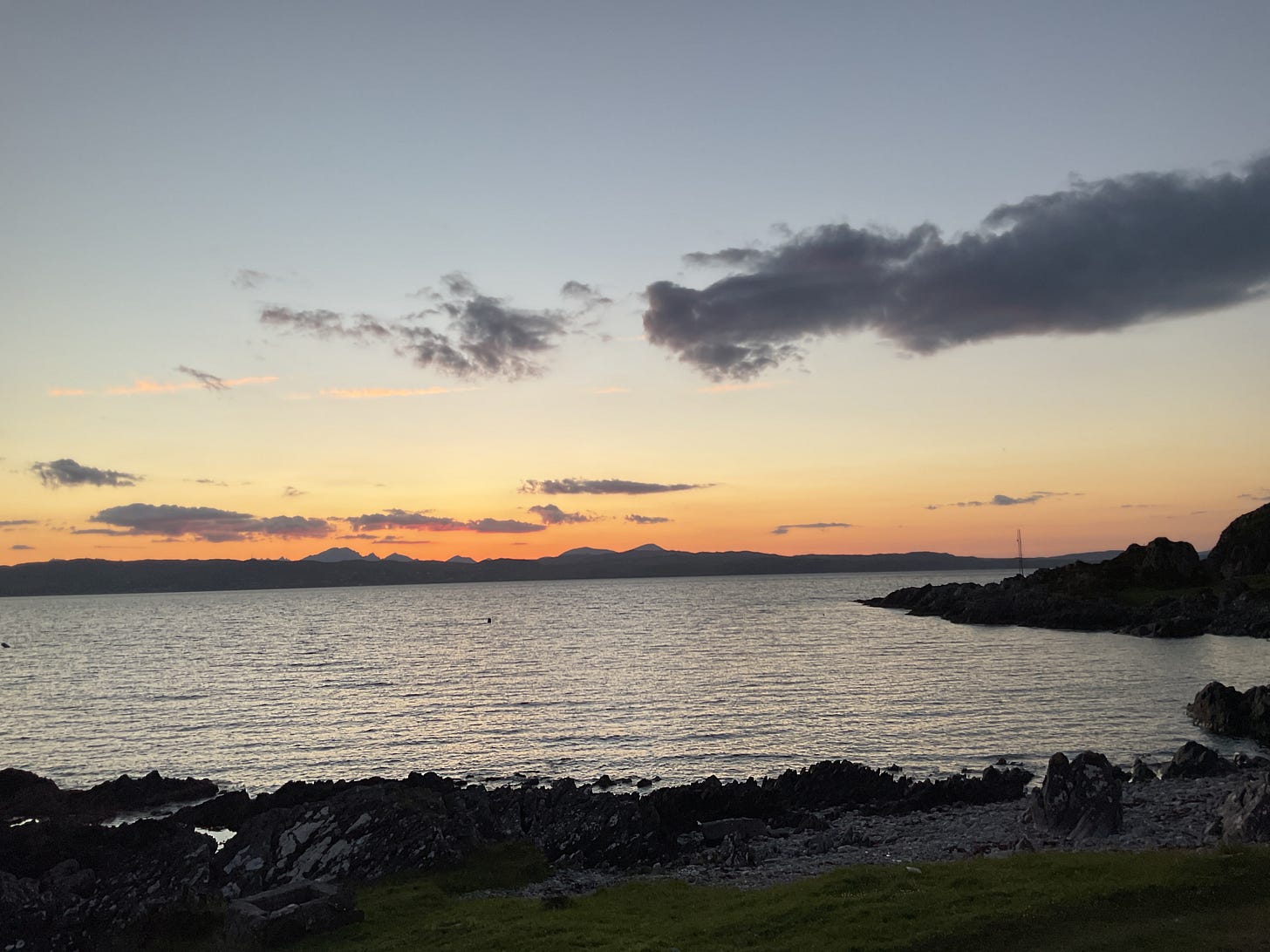
Doune, Knoydart, Scotland Mid-summer 2022
Doune is a tiny hamlet on Knoydart. It is unreachable by road and sits opposite Skye on the Sound of Sleat. Bleak and beautiful. Endless summer nights, bog brown in the damp of winter. Geology is everywhere - 12,000 years ago, just as the Holocene, the age that nursed human civilisation into being, was beginning, this was a place glaciated beyond measure, ice a kilometre thick, gouging out the lochs, shaping the hills to some claw-handed balance of stone and glacier. But today it is almost mid-summer, and it has a boundless bleak beauty, a joy to witness, and to be part of.
How do we see things properly? How do we really see the world at this time of climate breakdown and habitat destruction? How can we bear witness to the fullness of the thing, to the multifaceted nature of places like Knoydart, as we and it are changed by the climate change and ecocide wrought by capitalism and economic growth? Gathering anything but a few threads of a place may be impossible but, as we descend into the Capitalocene, I need ways to hold myself, ourselves, as accountable as I can be to the fullness of a particular place. Perhaps this will help to stop our gaze slithering away to the galloping consumption that is our culture.
Looking out across the sea from Doune you see Mallaig where the herring fleet used to come to offload their catch. Herring were gutted and salted on the quay by the crowds of fish wives that followed the fleet up and down the coast. From Mallaig the purpose-built railway would then deliver the protein to the hungry gullet of Glasgow, Manchester and Bradford. The elites were well aware - better perhaps than we are now - that we are only nine meals away from a riot. A steady haul of sugar, grain, meat and protein was both the motor of the industrial revolution and the pacifier of the massed hands whose labour and exploitation created the accumulating capital of the Empire. The herring and the fish girls are long gone now, the calories replaced by Indonesian palm oil and Ukrainian wheat, all fertilised by oil from the Gulf.
Doune has the archetypal West Highland landscape, great arcs of rock, treeless moor and bog. Laced with inlets, its bare, bleak beauty seems timeless to us. But like all our landscapes it was created by humans as much as by ice or by nature. In the 1851 census there were 157 people living in the village of Doune. Ten years later there were seven. Doune came almost last to the Highland Clearances, wrecked by a complex mix of forced enclosure of the commons, changing land use as landowners sought profit, all mixed with increasing poverty as previously cleared communities collapsed into the last remaining ones and crops failed with potato blight. Finally of course there was the deliberate ad hoc violence from landlords and clan chiefs – house burnings, beatings, debt peonage. The Clearances were part of a world-wide process that turned land held in common into commodified property. During the 1850s the people of Doune were shipped from Skye, to Saskatchewan and the Canadian prairies, where they themselves became small property holders, whilst the now dispossessed indigenous people looked on. The ruins of the crofter’s stone houses are scattered across a landscape now cleared of both trees and humans, by the grazing herbivore ecology of sheep and deer. The bleak, sweeping beauty of the Scottish Highlands that we love is mute witness to a colonial economy run for the benefit of the white male patriarchs of Victorian capitalism.
The Lockean theory of liberty holds that ‘men’ should be free to use their own labour to turn the unclaimed resources of the Earth into property and wealth. The trouble is that there is never any place that is unclaimed. Wherever you go, land is already occupied by other people, other animals, other networks of life. So if the capitalist is everywhere to exert ‘his’ God-given (as in Genesis 3) freedom to create wealth, the people of Doune together with the deciduous forests that used to cover Scotland must give way to the sheep and the deer and the desolation of the ruined black houses. Doune is the local version of the story of violence and expropriation at the heart of all capital accumulation. It is not a question of ‘doing capitalism better’ because the accumulation of capital always involves the expropriation of someone else’s communal land, food, water, labour, culture, resources, or data. The land from which profit grows is never empty, it is always already someone else’s, already filled with its own buzzing, blooming ecologies.
And this rentier economy run for the 1% lives on today. The Loch Nevis estate round the corner from Doune is owned by Rupert Soames (Eton, Oxford and the Bullingdon Club), who is both the current CEO of Serco and the grandson of Churchill. In 2021 his pay, including bonuses, was £4.9 million. £700 million of Serco’s income that year came from its Test and Trace Covid contract. Reading about him, he is clearly a talented man who leads with refreshing quirkiness - he keeps a toilet brush on his desk as his personal Shit-o-Meter to wave at underlings who might be gilding their reports. Interviews indicate that he recognises the role that happenstance and class have played in helping him to his great fortune. But still, none of this alters the inescapable inequality of capitalism that bears down on this landscape.
Skinny dipping at Sandaig round the corner from Doune, the June sun is hot, the hills amazingly beautiful. A deer stands on the shore. The temperature is rising, the sea rising. It is a relief to get into the water. I feel we are perched on the edge of wilderness, sustained by petrol, unable to escape our oily footprints.
There are no sea birds. When I was a child on holiday on the West Coast for all those years, there were lots of birds – razor bills, black guillemots, oyster catchers, curlews, cormorants, great crested grebes and mergansers. Flocks of black and white male eider ducks as big as a magnate’s carpet used to gather on the water in June. Artic terns, greater and lesser black-backed gulls, black-headed gulls, the occasional skua and great northern diver, gannets plunging from the sky. Now almost nothing. Gone with the herrings and the fished-out sand eels. I find the silence eerie. The absence of sound is like a premonition – Look, listen, nothing. You too, soon.
The other guests in our little 3-day community include an ex-oil man and an internationally renowned climate scientist. We step gingerly around the oil slick in the room, each knowing that the difference in our life paths is significant but that none of us have travelled this life as innocent babes, for we all come trailing clouds of carbon in our wake. Peter, the climate scientist is notably cautious when engaged around climate. Too many conversations with strangers have turned incandescent, too many factors to be weighed for any easy answers. In the past our prophets were individuals – Darwin, Malthus, Freud, Marx, whoever - today it is the IPCC and the icecaps and coral reefs who own the prophetic voice and Peter is not going to oblige us by coming down from the mountain with any personalised tablets of stone.
In the evening a lone deer stands outside the houses, foraging gently. At 2 in the morning the northern edge of the sky is still tinged with light, the sun slumbering along just below the horizon. I stand in the dusking dawn and think about how the same sun is, right now, shining out on the mid-winter Southern Ocean, firing the great cycles of carbon, water and calcium as it goes.
I have been thinking about forgiveness. Or rather being forgiven. I find that the theology of forgiving others is rather better developed than that of being forgiven oneself. To forgive others is to lay down the wounded self, to stop holding my hurt so close. It is a good and generous thing to do, something that lies fully within the arc of our agency. If we are lucky, we may find ourselves, together with the wound and the wounded, subsumed in some kind of healing.
But what to do when it is we who need forgiveness, us that has caused the wound? What to do when we seem incapable of laying down the knife, when each time we move we lacerate the Earth anew? How do we forgive ourselves when the guilt, the debt, is still accruing? Collective guilt of itself is paralysing, but without somehow being confronted with what we have done, we will continue to disavow what is happening, seeing with one eye that the Earth is falling apart, whilst screwing the other tight shut as we book the next holiday to Greece. Such cognitive splitting ends up with all the fetishised nonsense of carbon markets, biodiversity credits and geo-engineering because it is the nature and purpose of fetishes to allow us to both know, and continue transgressing. Meanwhile I can see the otter swimming in the bay - will the otter forgive us?
Opposite me a massive mountain swoops up from the sea, a thin layer of moss and turf built up in the 12,000 years of the Holocene, covers its grey flanks. A gulley plunges vertically down and already, a few millennia in, the water has carved a gash a meter or so deep where I can see a tumble of rocks at each turn in the sheer drop. This is erosion in action, and it is this weathering that ultimately heals Earth’s carbon dioxide excesses. Most carbon dioxide leaves the atmosphere via of rocks washing away. Doesn’t sound very hopeful, does it? Some of these Scottish rocks are pre-Cambrian, as old as time, some of the oldest known rocks on Earth, they don’t weather so much as endure. Still, each little crevice helps, and as the torrential rains pour down, the exposed rock beckons the molecules of carbon dioxide in to combine with its proffered calcium and settle into a new, mildly acidic marriage of carbonic acid and dissolved calcium which in turn will offer itself to the whelk and the diatom before falling to the ocean floor as proto-limestone. The oceans have so far taken great gulps of our greenhouse heat, but it is weathering of the rocks that will remove our carbon dioxide. And of course weathering is measured in millennia not centuries or decades.
The Earth alone and unattended removes 1 gigaton of carbon dioxide each year. Meanwhile we throw another 30 gigatons a year into its failing systems. You might think that if only we can stop adding this carbon dioxide it might not take that long for the Earth to weather all that carbon away but sadly Earth’s own gigaton of absorption per year is needed to to deal with Earth’s background carbon release. So the 1500 gigatonnes of CO2 that we have tossed into the atmosphere since 1750 will be with us for a long, long while. We can safely say that at least the next 100 generations of our children will be looking back to us as their ancestors asking why we failed to act.
A few days after we reach home, I find a tick just out of sight on my left haunch. A part of Knoydart has come home with us and is eating me. Big and round and itchy I’ve been scratching it absent mindedly for a few days. Removed, it crawls weakly on my finger before being flushed down the toilet. Although I have had several hundred tick bites in my 70 years, my heart still feels slight disgust. My head wonders about the contortions I would have to go through to see the tick as fully part of Creation. Not all bits of the web of life are equal it seems.
One day we go to Tarbert – the narrowest link between the sea and the freshwater Loch Morar. There are lots of Tarberts all over the west highlands because Tarbert means the place where you ported your small boat overland between one stretch of glaciated water and another. Knowing where your Tarberts were saved Neolithic and iron age peoples many miles of arduous coastal trekking. Looking at the map I can see they were right - this is the best place to cross. I think about using coracles on Loch Nevis – when I sailed these lochs, Loch Nevis was renowned for intense squalls coming off the mountains making it almost impossible to anchor securely so we never sailed here despite its beauty. I wouldn’t like to sail a coracle here and I salute these neolithic coracle carriers as we cross Tarbert, tracing their footsteps in the summer sun.
Running alongside our three days in Knoydart are worries about a dear younger relative, who is being investigated for a lump in her thyroid. Perhaps a benign nodule, perhaps thyroid cancer. She – and we – are waiting for definitive test results. Thyroid cancer of course might be related to Chernobyl whose radioactive iodine arrived over Britain when she was a child. Or perhaps to any of the other environmental toxins to which we are subject.
Looking on the web I see that one of the more recondite treatments for thyroid cancer costs £60,000 per patient per year. It has not been approved by NICE but I am still thankful for the science – enabled by those 500 years of colonial carbon and resource extraction – that promises treatment and cure for these gnawing possibilities. And thankful too for the mutuality embodied in the NHS that has (at least a little) prevented market commodification of medicine. And of course this mutuality grew out of the experience of exploitation and ruin embodied by the class history of places like Doune. All these good things, all this progress, depended – and depends - on the extractive and exploitative violence of capital accumulation. Yet again, we are caught on the point of the knife - what we want and need is exactly what is killing us.
While we were at Doune the outside world went on its way. The 94-year-old Queen celebrated her Platinum Jubilee and Boris Johnson survived a vote of no confidence. These largely passed us by. As so often politics seems to be a shadow-play. It no longer represents enough of the real to be worth paying much attention to. Somewhere we no longer believe in the future, or at least a future predicated on past assumptions of growth and Promethean dreams. We know that something is ending, and the centre is not holding. The periphery – places like Doune, the places where the taking and dumping and exploiting and violence happened – are becoming more important as whatever dark beast slouches towards us waiting to be born.
Its hard to know where all these facts and threads lead isn’t it? Does all this amount to a Quakerly ‘bearing witness’? Isn’t all this thinking just a distraction from being fully present to the beauty of Knoydart? And surely just being present is an entirely adequate aim. Perhaps this way of bearing witness is more akin to the compound eye of the insect – a multifaceted way of looking at the world. Such a multifaceted view also reflects our experience of living on the internet – a million ways to connect to everything else with nothing more than a Google algorithm to tell us which is the important one to look at. But it is also congruent with being part of an ecosystem - one way to experience the way everything, in every ecology, always ‘becomes together’. In an ecology there is no ‘up’ no ‘down’. Each living and non-living element is held in an on-going wave of co-being, and co-evolution as the ecology moves through time. We may choose to see things in terms of keystone species, or a staid succession to a climax ecology, or energy flowing back and forth between species. Or in terms of a personal journey which our autonomous self is busy persuading us is authentically our own. In reality, these are just many different frames, many ways to experience the richness of living in ecological relationship with the rest of life.
The point is that all this runs through me. I may not be aware of it, but this is what I can see from my bit of the web of life, of history, of becoming. We are always riding the wave of the present, formed by the past, and all the rocks it has ridden over. And we are always in the process of falling into the future. To live these times of Earth crises fully, to hold all these different aspects is not to try for any kind of all-seeing objectivity, still less control. Instead this multifaceted bearing witness carries the hope that my next act as I surf the wave of the present might be a little more in tune with the kind of life that the future, out there in the next instant, next decade, next generation, next millennium, is calling us to live.
No posts
Comments
Nothing yet. Say the first thing.
Sign in to join the conversation.