
What have we done? And why? Join me ‘On Earth As It Is’ . . . because only by understanding the past will we free ourselves from its tyranny.
Reading these documents cold, one is is left staggered by the callousness and cynicism of the individuals involved.
Next Thursday: ‘Every cause for war has vanished’
RUSSIAN SUPPORT STIFFENED Serbia’s spine.
Around noon on 23rd July 1914 – six hours before the deadline for Belgrade reply to Austria’s ultimatum – Serbia received a telegram from Russia’s foreign minister, Sergey Sazonov.
Sazonov promised Serbia Russia’s full support and advised its ally to accept all points on the ultimatum that did not conflict with Serbia’s sovereign rights.
Russia’s open-ended offer echoed the blank cheque that Austria had received from Germany a few weeks earlier.
The Serbian Government would do exactly as Russia advised. That afternoon, Serbian prime minister Nikola Pašić informed the French and Russian Embassies of the likely contents of Serbia’s reply. It seemed that Serbia would indeed fall on its sword and accept just about every clause.
This included dissolving all associations that might agitate against Austria-Hungary, censoring press criticism of Austria, and dismissing from service in the Serb armed forces and the government any officials who had taken part in anti-Austro-Hungarian agitation.
But they would not accept every clause. Serbia would refuse the demand that Austrian officials be allowed to join the investigation of Serb ‘accessories’ to the assassination of Franz Ferdinand (the critical Point 6), because it trampled on Serbia’s sovereign rights.
The murder, we should remember, was committed in Bosnia, outside Serb territory. But sovereignty was not the real reason Serbia refused: Belgrade feared that Austrian investigators would expose the role of The Black Hand, which had had close relations with the Belgrade government.
As the 6pm deadline approached, the word spread that Serbia had submitted to most of Austria’s demands. Did that still mean war? Would Austria accept Serbia’s partial prostration?
Truculent German and Austrian officials feared that Serbia might actually accept all their demands – thus denying them the war they so dearly sought.
Indeed, a prominent German confessed to Jules Cambon, French ambassador in Berlin, that Germans greatly feared that Serbia would accept every point.
So it was with indecent relief that Berliners read in the local press that General Giesl, Austro-Hungarian minister at Belgrade, was preparing to leave Serbia.
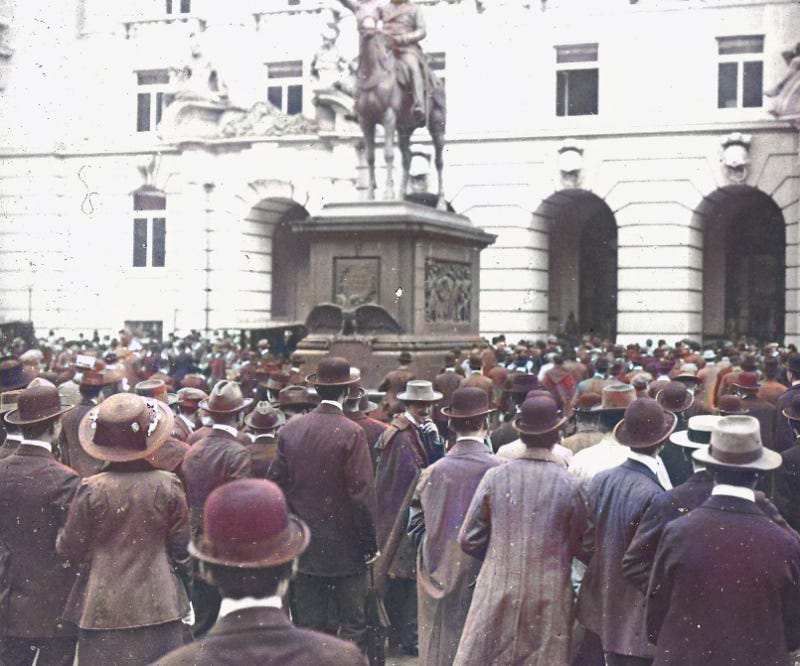
At the news, large crowds queued at newspaper offices in Berlin shouting ‘Hurrah!’ for Germany and singing patriotic songs. An alarmed Cambon advised Paris:
‘I, for my part, see in Great Britain the only Power which might be listened to at Berlin. Whatever happens, Paris, St Petersburg and London will not succeed in maintaining peace with dignity unless they show a firm and absolutely united front.’
—
Little Serbia proved a resilient participant in the great game of European power.
The Serb Government sensed, no matter how conciliatory its reply, that Vienna and Berlin wanted war in the Balkans.
Belgrade started officially mobilising its army at 3pm on Thursday 23rd July, three hours before the deadline.
At the same time, the government officers and the garrison began to evacuate Belgrade for the southern city of Niš.
Emboldened by Russia’s backing, the Serbs planned to use their reply to Austria to achieve three vital diplomatic aims: to win the support of the Serbian armed forces and extreme nationalists, by showing them that the country would not capitulate to Vienna; to win the sympathy of European governments and public opinion; and to cast Austria-Hungary as the aggressor.
—
So they took extreme care over the draft. The final version, sent for translation at midday on the 23rd, was whisked away several times during the afternoon and ‘so full of crossings out and additions as to be almost incomprehensible’.
At 4 pm, it was ready for typing, and, after some dithering over who should deliver it, Pašić personally took it to the Austrian Legation in Belgrade, at 5.45 pm.
There, he addressed General Giesl, the Austrian ambassador, in broken German: ‘Part of your demands we have accepted . . . for the rest we place our hopes on your loyalty and chivalry as an Austrian general.’
Pašić returned to his office and wrote to the Serb embassies in Europe: ‘Austria-Hungary,’ he warned, ‘unless they are determined to make war at all costs, will see their way to accept the full satisfaction offered in the Serb reply.’
The government then boarded trains for Niš, Serbia’s third-largest city and new wartime capital, leaving the near-deserted city of Belgrade at the mercy of the Austrian forces then massing on the border.
—
General Giesl knew exactly what was expected of him. On receiving Serbia’s reply from Pašić, he glanced at it, saw it was inadequate and signed a previously prepared letter, which was immediately handed back to the Serbian Government.
The letter severed diplomatic relations with Serbia and announced the departure of the Austro-Hungarian Legation. Giesl, his bags packed, ordered the destruction of the Embassy’s code books and, with his wife and staff, caught the 6.30pm train to the Austrian frontier.
‘I found the streets,’ he later wrote to the Italian historian Luigi Albertini, ‘leading to the station and the station itself occupied by the Serbian military.’
—
The Serbs well knew their reply had had no chance of being accepted. Yet their answer grovelled less than many had supposed.
With Russia hard at their shoulder, they took a tougher line than they would have done. Of the ten points, Belgrade partially or fully rejected Points 4, 5, 6 and 9, and had reservations about the rest.
There was more than a hint of mockery, of careless derision, running through their answers. Their curious circular sentences began with apparent offers to cooperate (‘The Royal Serbian Government regret that . . .’, ‘The Royal Serbian Government undertake to eliminate . . .’) and ended by pulling the rug from under Austria’s feet.
Serbia’s tone of mock innocence (‘Who? Us?’), their semblance of hurt pride and sly references to the harm done to their ‘good neighbourly relations’ with Vienna (relations were anything but!) were calculated to irritate and provoke.
Consider, for example, Serbia’s replies to Austria-Hungary’s three key demands, Points 4, 5 and 6:
‘4. [Serbia] agree to remove from the military service all such persons as the judicial inquiry [then underway in Bosnia] may have proved to be guilty of such acts directed against the integrity of the territory of the Austro-Hungarian Monarchy, and they expect [Austria-Hungary] to communicate to them at a later date the names and the acts of these officers and functionaries . . .’
Here, Serbia had agreed to sack the guilty parties, but only after Vienna sent them the names, rendering the whole exercise futile, because Serbia refused to allow Austrian investigation of its officials (see 6, below).
‘5. [Serbia] must confess that they do not clearly grasp the meaning of the scope of the demand made by [Austria-Hungary] that Serbia shall undertake to accept the collaboration of the representatives of [Austria-Hungary] upon their territory, but they declare that they will admit such collaboration as agrees with the principle of international law, with criminal procedure and with good neighbourly relations.’
If this meant anything, it meant that Serbia had no idea what Austria was on about, but would act according to Austria’s wishes at such time as they became clear, in accordance with ‘international law’, etc.
‘6. . . . As regards the participation of Austro-Hungarian agents in [Serbia’s inquiry into the assassination] . . . [Serbia] cannot accept [those agents on its soil], as it would be a violation of the Constitution and of the law of criminal procedure . . . ’
In short, Serbia was telling Austria to shove off.
—
Was Austria-Hungary actually going to declare war on Serbia and probably provoke a European conflict because Belgrade had refused to accept Viennese policemen on its soil?
The Austro-Hungarians responded with all the puffed-up indignation of an ailing and desperate empire. They attacked Serbia’s answers in turn, in order to win the propaganda battle and justify the real war. They circulated their reply to the European embassies on 28 July. Most cities did not receive it.
In any case, it persuaded nobody of Austria’s cause.
Austria-Hungary had also demanded that Serbia muzzle its anti-Austrian press, confiscate any propaganda deemed to incite hatred and contempt for Austria-Hungary and punish the perpetrators.
In response, Serbia merely proposed a new press law, with a vague commitment to control it.
The rest of Austria’s objections amounted to legalese, phony indignation and diplomatic pedantry.
—
The whole exercise, of course, was a grotesque charade, on both sides.
Take Serbia’s mocking response – ‘we possess no proof that the Narodna Odbrana and other similar societies have committed any criminal act’ – while in the next breath agreeing to ‘dissolve the Narodna Odbrana Society and every other society that may be directing its efforts against Austria-Hungary’.
In other words, Serbia had agreed to dissolve its most important cultural organisation for no reason whatsoever, making the gesture worthless.
Reading these documents cold, one is is left staggered by the callousness and cynicism of the individuals involved.
In the context of Austro-German war plans, they are intelligible as a set of malicious diplomatic contrivances.
Austria’s demands were merely the devious machinations of a sclerotic empire desperate to extract a casus belli in order to destroy its hated neighbour and restore its ‘prestige’.
Serbia knew this. Its answers had nothing to do with satisfying Austria, and everything to do with appealing to European opinion and unifying the Serbian people ahead of likely hostilities.
—
Vienna was in a quandary at the Serbian reply. Serbia had refused to give Vienna a firm case for war. Why had Serbia not rejected everything as anticipated, the government wondered. Were they not men of honour? How dare they submit to so much! How dare they grovel!
Serbia’s reply made war difficult to declare. And, worse, by going further to meet Austria’s demands than many expected, Serbia had enlisted European sympathy and stolen the wind from Vienna’s sails.
For a moment, Count Leopold Berchtold, the once-bellicose Austrian foreign minister, seemed oddly relieved: here was a chance to avoid conflict. Perhaps Belgrade had submitted enough?
Berchtold, back to his old leisurely, aristocratic self, briefly entertained the idea that a diplomatic victory may be enough.
The Austrian armed forces, too, faltered in their resolve. The General Staff were ‘like a horse three times taken up to an obstacle and each time reined back, will refuse to jump it’, warned the chief of staff, Conrad von Hötzendorf.
The Austrians, reluctant to declare war now the decision was upon them, dreaded the consequences.
Berchtold appeared to flirt with the idea of waging a phony war, which would retrieve Austrian honour without risking a European conflict. Quick to don his armour in a show of political defiance, he was just as quick to discard it when battle stared him in the face. The Austrians seemed to have lost their nerve.
Selected sources and further reading:
Albertini, Luigi, The Origins of the War of 1914 (3 vols), Enigma Press, New York 2005
Bethmann Hollweg, Theobald von, Reflections on the World War, (transl. by Young, George), Cornell University Library, New York, 1920
French Yellow Book, Chapter II, No. 8. M. Dumaine, French Ambassador at Vienna, to M. René Viviani, President of the Council, minister for foreign affairs, Vienna, 2 July 1914.
Geiss, Imanuel, July 1914 The Outbreak of the First World War: Selected Documents, Charles Scribner’s Sons, New York 1967
Hochschild, Adam, To End All Wars: A Story of Loyalty and Rebellion, 1914–1918, Mariner Books, Boston 2012
Hötzendorf, Conrad von, Aus meiner dienstzeit, 1906–1918, University of Michigan Library, Ann Arbor 1921
Keiger, John, Raymond Poincaré, Cambridge University Press, Cambridge 1997
Ludwig, Emil, July 1914, Putnam, London 1929
Ludwig, Emil, Wilhelm Hohenzollern: The Last of the Kaisers, AMS Press Inc, New York 1978
Margutti, Albert von, La Tragédie des Habsbourg, Bibl. Rhombus, Vienna 1923
Paléologue, Maurice, An Ambassador’s Memoirs, (transl. by Holt, Frederic), George H. Doran Company, New York 2008
Seton-Watson, Robert, Sarajevo: A Study in the Origins of the Great War, Hutchinson, London 1925
Smith, David James, One Morning in Sarajevo: 28 June 1914, Phoenix Press, London 2009
Sondhaus, Lawrence, Franz Conrad von Hötzendorf: Architect of the Apocalypse, Brill Academic Publishers, Leiden, Netherlands 2000
Sosnosky, Theodor von, Franz Ferdinand. Der Erzherzog-Thronfolger. Ein Lebensbild, Verlag Von R. Oldenbourg, Munich 1929
Strachan, Hew, The First World War: Volume I: To Arms, Oxford University Press, USA 2003
Sulzberger, Cyrus Leo, The Fall of Eagles, Crown Publishers, New York 1977
The World War I Document Archive, ‘The Assassination of Archduke Franz Ferdinand’: http://wwi.lib.byu.edu/index.php/The_Assassination_of_Archduke_Franz_Ferdinand
The World War I Document Archive, Records of national diplomatic communication: The Belgian Grey Book, The French Yellow Book, The German White Book, The Russian Orange Book, The Serbian Blue Book, The Austro-Hungarian Red Book, see also: http://www.gwpda.org/
This essay is an edited extract from my book 1914: The Year the World Ended published by Penguin Random House (UK and Australia).
Comments
Nothing yet. Say the first thing.
Sign in to join the conversation.