
A recent WSJ op-ed begins with:
Dear College Graduate:
Congratulations on your degree. I hope it was hundreds of thousands of dollars well spent, though probably not as fervently as your parents do.
According to the Education Data Initiative, the average annual cost of attendance for the 2022-2023 academic year was $27,146 for in-state students at public four-year universities, totaling $108,584 over four years. Out-of-state students averaged $45,708 annually, for a four-year total of $182,832. Students at private, nonprofit universities paid an average of $58,628 per year, for a cumulative investment of $234,512.
This sounds like a reasonable data-driven take. But, these numbers are ignoring the fact that cheap schools have the vast majority of our students, and ignoring the opportunity cost of living.
First, there is conflation of cross-institution costs with what the typical American pays. For example, if there are 2,000 colleges and universities, it can be easy to just look at the average across universities — but the largest universities that have the most students tend to be cheaper (large, non-profit state universities). As a result, the typical American pays much less than the unweighted average in tuition.
To see this, consider data from the Integrated Post-Secondary Education Database Data System (IPEDS). I have a structured db here that made it easy. We can look at the distribution of costs across public, private non-profit and private for-profit universities, weighted by their enrollment. Importantly, public universities charge far more for out-of-state and international students, so we split the costs weighted by enrollment of in-state vs. out-of-state students.
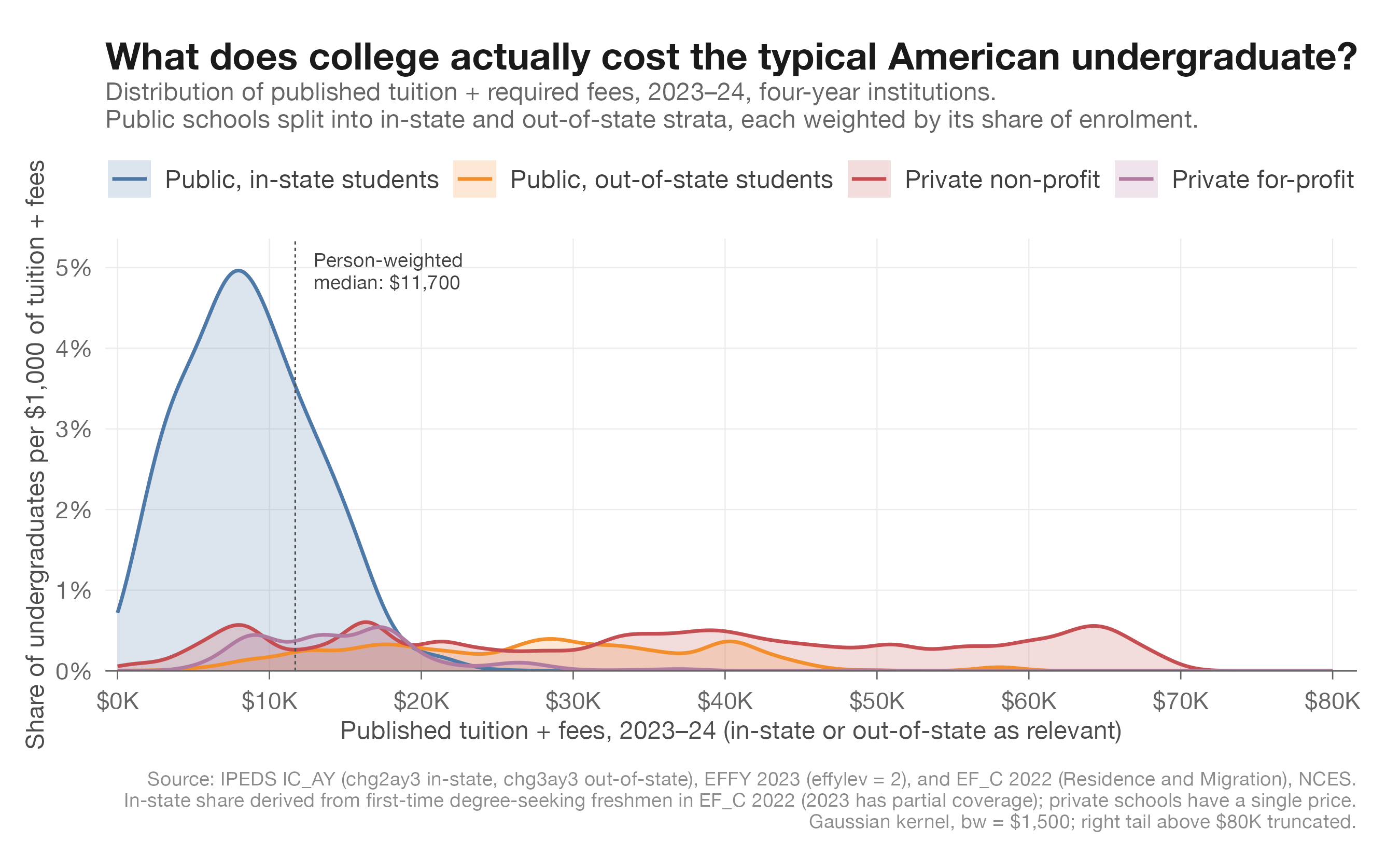
The median tuition is 11,000 dollars for a year for four year institutions. That’s a grand total of 44 thousand dollars in four years. And 50% of students would pay less!
Next, a reasonable critique here is that tuition isn’t everything — room and board is an important aspect of the college cost. Fortunately, for most schools, a full “cost of attendance” (COA) measure is reported. If we apply the same exercise, we see a much higher cost:
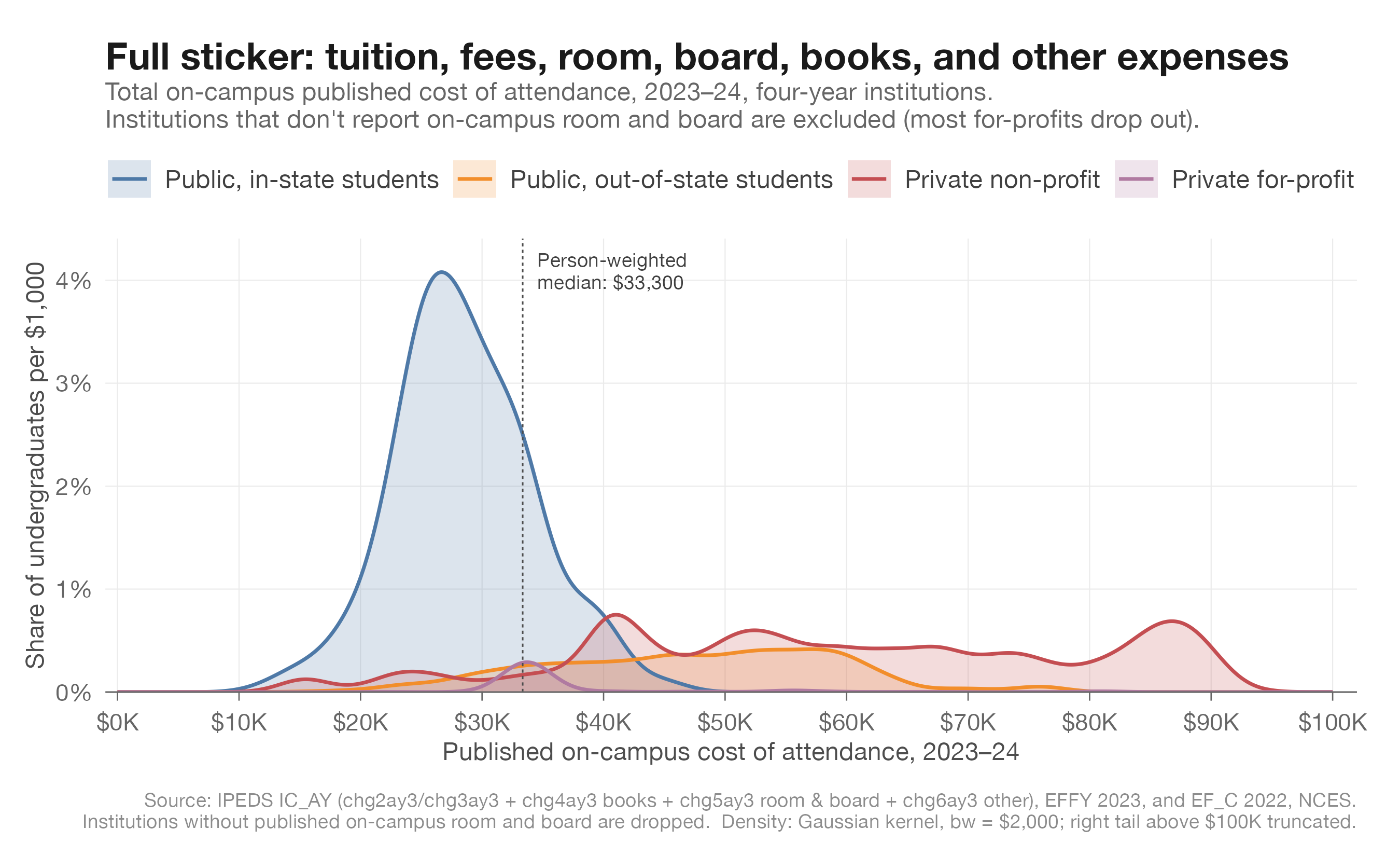
The measure has almost tripled! Room and board is expensive, clearly. And for the median student, four years of college would cost 132 thousand dollars.
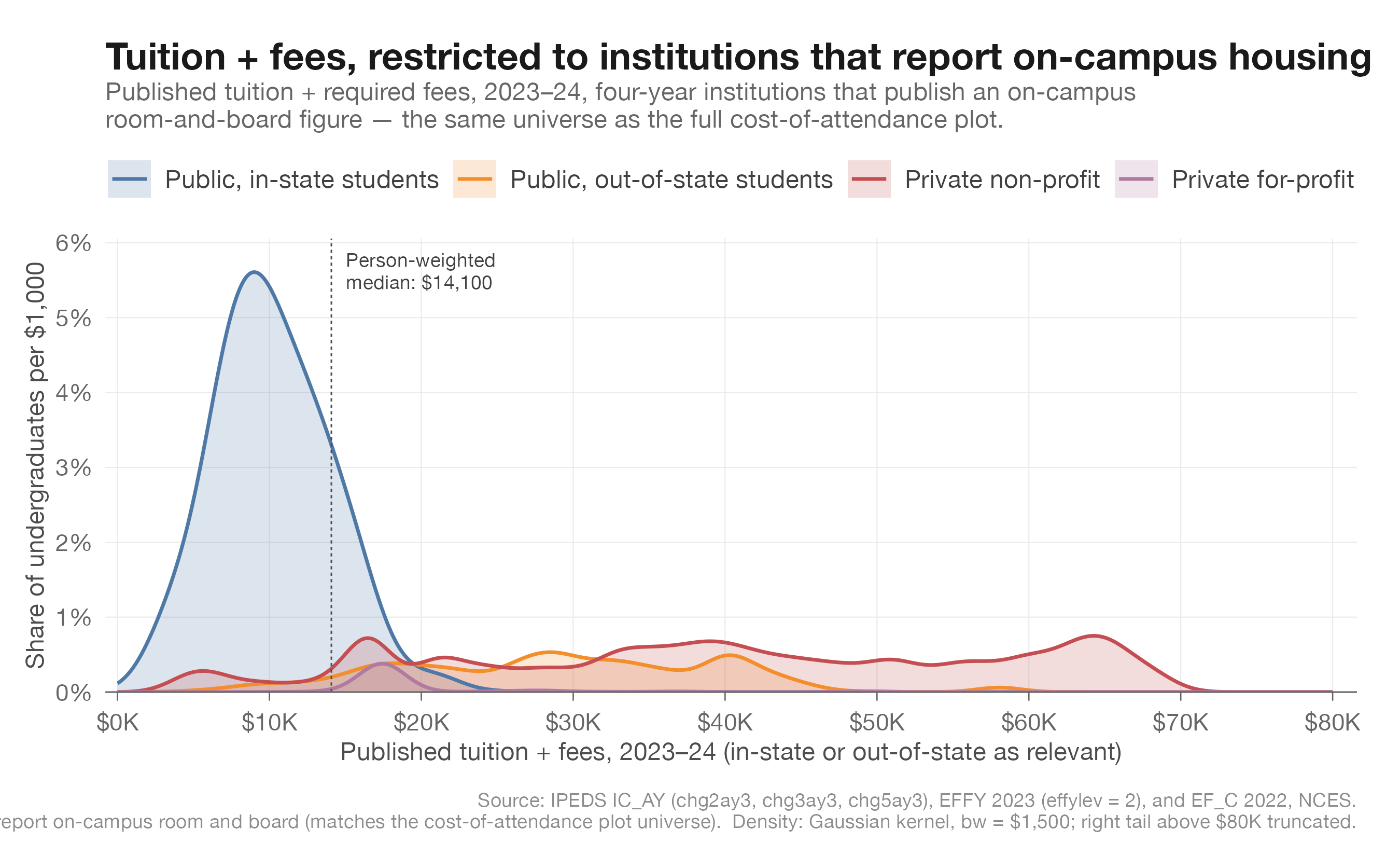
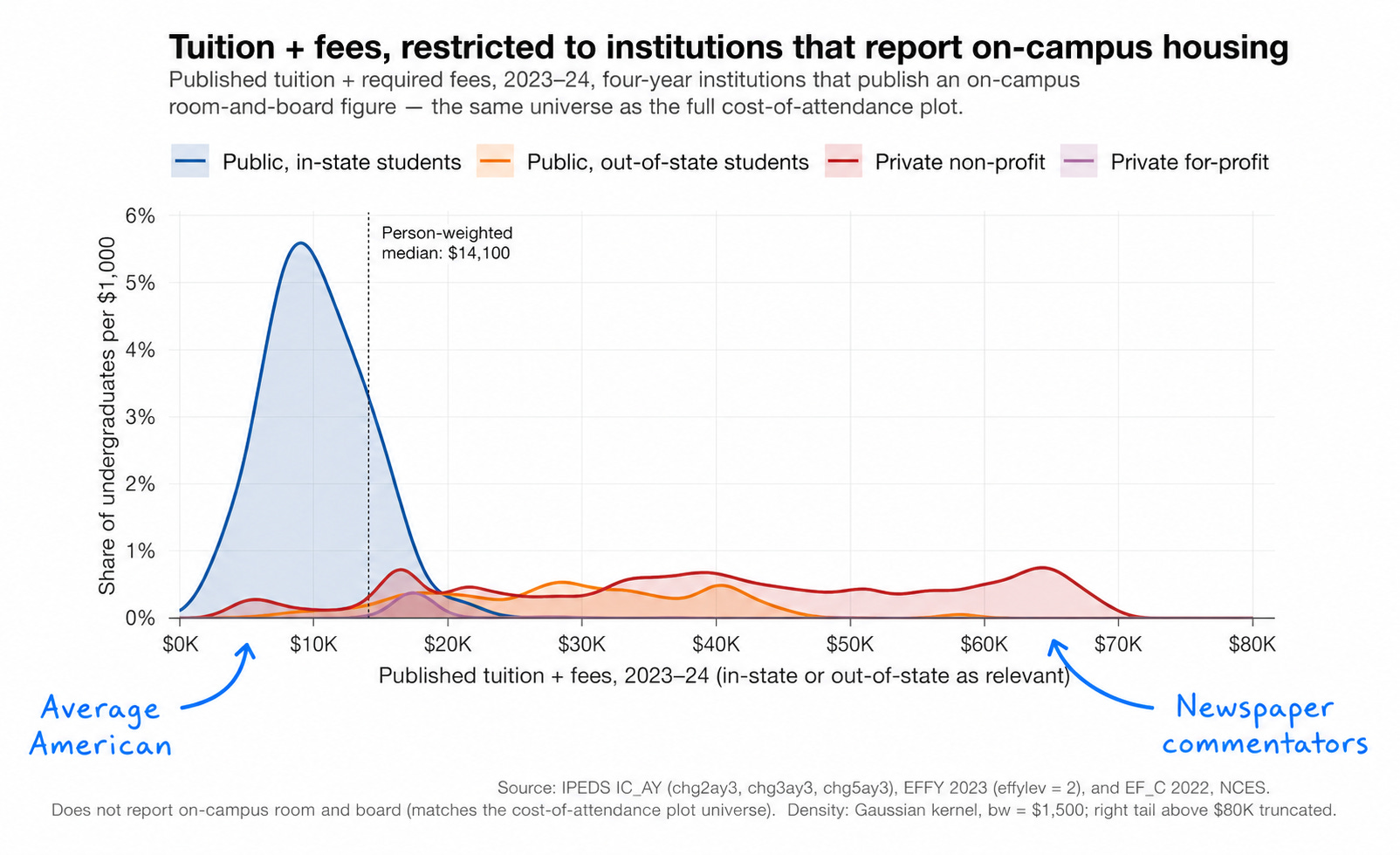
Two things are at play here. First, by condition on the institutions that report COA, we’re selecting on the more expensive schools (e.g. throwing out commuter schools). We can see below that the median student among those schools pays more on tuition overall.
Second, housing and food is just expensive! If we consider the counterfactual of just living in housing plus food, what would annual cost be? Consider the following exercise for a student living Urbana-Champaign (in Chamapign county)1:
FMR rent for a three bedroom is $1,372, split three ways: 457, for twelve months: 5,488 dollars
The USDA reports that monthly cost for food for an adult can be anywhere between 3,746 dollars a year to 5,737 dollars a year, depending on how thrifty you are.
Let’s say this is ten thousand dollars a year. Then, the cost over those four years is forty thousand regardless of college attendance. So the true exercise here for the median student is:
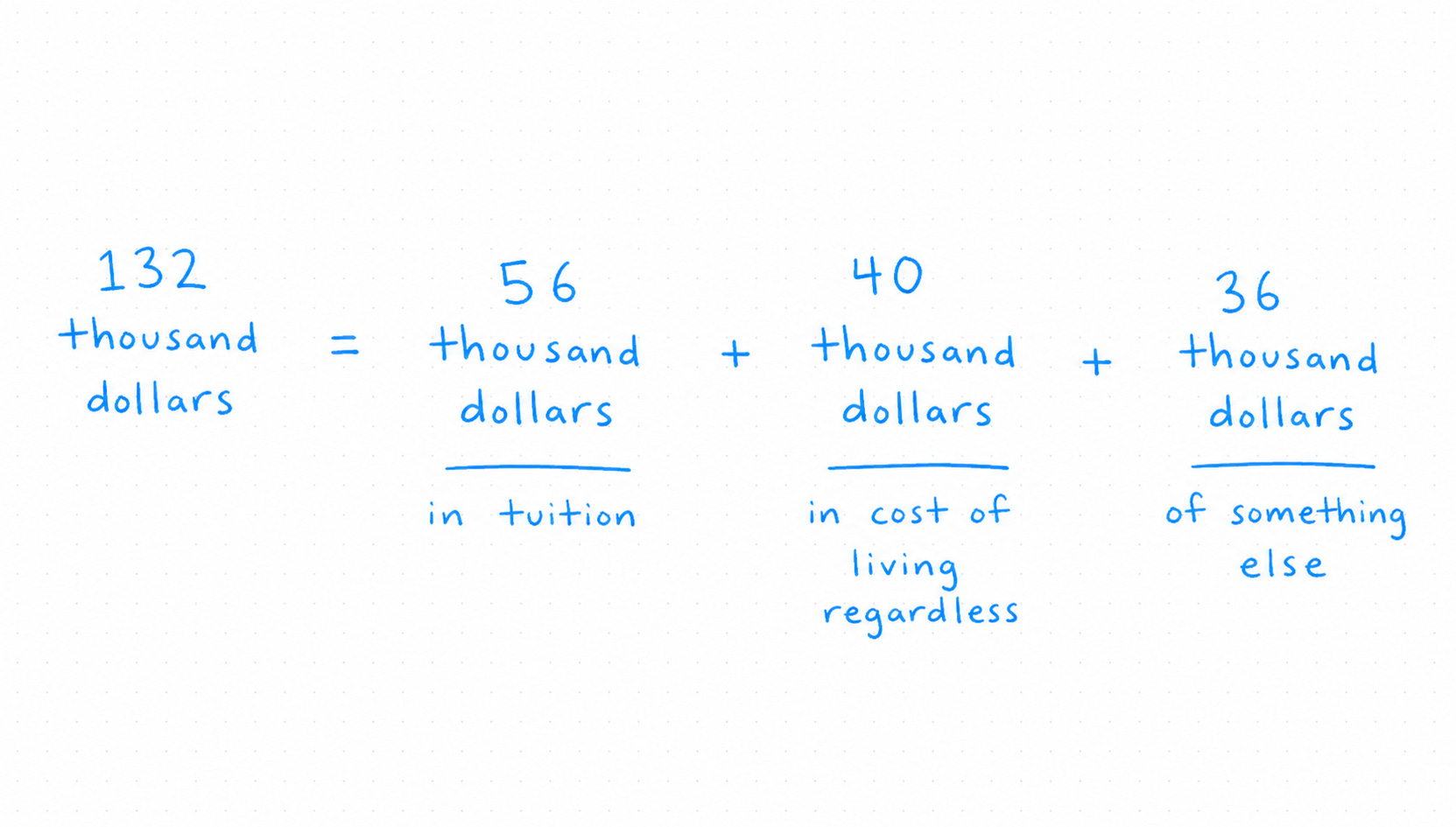
The residual for the median person is about 36 thousand dollars — the fringe benefits of being a college student, or selection based on location. All in all, the additional cost of college is costing the median student at most 80 thousand dollars for four years.
Importantly, this is sticker tuition, not net tuition. Net tuition is the cost you would actually face at an institution — net tuition is net of aid (grants from the federal government and the institution itself), and it is the actual economic measure that matters. So the above figures are the upper bound on costs. For many students, the cost may be far less than this, if the net tuition is lower (e.g. a full-ride).
Net tuition is very hard to measure. But to give you a sense of the magnitude, here are estimates of the annual net cost of an institution after financial grants.2
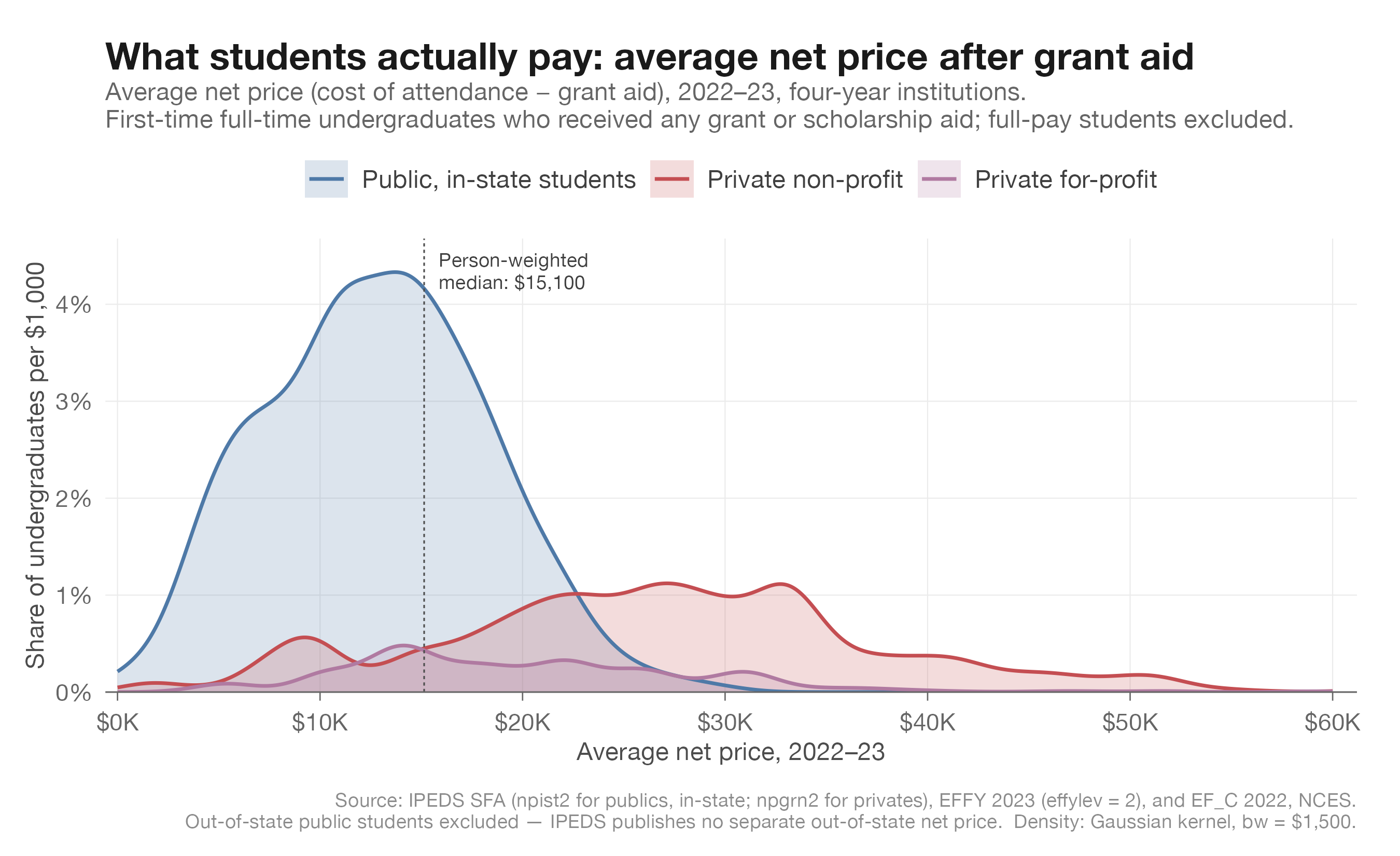
In aggregate, this implies that the median student is paying sixty thousand dollars (including room and board) after four years. Given our estimates of cost of living is forty thousand dollars, this starts to look like a decent deal.3
A caveat to this measure:
It is an institution measure, so this ignores significant within-institution dispersion in the costs (e.g. across the income distribution).
This ignores students who pay full freight, e.g. get zero aid. As a result, this will bias the measure downwards. We can average this about 20% of students paying full-freight, so for a fair comparison, we should probably bump up this cost by about 25%.
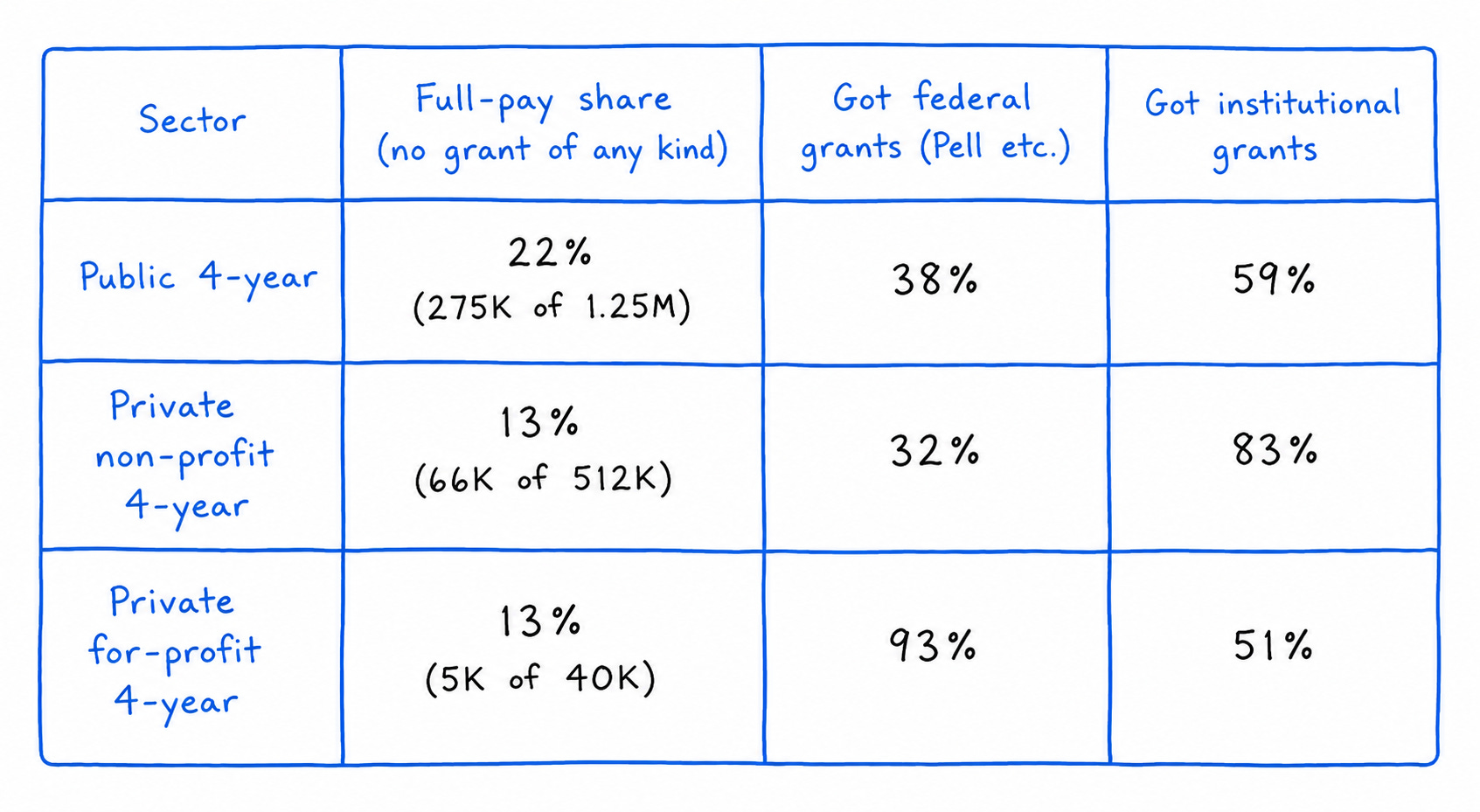
So let’s say the cost of college, after adjusting for the opportunity cost of living, is $40,000 for the median individual. This median student’s cost of attending college is three parts:
A tuition payment that can be quite affordable (or at least not too expensive) if it is at a public instate university, or quite high (in sticker price) at a private non-profit (such as an Ivy League university).
A cost of living that will happen due to the sheer fact that the student is a living breathing human being that needs food and shelter.
An additional set of costs that feed into the supplementary costs of attending a university (food, additional amenities, selection into expensive areas, books, etc.)
Higher education affordability is important, but we do ourselves no favors using the experience of elites to drive our cultural conversations about college.
I’m picking Champaign as a relatively affordable (low cost) location to create a lower bound on this cost — preserving the upper bound nature of the overall sticker price since we’ll be subtracting this part off.
This is not student loans — this is either federal grants or institutional aid.
Of course, the true economist response would say that four years of lost wages (as Cory says here) is quite costly too as opportunity cost goes! I agree with that, but I don’t get the sense that this is the argument that commentators are making on the cost of education. If your view is that college costs hundreds of thousands of dollars due to foregone wages, I ask your forgiveness for making you read all this data journalism, and agree that this is a cost.
No posts
Comments
Nothing yet. Say the first thing.
Sign in to join the conversation.