
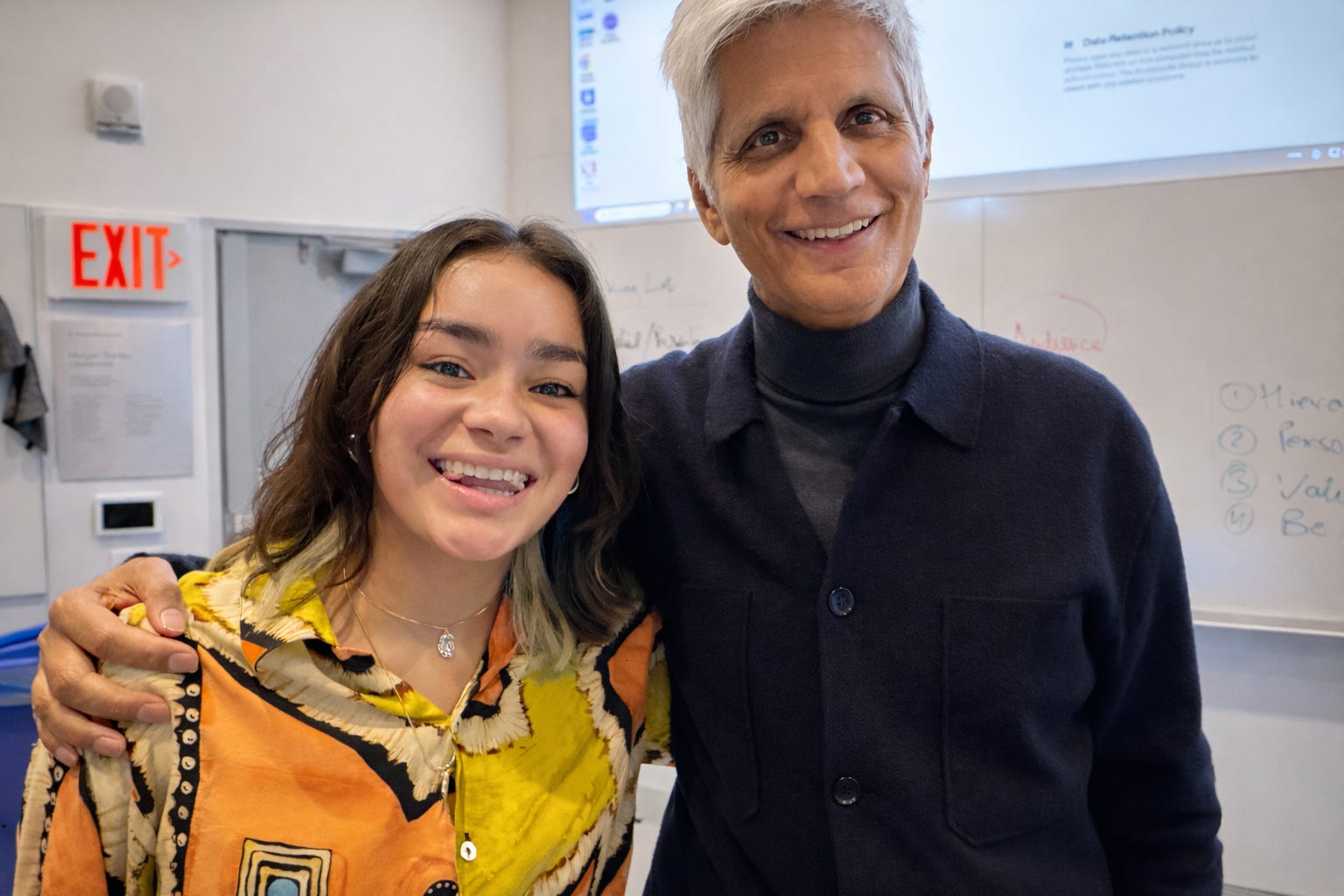
For Hitendra—friend, mentor, and fellow traveler—whose rare ability to build rooms like this continues to serve human flourishing with rigor, courage, and immeasurable care.
Earlier this week, I found myself back inside a room I’ve been in many times before—returning to an experience that has been precious to me ever since we were first introduced. What I didn’t expect was how differently it would meet me this time.
When I say “room,” I don’t mean a location. I’ve encountered it in different buildings, under different institutional banners, across continents and cohorts. What makes it rare isn’t where it’s housed, but the conditions deliberately cultivated inside it: a suspension of cynicism, a respect for rigor, and an expectation that inner development is not a side project but the work itself.
That room is something Hitendra Wadhwa has spent his career learning how to build. He’s a renowned professor at Columbia Business School and the founder of Mentora Institute, but those descriptors only gesture at what matters. For nearly a decade, I’ve worked alongside him not simply as a collaborator, but as a fellow traveler in a shared mission: advancing human flourishing through disciplined inner work, fusing timeless wisdom with the interdisciplinary sciences of human nature. Our kinship isn’t transactional. It’s grounded in a common belief that leadership without depth is brittle—and that joy and purpose are hard-won capacities, not soft ideals.
I’ve supported his course—Personal Leadership & Success—across its many iterations and traveled with him around the world in service of that philosophy. Over time, trust accumulates. Not just professional trust, but the kind that allows something personal to enter the field without being diminished.
That trust is what made his most recent invitation feel natural.
He wrote to tell me he had a guest speaker closing out the first day of the Executive MBA program—someone he was sure I’d appreciate: Niren Chaudhary, former CEO of Panera Bread. Then he added a second note, almost offhand, which brought a smile to my face. He asked if I could bring a guitar.
It wasn’t framed as a plan. More like a hunch.
Hitendra has an instinct for how truth lands. He knows that people often hold accomplished leaders at a distance—admiring, assessing, projecting, categorizing. Music collapses that distance. It humanizes without effort. And Niren, as it happens, is a passionate musician.
By the time I saw his message, the guitar problem had already been solved. Someone else had one. But he kept the invitation anyway. Which, if you know him, makes perfect sense. He is always widening the aperture, making room for the moment to become more than it might otherwise be.
That’s where the story became more personal than I anticipated.
My daughter Harley is fourteen—disciplined, thoughtful, and deeply committed to whatever she takes on. Last year, she captained her middle school volleyball team to its first-ever championship. Academically, she’s focused and consistently vying for the top of her class, with an eye toward astrophysics and space exploration—big questions, real rigor, the architecture of reality. And then, quietly, music entered her life. Not as a phase. As a pull.
The weekend before Hitendra’s course began, we spent the day marking that shift without quite naming it. It started with a haircut—intentional, considered, a small act of alignment. Then we went straight to Guitar Center.
Not browsing. Not killing time. She knew what she was there for.
She moved slowly through the store, holding different guitars, asking questions, paying attention to what she could. The way the neck felt in her hand. The weight. The balance. The way the instrument rested against her body. She asked me to play the ones she was most drawn to so she could hear and sense the differences, then kept returning to the same one. When we finally chose it, it wasn’t excitement that crossed her face first—it was resolve. This wasn’t a purchase. It was a commitment. Her first guitar. Not a toy. An instrument. A signal to herself that this mattered.
When I saw Hitendra’s invitation, I instinctively asked if I could bring her with me. His response was immediate and unhesitating: yes.
Harley’s reaction to my invitation told me everything. She wasn’t thinking about prestige or proximity to power. She was thinking about the chance to be in a room where people were genuinely working on themselves. She didn’t want to mess it up. She was nervous and excited in equal measure. Despite many years of moving in and out of these spaces, I had never brought her into this world before. The only advice that felt honest was the simplest: be yourself.
When we arrived, the room was full—full enough that we brought in extra chairs from another room. We sat in the far back corner, easy to miss. And then Niren began to speak.
I’ve seen many guest speakers grace that room with their presence over the years. Plenty were impressive, even unforgettable. This was different.
Within minutes, it was clear that this wasn’t going to be a talk about leadership as performance. It was going to be something else entirely.
Niren spoke about his own daughter, Aisha.
Aisha was born with a rare immune disorder and, by fourteen, developed a progressive lung condition that would ultimately take her life. She died young. But she lived with a clarity that makes our usual definitions of ambition feel strangely miscalibrated. As her illness advanced, she adapted with fierce creativity: when she lost mobility in her legs, she turned to painting because her arms still worked; when her arms weakened, she turned to writing because her fingers still could. She passed away at 18. By then, she had given talks seen by millions, completed numerous works of art, published a book, and left behind a body of work that felt disproportionate to the brevity of her life.
Listening to him, it was impossible not to feel the quiet insistence of mortality—not as fear, but as the reason the rest of the conversation mattered at all.
The story never asked for pity.
Niren spoke about values—not as slogans, but as non-negotiables. About the courage required to live them when it costs you something. About narrowing the friction between purpose and profit, not as a leadership trend, but as an ethical obligation for anyone who leads people and capital in a world already strained by distortion and distrust.
Then he spoke about joy.
Not as denial. Not as optimism. But as a choice—the refusal to let suffering colonize the entire inner landscape. He closed his talk by sharing how the values he prioritizes today were shaped by the values his daughter never let slip out of focus. Some inheritances, he conveyed implicitly, aren’t financial or genetic. They’re formed by what we take in from the people who shape us most.
Then he picked up a guitar.
He played a song he’d written years earlier when he was CEO at Panera—funny, disarming, unmistakably human. He talked about bringing music into town halls because people deserve joy at work, not just productivity. The laughter that followed didn’t break the gravity of the room. It confirmed it.
Throughout the talk, Harley’s hand went up several times. Not theatrically. Instinctively. She wasn’t trying to be noticed. Her hand went up because she was following closely and had something to say. But the room was large, the energy dense, and it would have been easy not to see her at all.
It wasn’t until Niren finished that she finally got her chance. Hitendra took the room back and invited students to share what his testimony meant to them.
This time, when Harley’s hand went up, it wasn’t coming down.
When Hitendra called her name and introduced her to the room, she quelled her nerves, thanked Niren for his vulnerability and said—simply, sincerely—that this was something she would never forget. She looked around the room and added, in her own words but unmistakable in meaning: Am I wrong? Won’t we all carry this with us?
For a moment, the room went still.
I felt my chest tighten—not with pride exactly, but with recognition.
The response she received mattered. The students didn’t even know she was there until that moment, but they didn’t treat her as a novelty. They received her as a participant. Serious. Human. Welcome. In that small exchange, she was given a quiet piece of evidence about the world: that ambitious people can be kind; that depth doesn’t require coldness; that sincerity still has a place in serious rooms.
The standing ovation that followed—for Niren, for the moment, for all of it—felt organic.
As the course concludes today, I find myself thinking less about what was taught than about what was made possible. This is what that room—wherever it happens to be housed—can do when it’s built with care and protected from the noise that dulls our capacity for meaning: it allows people of different ages, experiences, and stations to meet one another plainly, without pretense, and to leave carrying something that can’t be unlearned.
And sometimes, if you’re paying attention, life gives you a small, precise gift to make the lesson personal: a trusted friend who knows how to shape a field, a lightly mischievous request for a guitar, and a fourteen-year-old stationed in the back corner of a room that exists not because of where it is, but because of what it asks of the people inside it.
Some rooms are meant to be carried on.

Comments
Nothing yet. Say the first thing.
Sign in to join the conversation.