
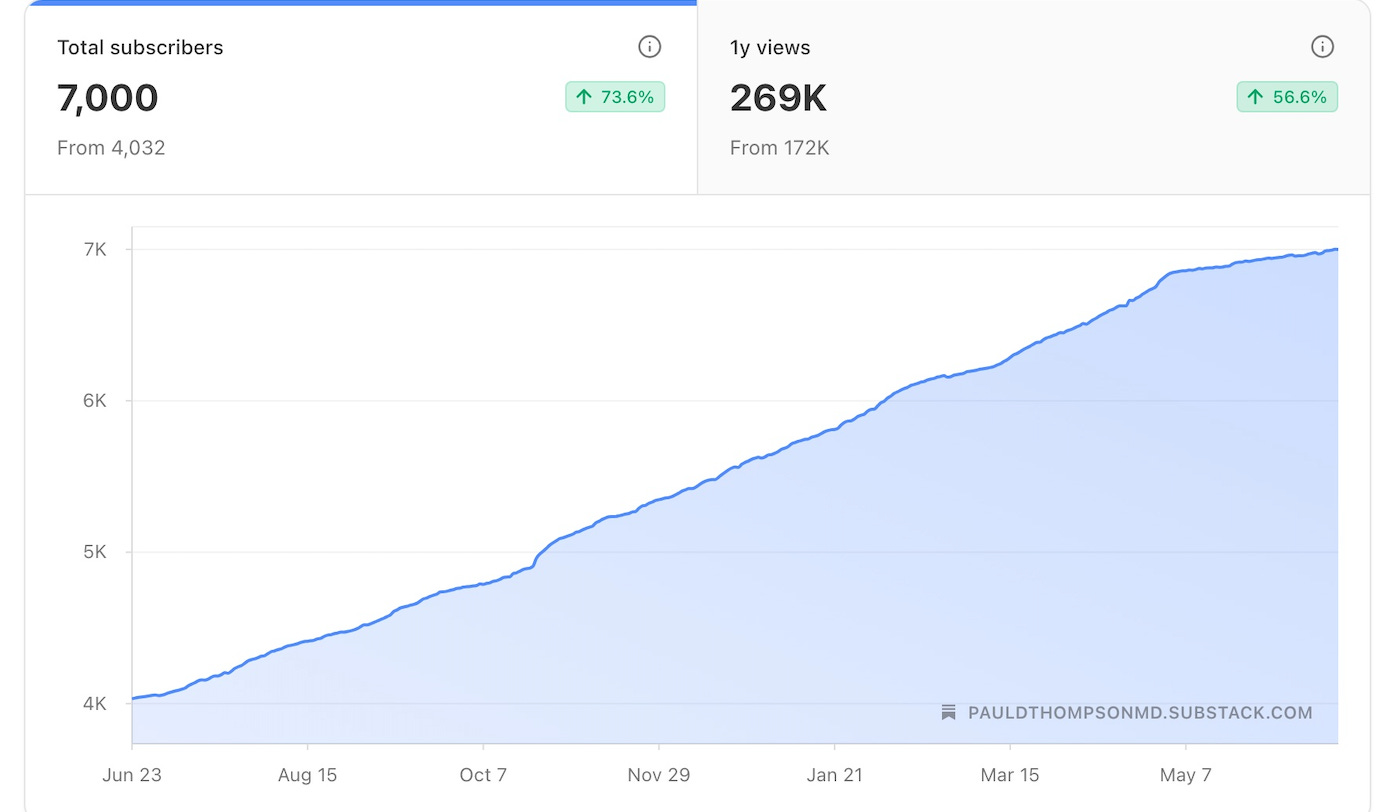
Graph of Subscribers to 500 Rules of Cardiology
On June 22, 2026 500 Rules of Cardiology reached 7,000 subscribers. That’s a lot of people, and I don’t take writing for you all lightly. I try to write about clinically important issues, in a way that makes reading the pieces interesting.
I acknowledge that my blog’s title, 500 Rules of Cardiology, is presumptuous, but I want to assure you that these “Rules” are what I think is correct, and that I do have some medical credibility. I have written over 500 peer-reviewed manuscripts, which have made some contribution to the literature. For example:
We were early (1) in addressing the cardiac dangers of exercise in 1979. The story behind that is that a runner died in a local running road race when I was training in cardiology at Stanford. I was discussing the death at work in the Stanford Heart Disease Prevention Program. Mike Stern, MD was an endocrinologist there and mentioned that he had collected several newspaper reports of similar events. Kevin Duncan, a medical student from Kansas, and I expanded that collection, collected data from the victims’ families and physicians, and published the results in JAMA. (1) That report was important because at that time, Dr. Thomas Bassler, a charming California pathologist and one of the founders of the American Medical Jogging Association, had created the medical myth that running a marathon conferred immunity to atherosclerotic cardiovascular disease (ASCVD). He did this by writing letters to the editors of major journals and by citing his prior letters on this hypothesis as documentation of its veracity. PubMed lists 66 publications to TJ Bassler, most of which fit that description.
Our original paper led to our being among the first, if not the first, to quantify the risk of vigorous exercise. That project collected jogging deaths in the state of Rhode Island, a state with one medical examiner’s office. This was run by Bill Sturner, MD (1934-2016). (2) Bill was able to collect data on all the deaths during jogging in the state because sudden deaths require an evaluation. We used state data on the frequency of jogging to estimate a yearly death rate during jogging of one death per 15,200 ostensibly healthy joggers. This absolute risk was low, but the relative risk of death during jogging was seven times higher than the risk during more sedentary activities. This study predated David Siscovick’s classic 1984 New England Journal of Medicine (NEJM) publication of cardiac arrests in Seattle, which also showed an increased risk of arrest during exercise and a yearly risk of one death per 18,000 joggers.(3) It was reassuring to obtain similar death rates from two sides of the country.
The interest in the risk of exercise continues and now includes a NEJM Reviews article on increased coronary atherosclerosis, myocardial fibrosis, right ventricular enlargement, atrial fibrillation (Afib), and aortic size in life-long endurance athletes. (4) But reports on the side-effects of too much exercise, have not come easily. Our first article on increased rates of Afib in life-long athletes was doubted and rejected by the major journals until I finally published it in the British Journal of Sports Medicine, (5) a good, but lesser known journal.
We also published one of the first reports of a cardiac events with cocaine use at a time when the cardiac risks of cocaine were underappreciated. Our report was that of a 21-year-old male who was given cocaine as a wedding present, and suffered an inferior wall MI on his wedding night despite having normal coronaries. (6) We also contributed three of the seven cardiac cases reported by my Tufts medical school classmate, the late Jeff Isner (1947-2001), in his seminal NEJM report on cocaine heart disease. (7) My three cases came from another collection Bill Sturner and I were compiling in Rhode Island.
With Peter Herbert, MD, I had 11 years of NIH funding to examine how exercise training affects high density lipoprotein (HDL) metabolism. We did, what are to my knowledge, the only studies on HDL catabolism in distance runners using radioactive iodine to track the HDL proteins. Peter taught me how to purify HDL, labelled it with 125I and inject it back into me and some of my running friends to measure HDL catabolism. These runners were not just your average joggers; three of the five subjects in our first study (8), including me, had qualified for the USA Olympic Marathon Trials. We documented that HDL levels were increased in the athletes, primarily because of reduced HDL catabolism. We thought that the reduced catabolism was likely due to reduced levels of triglycerides in the HDL particles, which prolong the particles’ survival. (9)
I have discussed our studies on statin myopathy in several prior blogs.(10-17) We were early to this topic and made some contributions, especially with the STOMP study. (18)
This summary is not bragging or to tell you to blindly trust what I post here, because all of my research projects have taught me one thing – trust, but verify. What I write in the blog is what I think is right, but I remember using procainamide to treat premature ventricular contractions and atrial fibrillation. We thought we were doing the right thing, but we were probably killing people. Several of our “contributions” contradicted current wisdom such as: Exercise is totally protective against ASCVD, you cannot do too much exercise, cocaine is safe, and statins have no muscle side effects without large creatine kinase elevations.
It is especially important now for clinicians to continue to critically evaluate common medical wisdom because so many studies of new drugs and devices are designed and funded by the manufacturers, and then published in journals supported by the same companies. I say that despite being a clinician who is eternally grateful to industry for the wonderful drugs and devices they have invented. It’s just that sometimes the enthusiasm exceeds the evidence.
So my experiences have taught me to question what I, and others, think is true. As you 7,000+ subscribers read what I write and what I think is true, I hope that you will also “Trust but Verify.”
Please continue to read this blog and encourage your friends and colleagues to do so as well. I would like to reach 8,000 subscribers. But verify my thoughts with your own experiences. If the principles I suggest work, add them to your own Rules. But be careful because … rules are made to be broken.
1. Thompson PD, Stern MP, Williams P, Duncan K, Haskell WL, Wood PD. Death during jogging or running. A study of 18 cases. JAMA. 1979 Sep 21;242(12):1265-7.PMID: 480538
2. Thompson PD, Funk EJ, Carleton RA, Sturner WQ. Incidence of death during jogging in Rhode Island from 1975 through 1980. JAMA. 1982 May 14;247(18):2535-8.PMID: 6978411
3. Siscovick DS, Weiss NS, Fletcher RH, Lasky T. The incidence of primary cardiac arrest during vigorous exercise. N Engl J Med. 1984 Oct 4;311(14):874-7. PMID: 6472399
4. Thompson PD, Eijsvogels TMH, Kim JH. Can the Heart Get an Overuse Sports Injury? NEJM Evid. 2023 Jan;2(1): PMID: 38320102
5. Sorokin AV, Araujo CG, Zweibel S, Thompson PD. Atrial fibrillation in endurance-trained athletes. Br. J Sports Med. 2011 Mar;45(3):185-8. PMID: 19654095
6. J S Schachne, B H Roberts, P D Thompson. Coronary-artery spasm and myocardial infarction associated with cocaine use. N Engl J Med. 1984 Jun 21;310(25):1665-6. PMID: 6727939
7. Isner JM, Estes NA 3rd, Thompson PD, Costanzo-Nordin MR, Subramanian R, Miller G, Katsas G, Sweeney K, Sturner WQ. Acute cardiac events temporally related to cocaine abuse. N Engl J Med. 1986 Dec 4;315(23):1438-43. PMID: 3785295
8. Herbert PN, Bernier DN, Cullinane EM, Edelstein L, Kantor MA, Thompson PD. High-density lipoprotein metabolism in runners and sedentary men. JAMA. 1984 Aug 24-31;252(8):1034-7.PMID: 6748208
9. Thompson PD, Cullinane EM, Sady SP, Flynn MM, Chenevert CB, Herbert PN. High density lipoprotein metabolism in endurance athletes and sedentary men. Circulation. 1991 Jul;84(1):140-52. PMID: 2060090
10. https://pauldthompsonmd.substack.com/p/whats-the-boston-marathon-got-to
11. https://pauldthompsonmd.substack.com/p/statins-increase-exercise-induced
12. https://pauldthompsonmd.substack.com/p/finally-a-proper-study-of-exercise
13. https://pauldthompsonmd.substack.com/p/the-risks-and-benefit-of-statin-treatment
14. https://pauldthompsonmd.substack.com/p/stomp-the-effects-of-statins-on-muscle
15. https://pauldthompsonmd.substack.com/p/its-bogus-to-use-n-of-1-studies-to
16. https://pauldthompsonmd.substack.com/p/some-patients-will-take-anything
17. https://pauldthompsonmd.substack.com/p/what-do-mushrooms-have-to-do-with
18. Parker BA, Capizzi JA, Grimaldi AS, Clarkson PM, Cole SM, Keadle J, Chipkin S, Pescatello LS, Simpson K, White CM, Thompson PD. Effect of statins on skeletal muscle function. Circulation. 2013 Jan 1;127(1):96-103. PMID: 23183941
#exercise; #exercisecomplications; #cocaine; #atrialfibrillation; #myocardialfibrosis; #rightventricule; #aorticsize; #athletes; #HDL; #runners
No posts
Comments
Nothing yet. Say the first thing.
Sign in to join the conversation.