
Be sure to subscribe to the Past Lives Patreon for tons of great bonus content, including Q&As, interviews with amazing scholars, and much more.
The young man never saw the knife that killed him. The long, thin blade slid under his shoulder blade, broke his rib, and punched into the lung beneath. Despite the overwhelming pain, he didn’t scream; he couldn’t, as all of the air in his body was forced out of him in one sudden exhalation. Shock drove his eyes wide. He gasped, or tried to. His jaw hung open, struggling to suck in air. A thin, rattling noise escaped his lips. Trying to find the source of the injury, he reached behind him, but his strength fled before his hand could reach the wound. He fell and never rose again. Whatever hopes and dreams he might have had died with him.
Subscribe to Past Lives on your platform of choice, or listen here:
For his people, however, the young man’s journey was just beginning. For his burial they dug a pit in the hot sand on the outskirts of their town, where the black land of the valley gave way to the red of the harsh deserts. Wrapping him in mats of woven reeds, they placed him on his side with his legs pulled up to his chest. His right shoulder, decorated with tattoos of an aurochs and a Barbary sheep, faced the sky. A few clay pots filled with grain and the paint he’d used to adorn his body in life went into the pit with his remains.
There were other graves nearby, many of them, a small city of the dead that existed parallel to the settlement of the living near the Nile and its bounty. The living used the same clay pots that served the dead, the same fine combs to brush their hair, the same instruments for mixing and applying body paint, the same jewelry of exotic shell, ivory, and polished stone.
He was well provided for. The living owed that much to the dead.
Break
Hello, my friends. Welcome to another episode of Past Lives. I’m Patrick Wyman.
More than 5,000 years ago, a young man died along the Nile River. His people buried him in the dry sand, and there he stayed until 1896, when a local resident discovered him and five other sets of remains. That resident went on to bring the famous British archaeologist and looter of antiquities extraordinaire Wallis Budge to the site. Budge immediately recognized that these were extremely old mummies, the oldest he’d ever seen, and set about excavating the burial pits. As was so often the case in these early excavations, Budge simply discarded what he found uninteresting, like the buried pots and the remains of the furs and mats in which the bodies had been wrapped. The British Museum, where Budge was the Keeper of the Oriental Department, acquired the mummies several years later. The young man’s remains were put on display in 1901, the earliest mummy the public could view in the museum’s extensive collections. If you go to the British Museum today, you can still see this extraordinarily ancient person - numbered EA32751 - in the same gallery where he’s been for more than a century. The early curators called him “Ginger,” because of the tufts of reddish hair still protruding from his scalp; today, he’s known as Gebelein Man.
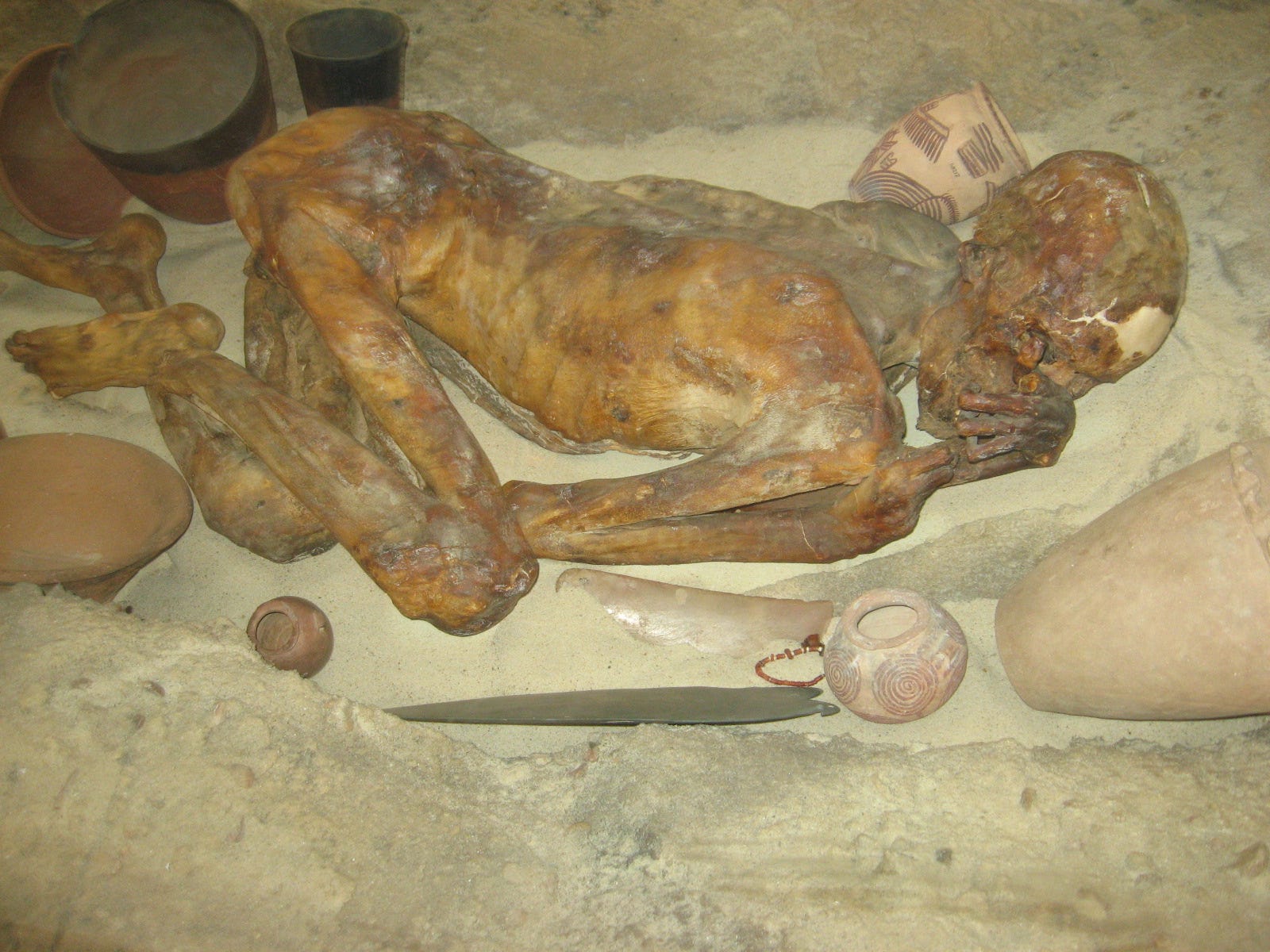
Compared to our friend Otzi, who lived around the same time in northern Italy, we know far less about the physical aspects of Gebelein Man’s life. From his mummy we can glean some hints about the manner of his death and a few other things about him, but what really makes Gebelein Man so special is that he comes from a time and place we know in extraordinary detail: the Nile Valley, in what’s known as the Predynastic Period, the age just before the first kings rose to unite all of Egypt from the Cataracts of the Nile to the Delta. Radiocarbon dating of Gebelein Man’s mummy indicates that he lived between 3341 and 3017 BC, the later years of the long centuries leading up to Egypt’s unification. This means Gebelein Man was a witness to the processes of state formation and cultural transformation that would eventually, over the course of millennia, turn Egypt into the civilization we know today. For Gebelein Man, all of that lay in the unknowable future, but from our vantage point, we can see the swirling forces of change that defined his era and, in all likelihood, his life.
In today’s episode, rather than focusing exclusively on what we can learn from human remains, we’re going to try to reconstruct the world in which Gebelein Man lived in as much detail as possible. This wasn’t the ancient Egypt that produced the pyramids, much less the stunning tombs of the Valley of the Kings or an empire that reached as far as the Levant; in Gebelein Man’s time, Egypt was a fractured land of petty kings warring and competing with one another for preeminence, when hieroglyphic writing was a brand-new invention, and the first experiments with intentional mummification of human remains were underway. This was the Predynastic Period, which lasted for the better part of a thousand years. Gebelein Man lived in the latter half of that period. To understand his world, we need to excise our sense of the inevitable future and focus on the uncertainty of a time when nobody knew the kings would one day prevail, let alone that “Egypt” would one day exist as a unified entity.
Let’s start with Gebelein Man himself, and what we can learn from his mummified remains. The reams of cutting-edge scientific tests that have told us so much about the lives of people like the Ancient One and Ötzi simply haven’t been performed on Gebelein Man: no detailed study of the pathologies on his bones, no isotope analysis, no DNA testing, no analysis of the contents of his digestive tract or the pollen that hitched a ride with the food he ate. The contents of hi s grave were lost in the course of excavation, either discarded by Wallis Budge or taken and sold by the locals who found them after the fact. In the case of Gebelein Man, we can only really talk about the basics: The mummy belongs to a man aged between 18 and 21, which we can tell because the growth plates in his bones were recently fused. He stood 5’4” tall, was robustly built, and generally looks to have been a healthy lad. When researchers placed his remains in a CT scanner in 2012, they found something remarkable: a puncture wound under his left shoulder blade, a stabbing blow delivered with so much force that it nicked that bone, shattered the rib behind it, and penetrated his lung. The dimensions of the entry wound are probably too large to belong to a projectile point, but not large enough for a spear; the most likely candidate for the responsible weapon is a long, thin dagger made of flint or more likely copper. The CT scan identified no signs of defensive injuries, like the gash on Ötzi’s palm or the bruises on his wrists. The location of the wound strongly suggests that someone took him by surprise: Gebelein Man never saw the blow that killed him coming.
There was plenty of warfare happening in the Nile Valley around this time, and archaeologists have found cemeteries with burials that clearly belonged to soldiers who had fallen in combat, including one with a number of decapitated bodies whose heads were taken as trophies. Gebelein Man wasn’t buried in one of these cemeteries, but in the same location as a number of other contemporary individuals, none of whom have shown any sign of violent death. Whoever killed this young man, and whatever their reason, we can tentatively suggest that the end of his life perhaps didn’t take place in the context of a pitched battle. Murder seems more likely.
There is one more fascinating thing that recent analysis has revealed about Gebelein Man. Visitors to the British Museum have long noted the dark smudges on his upper right arm, but it wasn’t until a team led by the archaeologist Renee Friedman examined his remains using infrared imaging that they were able to identify what those smudges were: the world’s oldest figural tattoos, a pair of horned animals facing toward the front of his body. The upper of the two animals is probably a wild bovine known as an aurochs; the lower is a Barbary sheep. Both were extraordinarily common in Predynastic art, with bovines remaining a symbol of male power and virility - particularly of the royal variety - well into the ages of Egyptian history we’re more familiar with.
Those basic facts and their narrow interpretation amounts to just about everything we know and can say about Gebelein Man’s physical remains. But we’ve hardly maxed out on possible ways to interpret his life. The Nile Valley in which Gebelein Man was buried is one of the best-understood archaeological landscapes in the world. We’re most familiar with the later millennia of occupation under the pharaohs of a united Egypt, but since the 19th century, archaeologists have carried out hundreds of excavations and performed a hundred years of continuous analysis. All of that means that we have a far better grasp of Gebelein Man’s home region and the time in which he lived than we do Ötzi or the Ancient One. Gebelein Man may be a less distinct figure than his fellow ancients, but we can view the world around him in much greater focus.
Broadly speaking, Egypt can be divided into two major regions: the Delta in the north, where the Nile splits into dozens of intertwining, braided channels before it meets the Mediterranean; and the Nile Valley further south, a long, thin strip of incredibly fertile land that was constantly replenished by the river’s floods until the introduction of massive dams in the 20th century. Most research on ancient Egypt has focused on sites in the Nile Valley rather than the Delta because they’re easier to find: The constantly shifting landscape of intersecting channels and surrounding marshes tends to erase signs of past activity. The Delta also had fewer of the conspicuous monumental structures that attracted early archaeologists to the region; that’s changing now as more sites dating to the distant Predynastic are excavated to modern standards, but the fact remains that we have far less information about the Delta than we do about the Nile Valley to the south.
Luckily for us, Gebelein Man lived in the Nile Valley, and in a particular slice of it that we happen to know extremely well. Gebelein is more than 300 miles south of Cairo, located along a bend in the river that looks like a backwards C. This relatively small area, with a desert route linking the two ends of the bend, is widely considered the heartland of ancient Egyptian political life, society, and culture. Thebes, the longtime capital of the pharaohs, was located here, along with a great many of the monuments that come to mind when we think of ancient Egypt. So too was the Valley of the Kings, where the pharaohs of the New Kingdom buried their rulers, including Tutankhamun and his infamous treasure hoard.
More than 2,000 years before that, however, the region around that bend in the Nile wasn’t the center of a sprawling state; it was a battleground between at least three warring petty kingdoms, each of which was centered on a substantial settlement. Hierakanpolis, or Nekhen, was one; the second, Naqada, gives its name to the archaeological cultures found in the region during the Predynastic; and the third, Abydos, eventually produced the rulers who would unite Egypt and served as the location of their earliest magnificent burials. In this region, we can see the entire sequence of cultural and political development that transformed the fractured Nile Valley into the homeland of powerful rulers, its people from wandering pastoralists and subsistence farmers into subjects of the pharaoh. In the second half of the fourth millennium BC, we can see the roots of nearly every aspect of ancient Egyptian society that would eventually come to define it, from reverence for the dead to hieroglyphic writing to massive royal tombs. Superficially, much of what appears in the archaeological record from this time looks familiar to us, but this familiarity carries a major risk: When we read this age in light of the future we know, we risk treating it as a prelude, where the only historical threads that matter are the ones we can easily spot and carry through into later ages.
For all the fascinating things we can learn from this approach, I think it’s a misleading way to actually make sense of the past. Not all of the threads woven during the Predynastic carried through to the Egypt of the pharaohs, and the continuities we do see don’t necessarily reflect what actually mattered most to the people living in that earlier time. Just because we can see kings or wannabe kings in the archaeological record doesn’t mean they were as powerful or important to Predynastic society as they would later become. Moreover, there’s no reason to think that those kings were on an orderly road to the ultimate power they would later come to wield: State formation, the process that defined the world in which Gebelein Man lived and died, was messy, violent, and unpredictable. Perhaps the tensions that went along with that process were the cause of his death.
Break
“State formation” sounds like a daunting idea, but it’s actually pretty straightforward: It’s the process that created states, with kings or other leaders at the top, underlings to do their bidding, and claims over people and territory. Ancient Egypt is generally considered to be one of the purest examples of state formation: We can see, both in the archaeological record and in scattered textual references to the Predynastic period in which Gebelein Man lived, how chieftains became kings ruling over a unified state. Because the ancient Egyptian state lasted for so long, and was so consistent in its basic ideological orientation and ways of doing business, it stands as the case to which all others are compared. This is often an implicit comparison rather than a conscious choice: Our idea of how states come into existence is so shaped by the Egyptian example that it seems like a checklist of traits, a roadmap to follow, rather than one possibility among many. Millennia of intensive agriculture in a rich, fruitful landscape - the thick, black soil of the Nile Valley - led to surplus production, which created an elite, who then competed with one another over the spoils until one of them emerged victorious and unified the country. Et voilà: state formation.
More recent research, however, has found cases of state formation all around the world over many thousands of years: in Neolithic China, not once but several times; in Bronze Age Europe north of the Alps, centuries before the Greeks and Romans invented “civilization”; in the tropical forests of Mesoamerica on multiple occasions between 1000 BC and 1000 AD; and a hundred other times and places. Few of them look much like Predynastic Egypt. What’s even more fascinating is that even the Egyptian case doesn’t look much like scholars used to think, now that we’ve had a long time to examine the concept and its execution.
That old idea of ancient Egyptian state formation was rooted in a 19th-century European conception of what a state was supposed to look like: Ancient states must have been the products of orderly, rational processes of construction, to that way of thinking, just like the sleek, powerful new nation-states of 19th-century Europe. But - and this seems obvious to say now in 2026 - ancient Egypt wasn’t a 19th-century nation-state. It never was. These early systematic excavators of ancient Egypt were reading back into the distant past their own ideas of what a state was and how it came into being, filling in the gaps of the evidence like the scientists in Jurassic Park using frog DNA to make dinosaurs. Official titles and seals had to speak to a single ruler with an efficient bureaucracy, the purpose of writing had to be administration, and so on. As it turns out, state formation in the 19th century was a lot less orderly than these scholars believed, but it was their belief in that orderly model that influenced their portrayal of ancient Egypt’s creation as a state, not the reality.
In this old way of thinking, every political development during Gebelein Man’s time - the Predynastic - had to lead up to a sharp break that created a new order with a single, all-powerful king ruling the entire country. This meant that for years, scholars hunted for the aspects of Predynastic life that proved this break occurred with the accession of Narmer, the first pharaoh. Those aspects had to conform to the model of civilization they believed to be true, one that emphasized agriculture, the generation of surplus, hierarchical leadership, cities, and writing for administration. Everything else was at best a dead end and unimportant to the future, or at worst completely unworthy even of notice, like the humble goods in clay pots that had been placed in Gebelein Man’s grave. How much richer would our understanding of this person be if Wallis Budge had bothered to pay attention to those pots, and what was in them? While we recognize how much was lost in the age of careless excavation, it’s easy to forget that our knowledge is still being shaped by the ideas that animated those careless excavators and their analysis of what they found.
When we go back and reexamine Gebelein Man’s world on its own terms, rather than those imposed by modern scholarship, it flares into brilliant light. Looking at the Predynastic from the perspective of its past, rather than its future, makes it both more alien and less. The key insight once again sounds basic, but it’s essential: Nobody knew the warring chiefdoms of the Upper Nile Valley were on their way to becoming ancient Egypt, that there would be any sort of unified state ruling over this entire region, or that the next 3,000 years would see remarkable cultural and political stability. We think of Egypt as a quintessentially agricultural society dependent on the Nile’s annual flooding to replenish its fields with moisture and rich silt, but during Gebelein Man’s life, agriculture was relatively new to the region; unlike Mesopotamia, where the earliest cities grew out of agricultural villages and landscapes that were already millennia old, the people of the Nile Valley were latecomers to farming. When we look at sites of an equivalent age in Mesopotamia, we see layer after layer after layer of occupation, a slow and steady movement to towns and cities. In Upper Egypt, the introduction of agriculture came like a bolt of lightning out of the sky.
Archaeologists have spent decades looking for the earliest farming villages along the Upper Nile, which would date to between 5000 and 4000 BC, and they haven’t found many. That’s in part because the Nile’s flooding constantly dumped new layers of soil on top of old settlements, which means that any evidence would be buried under ten or twenty feet of sediment; even so, that lack is striking. It’s possible we just haven’t found them, but these early farming villages do exist further to the north in Egypt, near the Faiyum Oasis and in the Delta; maybe we haven’t found them in Upper Egypt because they either weren’t common or didn’t exist at all. What we do see in the archaeological record of this earlier age, what we call the Badarian Culture - from about 5000-3800 BC - is evidence of mobile pastoralism: people moving around from campsite to campsite with their herds of cattle and sheep. All that remains of these people are thin scatterings of stone artifacts and animal bones and what are believed to be post-holes left behind by temporary structures. These people simply didn’t stay in a single place for long, and whatever farming they engaged in was opportunistic and secondary to stockraising. It was probably what we call “flood-retreat agriculture,” where the seeds are planted immediately after the flood and simply left to grow until harvest time. It’s less efficient than tending crops year-round, but offers more flexibility to people who still want to be mobile. That seems to have been the case in the Upper Nile Valley until quite late, around 3800 BC, just a few centuries before Gebelein Man’s life and death.
There was one exception to their general mobility, though. In life, they wandered, not just through the Nile Valley but into the deserts beyond; in death, they settled down in vast necropolises. To paraphrase the memorable words of the archaeologist David Wengrow, in Egypt, cities of the dead came long before cities of the living. This makes a certain kind of sense: Mobile pastoralists might not have permanent settlements, but they still require land to graze their cattle, perhaps fields for their flood-retreat agriculture, and access to particular routes through the landscape. Their necropolises were claims to territory, to the rights to graze, grow, move, and bury their dead. When other groups wandered into that territory, they would see the surface markers and know that the land belonged to someone else, that their dead made eternal claims to it. These pre-Egyptians of the Badarian Culture spent an enormous amount of time and effort on the dead, filling their graves with everything they had needed in life: combs, cosmetic palettes, and jewelry were all common, and while some people were buried with more than others, practically everyone had something.
But why then, in the fifth millennium BC, did these cemeteries come into being? The answer probably lies not in the Nile Valley itself, but in what was happening in the surrounding deserts. The era of the Green Sahara, when vastly increased rainfall had transformed the sand and bare rock of the desert into welcoming savannahs spliced by rivers, was coming to an end. The herders who had for centuries wandered through those savannahs with their cattle could no longer survive as the water dried up and the sands encroached. The Nile Valley became increasingly crowded with people. Perhaps mobile pastoralism was no longer as viable; it required more land than dedicated agriculture, after all, and with rising populations, there wasn’t enough yield to go around. It was these pressures that created the world Gebelein Man knew in the few centuries before his birth, transforming a pastoral society into an agricultural one, with petty kings waging ceaseless wars for supremacy in the Nile Valley.
The recency of this transition from pastoralism to farming and mobility to sedentism left deep marks on the culture Gebelein Man encountered in life. Compared to Mesopotamia around this same time, when the city of Uruk was already blossoming into an urban center with tens of thousands of residents and gigantic monumental buildings, the Upper Nile Valley was rather bland and crude; the first experiments in large-scale construction were just getting underway. Unlike Mesopotamia, however, it was mostly the dead who received the honor of occupying those new monumental structures, not the living. That intense emphasis on the centrality of death stuck around long after cemeteries were no longer the only way to lay claim to territory, with generations of practice winding its way into the cultural DNA Egypt would eventually carry into the age of the pharaohs.
The chieftains competing to be kings in the centuries of the Naqada Culture in the Upper Nile Valley, the age lasting from about 3800 to 3100 BC that included Gebelein Man’s life, did build some stunning structures, like the palace with imported cedar posts holding up a massive ornamental facade more than 40 feet wide that one powerful man constructed at Hierakonpolis around 3600 BC. Their largest investments, however, were in their eternal resting-places. Around that same time, one of the earliest identifiable rulers in Hierakonpolis erected a tomb measuring some 200 by 130 feet and filled it with his riches, most of which were later plundered, but enough beautiful, high-status pottery survived to tell us its occupant was a singular figure. Even more intriguing, a ring of animal burials surrounded the main tomb: Some were domesticated, but others clearly weren’t, like baboons, a hippo, and even an elephant, all of which had been kept alive for some time prior to their deaths. This would-be king had an exotic menagerie and enormous ambitions centuries before Narmer ruled over a united Egypt.
On the one hand, this looks like state formation, right? But on the other hand, the fact that centuries separate this man from the first kings of a united Egypt tells us that there were no straight lines from wandering pastoralists to a unified state. Instead, we see short bursts of intense competition and then decades of relative stability. Gebelein Man, to his misfortune, seems to have lived during one of those competitive bursts. He had no way of knowing, nor did anyone living in Upper Egypt at the time, that this last burst would lead directly to the rulers of Abydos uniting the Delta and the Valley. How could they? Such a thing had never existed before, nor was there any sense of inevitability pushing them toward that future. Their pastoralist heritage was still centuries closer to them in time than the Great Pyramid.
We can see that pastoralist heritage in Gebelein Man’s tattoos, of all places. One of the defining features of the old Badarian Culture was its emphasis on bodily decoration: paints, necklaces, earrings, anklets, bracelets, lip- and nose-studs. Graves contained extraordinary decorated combs and cosmetic palettes. This makes a certain kind of sense: When you have to carry around your possessions as you travel through the landscape, your body becomes a declaration of identity and status to the world. Even as Badarian pastoralists settled in the Upper Nile Valley and slowly transformed into the sedentary subjects of warring petty kings in the Naqada period, the body remained central, both in life and in death. Those two tattoos on Gebelein Man’s shoulder have survived, legible only under infrared light, when the body paints that adorned him washed away and the jewelry tha t decorated his body decayed or simply wasn’t thought important enough by Wallis Budge and his ilk to save. In those faded marks, the recency of the transitions that created Gebelein Man’s world are still visible.
Gebelein Man lived in a time of widespread and convulsive transformations. We’ll never know if the blade that killed him was wielded during a confrontation in some way related to the rise of those warring chieftains at Abydos, Hierakonpolis, and Naqada: A young, robust man dying violently in a time of conflict raises suspicions, but the evidence is gone forever. He certainly wasn’t the only young man of his time to die for the ambitions of the powerful. What we can say with certainty is that despite his life being shaped by these forces, Gebelein Man wasn’t aware of where they would one day lead. He would never see a king of a united Egypt, or even the concept of Egypt, for that matter. He had no idea that the ruler of Abydos in his day would have descendants who would wield maces and crush their insignificant enemies in reality and the images they disseminated to their subjects. Despite the royal tombs that were being built on a larger scale than ever before around him, despite the invention of the earliest hieroglyphic writing, his life owed just as much or more to the pastoralist past of his people. He was interred in a city of the dead, his body displaying to all around him who he was and why he mattered, probably with the goods necessary for his journey into death. Those aspects of Egyptian society, present long before his birth and remaining long after his death, were more vital and enduring than any king.
Next time on Past Lives, we’ll move a long way to the east, where we’ll meet another mummy. She was buried around 1800 BC in the hyper-arid Tarim Basin of Xinjiang — we know her as the Princess of Xiaohe.
Thanks so much for joining me, and I look forward to chatting with you again. If you haven’t already, please subscribe to our Patreon. It’s only 7 bucks a month, and you get access to tons of bonus content, like interviews with great scholars, Q&As with me, our book club, and much more. You can follow me on Instagram or on Bluesky.
Past Lives is a 100-percent independent production, and your support is what allows us to make this show. So, thank you.
Past Lives is written and narrated by me, Patrick Wyman. The producer is Morgan Jaffe. The music and sound design is by Gabriel Gould. The story editor is Rachel Kambury.
Subscribe to Past Lives and don’t forget to sign up for the Past Lives Patreon!
No posts
Comments
Nothing yet. Say the first thing.
Sign in to join the conversation.