
The Washington Post reported today that trade schools defrauded the GI Bill of $300 million while leaving thousands of veterans with worthless credentials and broken promises. But fraud isn’t the only way veterans get trapped, though. Structural fragmentation does the same damage.
Every year, roughly 6,400 veterans die by suicide – more than 17 a day - most within 12 months of their transition out of service. Although veterans compose only 7.6% of the US population, nearly 14% of American adult suicides are among veterans. The Department of Veterans Affairs (VA) tracks the risk factors with precision.
Financial Risk is a Proven Risk Factor
The VA knows that financial distress can push a veteran toward crisis in its own right. Falling behind on a mortgage, accumulating high-interest debt, or losing a job or the income of a spouse who has become a full-time caregiver can create a constant pressure that reaches into every part of daily life. Shame makes it harder to talk about. A veteran may begin withdrawing long before anyone records a change in mood or a suicidal thought in a medical chart. By the time the crisis becomes visible to the healthcare system, its earliest warning signs may already have been sitting for months in missed payments, overdraft notices, and unopened envelopes.
The difficulty begins when that veteran asks for help. A mental health professional may recognize the danger without having any way to stop a foreclosure. A financial counselor may help restructure the debt without knowing that the client has begun thinking about suicide. A caregiver organization may see that a spouse has left work to care for an injured veteran without seeing how quickly the lost income is destabilizing the household. The veteran is then sent from one part of the system to another: another phone number, another intake form, another organization with different eligibility rules. Each referral may be reasonable on its own. Together, they place the burden of coordinating the response on the person least equipped to carry it.
This gap doesn’t show up in agency budgets or congressional testimony. It’s not a policy failure you can vote on. It’s the space between knowing what kills veterans and having an actual system to stop it. And it’s where most of the preventable deaths happen.
Last month, two great organizations began bringing those services closer together.
Veteran Debt Assistance (VDA) donated $100,000 to Disabled American Veterans (DAV) to expand their Caregivers Support program. The amount is modest beside federal spending on veterans’ healthcare. What matters is the premise behind it: financial strain, caregiving demands and mental health often deteriorate together. This partnership treats them as parts of the same crisis rather than problems to be routed through separate systems. Stabilizing the veteran may require stabilizing the household around them.
Patients Over Paperwork
For decades, veterans have moved from one system to another for medical care, benefits and support at home. Each office may handle its own piece competently, but veterans are still left carrying the full burden between them.
I remember what that fragmentation looked like when I returned from Iraq in 2004. I carried my medical records in a folder. When I moved, changed providers or needed care somewhere else, I often had to explain my medical history from scratch. Doctors in Philadelphia or Bucks County couldn’t see what doctors in Baghdad or Fort Bragg had already treated. A medication change made in one system might not appear in another. The burden of maintaining continuity fell on the patient, including patients suffering from brain injuries, chronic pain, post-traumatic stress or severe depression.
I coauthored legislation while in Congress back in 2008 to mandate the DOD/VA to have an integrated Electronic Health Record (EHR) While the DOD implemented on-time and on-budget with 100% implementation, the Veterans Health Administration is finally progressing swiftly with Oracle in a public-private partnership to replace their EHR with the same unified, joint electronic health record system DOD uses - the largest digital transformation in VA’s history. Whether someone receives care through the Department of Defense or the VA, clinicians should be able to see the same essential information. A prescription filled in Michigan is visible to a doctor in Florida. A mental health note written in Ohio follows the veteran to Alaska. It’s what should have existed twenty years ago.
Better information, however, does not automatically produce timely care. A medical record can show exactly what a veteran needs and still leave that veteran waiting. The real test is whether the information leads to action and whether the organizations involved can see the same crisis in full.
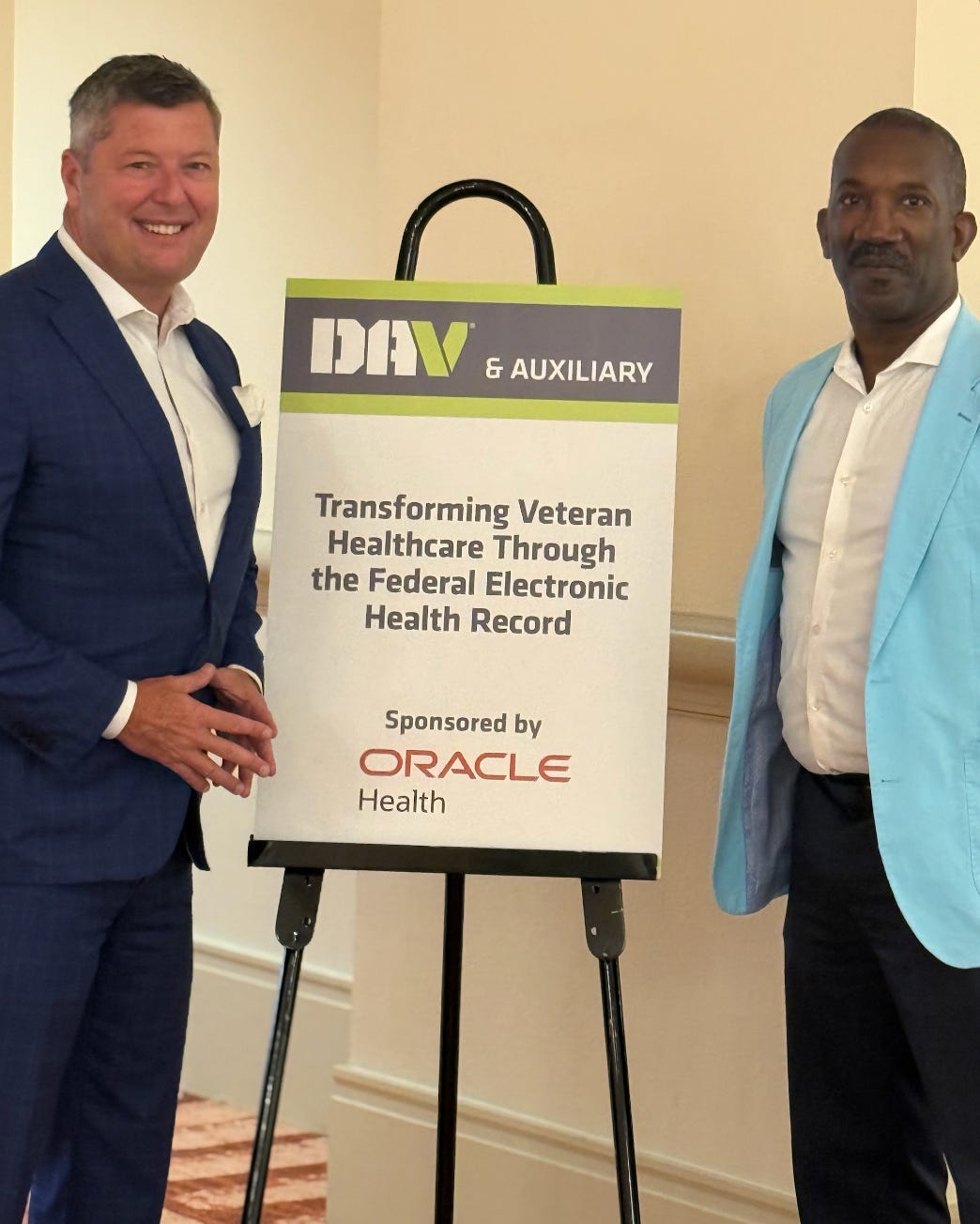
Former Navy Chief Medical Informatics Officer, Dr. James Ellzy, now Oracle VP, and I had the honor of holding a fireside chat at the DAV Conference yesterday, listening to any concerns our fellow veterans might be feeling (disclosure: I’m the Chairman of the Oracle Health board).
The VA’s unified electronic health record is beginning to reveal where veterans still encounter unnecessary delays. At our fireside chat yesterday, a Navy veteran raised one example: veterans in crisis who call for emergency refills of psychiatric medication may still be told they must first see their doctor.
That requirement was easier to defend when pharmacists and physicians could not reliably see the same information. A shared record changes the calculation. Providers can review a veteran’s prescriptions, treatment history and recent care across the network. Rules built for a fragmented system can now be reconsidered in light of information that is already available.
The pharmacy side shows how this works. The VA runs the largest pharmacy network in the world. Early versions of the new system struggled with prescription processing—a veteran waiting for a mail-order refill wouldn’t get bridging medication fast enough. Rather than accept that friction, the system was redesigned. Now pharmacists can issue short-term medications while the veteran waits, reducing the gap between crisis and care.
The system remains imperfect. But the principle is becoming clearer: patients should not be placed at risk simply because information, authority and responsibility sit in different parts of the bureaucracy.
This is where the actual evidence base matters.
Building a National Coalition with Face the Fight
Since Face the Fight launched in June 2023, its coalition of more than 300 organizations has distributed over $41 million across 83 projects. It’s been an honor to serve as their Honorary Co-Chair with JoAnn Bass, Retired Chief Master Sergeant, which is the highest enlisted rank in the entire Air Force These initiatives have conducted more than one million suicide-risk screenings, initiated over 250,000 conversations about safely storing firearms and other lethal means, and provided suicide-specific care to more than 110,000 veterans. Altogether, the coalition has reached 1.4 million veterans, service members, family members, caregivers and survivors.
That emphasis on lethal means is especially important. Firearms were involved in 73.3 percent of veteran suicide deaths in 2023. A conversation about changing the code on a gun safe, temporarily giving a family member the key, or otherwise creating distance from a weapon can interrupt a crisis before it becomes irreversible.
Most veterans (53%) are not even enrolled in the VA - and even among those who are, reaching out means confronting pride, stigma, the belief that you’re supposed to handle this yourself. All of it adds up to silence. When a veteran finally does break through that barrier, they face a second problem: access to treatment that actually works.
Take, for example, Prism, a prescription self-modulation treatment developed by GrayMatters Health for PTSD that’s FDA-cleared and effective. It works by retraining the brain’s response to threat through controlled sensory feedback. For some veterans, it’s the intervention that finally pulls them out of the cycle when medication and talk therapy haven’t. Not enough providers know about it, and insurance coverage is fragmented. Access depends on where you live, what you’re insured through, and whether your VA medical center has decided to offer it.
The Face the Fight model works because it connects three functions: prevention, connection, and access to evidence-based care. Treatment options like Prism exist for the clinical piece. Peer networks provide the ongoing connection. It’s still fragmented. But it’s less fragmented than it was.
Call to Action
While only 7.6% of Americans are veterans, it takes all of us to be part of the solution - and not just a ‘whole of government’ approach but a ‘whole of nation’ one. If you know a veteran who’s falling behind financially, tell them about VDA. It’s free, and they understand that money and mental health are connected. If you know someone caring for a veteran, tell them about DAV’s caregiver program and the Face the Fight initiative led by the Elizabeth Dole Foundation. If PTSD is the problem, tell them how Prism is an option and mental health providers are a phone call or text away.
The organizations are there with interventions that work. Luckily, most are good actors.
It’s time we face the Fight. Together.
Comments
Nothing yet. Say the first thing.
Sign in to join the conversation.