
Latam has a new unicorn. The first AI-native one. That, plus a couple of meaningful acquisitions, an event worth highlighting, and the best content I consumed this month.
For those of you who recently joined the Newsletter: the first Friday of each month I publish the Monthly Download for the previous month, where I share my highlights and use them as an excuse to discuss a couple of topics.
In this edition:
New Latam Unicorn Alert!
In the Room
Big News of the Month
Best Content of the Month
Coffee Break

It’s been quite some time since I had to update my Latam unicorn database. To be specific, September of last year when Kapital achieved the status. Fantastic news for the region to learn Enter has achieved unicorn status. It’s also worth highlighting that Enter is the first Latam AI-native company to achieve this milestone.
The Brazilian legaltech startup raised $100M, reaching a $1.2B valuation. Enter allows legal teams to manage their full litigation portfolio supported by AI agents. The result is higher win rates and billions of dollars in savings for their clients. The round was led by Founders Fund and included Ribbit, Sequoia, Atlantico and Kaszek. The company shared that since their Series A, revenue has grown 10x, the client base has tripled, and over 300k lawsuits per year are running through EnterOS. Some of the company’s clients include Nubank, Mercado Libre, LATAM Airlines, and Bradesco.

This is great news, and continues the trend we've been seeing: megarounds happening in the region every month (Plata, Kavak, ARQ...). Enter also continues a trend I’ve highlighted in the past: unicorns in the region are skewed toward two categories, Brazilian and/or Fintech.
In my yearly wrap-up of 2025, I actually mentioned Enter as the best example of the approach Latam startups should target within AI: enterprise vertical applications, where regional specificity matters and which are often complex spaces for global players to address. This is specifically what I said about Enter in December of last year:
“A great example is Enter: its AI agents support lawyers across the full lifecycle of a lawsuit and already deliver measurable savings for large enterprises in Latin America. Brazil alone is one of the world’s largest and most complex legal ecosystems. What Enter is building will ultimately travel, but critically, it began with a massive local opportunity. This is the type of playbook I expect more LatAm founders to follow.”
I can only emphasize: this feels like the right playbook. There are multiple opportunities in the region, but finding one that allows for a massive outcome is key.
I was once again invited to attend Perspectives by my good friends at Collective. For those of you who haven’t heard of Collective, they are a key partner for organizations looking to develop their talent and prepare them for the future. This edition of Perspectives focused on how organizations should execute the adoption of AI.
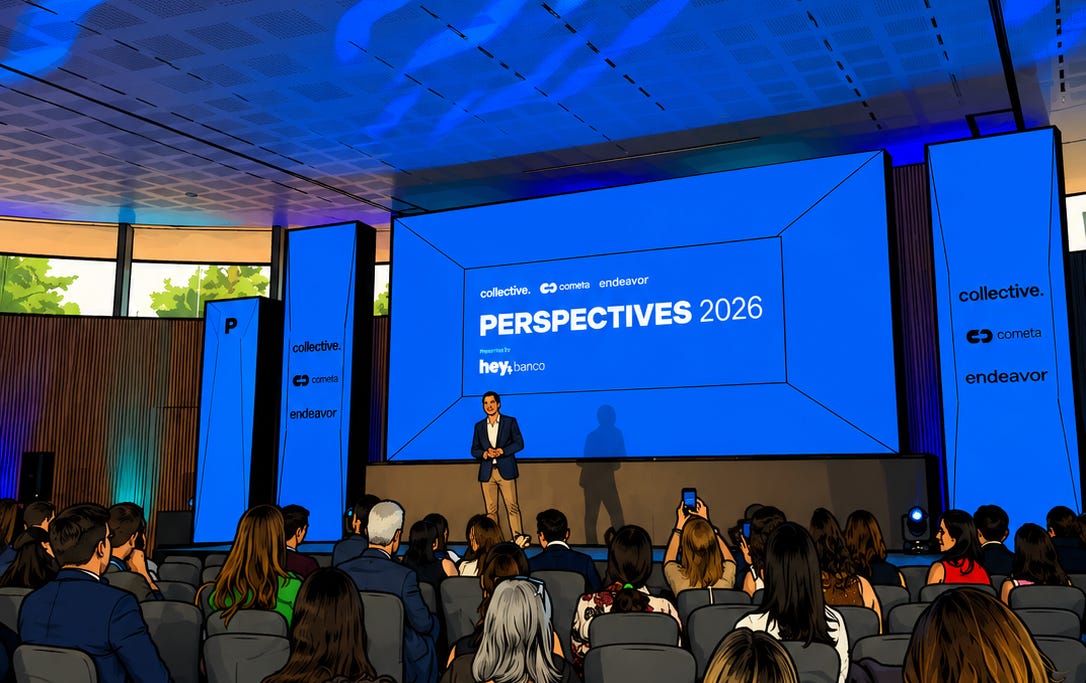
The event included a keynote from Christina Wallace, senior entrepreneurship lecturer at Harvard Business School, author of The Portfolio Life, and angel investor. Christina highlighted how our competitive advantage is built through the intersection of our unique knowledge, experiences, and perspectives. The tools we use (ChatGPT, Claude, Copilot, etc.) are in no way the source of our unique advantage.
To wrap up the event, James Wang took the stage. We’ve highlighted James before for his Substack Weighty Thoughts. James is also General Partner of Creative Ventures and author of What You Need to Know About AI (one of my favorite books of 2025). During his fireside chat, James highlighted how only 6% of companies have captured real economic value through AI. The issue is not the adoption of technology in an organization, it’s the culture and the systems in place that enable the adoption of AI, and how organizations can leverage their unique data, which no other competitor can replicate.
As I highlighted last year, we need more of these events in Mexico and Latam. They allow for in-depth conversations and new perspectives. Kudos to everyone involved for bringing many of the leading executives, entrepreneurs, and investors in the region together to share an afternoon focused on the complex issue we are all tackling.
Two meaningful acquisitions during the month worth highlighting.
Vertex, the public US tax compliance software company, acquired Brinta, the Uruguayan startup which provides tax determination, electronic invoicing, and automated compliance filing for tax returns in the region. The acquisition will allow Vertex to expand its services throughout Latin America.

Klar, the Mexican neobank, announced the acquisition of Yave, the Mexican digital mortgage platform, which will allow Klar to expand its credit value proposition beyond credit cards, investments, and personal loans. The company highlighted that this acquisition will enhance their product ecosystem and allow the company to expand into new products like car financing.
Terms were not disclosed in either transaction, and these are likely deals on the moderate side, possibly even acquihires. Regardless, to the extent that they generate liquidity for early investors and founders, they should be celebrated. It’s healthy to have acquisitions in our ecosystem, and a great signal that a US public company is looking at Latam to enhance their value proposition.
This announcement flew under the radar. Having the largest bank in Mexico sign an agreement that enables startups to access NPM (an independent U.S.-regulated entity) to explore liquidity solutions, including structured tender offers and private secondaries, is meaningful news.
Per the announcement:
“This initiative aims to address the growing demand for liquidity among founders, employees, and early investors in the Latin American tech ecosystem.”
Hopefully we hear about concrete examples of this collaboration in the near future. In an ecosystem desperate for liquidity, this may become a fantastic lever for Latam.
As the battle between OpenAI and Anthropic heats up, this article by Pitchbook is a great summary of where we stand.
Anthropic has quietly emerged as OpenAI’s strongest rival, surpassing it in valuation while raising significantly less capital. The company has gained meaningful traction in enterprise software, particularly among developers, where Claude has become a credible alternative to ChatGPT.
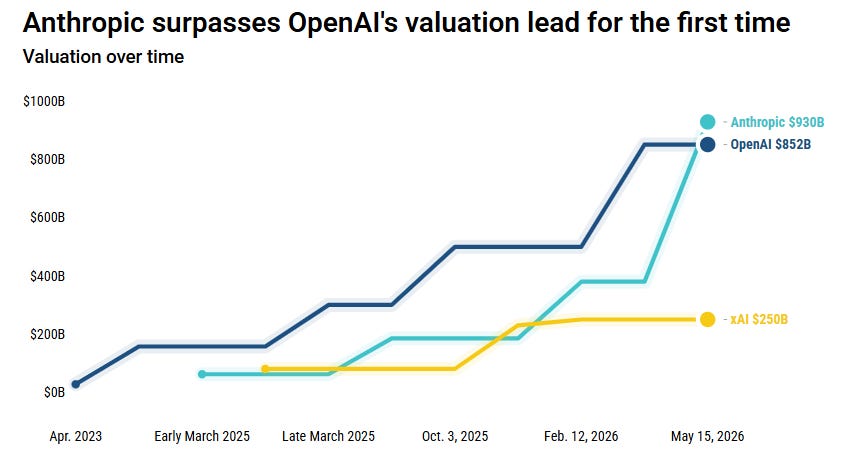
It’s worth highlighting that the market is beginning to reward capital efficiency and enterprise monetization, not just technical leadership. For years, OpenAI appeared to be the clear winner. Today, Anthropic is demonstrating that in frontier AI, distribution, pricing power, and enterprise adoption can matter just as much as having the most famous model. As both companies scale toward potential IPOs, commercial execution may prove just as important as technical leadership.
I’ve followed Scott Galloway’s content for some time now. Through podcasts and his newsletter, Prof G has consistently provided insightful content worth consuming. His recent move to Substack felt meaningful. I bet on Substack a couple of years ago when I started this newsletter. It wasn’t the obvious option, but I bet on it being a platform that would quickly rise to prominence and the value of having more control over my audience.
In this interview, Scott deep-dives into the rationale behind his move to Substack, which was less about audience growth and more about building a more valuable business.

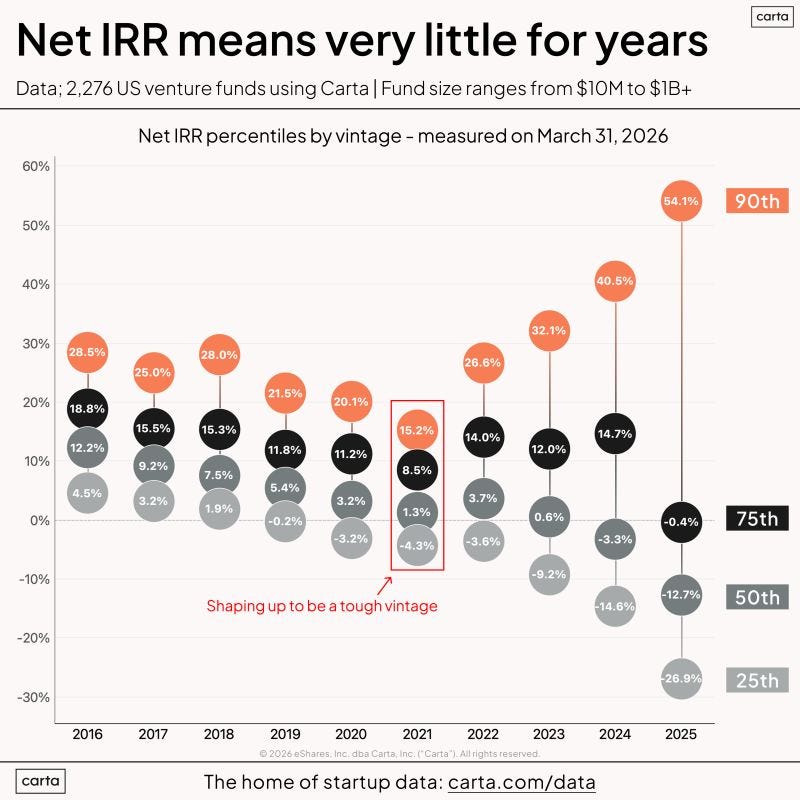
Peter Walker from Carta shared a chart on Net IRR percentiles by vintage for US VC funds. Most VCs will tell you IRR is not relevant, focus on TVPI or MOIC. I’ve been that person. And while the argument still holds, especially early on in the vintage, as time passes it becomes a more relevant metric.
I’ll probably be deep-diving on the topic soon, stay tuned.
Busy month on the coffee front. A couple of shops worth highlighting.
Groundwork (Los Angeles) — Took a few days off in LA with my wife earlier in the month, which allowed us to try several coffee shops. One of our favorites was Groundwork. Digging a bit into the history, the company is a pioneer in the specialty coffee industry, known for being one of the first certified organic coffee roasters in California. It was founded in 1990 in Venice, California.
The quality of the coffee is clearly superb and it shows.

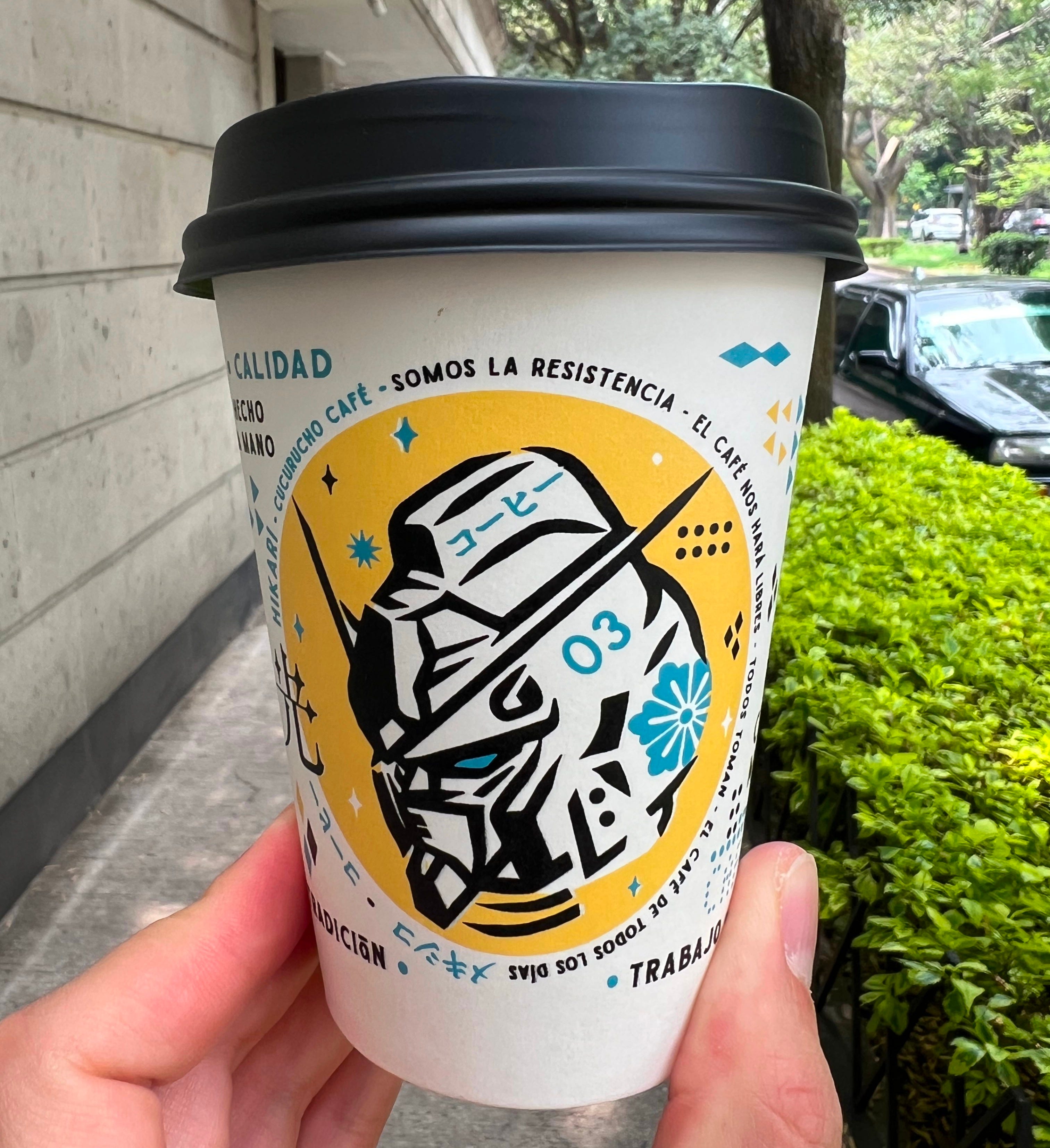
Cucurucho Cafe (CDMX) — Probably one of the coolest and most complex coffee cups I’ve documented to date. Cucurucho takes their craft very seriously and it shows in every detail. Their coffee was a bit acidic for my taste, but definitely worth the visit if you happen to stumble into one of their locations in Mexico City.
That’s it for the May 2026 download!
As always, feel free to drop your comments and share your own highlights.
Comments
Nothing yet. Say the first thing.
Sign in to join the conversation.