
Taking a step back mid-year is becoming a tradition for this newsletter. It’s a great exercise. It allows me to reflect on the expectations coming into the year, where we were right, and where we need some adjustment.
The expectations coming into 2026 were mixed. Unlike 2025, where there was a lot of optimism, apart from AI it was difficult to figure out what 2026 would look like. Let’s review what has happened, and what to expect during the second half of the year.

If you’ve been around this newsletter for a while, you might remember the July 2025 Monthly Download, where we highlighted how for the first time since the second quarter of 2012, Mexico surpassed Brazil in venture dollars. That implied over 13 years where Brazil had dominated quarter after quarter. At the time, I highlighted my expectation that Brazil would continue to dominate, albeit Mexico might be able to win a quarter every once in a while.
Boy was I a bit off.
2026 has been all Mexico. It has led the region during the first two quarters of the year, driven by growth rounds from some of its most distinguished startups: Clip, Plata, Kavak, to name a few.
To put things in perspective, venture funding in the region for the first half of 2026 has hit roughly $2.5B USD. That is a significant improvement when compared with the same time frame in 2025, when funding reached approximately $1.8B USD.
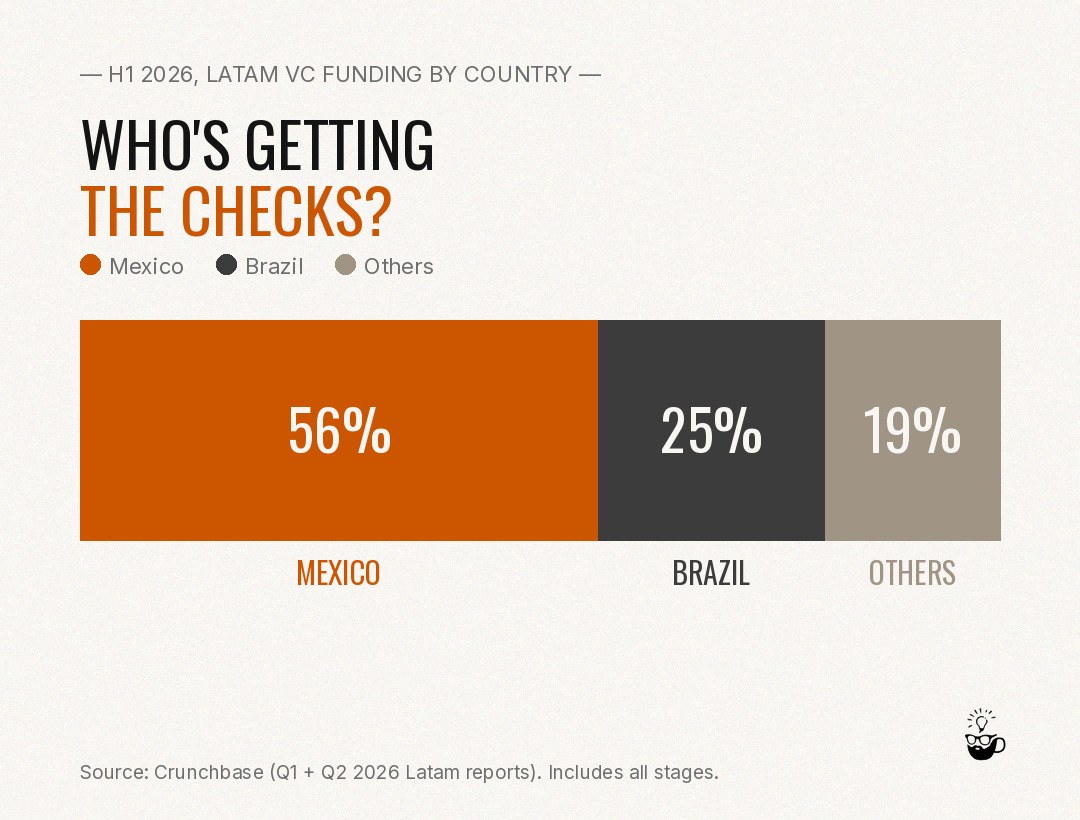
Shifting back to Mexico's dominance, the difference has been so stark during the first six months of the year that it has even pushed some Brazilian VCs to speak up on the topic. Below, a recent post by Rodrigo Baer, Partner at 14B Venture Capital.
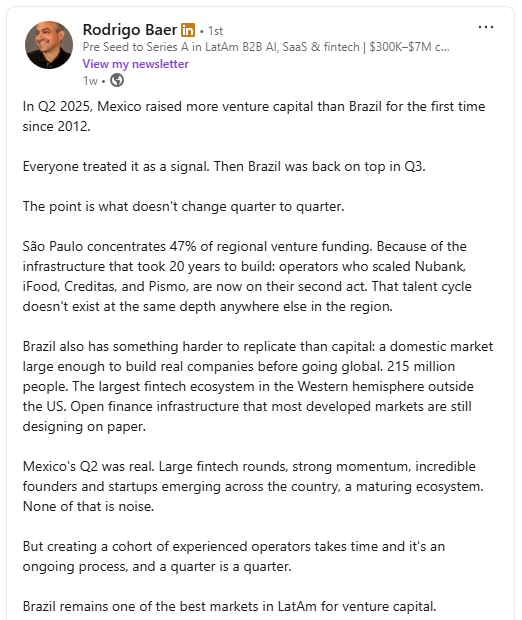
As I commented on his post, I agree with the overall message from Rodrigo. I still believe Brazil is in a better overall position than Mexico. However, the distance between both markets has shrunk, and global investors are clearly seeing something they like in Mexico, and acting on it.
All this to say: we need to get used to seeing Mexico taking the quarterly lead more frequently than it did during the previous 15 years. And that is very healthy for the region.
Given Mexico’s lead, I have a tough time seeing Brazil catching up. We should expect 2026 to be the year Mexico leads Latam in total venture investment.
Mexico’s dominance isn’t just about volume. The type of capital flowing into the country matters as much as the amount.
Last year I published an analysis on how Latam VC could be reduced to Brazil and/or Fintech. When you look at the unicorns at the time, most of them had at least one of those characteristics.
Looking at the largest deals in Latam in the first half of the year, one could argue it’s now Mexico and/or Fintech. Six out of the top 10 deals are fintech or fintech-adjacent. While only three deals are Mexican companies, they are the top three deals and account for roughly $1.2B USD, while the remaining seven deals account for about half of that.
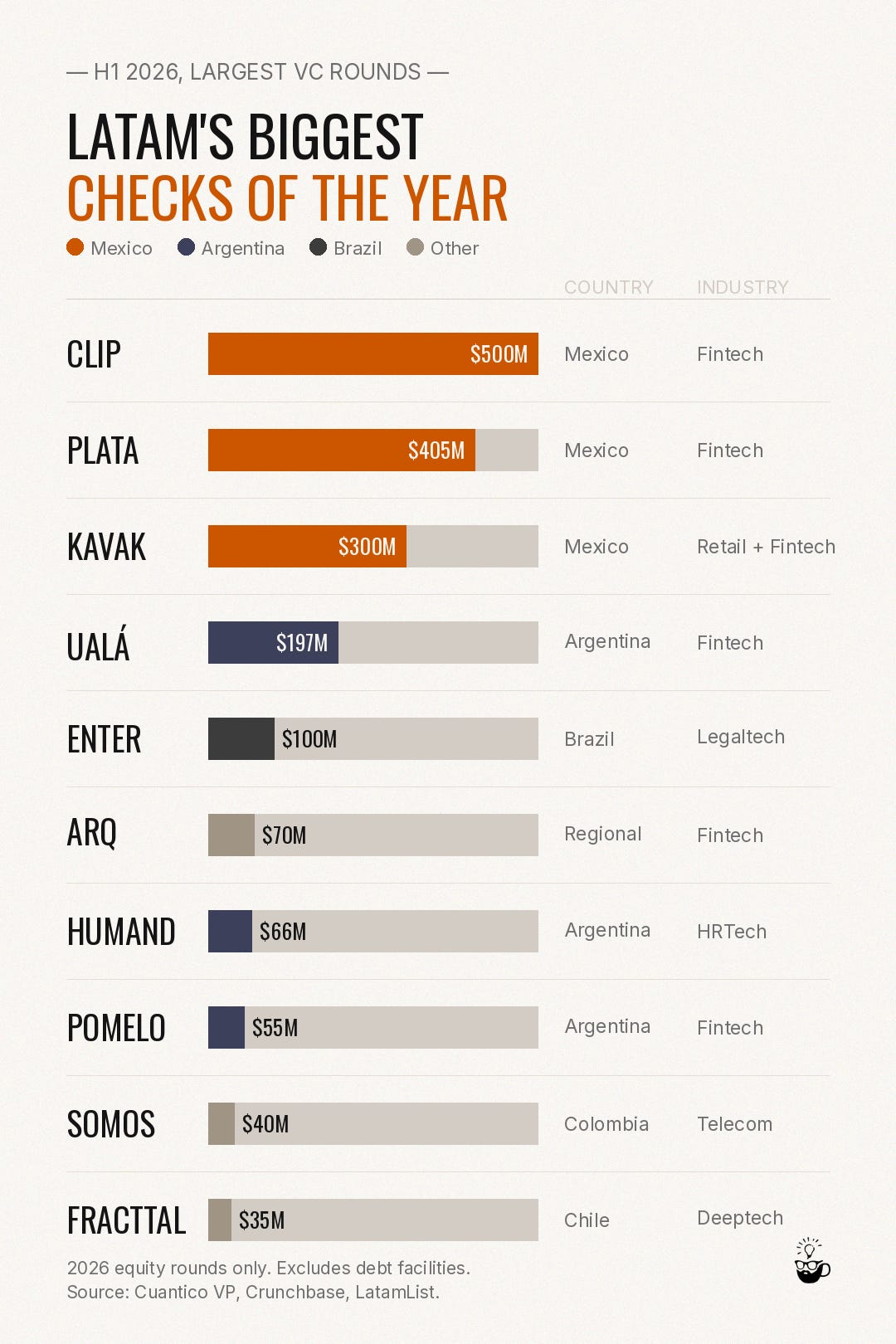
Mexico + Growth + Fintech seems to be the winning strategy these days.
Part of the explanation is structural. Mexico has a large underbanked population, a growing middle class, and a regulatory environment that has been increasingly friendly to fintech innovation. Global investors understand that playbook well. It is the same one that worked in Brazil a decade ago, and they are betting it plays out again in Mexico.
Worth highlighting: ARQ is an interesting case. Its founders are Argentine, and their presence in Mexico started from the beginning, making it difficult to pin down to a specific country of origin.
Argentina’s story deserves more attention than the Mexico narrative is giving it. Three of the top 10 deals in H1 2026 are Argentine companies, Ualá, Humand, and Pomelo, and all three have significant operations in Mexico. That is not a coincidence. Argentine founders have shown a consistent ability to build regionally from day one, and the capital they are attracting reflects that. In a half-year dominated by Mexican megarounds, Argentina is quietly having a strong vintage.
On the Brazil front, they only landed one deal in the top 10 through Enter. That is surprising. It may also signal things to come in the region.
Brazil has historically led Latam by producing companies that attract global capital at scale. One deal in the top 10 for the first half of the year suggests that pipeline may be thinner than usual right now. Whether that is temporary or structural is the question worth watching in H2.
Having a boom in growth and late-stage is great, and it has dominated the headlines for the last few months. However, it’s worth digging deeper, as this has come at the expense of angel-seed and early-stage deals.
During 2026, over 70% of investment has been focused in late-stage and growth deals.
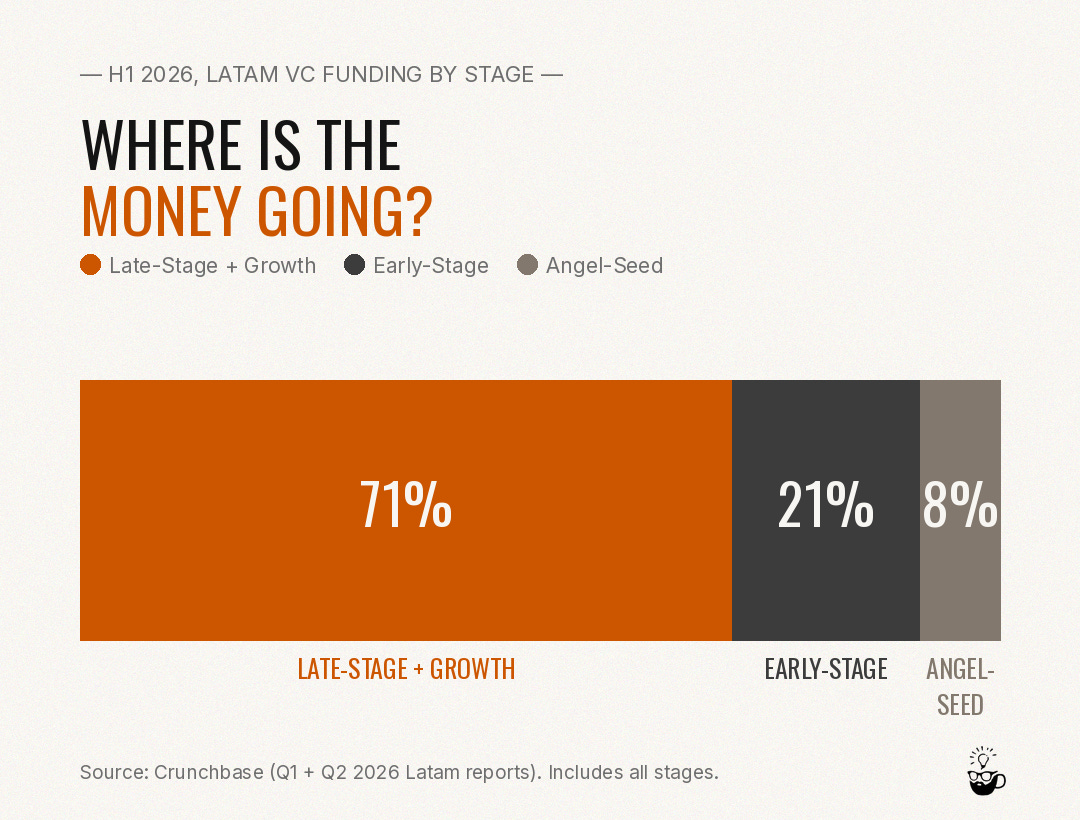
This makes sense in a way. Massive rounds are likely to skew numbers. As long as early-stage and angel-seed deals remain healthy, it shouldn’t be an issue. The reality is that the first two quarters of this year have had the lowest investment in these categories in quite some time.
We are basically asking a smaller number of companies to deliver. Or else.
If this trend continues, it could imply significant consequences as we move forward. The size of the cohort of investable companies at the late and growth stage will shrink as these vintages mature.
Let’s use Mexico as a case study during Q2 2026. The country raised $944M during the quarter, but strip out Clip and Plata and only $39M is left for the rest of the ecosystem. That works out to less than $500K per day in early-stage investment for the entire quarter.
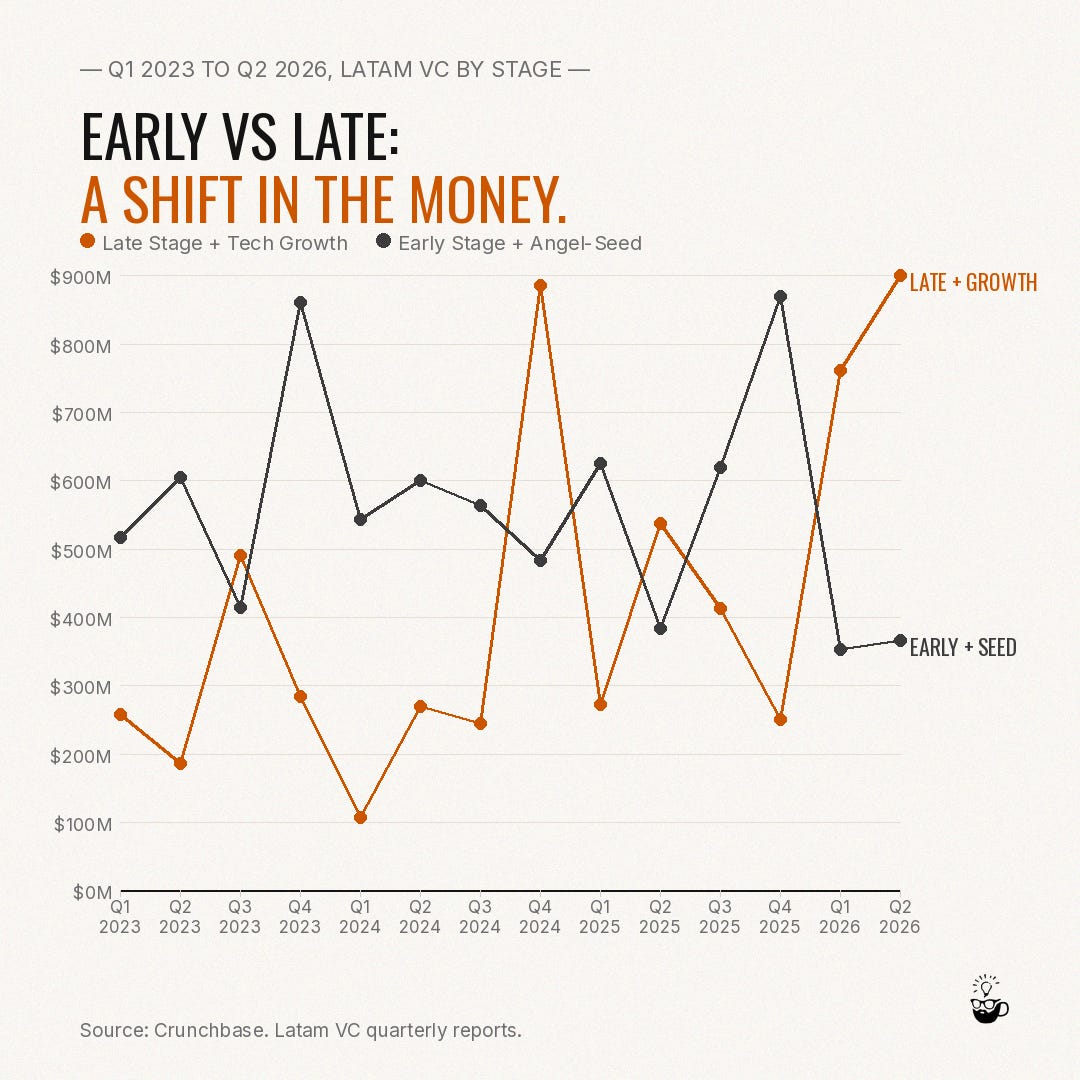
I’ve written before about the bar getting higher: higher concentration of money into fewer deals. What these numbers seem to imply is that there is less money for fewer deals. Improvement is likely as there is usually a reporting delay on new deals, but I doubt the recovery will be significant.
If Q3 2026 shows a meaningful recovery, this becomes an anecdote. Right now, it doesn’t look like one. Six months of data now suggest the volume of early-stage deals in Latam is lower than anything we’ve seen in the last three years.
The first half of 2026 has a headline story and a quieter one running underneath it. The headline story is encouraging: Mexico is asserting itself as a regional leader, global capital is flowing into Latam growth companies, and fintech continues to produce outcomes that get noticed beyond the region. The quieter story is harder to ignore: the foundation is thinning.
Both are true at the same time.
In Part 2, I’ll cover what the SF migration means for the ecosystem, the structural challenges facing the fund landscape in the region, and what the Vertical AI trend (and Enter specifically) tells us about where the real opportunity lies.
Comments
Nothing yet. Say the first thing.
Sign in to join the conversation.