

I was on a call today when someone asked me, "What does the science say about how many times we should check email each day?"
It's a reasonable question. The answer, according to research, is quite clear: about three times daily. Responding to emails at specific times of the day significantly reduces stress and improves well-being. Professor Gloria Mark's research at UC Irvine found that when people are cut off from email, they experience less stress, focus better, and have more natural heart rates.
All very rational. All very sensible.
Yet here we are, checking our inboxes 50, 60, 70 times a day.
This gap between what we know we should do and what we actually do is where I find myself most curious.
Why do we continue behaviors that we know are harmful to us?
For decades, economics was built on the concept of homo economicus – the rational economic man who makes logical decisions to maximize utility. We've since discovered, through pioneers like Daniel Kahneman and Amos Tversky, that humans are far more irrational than rational. Our decisions are colored by cognitive biases, emotional states, and situational contexts.
The same principle applies to our relationship with email. The science tells us to check it three times a day, but science doesn't account for the emotional architecture we've built around these digital tools.
Our relationship with email follows the exact pattern described in Nir Eyal's "Hooked" model:
Trigger: external (a notification ping), eventually internal (a feeling)
Action: Opening the app or browser tab
Variable Reward: Sometimes important messages, sometimes nothing
Investment: Responding, organizing, or simply absorbing the information
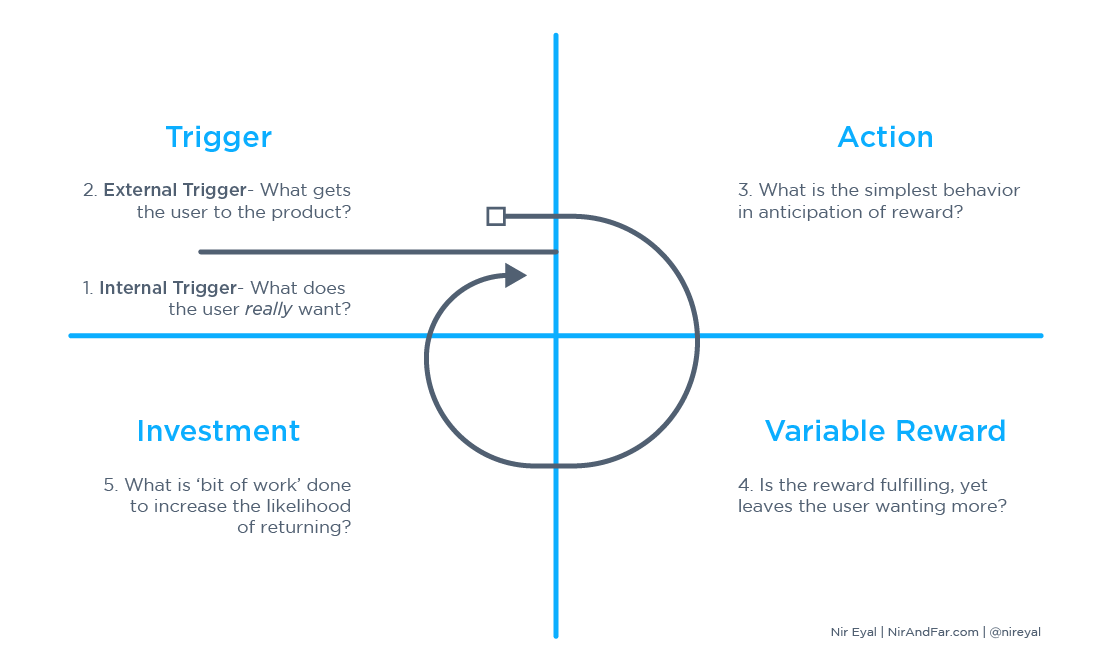
The genius – or perhaps the tragedy – of this loop is how it eventually eliminates the need for external triggers. We move from needing a notification to reaching for our inbox whenever we feel a certain way.
Bored? Check email. Anxious? Check email. Frustrated with a difficult task? Check email. Uncertain about what to do next? Check email.
The loop becomes self-sustaining. Our emotional states become the triggers.
Two weeks ago, I had a very short window between finishing a keynote and getting to the airport to catch a flight. Caught in Fort Lauderdale traffic, I found myself cycling between different apps on my phone—checking news headlines, sports, email, WhatsApp—again and again, until I caught sight of what I was doing and put the phone away.
I felt stressed that I would miss the flight and I was using this constant shifting of my attention to distract myself from what I felt inside. But I had to put the phone away and be with it, accept it. Once I did that, it didn't feel so bad. If I missed the flight, I missed it. I'd get another one. My perspective started to zoom out, and as I saw the bigger picture, I became more calm.
The reality is that we don't check email 50 times a day because we're expecting 50 important messages. We check it because the act of checking itself has become a coping mechanism—a way to momentarily relieve the discomfort of our inner experience.
And herein lies the nature of our codependency: we use email (and Slack, and Teams, Instagram, X etc.) not as tools but as emotional regulators.
The most insidious aspect of this relationship is how instantaneous it becomes. It begins not with an emotion, but with a bodily sensation—a subtle tightness in the chest, perhaps, or a flutter in the stomach, a slight increase in heart rate. And within a split second—before we've even interpreted this sensation—we're reaching for the inbox.
Lisa Feldman Barrett's groundbreaking work on emotions helps explain this process. Her research shows that emotions aren't hardwired reactions but constructed experiences. What happens first are physical sensations—the raw data of our internal experience. Our brain then makes meaning of these sensations based on past experience and context.
What's fascinating is that our digital behaviors often short-circuit this meaning-making process. We react to the raw sensation before we've even constructed an emotion around it. The body senses discomfort, and the hand reaches for the phone—bypassing conscious awareness entirely.
This happens below the threshold of awareness. It's not a decision we make; it's a response we have.
And in that split-second reaction, we sacrifice our ability to create space, to focus on what matters, to be present with ourselves. We fragment our attention into smaller and smaller pieces until we can no longer see the whole.
When we talk about our relationship with digital tools like email, we often frame it as a matter of willpower and discipline. Just check it three times a day. Just turn off notifications. Just be more mindful.
But this approach often fails us, doesn't it? We make these resolutions in moments of clarity, only to find ourselves back in the same patterns hours later.
Perhaps this is because we've misidentified the nature of control in this relationship. Control doesn't come through willpower as much as it comes through awareness.
Part of what keeps us tethered to our inboxes is a deeper association we've formed: the belief that work happens when we're on screen. To step away feels like idleness, like wasting time.
This association creates a self-reinforcing cycle. We stay at our screens because that's where "work" happens, but in doing so, we deprive ourselves of the very breaks that would allow us to self-regulate and ultimately work more effectively.
What does it mean to self-regulate? At its core, it means reconnecting with ourselves.
When we're constantly engaged with our screens, we're extending our consciousness outward – into the environments of others, into digital spaces, into the countless perspectives and demands coming through our devices. We're everywhere except where we actually are.
The longer we stay in this extended state, the more difficult it becomes to create inner stability or a sense of consistency within ourselves. We become like water taking the shape of whatever digital container we pour ourselves into.
And so we outsource our emotional regulation to these tools – a quick hit of dopamine from a new message, the brief relief of distraction, the illusion of productivity from clearing an inbox. But these external forms of regulation ultimately leave us unfulfilled, because they can't address what we're really seeking: a stable sense of self in an increasingly fragmented world.
I'm not suggesting we need to judge ourselves for checking email 50 times a day, or for scrolling Instagram when we meant to finish that presentation or respond to that important client. Judgment only adds another layer of discomfort to escape from.
Instead, I'm inviting curiosity. What's driving this behavior? What am I seeking when I reach for my phone first thing in the morning? What feeling arises right before I tab over to my inbox for the third time in ten minutes?
The driver might be different for each of us. For some, it's anxiety about missing something important. For others, it's the discomfort of focusing on challenging work. For others still, it's a deeper sense of disconnection or inadequacy that we're trying to soothe through constant engagement.
Whatever it is, awareness of that driver gives us something that willpower alone cannot: the possibility of choice.
Without awareness, we remain caught in the cycle – making resolutions, breaking them, judging ourselves, and trying again with renewed determination but no new understanding. With awareness, we can begin to see the patterns and, in seeing them, create the space for something different to emerge.
This isn't about fixing or optimizing ourselves. It's about coming home to ourselves in a world that constantly invites us elsewhere. It's about remembering that behind the screens and beneath the notifications, there is a self that exists independent of digital validation or distraction.
So perhaps the next time you notice that impulse to check your email, instead of either following it automatically or forcefully resisting it, you might simply pause and notice: "Here I am, feeling something that wants relief." And in that noticing, you might discover a freedom that no amount of digital discipline could ever provide.
No posts
Comments
Nothing yet. Say the first thing.
Sign in to join the conversation.