
Deep Dive Podcast
Audio segment produced with AI narration summarizing Patrick Madrid’s written content.
0:00
-18:29
ONE OF THE MOST frequently repeated historical misconceptions about the Catholic Church is the notion that, in the Middle Ages, there were sometimes as many as three competing popes reigning simultaneously. This is simply not true and results from a misunderstanding of the historical details. 1
So how did this notion of three popes at one time become so widespread? First, it’s true that at different times in Church history, several men simultaneously claimed to be the pope, but this is not the same as there actually being three validly elected popes reigning simultaneously.
In this brief article, I'll cut to the chase and give you the big picture without descending into the myriad, arcane historical details, so that you can see why the notion of three popes reigning at the same time is false. 2
It doesn’t matter if two or three or even a hundred men claimed at the same time to be the validly elected pope. There can only ever be one pope at one time. Only one man at a time can hold the “keys of the kingdom of heaven” that Jesus promised to Simon Peter (Matthew 16:18) and, by extension, to his successors.
This “three popes at one time” argument proves nothing other than that there have been challenging and difficult episodes in the 2000-year history of the Catholic Church in general and the papacy in particular. Those who attempt to make this issue into something important are making a mountain out of a molehill and, worse, entirely missing the point.
In spite of the spate of confusion among claimants and their supporters, the Church indeed was able to methodically and accurately determine in due time which of them was in fact the valid pope. Though recognition of the authentic line of Petrine succession was strained during this time, the succession itself never broke and that unbroken line of popes from then until now is intact and secure.
Jesus never promised His Church wouldn’t pass through times of uncertainty and confusion. But He did promise: “In the world you have tribulation; but be of good cheer, for I have overcome the world” (John 16:33).
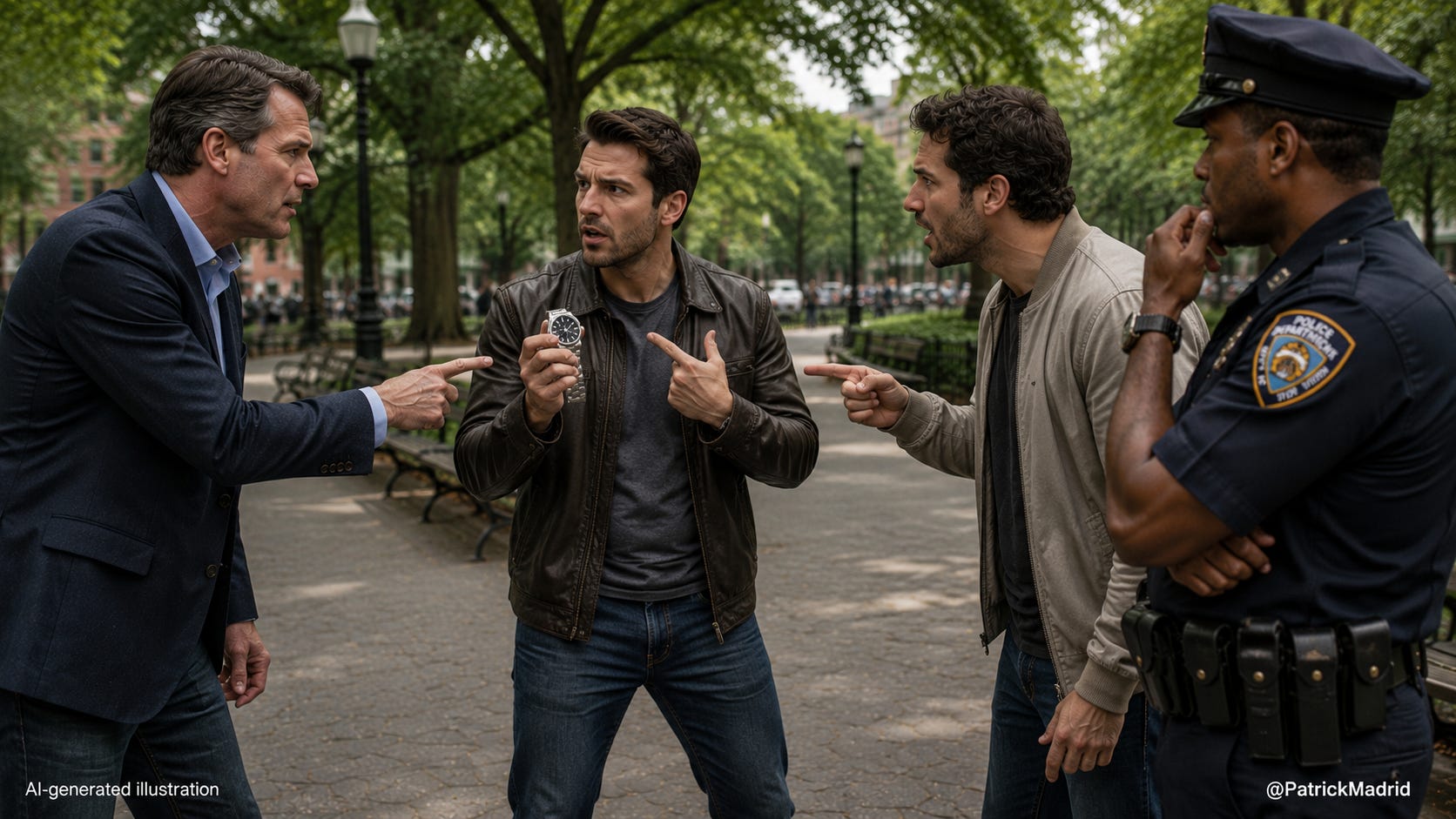
Imagine you own a very expensive watch. One day, while walking in a park, you lose the watch. You search everywhere but, in the end, can’t find it. Heading home disheartened, you notice two men fighting over something. As you approach them, you see the object of their dispute is the very watch you lost. You go over to claim ownership, but they refuse to give it over.
A police officer arrives and begins to deliberate as to the true owner of the timepiece. He finds three claimants to the watch, but knows there can be only one true owner.
So it was with the papacy.
In fact, there were a few times in which two or three men simultaneously claimed to be the pope, but that doesn’t mean that all of them were the pope. This is because there can be only one legitimate, validly elected Bishop of Rome, who is by definition the pope, at any given time. Any other concurrent claimants to the papacy are mere counterfeits, whether they realize it or not.
The Great Western Schism (1378-1417), as it’s commonly known, is the brief period in Catholic history within which such confusing rivalries for the papacy occurred.
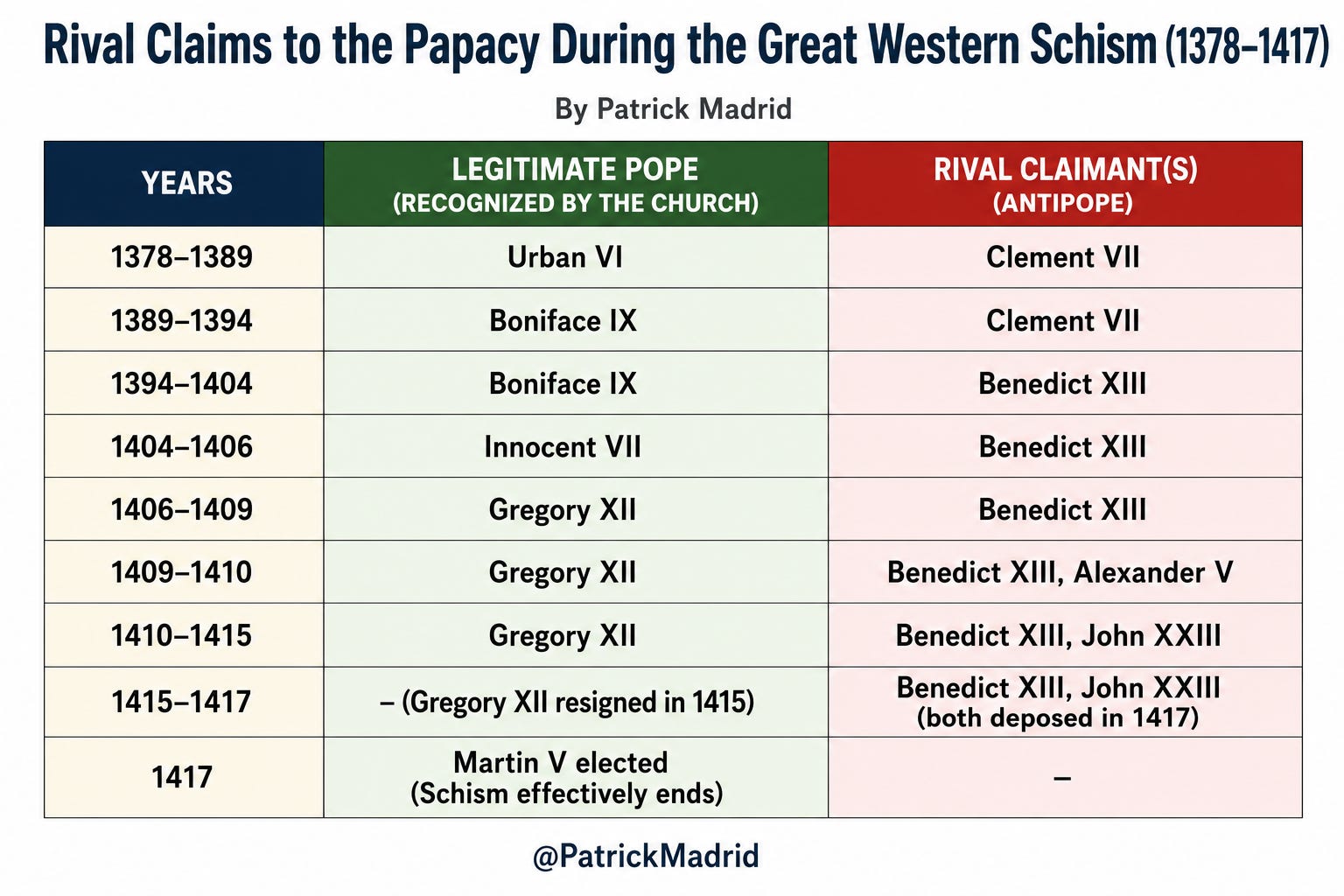
In less than 40 years, fully eight different men vied for official Church recognition as the validly elected pope.
Four of them are recognized by the Church as having been validly elected . . .
Urban VI (1378–1389)
Boniface IX (1389–1404)
Innocent VII (1404–1406)
Gregory XII (1406–1415, resigned the papacy)
And the four who were anti-popes (i.e., invalidly elected) were . . .
Clement VII (1378–1394)
Benedict XIII (1394–1417; deposed 1417, maintained his claim until 1423)
Alexander V (1409–1410)
John XXIII (1410–1415)
As you'll see, the real issue was never whether there were multiple claimants to the papacy. The real issue was how the Church, in each dispute, determined which claimant had in fact been validly elected pope.
The confusion was so great that even two canonized saints of that era, St. Catherine of Siena (1347-1380) and St. Vincent Ferrer (1350-1419), both learned and sagacious, nevertheless reached different conclusions as to who was the validly elected pope. Catherine defended Urban VI as the legitimate successor of St. Peter, while Vincent was sincerely convinced that Benedict XIII, the Avignon antipope, was the true pontiff.
Eventually, however, when Benedict refused to renounce his claim for the good of the Church and thus help bring the Great Western Schism to an end, St. Vincent formally withdrew his support.
Happily, this sorry chapter in Church history eventually came to an end, but not without a great deal of division and confusion for a time. Here’s a visual overview showing which popes and anti-popes were rival claimants:
The story begins, surprisingly enough, not in Rome but in Avignon, France. In 1305, Pope Clement V was forced to move the papal residence from Rome to Avignon. At the time, violence was breaking out among the noble families in the Eternal City. This put the papacy in physical danger, so the move was an important one.
After seventy years of exile in France, Pope Gregory XI moved the Holy See back to Rome. When he died in 1378, it became necessary to choose a pontiff who would be able to draw both the French and the Roman factions of the Church together. With this intention, the well-respected Archbishop Bartolomeo Prignano was elected, becoming Urban VI. It’s important to note that his election was supported by all major parties in the Church.
Unfortunately, as historians note, Urban VI’s personality seemed to undergo a metamorphosis after his ascension to the papal throne. He became difficult to work with, being vocally critical of anyone he disapproved of. This quickly alienated his former supporters, who then conspired to replace him.
Thirteen members of the Sacred College met in a secret conclave and elected another pope, the former Robert of Geneva. After his election, the antipope Clement VII moved his claimed see back to Avignon and reigned there in schism.
Sadly, the usurper to the papacy was everything the real pope wasn’t. While Urban VI was brusque, Clement VII was diplomatic; Urban VI was arrogant, but Clement VII was endearing.
These realities quickly split the allegiance of the Church. There were mutual excommunications between the two parties, and the debate as to who was the legitimate pontiff raged throughout the Catholic world. The various powers of Europe got involved, siding with either Rome or Avignon, whichever was more beneficial for them politically.
Eventually, old age caught up to both men, and they died. Their successors, Boniface IX for Urban VI and Benedict XIII for Clement VII, continued the rift despite several attempts at reconciliation.
Boniface IX’s reign was short, and he was followed by Innocent VII, and then Gregory XII. Benedict XIII had, by this time, lost the all-important support of the French royalty. In fact, he spent a good bit of time in their custody, cut off from communication. Nevertheless, this didn’t weaken his resolve to be considered the true pope.
This mess got even more confusing when, in 1409, a council convened at Pisa elected yet another antipope, John XXIII. However, this only served to worsen the matter.
Europe was, by this time, sick of the divisions and yearned to be united spiritually once again under a single Roman head. Their desires were finally realized at the Council of Constance in 1414. Gregory XII resigned the papacy, while both John XXIII and Benedict XIII were removed from their sees. In their place, in 1417, a new pope agreeable to all, Martin V, was elected.
There were many other (mostly earlier) antipopes. However, this period saw the most dramatic episode.
The question remains as to who was the legitimate pope at this time.
Actually, the answer is an easy one: the papacy never left Rome.
Even though Urban VI was an unpleasant fellow and, perhaps, a difficult person to work with, he was, nevertheless, the legitimate successor to Peter. Likewise, his successors, Boniface IX, Innocent VII, and Gregory XII all had the legitimate title to the papacy.
Just because other parties claimed to be popes doesn’t mean they actually were popes.
Remember the analogy of the watch, your watch, whose ownership was disputed vigorously by several other men, none of whom were the actual owner. Even though the others claimed to own the watch, that didn’t make it so.
The essential thing, when evaluating the past 2000-year history of the papacy and its 267 different occupants, is to follow the pedigree of succession. Only then will you be sure to follow the true Vicar of Christ.
Yes, there have been vexing controversies, claims, and counterclaims over who, if anyone, is the validly elected pope at any given time.
To borrow an analogy from Saint Paul, the popes are indeed “earthen vessels.” And thus, in Christ’s own institution of the papacy,
“we have this treasure in earthen vessels, to show that the transcendent power belongs to God and not to us. We are afflicted in every way, but not crushed; perplexed, but not driven to despair” (2 Corinthians 4:7-8).
But in spite of those sometimes confusing difficulties in human ecclesiastical affairs, it is clear that there was never more than one validly elected pope reigning at the same time. The Church was afflicted for a time, but not crushed. Perplexed, but not driven to despair.
Regardless of how many claimants may have vied for the papacy, once you see that fact clearly, all the rest is just background noise.
Copyright © 2026 Patrick Madrid. All rights reserved. All text, images, and other original content are the property of the author. Adapted and expanded from a section in my 1999 book Pope Fiction.
I hope you enjoy my articles here. If so, please tap the Share button above to post any of them on X or Instagram or to send it to someone who might be interested in it. And if you enjoy thoughtful, friendly, faith related content, you’ll appreciate my daily program on Relevant Radio. Listen here or get the free Relevant Radio app.
Or, as Jonathan Frakes, of the show Beyond Belief: Fact or Fiction, might put it: “Not a chance. This one is fiction. Completely made up. It never happened.”
For a riveting, detailed account of the Great Western Schism, its principal players (including the great St. Catherine of Siena!), and its ultimate resolution, see Warren H. Carroll, The Glory of Christendom (Front Royal, VA: Christendom Press, 1993, p. 425-534).
No posts
Comments
Nothing yet. Say the first thing.
Sign in to join the conversation.