
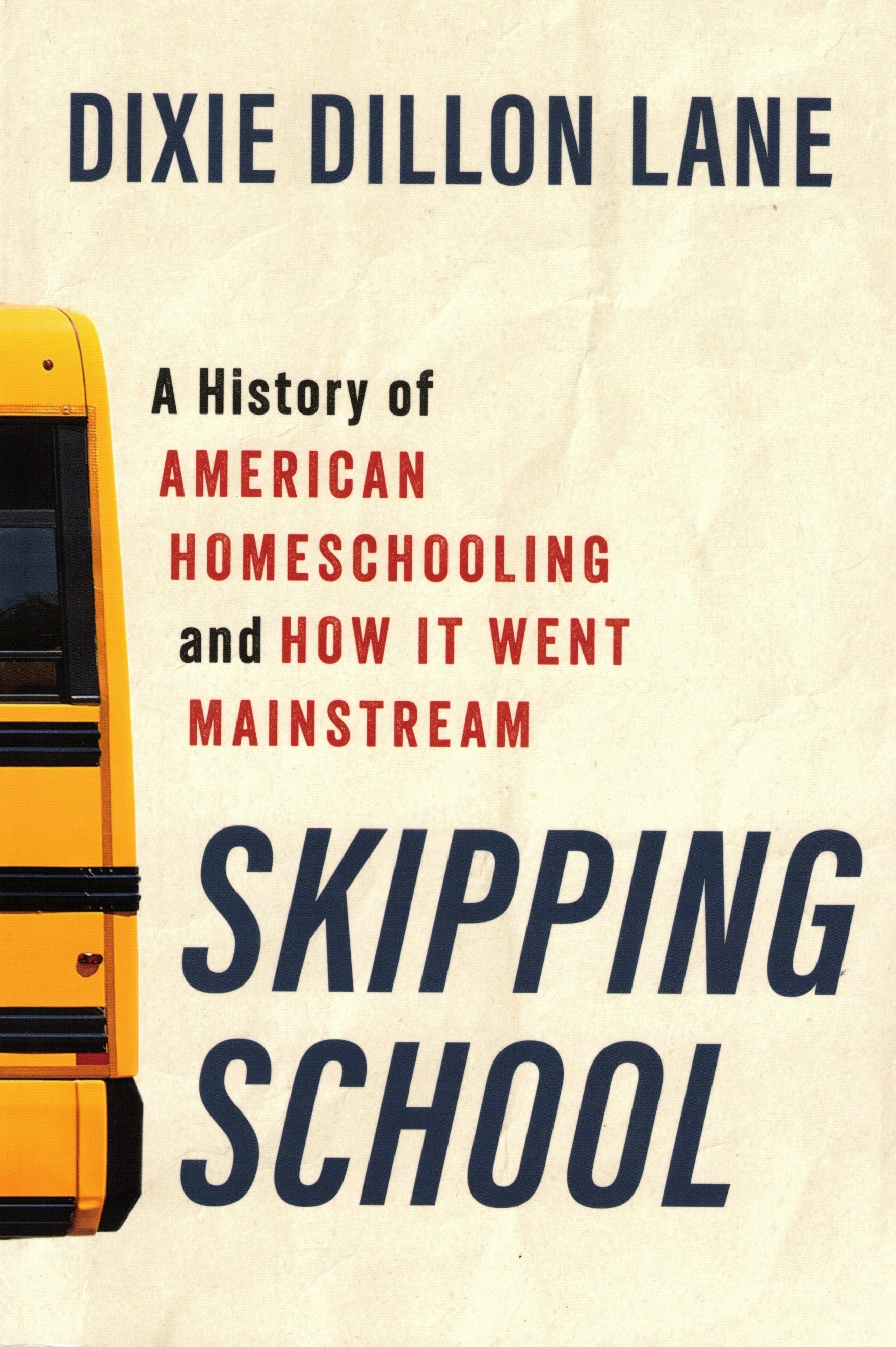
It’s a strange feeling to read a history of American homeschooling as one who was, and still is, actively involved in that history. Yeah, I’m old, but I didn’t think I was “historically” old until I read Skipping School: A History of American Homeschooling and How It Went Mainstream by Dixie Dillon Lane.
The book uses “national-level research sources and research from my close historical study of one high-homeschooling location—Los Angeles County, California—to make arguments both about the experience of homeschoolers and about homeschooling as a national movement and educational practice.”
Dr. Lane attended public schools in childhood and is now a homeschooling parent, which makes her approach to the topic more sensitive than the usual research done by homeschooling outsiders. Her engaging and wide-ranging book is focused on
… the particular dance between families and larger communities—some governments, some churches, some schools, some subcultures, and wider society as a whole—that characterizes homeschooling. It is not a catalog of all the players, all the subcultures, all the politicalizations, all the criticism or adulation that have some role to play in the history of homeschooling. … Instead, this book offers a bottom-up and a top-down view of homeschooling. This book seeks to find answers somewhere in the middle, answers that will offer insight to both historians and American parents generally. This is a book, first and foremost, about people.
… When I say, then, that homeschooling has become an “educational norm” or “part of the American educational mainstream,” I do not mean to suggest that it is practiced by a majority of Americans. Rather, I mean to say that it is both practiced by enough Americans and accepted by enough Americans to be considered a minor norm within the larger American landscape.
This is similar to how, for example, attending private school is accepted as within the realm of normal in the United States even though most American children do not attend private school.
Lane opens her book with California homeschooling court cases from the 1950s and 1960s that laid the groundwork for future court battles. She also writes a concise outline of the shifting educational paradigms within American schooling after World War 2 that led to these battles.
Both the American and Soviet governments knew that building up their respective political systems, their economic prowess, and their international influence required first, as historian David Raleigh writes, “educating the builders.” As a result, soon after the Second World War, American governments and educational experts begawan unprecedented effort to direct the reform of schooling at every level across the country. Doing this, however, required dramatically increasing government and expert (especially administrative) control over schools, privileging this over parental rights and influence.
… from roughly 1920 to 1945, the leading lights of American education had wished not only to mold society through schools but also to require that teachers exert tremendous personal effort to adapt to the local needs of their classrooms (as they saw them), even to the point of writing textbooks to suit their own students. In other words, while schools had been moving toward expert control in those heyday years of progressive education and teacher professionalization, they did so with a profound respect for the importance of school and community ties and of teacher autonomy.
The much more radical transformation from local to large control that occurred in the 1950s and ‘60s was a different thing altogether. This change was born not out of a lack of interest in local influence but out of a pressing fear that without a nationally overseen education, the next generation of Americans would not be able to defeat the Communists as their parents had defeated the Nazis. And now the transfer of power from ‘lay citizens to elite decision makers in government,’ as Joseph Murray has written, was moving forward far more rapidly.
Leaders for homeschooling emerged from the schools of this time, namely John Holt and Raymond and Dorothy Moore. John was a private school teacher, while Ray was a researcher at the US Office of Education and Dorothy was a public school teacher. Lane writes about an an influential article by the Moores in Reader’s Digest that argued
the family is the primary educational delivery system. … In fact, John Holt responded to the Reader’s Digest article with a letter encouraging the Moores to take their criticisms even further. Many readers, both famous and less so, agreed that the home and family were the best available setting for alternative education. And so parents, not teachers, would have to lead the way.
Lane’s interviews with the people in Los Angeles county who established the early local homeschooling support groups, conventions, and educational resources shows how ordinary people can create and establish in their own families and communities the changes they want in school and society .
Lane divides her book into three parts: Better at Home (1950–1990), Back to School (1990–2010), and Into the Mainstream (2010–2024). Referring to current-day mainstream homeschoolers, Lane writes:
… we can say with some confidence that while the desire to educate children religiously played a (sometimes highly important) part in a large number of homeschoolers’ decisions to homeschool in the early twenty-first century, the overall motivation of homeschoolers as a group was almost certainly not primarily religious and has grown to be less so over time. As numerous of the NHES (National Household Education Survey) reports have repeated, ‘parents homeschool their children for many reasons that are often unique to their family situation.’
Thus, although a majority of homeschoolers were religious—as were a majority of Americans overall, let us not forget—religiosity did not define homeschooling whether in motivation or demography.
Later in this part she writes, “…it seems that post-2020 homeschooling is characterized far more by diversity of motivations, races, and income levels than it is by high religiosity, middle-class income, or white skin.”
Since the book is focused on California and presents a general history of the homeschooling movement I understand why the author doesn’t address certain issues, such as the aggressive sales and lobbying tactics the Homeschool Legal Defense Association (HSLDA) used in the 1980s and ‘90s that divided religious, secular, and nonsectarian homeschoolers. HSLDA focused on religious rights over educational freedom and children’s rights, but they were not the only group fighting for homeschoolers’ rights in those days.
John Holt often wrote about and offered advice about homeschooling court cases and legal issues and published a list of Friendly Lawyers in Growing Without Schooling (GWS) magazine that was updated regularly. Ray and Dorothy Moore were advocates for homeschooling in many court rooms throughout the 1980s. Constitutional attorney John Whitehead founded the Rutherford Institute in 1982 as “a nonprofit public interest law firm … that defends civil liberties, human rights, and religious freedoms.” Whitehead co-wrote Home Education and Constitutional Liberties: The Historical and Constitutional Arguments in Support of Home Instruction in 1984.
There were members of the National Coalition of Alternative Community Schools, such as Ed Nagel (NM) and John Boston (CA), who supported homeschoolers by creating distance learning programs and defending them in court when challenged. The Clonlara School in Michigan was an international distance learning program and it’s founder, Dr. Patricia Montgomery, spent a lot of time defending homeschoolers, unschoolers in particular, to school officials. Pat traveled and testified in courts across the US about the validity of Clonlara’s program and parents’ abilities to homeschool, usually without charge to the family. Pat also worked with independent lawyers who fought for local homeschoolers in court. Gene Burkart was a lawyer who offered legal advice and representation, often at no cost, to homeschoolers in MA from the late 1970s until his death. Such grassroots support focused on local and state homeschooling issues without the national political goals, media connections, or funding of HSLDA.
Many homeschoolers referred to joining HSLDA in this time as a legal insurance policy that you’d be foolish not to pay money for in case a school official knocked on your door—which might happen, but often did not. As one homeschooling father told me, “Their whole pitch is if you don’t join us the Boogie Man is going to get you.”
Further, HSLDA had a larger agenda beyond homeschooling that is related to Christian Nationalism (Dominionism). While Holt and the Moores decried school practices they still sought cooperation between schools and homeschoolers, whereas HSLDA had a scorched earth policy towards public schools, which they claimed were “Godless monstrosities.” I recognize the contribution of HSLDA to support homeschooling legally, but it often did so by co-opting or ignoring the grassroots efforts of homeschoolers who didn’t align with their political and religious goals.
While the noted declines in academic achievement in public schools have been recorded and argued for decades in the US, particularly since the pandemic, Lane notes that educators and the media have focused on the negative educational outcomes for some homeschooled children far more than the data indicates they should.
Perhaps most intriguing is data form the ACT college entrance exam on homeschooler performance. The ACT released a report in 2020 that made composite scores from public schoolers, private schoolers, and homeschoolers available over the previous two decades. The ACT’s main finding was that between 2005 and 2019, homeschoolers’ composite ACT score was significantly above that of public schoolers (and slightly below that of private schoolers): homeschoolers’ average scores have been consistently higher than those for public school students. While private school students scored even higher than homeschoolers, the difference between homeschooled and private-schooled kids was much smaller than between public-school children and homeschoolers.
Academic achievements are one metric to compare schools and homeschoolers, but there are other, deeper, reasons why families decide to homeschool besides getting good grades. Dr. Lane’s interviews for the book show this, and her exploration of the history of homeschooling in America shows us a bigger picture about how the drive for central control of education for state and national purposes has become a dead weight against educational change that serves local families and communities.
Comments
Nothing yet. Say the first thing.
Sign in to join the conversation.