
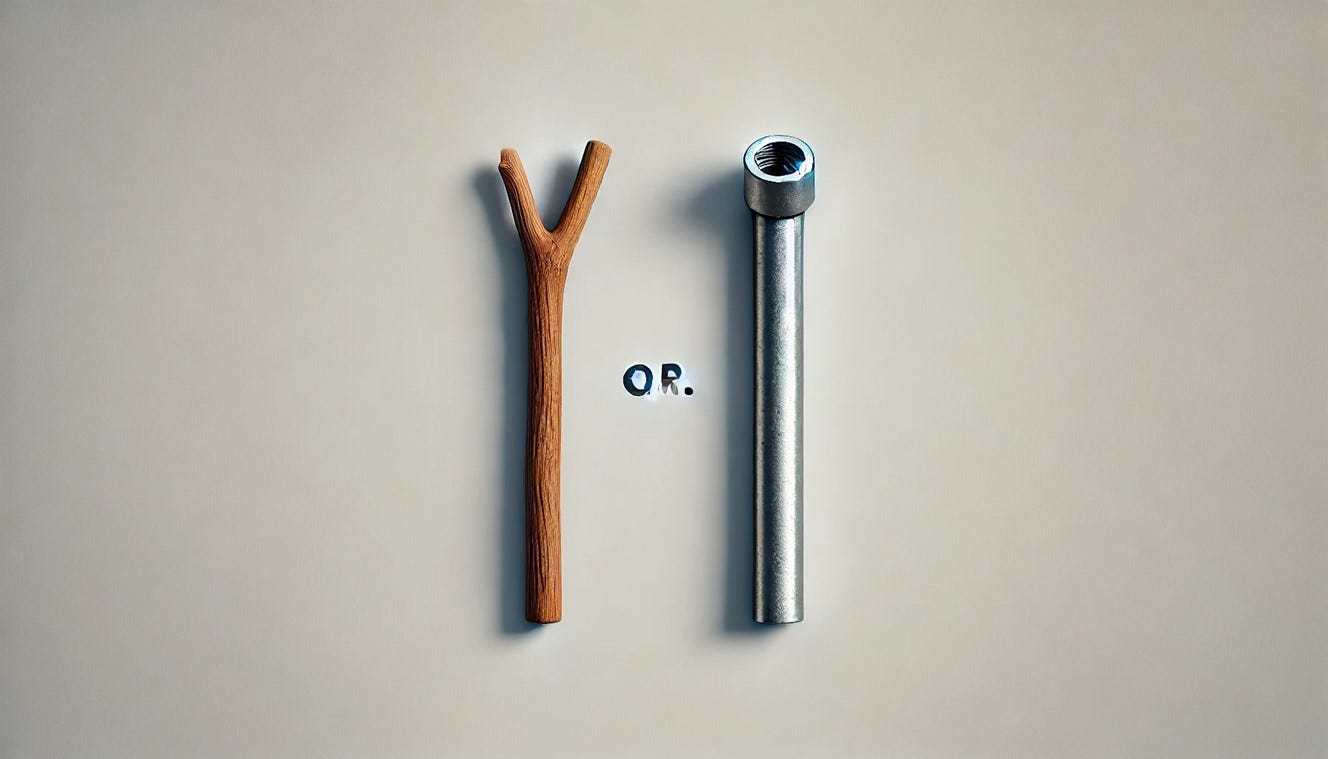
Would you rather be beaten with a stick or a pipe?
Would you rather be beaten with a stick or a pipe?
This is the question Brits have been mulling over today as they head to the polls. It looks to be a record-breaking defeat for the pipe, and a stunning supermajority for the stick. (The stick is, at least, more sustainably sourced.)
Yes, Brits have been tussling over the election for the past month, fuelling great debates at the pub and tempestuous rifts at the dinner table. Net Zero could be abandoned altogether if we could only harness all this useless hot air.
And was it worth it?
Well, about 45 million Brits voted last time, meaning your one ballot contributes 0.000002% of the total. Statistically, your vote makes no difference at all. And yet voters sacrifice their days not just going to the polling station but also thinking about and talking about and arguing about politics. Psychologists call this the paradox of voting – why do people invest so much time and effort into something that has no outcome for them? Even if you’re able to find a manifesto that suits your complex beliefs, and even if your vote made a difference, and even if the politicians then kept their promises, how much impact would these changes really have on your day-to-day life, personally?
In truth, voting fulfils psychological rather than rational needs. Some suggest that voting is identity expressive. You don’t actually expect your vote to matter any more than you expect that cheering for England will really help them beat Slovakia. It’s all about demonstrating your tribal allegiance and getting a feeling of righteousness and esteem from it.
Voting is also cathartic. Politicians act as a kind of scapegoat for all of society’s ills. Sir James George Frazer famously wrote about this in The Golden Bough – all societies throughout history have ‘killed the king’ and replaced him with a young contender as a means of social renewal. Look at most politicians’ approval rating over their tenure, and you’ll see that it starts strong and then dips over time as they become the focal point for blame. In reality, it’s absurd to point the finger at a politician or a party for all the country’s faults, especially when the same faults (like moral, financial, and institutional collapse) are being felt the world over, no matter the flavour of government. In the UK, people believe they can be saved from the right-wing party that caused so many problems over the last decade; in France, people believe exactly the same of their left-wing government.
The issue with this scapegoating is that we can only focus on one thing at a time and, like a magic trick, we miss the crucial mechanics while our attention is diverted elsewhere; we vent our frustrations on the politician of the day instead of the oligarchs and plutocrats who probably hold more responsibility.
Voting gives an illusion of autonomy
In this way, voting gives an illusion of autonomy. It makes you feel like you have a say in things, when really you don’t, and that keeps you compliant. Psychologists call it the ‘but you are free’ technique: you’re about twice as likely to agree to something if you feel like it’s your own choice. Like the waiter who offers still or sparkling, people are less likely to quit the game of politics if they felt they had a choice between the blue team and the red team.
Voting similarly gives an illusion of sensemaking. It allows voters to feel control and certainty – to feel that, even if you don’t like them, at least some people are in charge. There was a study which found that conspiracy theories can be psychologically beneficial because they empower disenfranchised people with a degree of certainty in a chaotic world. Voting is much the same. What’s the difference, really, in believing that a small group of people in Westminster can control Britain’s destiny versus a clandestine group of shapeshifting lizards doing the same? Both are to grossly overestimate human interference in massive, complex social networks.
In reality, politicians have little impact on society. A recent Sky News article put forward seven reasons why voting makes a difference. One of these was that the Conservative government passed gay marriage in the UK despite opposition from its own party. As good as gay marriage may be, it is probably not a move conservatives expected when they voted for the party. Gay marriage has developed in much the same way all over the Western world, whichever political parties may have been in power at the time.
As the saying goes, politics is downstream from culture – and, as another saying goes, if culture is the flower then biology is the root. The brilliant book Predisposed showed how much of political preference is in our genes – like our innate sensitivity to disgust, or tolerance of ambiguity. It’s also likely influenced by evolutionary drives such as the response to perceived out-group threats, or the ‘behavioural immune system’ response of collectivism in response to disease.
We are biological machines converging in enormous collective organism like a shoal of fish. The idea that a given politician – let alone a single vote for him or her – can have a significant impact on these mass systems is akin to King Cnut thinking he could turn back the tide.
We all have limited brainpower; we can only focus on one thing at a time. Remember the Titan submarine story? One day it was all anyone could talk about, and the next – poof – it was replaced by something else. Life passes by in a blink; why waste it on these tedious (at best) and malevolent (at worst) politicians?
As for me, today I’m in beautiful Tivat, watching the yachts and the schooners bouncing off the crystal marina. I’ve not wasted an iota thinking about politicians – neither the stick nor the pipe.
(N.B. Except, of course, for the several hours spent writing this article).
No posts
Comments
Nothing yet. Say the first thing.
Sign in to join the conversation.