
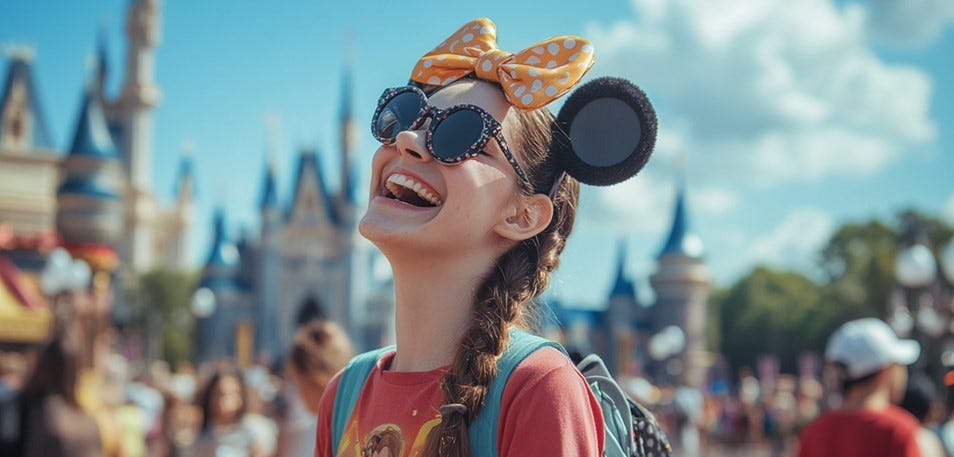
Jess loves Disney. Her husband, posting on Reddit with 20k upvotes, does not. Over 13 years of marriage, every single holiday (including their honeymoon) was to Disney World. ‘We go, we eat the Mickey Mouse ice cream, we wear the mouse ears,’ he bemoaned. ‘Every trip.’
Having voiced his dismay, Jess booked a new resort, in Hawaii. It was Aulani, A Disney Resort & Spa.
One of the top responses to his conundrum read, ‘You are living my worst nightmare, legally tethered to a Disney adult.’
A Disney Adult is, as you probably guessed, a grown-up fan of all things Disney; a typically childless devotee. It’s not just Jess – it’s a whole phenomenon. When New Statesman reported on it, they gave the case of 29-year-old account director Sarah, who dressed as Disney characters, hosted a Disney fan podcast, and accrued 2.2m views on a video of her breaking down in tears meeting Goofy at a Disney Park. And Disney is not just Mickey and Minnie anymore – the modern Disney adult also includes the Star Wars bobblehead-collector and the 30-year-old Marvel superfan.
Broader still, various outlets have reported on how adults (or ‘kidults’) account for a large and growing percentage of toy sales – a bigger share than pre-schoolers, even.
Late comedian Norm MacDonald once asked why, when people talk about adult toys, it’s always a dildo or something, and never like a cool little racing car. Well, now perhaps it’s more likely to be the latter.
Perhaps it’s the marketing campaigns executed by these multibillion dollar corporations. Disney reportedly once sent representatives to visit new mothers in almost six hundred maternity wards bearing gifts of branded onesies and asking them to register their child at DisneyBaby.com. Many Disney adults visited the park from a young age, and the Disney universe is cemented in most, if not all, of our childhoods to some degree. Even as a cynical, health-conscious adult, I occasionally find myself drawn to McDonald’s golden arches like a sea snail drawn to an angler fish, thanks mostly to nostalgic imprints of family days out and childhood birthday parties.
But there are lots of companies targeting children and childhoods with impressive marketing which don’t inspire the same level of devotion. No one is dressing up as Ronald McDonald or the Coco Pops monkey (well, I’m sure some people are). What is it about Disney that inspires such fanaticism, and why today?
The Jungian concept of the Puer Eternis (‘eternal child’; remaining childlike into adulthood) might explain it. It’s ironic that Disney, who animated Peter Pan in 1953, would become a mecca for those with Peter Pan Syndrome; that the animators of Pinocchio would create their own Pleasure Island where little boys never grow up but are instead transformed into asses by their own naïve hedonism.
Modern life is sorely lacking in rites of passage, especially for men. There are few punctuations marking the transition from boy to man. Anthropologists have long recorded how tribes might, for example, separate boys from the domestic space and put them into a dark cave or room, symbolising a womb, wherein men from the tribe would dress as monsters for the boys to overcome the fears - after which they may be physically marked in some way before returning to the tribe a man with a man’s responsibilities.
There are no such rites of passage in the modern West; the apocryphal little boy has no wild monsters to tame, no golden spring to guard. Marriage rates are down, birth rates are down, home ownership is down. It’s well documented that these life transitions change you; you become less impulsive, less insecure, and more agreeable (importantly, perhaps less narcissistic). I can tell you myself that since having a child, I don’t care what I wear outside of the house and I don’t have the time to play Witcher III nor the interest to watch Deadpool & Wolverine (although, in fairness, I did).
Without these transition points, people may neglect to put away childish things.
Technology may be infantilising us too, keeping us shielded from discomfort, responsibility, and problem-solving; feeding us an endless stream of gratification. The Matrix is derived from the Latin word for ‘womb’ after all; technology is the devouring matriarch, the nanny state, breastfeeding us long past when it’s healthy. Not for nothing can the Disney adult be found coddled in subreddits and Discords.
In our globalised, safety-obsessed age, Disney universes might also be fulfilling men’s yawning urges to explore and pioneer. Alexander wept, for there were no more worlds to conquer - but has he had a go at Divide & Conquer’s Third Age: Total War? A Behavioural & Brain Sciences paper concluded that ‘imaginary worlds co-opt our preferences for exploration… [we] would find imaginary worlds very attractive for the very same reasons, and under the same circumstances, as they are lured by unfamiliar environments in real life’. The Marvel Cinematic Universe and the Star Wars worlds of Tatooine and Alderaan may be a way for men in particular to satisfy their hardwired yearnings to explore.
Another unsatisfied urge is the modern West is parenthood. Fertility rates have collapsed in recent years (particularly since 2020, for no reason at all!). As Freud said, if a need is pushed under the surface, it will simply bubble up elsewhere in another form. A recent paper found, for example, a link between declining birth rates and increasing pet ownership; the repressed parental drive simply popped up in the pet shop.
Disney, for its part, is a supernormal stimulus for parenthood. Like a cuckoo chick tricking a mother bird into feeding it more because it has the biggest beak in the nest, Disney has hijacked parental instincts with its impossibly cute characters. Over the years, Mickey himself evolved to have a bigger, rounder head, bigger ears, bigger eyes, a more buttoned nose. These days, every Disney vehicle must have some kind of baby Yoda, and it’s not for the kids. A study found that four-year-olds chose a teddy bear with adult features almost two and half times more often than one with baby features; it’s older children and adults who choose the cuter bears.
There’s a sense of familiarity and community in fandoms like Disney which may be lacking from modern life. One study, for example, found that ‘bronies’ (adult fans of My Little Pony) scored lower on the Meaning in Life Questionnaire - for example, being more likely to agree that ‘I am searching for meaning in my life’. Westerners are increasingly atomised and alienated - things that used to bring an anchor of purpose have been dissolved. Globalism has dissolved national and ethnic identities, religion is on the wane, families and communities have been spread asunder, entertainment has turned us into passive consumers rather than creative producers, and AI will soon take away our business (our busyness). Nature abhors a vacuum, and Disney provides pre-packaged pastimes, fandoms and heroes to fill the gap.
Books written after WWII, like The True Believer and Fear of Freedom, explained how our kind of rootless and reactive times can lead to people attaching to totalitarian ideologies. Perhaps we should be grateful that we have people attaching to cartoon fantasies instead. Although, a quick foray into Twitter will show you that the most extreme left-wing transgender Marxist and the most extreme right-wing fascist neo-Nazi are both likely to have an anime character in their profile picture. It seems the political horseshoe is worn by Rainbow Dash.
We do live in chaotic times, after all, which those post-war psychoanalysts argued can result in regression. Terror Management Theory research shows us how reminding people of their mortality can make them seek hedonistic escape and overvalue nostalgia. Disney adults might be regressing into the safety of childhood to avoid the terror of the modern age. Miniature figurines of Iron Man and Elsa might likewise provide some sense of control in the upside-down helter-skelter that is 2025 and beyond.
In all, adults become obsessed with fantasies like Disney for the same reason they become obsessed with anything - they are lacking something. Whether it’s exploration, parenthood, community, safety, or control. But aren’t we all?
There’s no judgement here - we all have a little kidult in us. This past Christmas, my family were agog when I jumped onto the floor to wrench the pieces of my toddler’s Duplo digger from him and start to assemble it (‘What?! He’s too young to do it himself.’). It’s good to be a little childish sometimes - to walk through each day in awe, to be creative and silly, to view the world pure and unfiltered.
But if, like Jess, you find yourself reaching for the Mickey ears after about the age of 23, perhaps ask if some other area of your life needs attention first. You don’t want to look goofy.
No posts
Comments
Nothing yet. Say the first thing.
Sign in to join the conversation.