
Happy Budget Day!
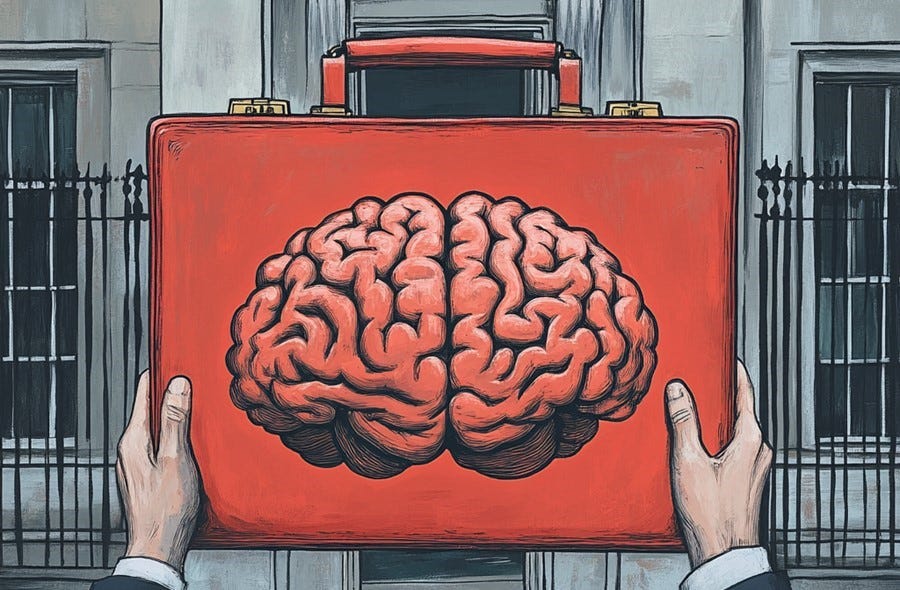
Last week, we Brits celebrated the national holiday with gusto. For the uninitiated, there’s a big red briefcase to do with money. It’s a bit like Chinese New Year, except instead of a red envelope, it’s a red briefcase, and instead of swapping with one another, the chancellor shares just one with all of us, and instead of giving you money, they take it away.
Look, I don’t do politics. What I do do, however, is psychology – and I noticed a few tricks being used on us this budget around. Here are five nudges that oiled us up for last week’s tax rises.
1. Placebic Information
If there’s one thing progressive liberals were hoping for when they voted in a Labour government, it was surely taking away the winter fuel allowance from those greedy pensioners. If anything is a hallmark of the bourgeoisie, it’s using ill-gotten capitalist gains to not freeze to death in old age.
This was almost an unbelievable move from Labour. On the surface, it seemed callous and dunderheaded – but what if it was a calculated move? What if, by doing something so drastic, they were sending the public an implicit message about how bad the finances are and emotionally priming us for tax increases?
There was a psychological experiment where a researcher asked participants if they could cut in line for the photocopier (Gen Z readers – this is like a big machine for screenshots but on paper). A significant chunk of people quite reasonably said no. However, people were much more likely to comply if the researcher asked, ‘Can I cut in line because I need to make some photocopies?’
Even though it was useless information, it still provided a pacifying rationalisation. We need a ‘why’ to comply. Removing the winter fuel allowance made it seem like the finances must be in real trouble, necessitating higher taxes.
This is unquestionably what Labour were doing. I mean, I don’t have any actual evidence this is true, but imagine how interesting it would be if it were true, and really, isn’t that more important?
2. The Door-in-the-Face Technique
What’s one thing the chancellor has in common with Motley Crue?
When the hair metal rockers made the video for Girls, Girls, Girls, set in a strip club, they knew it was too raunchy for MTV. So they made two version: the one they wanted, and even spicier one they sent to MTV first, knowing it would get rejected. Their original video, sent as a follow-up, was accepted as an apparent compromise on the band’s part.
Psychologists call this the door-in-the-face technique. We’re more likely to agree to a request if we’ve said no to a larger request first. It makes the target ask seem more reasonable by comparison.
In the weeks leading up to the budget, there were all sorts of panic-inducing stories in the press about schemes Labour were considering. One, for example, suggested an ischemic doubling of capital gains tax, from 20% to 39%.
In the end, the tax was increased to ‘only’ 29%. Instead of being angry at the rise, I felt relieved it wasn’t as steep as I expected. ‘Oh,’ I said to my wife, ‘It’s not so bad after all’. Then I remembered I’m poor and don’t pay capital gains tax.
3. Framing
Framing is a well-established psychological principle in which people are more sensitive to loss than gain – about twice as sensitive in fact. As the old saying goes, a bird in the hand is worth two in the bush (although this does little to placate the security team at Birdworld, believe me). For example, people are more likely to buy beef that’s framed as 80% lean versus 20% fat, undergo a surgical procedure with a 99% survival rate versus a 1% mortality rate, or manhandle a toucan at a popular avian tourist attraction if there is a 82% chance of avoiding parrot fever versus a 18% chance of catching it.
Some important context for readers outside of the UK. Here, we have something called inheritance tax. Once Brits have been put out to pasture after this exhausting life of scrimping and saving under massive tax burdens and they breathe their final sigh into the sweet release of death, safe in the knowledge that they at least have made life a little bit easier for their children, the government bravely swoops in and takes half their stuff for having the gall to die.
One way Brits could ensure their life labours could be passed on to their children unmolested was through pensions, which were exempt from inheritance tax – until now. (You see, the best way to ease the burden on the welfare state is of course to punish people for saving for retirement.)
When it comes to the budget, the chancellor Rachel Reeves used a very interesting turn of phrase when talking about applying inheritance tax to pensions – she referred to it as closing a ‘loophole’.
This is a classic framing technique, implying that those intending to leave a legacy for their children through pensions were engaging in some kind of abnormality or subterfuge, rather than the most natural and normal thing in the world, and that it’s only right and just to prevent that from happening.
One might think the only ‘loophole’ here is the ‘loophole’ the government uses to appropriate people’s money in the first place.
4. Contrast Effect
Would you rather buy your family a labrador for a pet, or a shih tzu? There’s a big difference between the two.
Or is there?! Compared to say, a Vietnamese giant centipede, the differences don’t seem quite so large. They’re both soft and four-legged with a penchant for slippers. Very rarely will either dog wrap their exoskeleton around you and use their fangs to inject debilitating venom.
Psychologists call this the contrast effect. We don’t judge things in a vacuum, but rather in relative terms. This might be why Rolls Royce sometimes sell their cars at yachting conventions – next to a hundred-footer, a vintage Phantom looks like a bargain.
The budget has made good use of the contrast effect, attacking seemingly wealthy people – that is, people wealthy enough to have a pension, a farm, or a business worth leaving to their children, or people wealthy enough to have a second home or tenants – and amplifying the apparent contrast between them and the less wealthy.
But to pit the common man against those with pensions or farms is to miss the bigger picture – it’s to set the labradors and the shih tzus against one another while drawing attention away from the centipedes with their trust funds and their fancy hats, who are unlikely to feel much difference. The FT reported, for example, how tax increases would see the cost of a private jet to Kuala Lumpur increase from £150k to £153k. Take that, capitalist pigs!
5. Incrementalism
Did you know that income tax was introduced as an emergency, temporary measure? It was just 10% at the time, during the Napoleonic War in 1799. The unpopular tax was repealed and reintroduced several times over the following century, ramping up bit-by-bit. Today, British income tax sits at between 20 per cent and 45 per cent, amongst a deluge of other taxes.
The point is – these new taxes are not going to go away. They’re always two steps forward and one step back, and, when it comes to tax collecting, that’s the biggest psychological trick of all to get you to pay.
Well, except for the ‘putting you in prison’ stuff.
No posts
Comments
Nothing yet. Say the first thing.
Sign in to join the conversation.