
When you are just old enough to comment on the declining quality of films, but young enough to miss any reference to Blackadder - it can be tricky to discuss movies in general. After all, nostalgia doesn’t fit, the leading men and women of my era are all still there in the spotlight, releasing new films every year, it seems.
The Dark Knight films were truly the defining movies of the previous decade, where Heath Ledger’s Joker would set the standard for method acting and posthumously scoop an Oscar after his tragic passing. Christopher Nolan is the director of our time most often lauded for going the extra mile to capture authentic movie moments, and putting real graft into his scripts, working with a close-knit group of talented actors to put the story across, whether it be Inception, Dunkirk or Interstellar.
When you realise the latter film was released in 2014, it puts into perspective the lack of quality movies that have followed. The must-watches, that you’d plan a cinema visit around. There are myriad reasons for this, but given the recent thread on X that declared Interstellar the “last great movie” - at the end of 2025 I dived into some award-winning performances that preceded this film, and even me, to glean some insight into why older movies continue to stand the test of time, compared to the latest Sydney Sweeney / Glen Powell / Timothee Chalamet blockbuster that launches, rises, peaks and fades within the same financial quarter.
In Cinderella Man (2005), Russell Crowe, Paul Giamatti and Rene Zellweger put on a real show. I am transfixed by Giamatti as of late, from Sideways to The Holdovers and now his performance as Joe Gould (promoter, coach) to Crowe’s Jim Braddock (world champion boxer) I am already a lifelong fan. As a character actor, there aren’t many better.
A rags to riches story in the ‘American Dream’ era is not an unexplored topic in Hollywood. However, the essence of realism that ran through the movie was something that struck me in comparison to what we see on screen in the 2020’s. A realistic portrayal of a boxer who would rather go hungry than watch his kids struggle, despite having a fight later that night. The man who would make it onto the big stage in his craft, but still need to show up for extra shifts at the dock, barely recognised in the street or at work.
After Crowe’s Jim Braddock eventually made his money and title, he didn’t go on to live a lavish life. An ex-World Champion prize fighter, he served bravely in World War Two alongside his boxing coach (played by Giamatti) and then returned home. At almost 60 years of age, he laboured on the Verrazzano bridge that now stands in New York. A distinguished, unique, real, wildly successful but hardly celebrated, life.
In the film, Crowe’s pain and willingness to help his family through the only means necessary, quiet desperation and battle between agreeing with his wife to find another way to provide, and unleashing the frustration of 10 million hungry New Yorkers into his opponents, make this an awesome two-and-a-half-hour watch. Having seen Crowe as a Roman General, brilliant yet troubled economist, Irish-American boxer, and recently Nazi Commander Hermann Goering in Nuremberg, he has the stripes to be one of the top 5 actors of the last 3 decades, if not top 3. There are traces of both John Nash (Beautiful Mind) and the Maximus Decimus Meridius (Gladiator) characters in Crowe’s portrayal of James Braddock, not least the solid fighting technique, sharp mind, quiet and Stoic nature with clear evidence of more fierce rumblings within.
The ebbs and flows of success from the start allow the film to transcend the standard David vs Goliath story, despite leaning into it with the colossal Max Baer as Braddock’s final opponent. The 1929 stock market crash runs parallel to the career of Braddock himself, and throughout the entire film. Braddock shows utter bewilderment at the idea of his investments failing him so quickly, referring more than once to the invisible hand of the market that was supposed to be a sure thing, and how it so rapidly dictated the course of his life, and the lives of everyone else around him. In typical working-class fashion, he states that high level boxing is easier than economics, because he can see his opponent coming.
The acrid smoke surrounding the ring almost comes through the screen in the fight scenes, and Giamatti’s physical animation, speeches, pride and involvement in every round made you want him in your corner, he was a charismatic, scene-stealing matador with skin in the game, like a Ryder Cup captain who wants to help and win so badly that he is practically taking the shot for the player. The Best Supporting Actor Oscar nomination did indeed come his way.
The scene where Braddock, a former champion, but also father of two-turned-bankrupt before the age of 30, is forced to go hat in hand (literally) to the suits in the boxing world who would very soon profit from his talents, to scrape enough change to allow his kids to move back in and turn the lights on, is rock bottom. To be fighting for the world championship title at Madison Square Garden only a year later would still seem a straightforward task compared to having to beg, one handed, for enough coins to keep his kids.
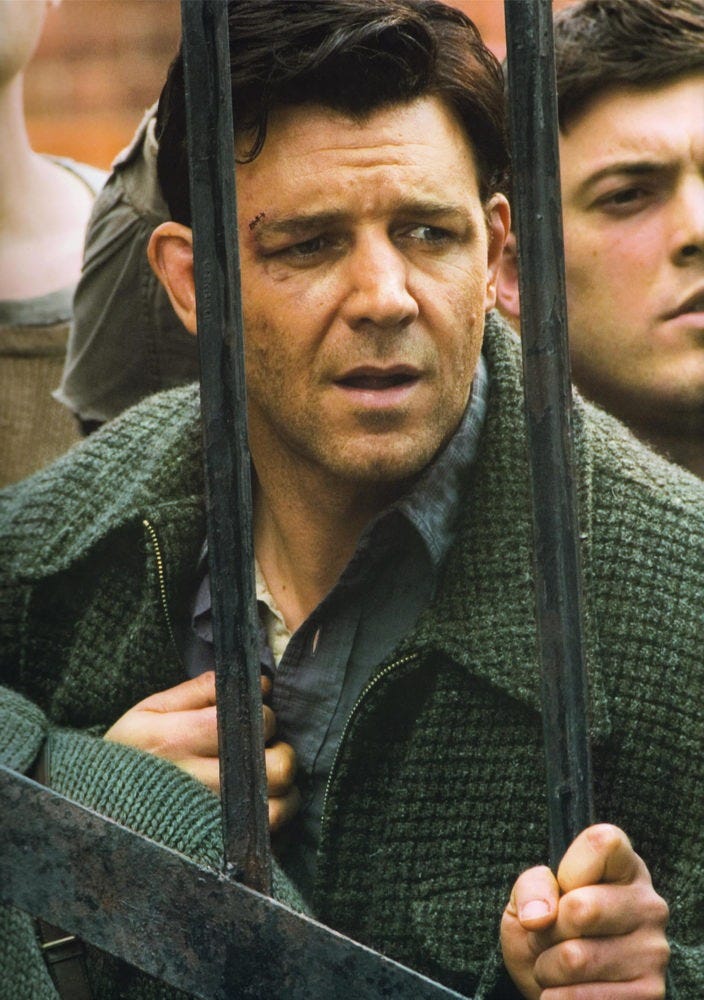
You can see the pain etched on Crowe’s face, as the Oscar-winning actor becomes the mild-mannered Irish-American immigrant looking for the best way to keep the lights on (literally) while marvelling at the idea he could win real money by fighting. He wore a pained, tired, gaunt expression, but also a sheepish, unassuming grin during parts of the film, channelling the chaos of his life’s many hardships once he got into the ring.
His success was a beacon of hope for the underbelly of New York that were cast aside between the wars, who didn’t dare entertain the American Dream for fear of the opposite, and this was not lost on his character.
The 1920’s America, working-class mentality of staying in your lane was a clear metaphor that ran succinctly throughout the thread of the film, not least when in the title fight at Madison Square Garden, the silence and unease of the crowd to vocally get behind their working-class champion eventually swells to crescendo off the back of one quiet cry, demonstrating the undeniable ability of one man to affect change.
“Face your battles head on. At least you can see who’s throwing the punches.”
One of my favourite Christmas presents in 2025 was a movie review journal. It is rare that something so simple would resonate, but it is because by the time I have watched the end of a film, I have done a lot of research on said film, and my family and close friends likely may not want to hear all about the budget, filming restrictions, Oscar nods, parallels with the true story (for biopics like this), and the cast in its entirety - straightaway.
Therefore, documenting thoughts being a sort of pastime of mine as it is – it was a thoughtful gift. Submitting more varied thoughts through Substack (sport will still feature prominently) will hopefully be an ‘in’ for 2026.
Best wishes for the New Year ahead.
Pat
Comments
Nothing yet. Say the first thing.
Sign in to join the conversation.