
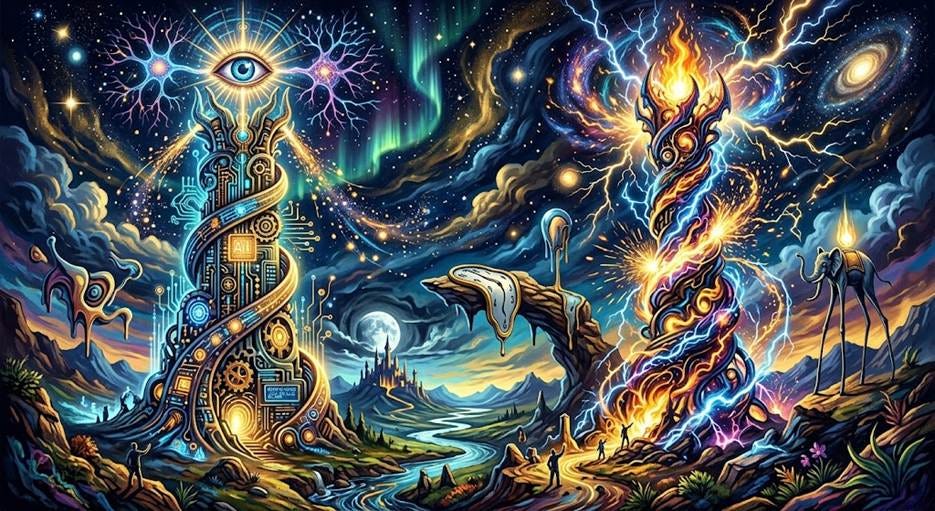
Just as electricity transformed almost everything 100 years ago, today I actually have a hard time thinking of an industry that I don’t think AI will transform in the next several years. — Andrew Ng, 2017
AI is like electricity. Andrew Ng made this analogy many years ago, and it has borne out well as AI has improved immeasurably in the last decade. Let us count the ways:
Flexibility: AI is a kind of software. The intelligence of AI creates a flexibility that makes software itself more amenable to our needs. Electricity is a kind of energy that is more flexible than other forms.
Atomicity: AI can be served in atomic units; its atomic unit is the token generated by inference. Electricity can be served in literal atomic units, an electron at a time, measured in Kilowatt-hour or Joule units.
Infrastructure: Both AI and electricity need infrastructure to produce valuable output. AI is being served by AI supercomputers in centralized data centers, similar to how power plants are centralized infrastructure for delivering electricity. Both AI and electricity can be generated locally, if you have your own GPU or solar panels, but in both cases, scaling infrastructure is needed to scale outputs.
Embedded ubiquity: Electricity powers home appliances, vehicles, industrial applications and more. Not a single appliance or application, electricity is the platform for energy delivery for much of modern society. Similarly, AI will be embedded in applications and will be the intelligence in applications and appliances both for personal and enterprise use. AI will be everywhere.
Economic platform: Electricity was the basis of the second industrial revolution and restructured the economy in the late 19th and early 20th centuries. AI is driving yet another technology revolution, accelerating technology-driven growth and disrupting the economy.
These two platforms – intelligence and energy delivered by AI and electricity - are the two main economic pillars of the 21st century intelligence era economy. All economic value is defined and shaped by the fundamental forces of energy and intelligence.
Everything we make, mine, create, move, fabricate, serve, farm, sell, trade, is based on the intelligence (via decisions, designs, technical specs, artistic inputs, legal determinations) and energy (used in mining, manufacturing, transport, and services) needed to make them happen.
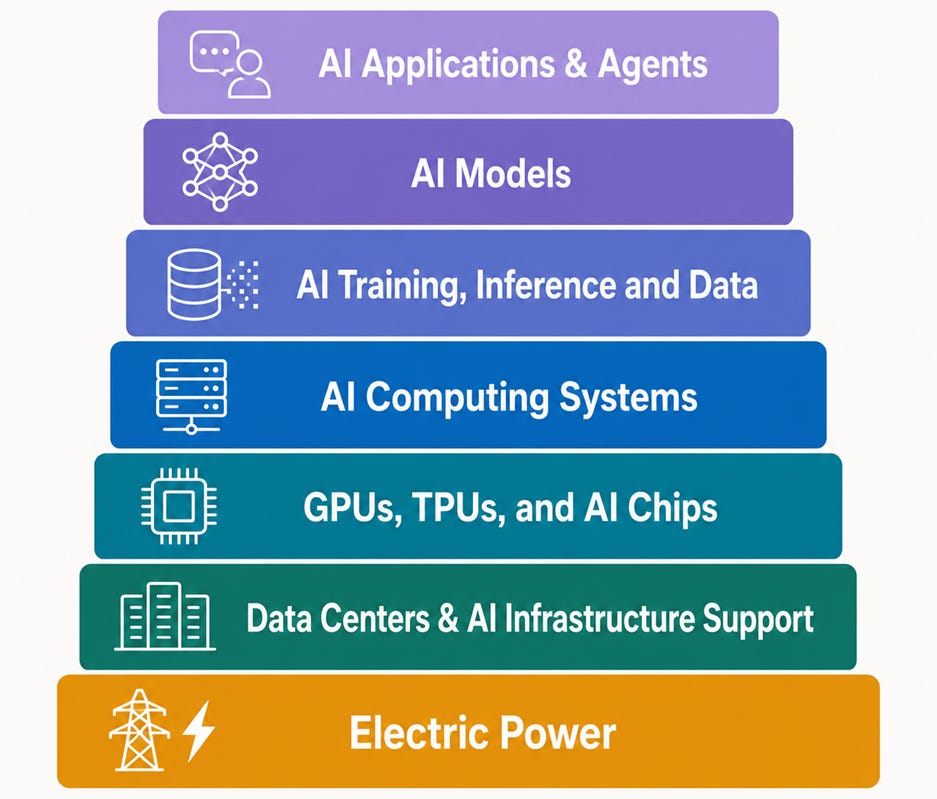
The intelligence pillar is a technology stack built on AI models, training, chips, and data centers; supporting it all is electrical energy itself. It takes many gigawatts to power the supercomputers that run AI workloads. The efficiency of our economy depends on the efficiency of those technology and energy stacks.
The analogy between electricity and AI is useful if the adoption of electricity and its impacts give us clues into how the AI revolution will play out. For example, while there was no electricity ‘bubble’ or bust per se, there were electricity-related booms, bubbles, and busts, as seems to happen with nearly any technology disruption.
The challenge is that AI technology progress and adoption is so much faster than what occurred with electricity. Electricity took 4 decades to achieve penetration above 90% in the US, only reaching it after World War II. Globally, there are still hundreds of millions of people without direct access to electricity.
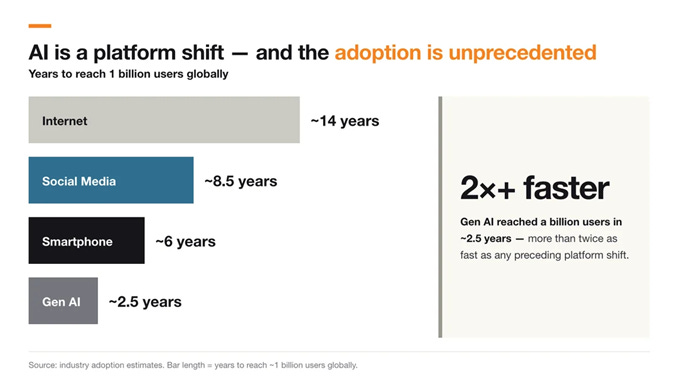
Since 2023, AI Adoption has grown faster than any major consumer technology on record. In just 2.5 years, generative AI reached a billion global users, which is much faster than smart phones, social media, or the internet let alone electricity.
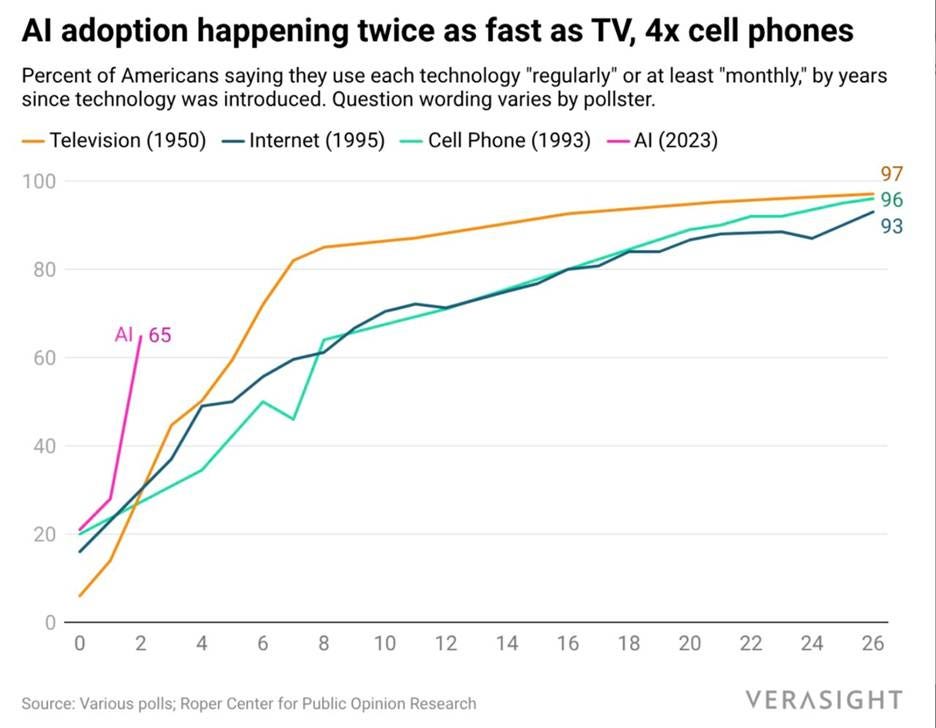
Verasight reports that roughly 64% of Americans now use AI at least monthly, a curve that appears much steeper than television’s rise in the 1950s and cell phone adoption in the 1990s. Adoption has gone global as well; several other countries such as Singapore report higher AI adoption than the US.
The adoption of generative AI has largely centered on AI chatbots. The billion users have interacted with AI through ChatGPT or other AI chatbot interfaces. The use of AI as agents is even newer, but the curve has been just as steep.
Even faster than AI’s adoption curve has been the rapid advance of AI capabilities. AI models in 2026 are vastly more capable than they were just a few years ago, with many AI labs competing at the frontier and delivering AI models in mid-2026 that all would have been state-of-the-art had they been delivered just 6 months prior.
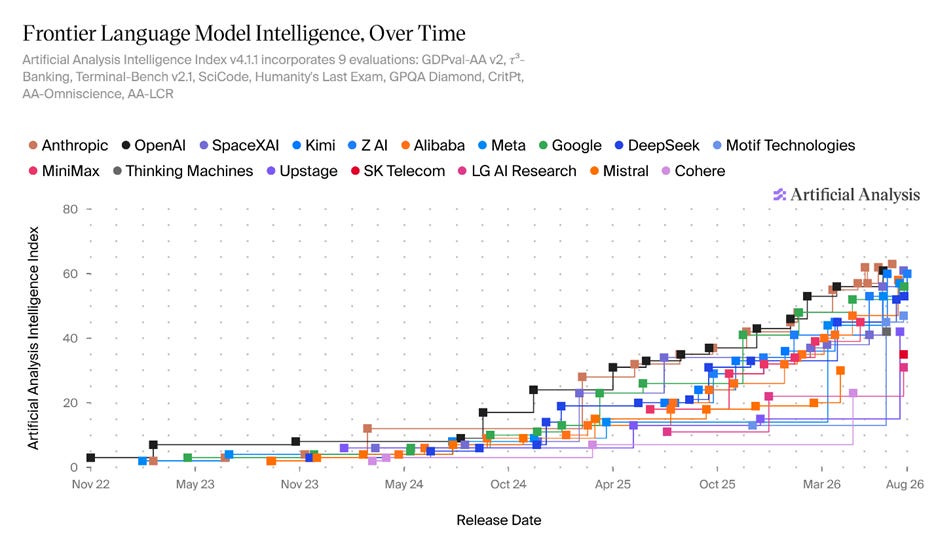
Rather than slowing down, AI progress is accelerating in 2026 thanks to recursive self-improvement, as AI itself accelerates improvements in the AI technology stack. An example of that has been OpenAI’s GPT-5.6 Sol optimizing their Luna model.
Google’s current troubles show how quickly things are shifting in the AI race. Gemini 3.1 Pro was briefly the best AI model in the world when it previewed last November. Now, Google is a laggard because they haven’t delivered a successor in the past 6 months to their formerly SOTA flagship AI model.
Just as AI’s killer app was the chatbot, with ChatGPT, electricity found its “killer app” in the lightbulb. The initial application of electricity brought light to homes and workplaces. Once electrical power was available and motors could be adapted to different uses, new inventions arose to plug in to electric power, from the vacuum cleaner to the refrigerator to the factory machine tool. Each electrical invention and application had its own invention, development and adoption path.
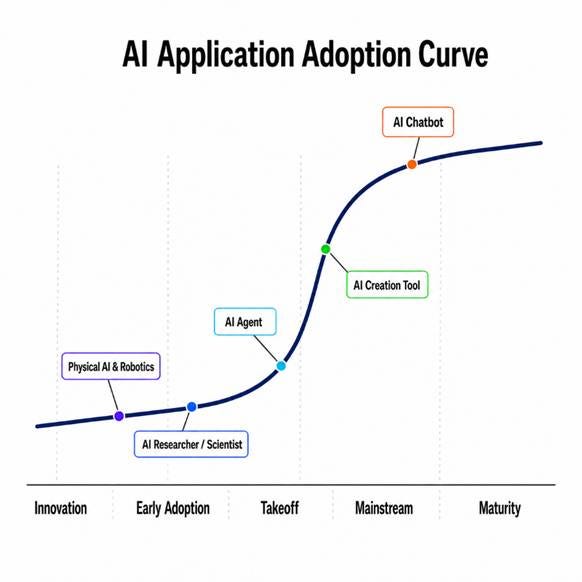
As a general-purpose technology like electricity, AI has many potential applications, which can be grouped into five major categories:
As an AI chatbot to answer queries.
As an AI creation tool, to generate images, music, video, writing and other content.
As an AI agent, to perform tasks, generate software, and automatically complete workflows.
As an AI researcher or AI scientist, to perform scientific analysis, generate mathematical proofs, develop new molecule or drug candidates, or invent new technologies or innovations.
Embodied as physical AI in an AI robot, self-driving car, or other physical AI application.
These five broad categories of use cases of AI have distinct needs and characteristics while sharing common need for AI intelligence. While we could partition AI applications in more fine-grained detail, the five categories capture the broad scope of what AI can do.
As with electrical appliances, AI’s various applications in agentic AI, physical AI and inventive AI are on different development paths and timelines. The implications of this are that the AI “wave” is not a singular wave, but a succession of waves, each one riding its own adoption S-curve. These are the 5 waves of AI.
Three years ago, in one of my earliest AI articles, I spoke of that time as the “steam engine days of AI,” to express how much more AI efficiency and capability was still to come. We have come far with the development of AI reasoning, massive improvements in AI models, and the huge uptake of AI adoption and agentic AI tools. Yet even now, there is no wall to further AI improvement.
Looking at the landscape of these five AI applications areas today in 2026, AI may have crossed the chasm into general use for some uses, but we are still in early days in terms of AI’s ultimate development, capabilities, adoption, and impact. We are already far along the AI chatbot adoption curve, but that does not mean that AI overall is anywhere near mature; there is less penetration for the other 4 applications, and those other four applications are more impactful and provide more leverage to our economy.
We will explore further the 5 waves of AI and the specific status of each of these AI waves in a follow-up.
Comments
Nothing yet. Say the first thing.
Sign in to join the conversation.