
INTRO (scroll down for new leads):
What do I mean by ‘superplay’? It’s an element of our current condition—where our natural capacities for envisioning and rehearsing (that is, play) escape their sandbox, and quickly become consequential in the world.
They escape because powerful technologies - specifically the accelerating computations of AI - keep breaking the barriers between what we can imagine and what we can make.
This regular report will aim to catch this superplay as it arises in the world, and notes who’s wielding its powers (and who isn’t—yet). It’s also a taster for deeper dives into creativity, radical technology and power, undertaken by Superplay Consultancy (for services and rates, contact here)
The AI boom also heralds an age of the justificatory essay. Those owning and commanding these technologies seem to be putting their markers in the historical record. They propose new social contracts and regulatory institutions, as if to indicate to posterity that they had anticipated the chaos that all this human-task-replacing upheaval would bring.
For example, Google Deep Mind’s Demis Hassabis suggests here something akin to a financial regulator, run by government, private and civic participants, which takes 30 days to approve or disapprove a new “frontier” model for safety assessment. (That seems a ridiculously short time period to me, and more like an elaborate rubber stamp exercise).
This comes along with Hassabis’s usual calls for new philosophical and economic thinking: “what sorts of new economic models will be needed to help everyone thrive in a post-scarcity world? What values do we want to live by, what will meaning and purpose be, and how might even the human condition itself change?”
Thinking Machines pushes the quirks of humanism, while justifying their place in a non-monopolistic marketplace: “Humanity has flourished through individual weirdness and creative tension. We envision alignment as a feature not of a single model but of an ecosystem of AIs raised in different places, disagreeing, competing, and learning from each other. We believe in keeping the weirdness alive.”
The most impressive of these humans-over-ai peddlers is the new Humanist Review of AI, commissioned by Microsoft’s Mustapha Suleyman.
His convening power is extraordinary. There’s AI-grappling pieces from artists like Nick Cave, Naomi Alderman and James Bridle, each of them setting limits on AI’s ability to simulate human character. But also philosophers like Kwame Anthony Appiah, Pak Hang Wong, and Alain De Botton, who journey from the ability to choose our AI future (Appiah) to a Confucian subtlety about our agency within that (Wong). And politicians and economists (Audrey Tang and Daren Acemoglu) who share their theories and experience of deploying AI in democratic and development contexts.
You’d have to devote the equivalent of a day or two’s attention to these (and other just as rich) pieces. But it all feels like a real Second Enlightenment (E2) moment. Smith and Hume and Ferguson, wandering through their burgeoning 18th century cities of Edinburgh and Glasgow, theorising the modernity arising around them… A shame not to catch it as it arises.
From Aeon - like Noema, one of these E2-esque outlets - I like this essay on Silicon Valley’s Science-Fiction Problem. Which is that of tech moguls taking SF and Fantasy symbolism, and wrapping their projects in its surface allure, while ignoring the moral and political critique/complexity in the original works.
Examples: Musk urging the military he’ll make Star Trek real, while ignoring the series’ post-capitalism and multiculturalism. Zuckerberg invoking Neal Stephenson’s Snowcrash, taking the platform and forgetting about its warnings against corporate control.
And of course the legendarium of Tolkien spreading everywhere, from Anthropic’s Amodei invoking the Ents in his most recent essay, to the Thiel-verse of Tolkien-named enterprises - Palantir Technologies, Mithril Capital, Valar Ventures, Lembas LLC, and more. The latter invoking warriors and surveillant sorcerers, but not the small-scale communitarian virtues of the Shire.
I was surprised to see no mention of the misuse of Iain M. Banks by Musk, Bezos and others - naming their spacecraft and projects after a Scottish democratic anarcho-communist’s futureworld.
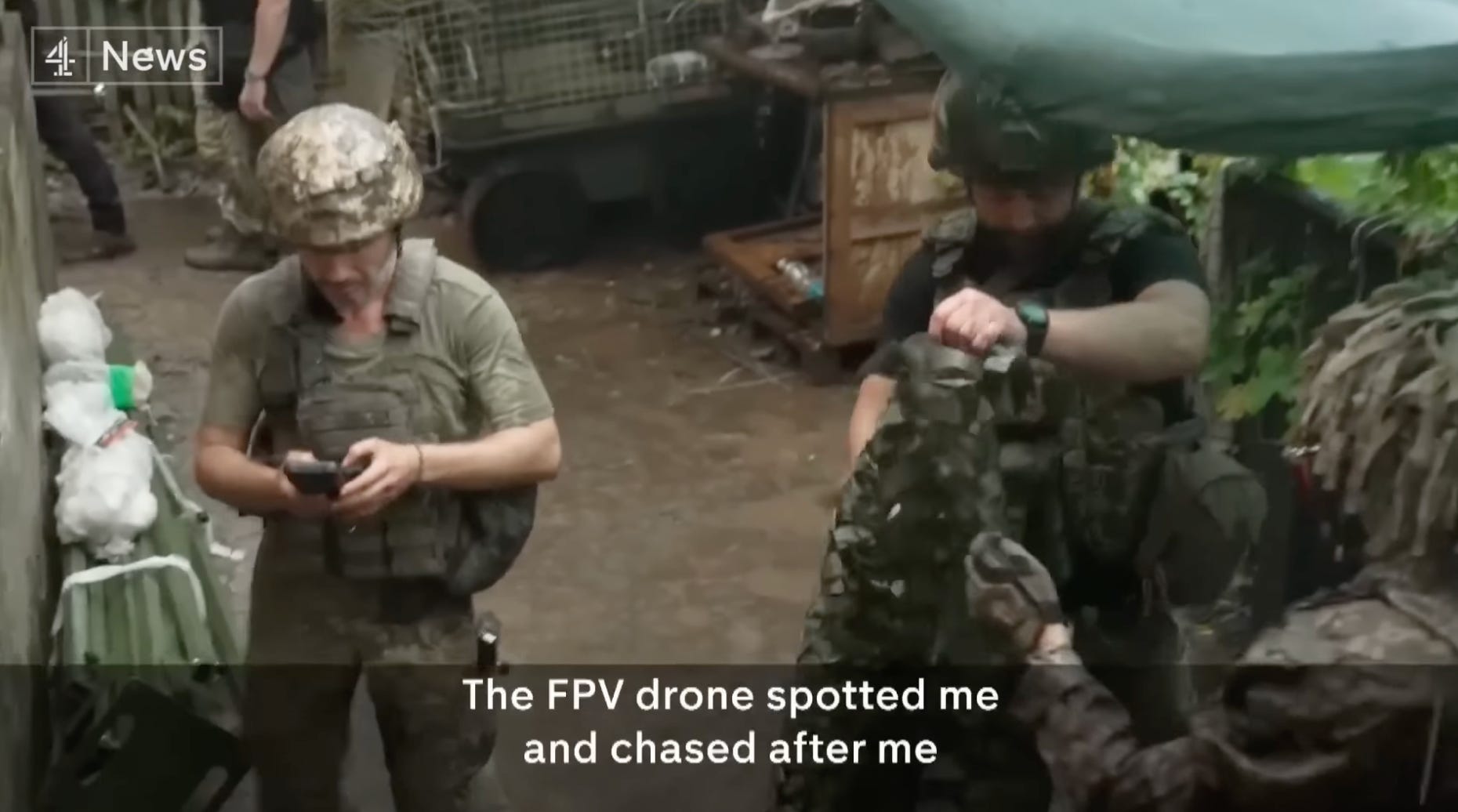
And to conclude this week, a Channel Four News item which laid out Ukraine and Russia’s drone war, and its surreal consequences, like some grimy cyberpunk comic come to life.
Roads over-arched by meshwire, to protect from aerial attacks; autonomous wheeled supply robots running alongside the cars; droll drone operators, nonchalant with their lethal gaming consoles
It’s an unscriptable science-fiction ground into life, by means of the killing fields. [See tv report below and read the accompanying Substack piece].
Never a great argument for humanism, the practice (and simmering latency) of war. Next time…
For more, and to see whether Superplay can illuminate your challenges around radical tech, creativity/play, and power, visit here and contact us here. If you’d just like to subscribe, the mechanism is below.
Comments
Nothing yet. Say the first thing.
Sign in to join the conversation.