
This is an open-access version of my weekly column in The National, published Saturday, 25th July 2026
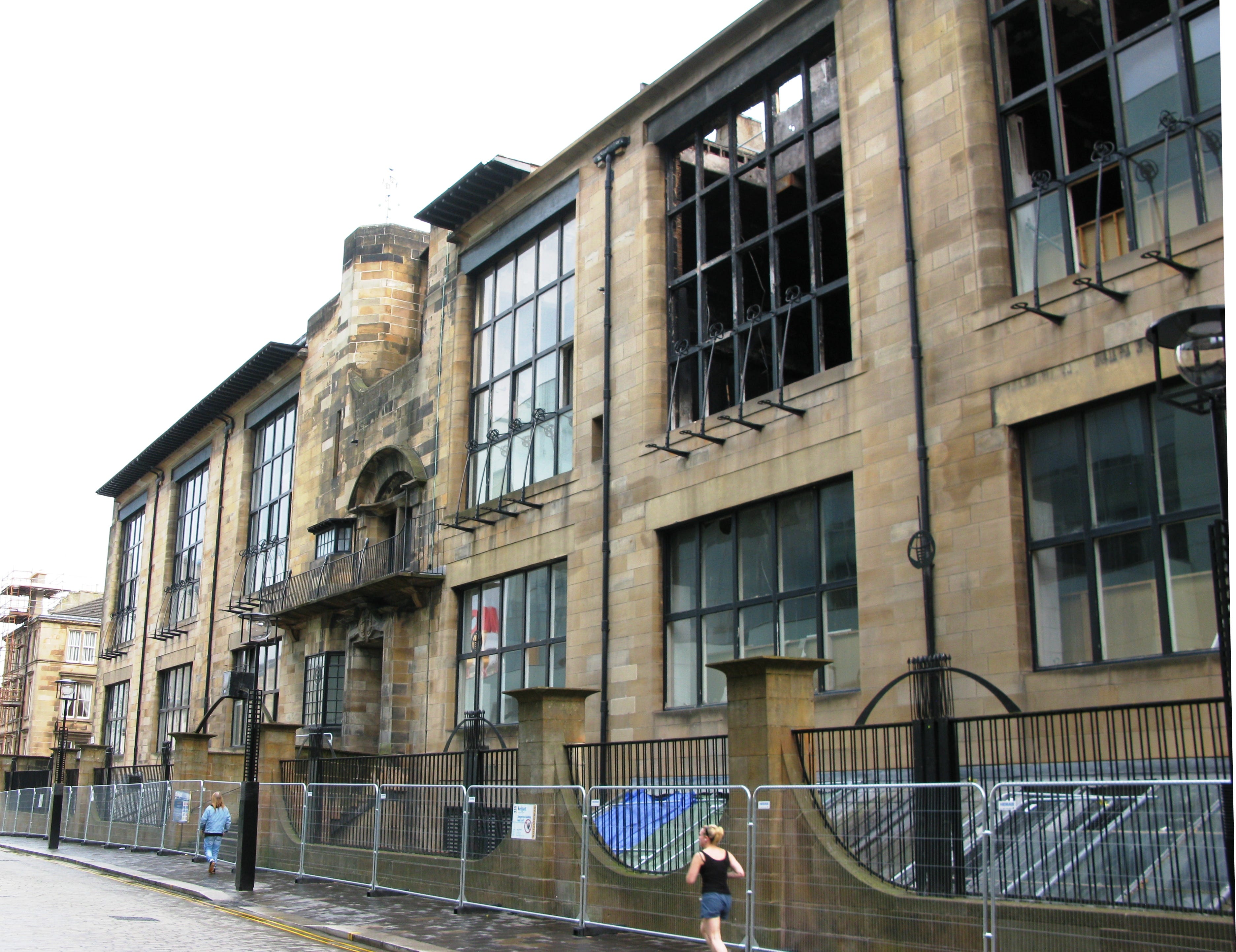
WHAT to do with the burnt-out shell of the Mackintosh Building?
Glasgow School of Art (GSA) announced this week that it couldn’t bear the cost of complete restoration (or “faithful reinstatement”). It’s up from £65 million to £265m, equivalent to five times the GSA’s annual turnover.
Other creative-clustery options are being suggested, which I’ll explore later. But one of the trickiest factors in anything short of the “Mackintosh Faithful” option is the sheer sensual memory of the Mack, suffusing so many lives.
You literally undergo an ascension to get there. The first time you come up from Sauchiehall Street (for me, a Glasgow Uni aesthete in the early 80s), you wonder whether the massive stone wall will reveal a castle at the top of the hill.
Then you come round to its massive glass frontage, its chiselled swoops and curves and statuary.
As the Mackintosh phenomenon swelled alongside Glasgow’s renaissance, I would fondly imagine parallel histories. Ones where Charles Rennie Mackintosh (CRM) was properly supported to build momentously in his home city, leaving buildings as bold as this all over the place.
And then to go inside … my points of entry were to take the elder daughter to her Saturday drawing classes in the late nineties. I’d then drift around the building till I came to the library.
What a place. A dark, intricate network of vertical and horizontal timbers, into which a cluster of metallic-organic lights descended.
For me, it was always on the cusp of being too beautiful. How could any student’s nascent imagination compete with it?
The acrid irony is that, from Mackintosh’s highly detailed plans, the library was faithfully rebuilt after the 2014 fire. Johnny Rodger, a GSA academic, saw it near-completed a few months before the second, obliterating fire in 2018.
The fidelity was all the way down. For example, they sourced the original tulipwood, tracking it down to a demolished 19th-century sawmill in Massachusetts.
Rodger felt like Sigmund Freud finally seeing the Acropolis: a joy in encountering it as an object, but an astonishment that it actually existed beyond the pictures.
Or, for that matter, beyond CRM’s exceptionally detailed architectural drawings. If skilled-enough craftspersons could exactly reproduce the library or the building, mused Rodger, then are the plans the true reality of the Mack?
It may be a little GSA to put it this way. But I think the preference for “faithful reinstatement” has a strong emotional taproot. There are passions here about restoring a past that we have somehow dishonoured in the present.
He’s left us the plans! How easily, given enough resources, we can fix all that damage!
But there’s been a lot of “damage” since its opening as an art school in 1909. Almost an idyllic moment – before two world wars and one Cold War; before planet-threatening weaponry and bloody decolonisations; before global warming, lethal pandemics, disintegrating technologies…
There’s so much that unravels us daily. The maldistribution of resources and energy is so manifest our lives. So it’s understandable why we would be “faithful” – a significant usage - to this beautiful vision.
Why wouldn’t we want to honour something that puts artifice and nature in perfect balance? Given all this other grief?
Except, in the raw facts of the building’s double destruction, these were fatally imbalanced. In 2014, the spark came from a student’s end-of-year installation, which met an incomplete fire suppression system.
In 2018, the sprinklers were in the process of being installed, the fire alarm didn’t go off, the initial cause lost in the fierce conflagration. All that beauty, dependent on the failure of such banal systems.
I respect and understand the arguments of Rebuild the Mack, where Professor Rodger has joined with the architect Malcolm Fraser to mount a campaign that claims “Notre Dame” status for the Mackintosh Building.
It is, they say, “utterly Scottish and utterly international, muckle and robust, crafted and delicate”– but currently standing as “four gaunt walls round a sepulchral void… There is no better recorded, debated and understood building in Scotland, and we know how to rebuild it”.
But there are some doubtful questions flickering about me. Has the Mackintosh’s original design, with its heavy wood interiors, been a tinderbox waiting to happen for decades? And what organisation should we entrust with any “faithful restitution”, given the management record of the GSA in the 2010s?
I agree with Rebuild the Mack, when they say that “the debates on cause and responsibility still rage like an ongoing fire here”. So I’ll plump for a positive vision.
I’ve been digging into the documentation around the Mack that’s burgeoned over these last few years, and I will admit to a preference for what’s known as the “Mackintosh Studio” option. It preserves the frontage of the building, but opens up behind it spacious exhibition spaces, labs and studios.
It looks modern, flexible, usable. And just as importantly, the opposite of flammable.
Reading this week’s GSA document, such a studio could have “convening power” for Glasgow’s “fourth designated innovation district”. They map out a “creative and performance supercluster” that extends from Sauchiehall Street to the Forth and Clyde Canal, and all the theatres, colleges, dives and warrens in-between.
Easy to render this as corporate managerial bollocks, of course – for example, the Mackintosh Building as the “heritage anchor” for such development. The “national commitment” that the GSA is looking for, in terms of raising funds, is somewhat different from rallying support for a Notre-Dame-style original reconstruction.
The way the building would function, in such a vision, is as a beacon of active and current creativity – not a fragile historical restoration, eventually aiming at tourist footfall. (The GSA is at pains to stress that it has met its goals as an academic institution over the last decade, without having to rely on the Mackintosh Building as a facility).
So the option that GSA has currently decided on is titled “stabilisation and repair”. Essentially, they’re making sure the walls don’t cave in, until the development wagons (and their funds) are travelling in the right direction.
But even if the Mack were to become the jewel in some Glaswegian creative cluster, I would not go for the “faithful” option.
To imitate Mackintosh perfectly may be the least Mackintosh thing we could do. Why don’t we let CRM’s great edifice be the enabling platform for a new era of craft and design? One that aims at his target of bringing together nature and technology, using current methods and sensibilities – digital, ecological, the artificial in its many contemporary registers.
The next Mack could power the young artists and creatives of the 2020s. While ensuring it is structurally safe for them to be there.
I loved the old Mackintosh. I can still feel the well-weathered front door on my hand, giving way with a hefty push as I usher my wean into her classes.
But ask yourself: if beamed into 2026, what would the great innovator himself have wanted to happen?
For more information about the Rebuild the Mack campaign, visit rebuildthemack.com
Subscribe to The National here.
Comments
Nothing yet. Say the first thing.
Sign in to join the conversation.