
“Auld Tree” is a series of (presently) 3 malt spirits, which have been distilled using tea in the process. The three teas used are a Wakocha, Shuixian, and a Dancong. Postcard Teas recently hosted a tasting of all three, which was free to attend.
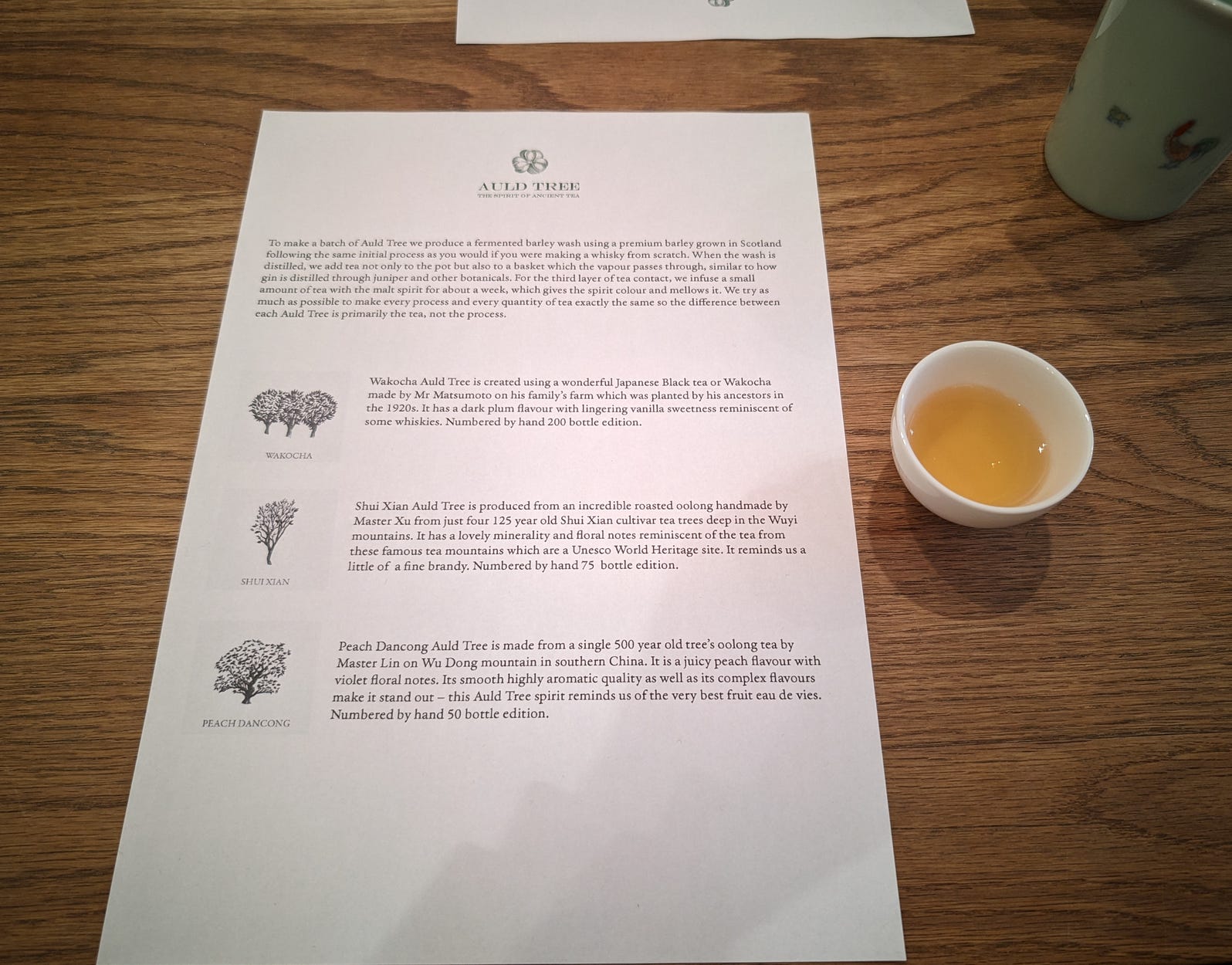
The first of the three spirits is the Wakocha, which uses a base of “Supernatural Black”, one of the Japanese black teas that Postcard offers.
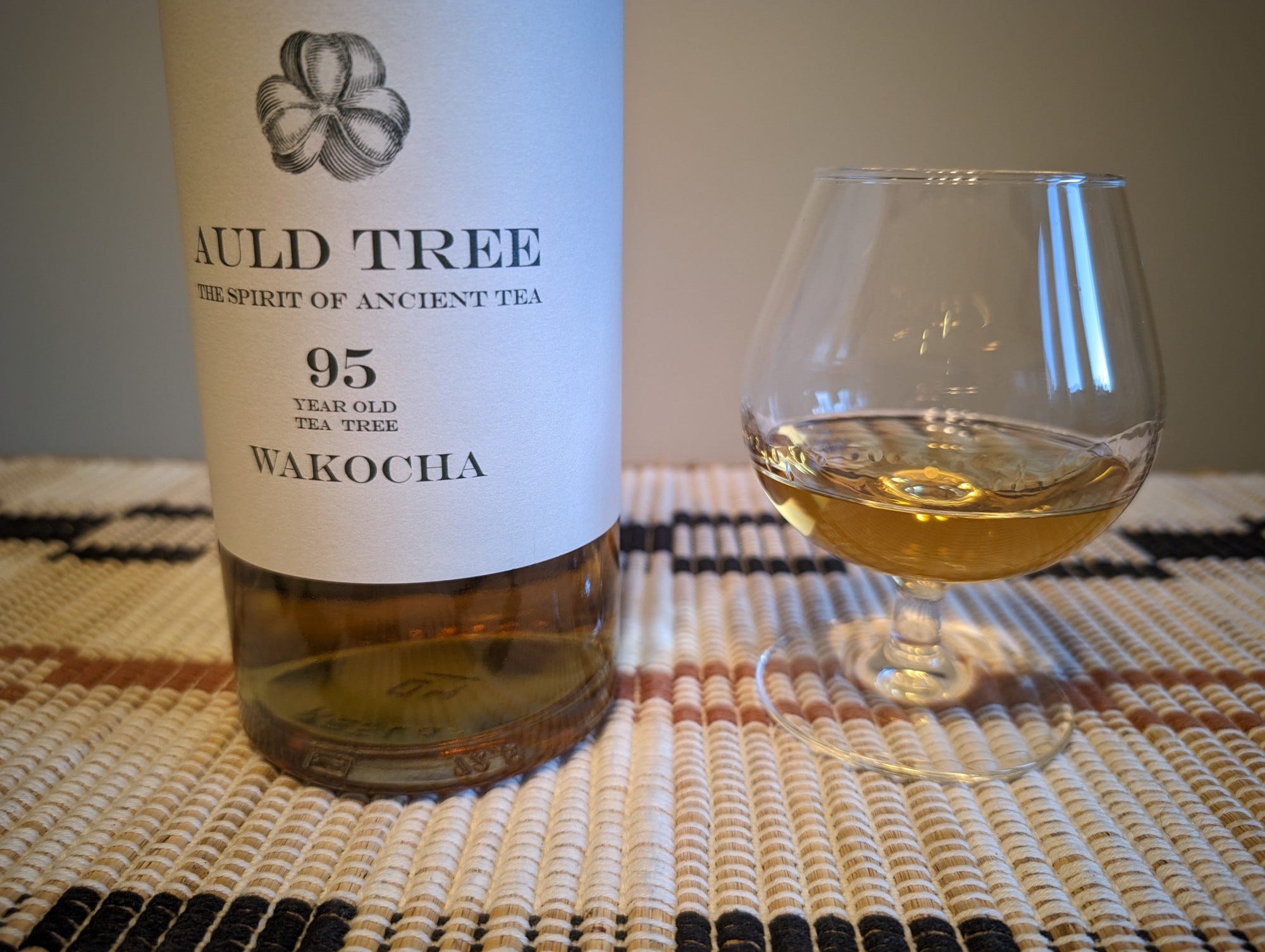
This is the only of the spirits that I had drank before attending the tasting. When served in a tulip-shaped glass, there is a distinct aroma of the vegetal green aspect of Mezcal, alongside baking spices such as cloves and cinnamon, with a little ground coriander. When drank, the first note I got was black pepper, which then receded into the aftertaste of cacao nibs, and a slight hint of caramel. The texture was smooth, and almost buttery. It does not give off the same impression of harshness as newmake whisky, and has a certain degree of sweetness.
However, at the tasting, we were served the spirits in porcelain teacups. This provides a totally different experience, both from the base material and from the structure of the cup. For those unfamiliar, a glass such as the ‘snifter’ above, and other alcohol glasses that curve inwards, will concentrate the aromas to the nose. With the wide, flat teacups, the primary experience was the body of the spirit.
The Wakocha retained a degree of herbality, and had much more sweetness, with a note of caramel. It was much smoother, and was an easy, pleasant drinker. Some (not myself) noted plum, particularly drawing attention to a resemblance to Slivovitz, a plum brandy/eau-de-vie. This is likely a result of the underlying plummy character of the tea, Supernatural Black.
The next spirit after the Wakocha was the Shuixian, made using a base of an unreleased Shuixian by the same maker (Master Xu) as Postcard’s other yanchas. On the nose, I got a strong nuttiness (not like roast, notably), alongside a fatty richness that combined to give the perception of a nut paste, like peanut butter. Hiding between these aromas was a slight floral note. When drank, the peanut-adjacent note remains, but closer to the skin of the peanut, lingering strongly in the aftertaste. The texture that remained in the mouth after a sip was somewhat oily. The ‘structure’ of the spirit felt remarkably similar to a more lightly brewed medium roast Shuixian, but sweeter and obviously harsher due to the alcohol, alongside somewhat thinner texture and body. It is also smoother than the Wakocha.
When adding even a little water to the Shuixian, it thins out the body considerably, removes the aftertaste, and kills the aromatics. Given this is a 43% spirit, I do not think there is much need to add water to any of them, but it is still worth trying at least once - the addition of water made the body closer to a somewhat aged whisky.
The final spirit in the tasting was the “Peach Dancong”, using the tea from a single tree (the actual definition!). The amount used for the Auld Tree apparently made up a third of the tree’s total production in that year. Interestingly, despite being an aromatic oolong, the Dancong initially did not have as much of a strong aroma as the others (even in the teacups). The aromatic experience, as a result, mostly occurs when drank, where I got a distinct fruity and floral character.
I initially related the combination of these notes to rosehip, but later switched between white stonefruits such as peach (perhaps unsurprisingly!) or nectarine, and then elderflower. The liquor itself was remarkably smooth and light, not as sweet as its peers, and had an interesting aftertaste that I could not place. Once I arrived at 'elderflower’ as a possible identity of the floral note, I made another relation - this had a remarkably similar structure to a nicer imo (sweet potato) shochu (Japanese distilled liquor). Some of the Shochu I’ve had has had an aromatic component that reminded me of elderflower, in a similar manner to this one.
The Peach Tree also did not benefit from the addition of water, also destroying the body and aromatic profile. I don’t think any of these benefit from the addition of water. However, I have found the Wakocha to be an admirable addition to cocktails. It has a strong presence in the middle of the palate, and the aftertaste is very compatible with others, layering alongside them rather than overpowering or replacing them. I have a few tea-focused cocktails in the works that have been benefiting from a small amount as a modifier.
I would not consider any of the three to be similar to the categories they were compared to, being whisky, brandy and eau-de-vie respectively - these stand on their own, better compared to each other than any other spirit. I’m excited to see what they’ll come up with next.
No posts
Comments
Nothing yet. Say the first thing.
Sign in to join the conversation.