
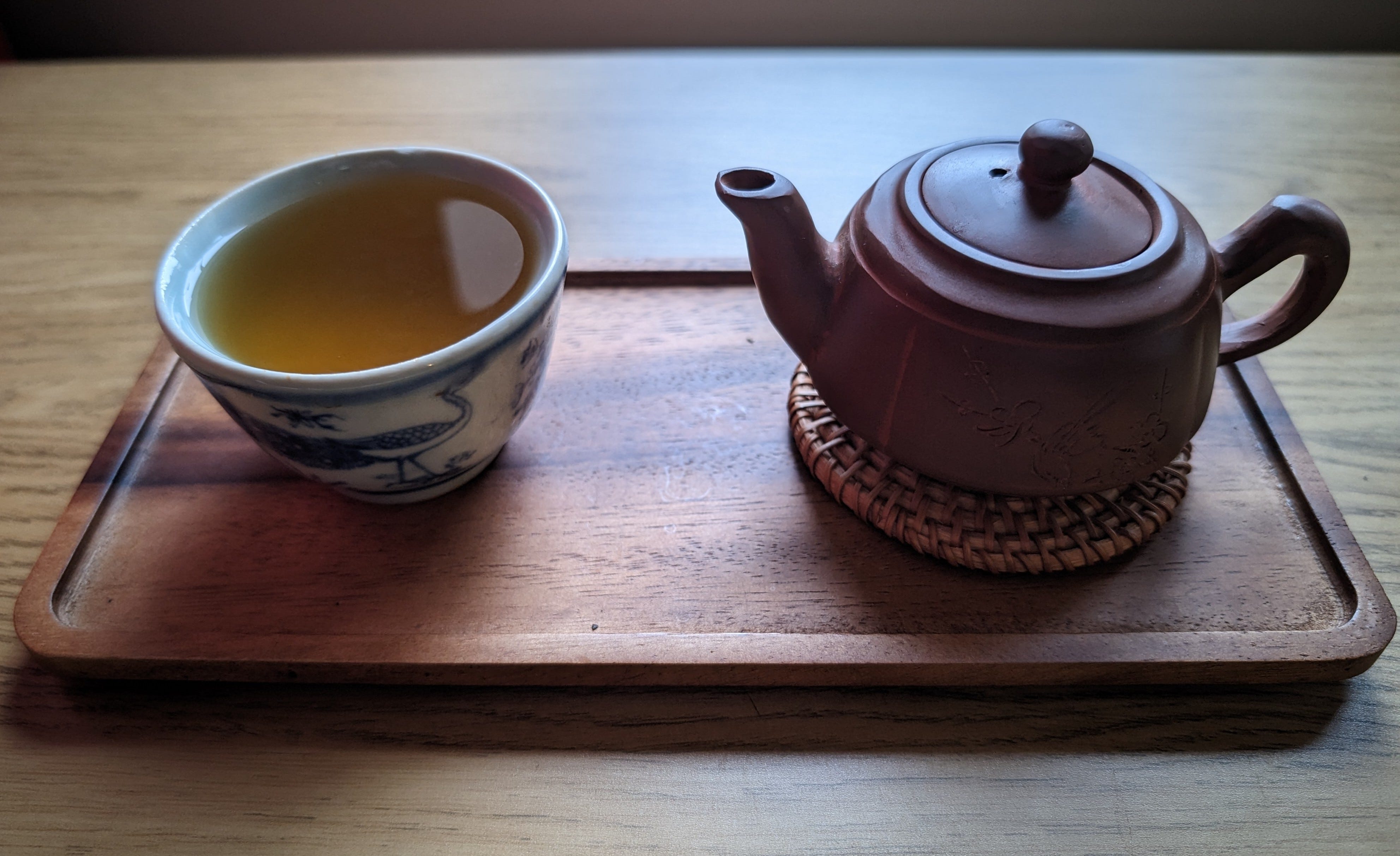
OneRiverTea recently released a sample set of “Raw” Liubao. I am a vocal opponent of the name “raw” liubao (as opposed to ripe), because it implies a simple dichotomy in processing styles that is simply not the case. However, in this case, it is a sensible descriptor - these are all styles that do not undergo any significant degree of fermentation beyond aging. Thus, I’ll lay down my pitchfork and torch, just this time. All teas were brewed initially at 7g/90ml in a Yixing Zini teapot.
I think that this tea is a strong primer for the set, as it is a good example of a typical well fermented ripe Liubao. When pushed, it yields a dark chocolate bitterness, and it leaves a woody aftertaste. It has a pleasant texture, and ok longevity. Nothing to object to, nothing unusual, perfectly in alignment with most modern Liubao.
As a contrast, the 2010 Yao Aroma is by far the most unusual in the set, in my opinion. The vast majority of teas that are consciously smoked are done so using pine wood, which has a particular recognisable character. Here, there is smoke, probably intentionally, but it was clearly not pine wood. My initial thought was that it was a paper fire, but that wouldn’t make much sense. Brewed at 7g/90ml, the smoke is notably vegetal near the front of the palate, and there is a strong note reminiscent of old books or old paper. The tea is thick, and the aftertaste is similar to that of blue cheese. As a whole, this is particularly pungent and harsh, with some considerable astringency. I had to stop brewing my first session with this tea only three steeps in, as it ended up being far too harsh.
Luckily, the second session went much better, at 4g/100ml. There was still a strong old book aroma, but it lacked the pungent smoke and paper notes that were sufficiently concentrated to make the tea undrinkable. Instead, there was a noticeable dark stone fruit taste, similar to a prune. Interestingly, the aftertaste was quite fresh and green, reminiscent of cucumber, despite the overall dark profile of the tea.
The 2019 Yao Aroma makes for an interesting contrast with the 2010 Yao Aroma. Despite being from different producers, it seems somewhat clear to me how the 2019 could age and develop the profile of the 2010. The 2019 lacked the same intensity and pungency of smoke as the 2010, however, which let me read it more clearly as a “wood” smoke, rather than “paper”. It lacked the vegetal or papery aspects of the 2019, and instead had a taste quite reminiscent of grains (buckwheat came to mind), as well as a certain degree of light woodiness. As a whole, the 2019 was far more manageable and less harsh than its peer.
In my initial session with the Purple Bud, there was a very interesting interplay between two aspects of the tea: a certain dank, wet note, adjacent to leather or perhaps rubber, and a thick, sweet, almost candy-like profile beneath it. Once that initial note, which I initially identified as storage, faded, the tea was particularly milky in taste and texture, with a note of corn (maize) that receded into the same aftertaste one gets from proper honey. When brewed at a lower ratio in a neutral vessel, the results are much the same, but with some changes in texture and intensity of notes — it is when a particularly muting vessel is used that this tea really shines.
Said muting vessel is, of course, the previously mentioned Nixing pot. Once the leathery storage note is hidden, the tea takes on a bright character — the milk, corn and honey notes really start to shine, and the texture becomes that much thicker to the extent that it ought to be described as “creamy” rather than “milky”.
I tend to make a point of seeking out unusual teas, in terroir, processing, and so forth. As of such, a roast applied to a tea outside of the usual suspects1 is not something that is particularly unusual to me. As of such, I cannot particularly say that this tea enthralled me quite as much as the others in the sampler, given that it ends up dancing to the same tune as quite a few of those. However, this is a particularly pleasant example.
Some younger greener Liubaos have particular astringency to them, and a noticeable vegetality, such as that in green tea. In this tea, that greenness is tuned down a considerable amount. The overall impression is much warmer (where greener teas tend to have a certain ‘coldness’), thicker, sweeter and toastier. There is a slight ashiness and astringency from the roast, but it overall mostly contributes pleasant texture and seems to counteract some of the harshnesses of younger tea, creating an overall smooth tea.
The real first impression I had with this sampler, before I even ordered it, was that 7g isn’t a very sensible sample size for Liubao. 7g of ripe Liubao can easily be too much for many people, and raw is certainly much harsher. This proved to be the case, and lower ratios of 3-4g performed best for all of these teas other than the factory ripe. I found the Yao Aromas to be incredibly interesting and unique, despite their considerable harshness, and the Roasted and Purple Bud were both pleasant drinkers. Prior to this sampler, I’d not heard of, let alone tried, any of these styles. As of such, I am very grateful to have gotten the chance to try all of these.
No posts
Comments
Nothing yet. Say the first thing.
Sign in to join the conversation.