
Imagine, for a moment, that your neighbor owns a gun because he believes someone is trying to kill him.
You may think he’s overly cautious. You may think he’s paranoid. You may think he’s wrong, crazy, or gun-mad.
But if your strategy for persuading him to put the gun down is to surround his house, scream death threats through a megaphone, and do everything to assure him that his fears are justified, don’t be surprised when he buys more ammunition.
Human beings do not become less defensive when they feel threatened. They become more defensive. Duh.
If there is one lesson Israelis absorbed from October 7, 2023, it is that the nightmare they had spent generations preparing was not a figment of their collective imagination.
The mass murder and other terror did not convince Israelis that their security concerns were exaggerated. It convinced them that they had underestimated them.
And then something extraordinary happened.
Instead of responding to the massacre by reassuring Israelis that they still had a place in the family of nations, instead of pressuring Palestinians to envision a future of peace instead of more bloodshed like that terrible day, the world overwhelmingly did precisely the opposite.
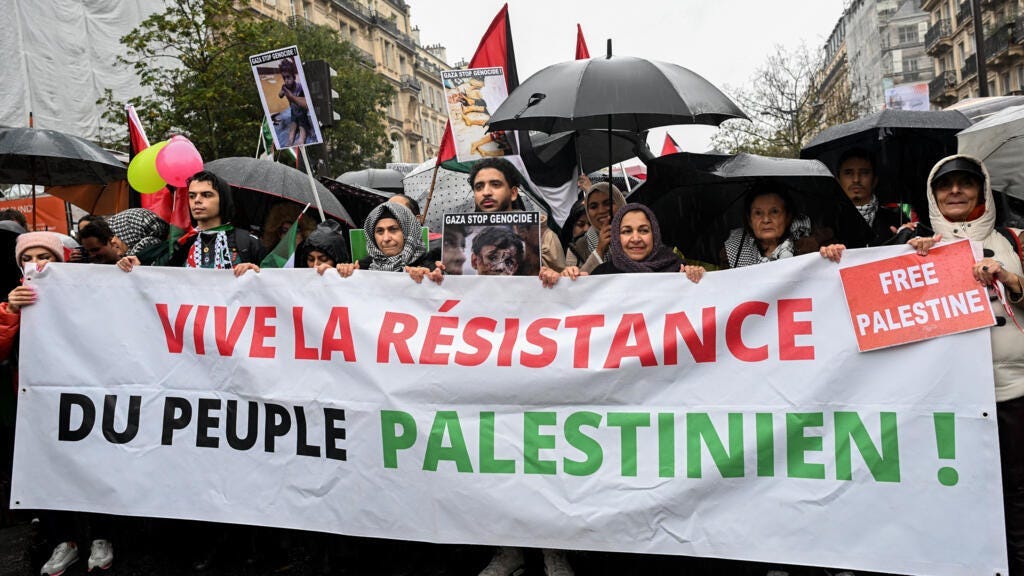
Within days, before Israel had even mounted its military response, crowds gathered in cities around the world celebrating and rationalizing the attacks.
University students blamed Israel. Demonstrators chanted slogans that many Israelis and Jews hear as calls for the elimination of the world’s only Jewish state, at best, and for genocide, at worst.
From the river to the sea. Globalize the intifada. By any means necessary.
Whatever individual marchers intend those slogans to mean, millions of Israelis hear something very specific.
They hear: You are not safe. You are not welcome. You do not deserve to live in peace — or live at all.
Then activists express astonishment that Israelis seem militaristic, that they seem to be even less willing than before October 7 to take risks for peace.
If your objective were genuinely to encourage compromise, this is almost exactly the opposite of the strategy you would choose.
You would begin by reducing fear, not amplifying it.
You would reassure Israelis that a Palestinian state would not become another launchpad for rockets or another October 7.
You would demonstrate that coexistence — not conquest — is the objective.
You would tell Israelis, loudly and repeatedly: We recognize your right to exist. We recognize your legitimate security concerns. We want your children to live safely. We — Palestinians and their overseas allies — are not your enemies.
Only then could trust begin to emerge.
Trust requires security. Not merely physical security, but psychological security also. Confidence that tomorrow will not bring annihilation.
Israelis today possess very little of that confidence.
Can anyone blame them?
October 7 was not merely a terrorist attack.
It shattered one of the foundational assumptions of Israeli society — that the state could reliably protect its citizens from mass slaughter.
Then the world responded in ways that reinforced rather than alleviated Israeli fears.
Imagine trying to persuade someone to dismantle the walls around their home while murderous protesters outside are shouting that the walls should come down by any means necessary.
No rational person would agree.
So let us ask a different question.
If the objective really were a “free Palestine,” what would that movement actually look like?
It would begin by acknowledging an uncomfortable truth.
There will never be a free Palestine without a secure Israel.
No Israeli government — left, right, or centre — will voluntarily create conditions it believes invite another October 7.
If you want Israelis to take risks for peace, you must first persuade them that peace will reduce risk rather than multiplying it.
Instead of chanting “Globalize the Intifada,” demand that Palestinian leaders abandon the language of permanent war.
Instead of celebrating “resistance” “by any means necessary,” insist that terrorism has no place in a national liberation movement. (Especially one that could achieve its objective almost instantly if it demonstrated genuine willingness to coexist. This assumes, of course, that coexistence is its objective.)
Instead of teaching another generation that all of Israel is occupied Palestine, and that opposing it is more important than life itself, teach that compromise is not betrayal.
Instead of rewarding maximalism, reward coexistence.
Instead of glorifying martyrdom, glorify state-building.
Instead of promising victory over Israel, promise a future alongside Israel.
That is how nations are built. Not through perpetual revolution. Through institutions, economies that actually work, schools that teach legitimate subjects, not ones that inculcate self-destructive, violent nationalist extremism.
A “free Palestine” would be a result of building real infrastructure, not more terror tunnels, a civil society, not one built on nihilism and hatred.
The tragedy is that many people marching under Palestinian flags sincerely believe they are helping Palestinians.
They are so certain of their rectitude.
But every movement should occasionally ask itself one brutally honest question: “If our methods consistently produce the opposite of our stated goals, is it possible that our methods are wrong?”
Peace requires two peoples who believe they have a future worth sharing.
Fear tells each side the opposite.
Every slogan that deepens existential fear pushes peace further away.
Every threat convinces another Israeli that compromise is too dangerous.
Every celebration of violence persuades another Palestinian that violence works.
Both peoples deserve better than that.
A genuinely pro-Palestinian movement would prepare Palestinians for the difficult work of building a state rather than the impossible dream of eliminating another one.
And, as I have written before, we can make endless demands on Israel — and the world does — but there is only one side in this conflict that can make peace because there is only one side that is making war: the Palestinian elites and their terrorist enablers.
If we truly want Palestinians to live in freedom, dignity, and statehood, then we should be asking not what feels morally satisfying in a protest chant, but what actually makes that future more likely.
Right now, too much of what passes for “radicalized,” activism is accomplishing the exact opposite.
If your strategy leaves Israelis more frightened, Palestinians more radicalized and both peoples more convinced that coexistence is impossible, then it is not a strategy for peace.
It is a strategy for perpetuating the conflict you claim to oppose.
Ah, but there’s the rub.
You are not trying to end the conflict. At best, you are posing as a humanitarian political activist when you have no right to do so. At worst, you are trying to promote an end where Israel is destroyed and Palestine stretches from the river to the sea.
That won’t happen.
And by tirelessly flogging that objective, you are sacrificing tens of thousands more Palestinians to your self-satisfied ideology, wrapping yourself in a self-righteous flag of peace, while almost certainly promoting more decades of conflict in which dead Palestinians outnumber dead Israelis by orders of magnitude.
What will it take before you see that what you call “pro-Palestinian” is anything but?
*
Follow me on Facebook: https://www.facebook.com/profile.php?id=61588402258315
Follow me on Insta: https://www.instagram.com/patsshtick/
Follow me on X: https://x.com/PatsShtick
*
Some people have generously asked me to make it possible to make one-time contributions to support my work. I have now set up a PayPal link for donations. If you like snappy smackdowns of antisemitism and anti-Zionism and want me to keep it up, any support is deeply appreciated. Click here.
Comments
Nothing yet. Say the first thing.
Sign in to join the conversation.