
(Video above is me interviewing Joana Rocha, the amazing founder of Waves and Minds surf camp in Ericeira, Portugal).
You know those small things that you don’t want to do, but you force yourself to do them anyway? You do them fairly often or even just sometimes, and there’s no way of getting around it—they just aren’t fun. For me, it’s things like getting up early to lift weights. Or flossing. Or even emptying the overflowing recycling box that somehow is always, never-endingly, toppling over with cans, cereal boxes, and plastic berry containers.
As anyone who studies fortitude and resilience will tell you, it’s EXACTLY THESE THINGS that build our ability to adapt, thrive, and live longer. In our heads, we generally never equate flossing with perseverance. But the simple act of doing something that your brain registers as difficult, uncomfortable, not fun, or even painful (pain with flossing is relative, I suppose) strengthens our anterior mid-cingulate cortex (aMCC), an area of our brains that is frequently called the “seat of willpower”. Some research even suggests that the aMCC is also the seat of the “will to live”, as people who live the longest (“superagers”) have much more developed aMCCs when compared to peers.
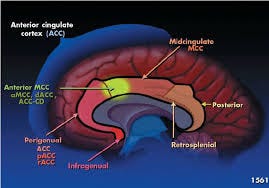
And here’s the thing: doing things you don’t want to do is the only way the aMCC develops. It won’t actually develop unless you do these things. So, in an effort to be mentally strong and maintain the ability to persevere even when things get hard, keep doing those things!
To summarize a bunch of research (references at the bottom of the page, if you want to deep-dive) around the aMCC, here’s a quick list of reasons you may want to consider working on strengthening yours (and, importantly, that of your kiddo(s)!).
Those with more developed aMCCs have been shown to:
live longer1
maintain amazing cognitive ability as they age (e.g. “superagers”)2
have higher levels of tenacity and perseverance3
have more willpower and control4
have higher life satisfaction5
have better emotional control6
show greater ability to achieve goals7
the list goes on...
What are some of the characteristics you want to see in your kids? I bet things like resilience, grit, perseverance, and cognitive ability would show up on that list (of course next to things like kindness, empathy, collaboration, self-confidence, etc.). We all want our kids to have these things. But how do we do that?
The absolute best way is to have them do the “hard” things! That project that’s a struggle in school? Help them struggle through it, but let them do it. That new camp they are unsure about trying because they don’t know anyone? Encourage it as much as humanly possible. That food they don’t want to eat? Try to get them to at least try a bite whenever you can.
And finally, that sticky wetsuit they don’t want to put on. Let them struggle and finally succeed. It may seem small, but their brain will benefit, and, in turn, their confidence, resilience, cognitive ability, grit, and mental strength will grow—shaping them into little humans that can face challenges in life with the tenacity and courage we all need as we grow up.
https://alz-journals.onlinelibrary.wiley.com/doi/10.1002/alz.13438
https://www.researchgate.net/publication/398536052_The_Neuroscience_of_Pushing_Through_How_the_Anterior_Mid-Cingulate_Cortex_Enables_Determination_and_Lifelong_Wellbeing
https://infofit.ca/what-in-the-world-is-the-amcc/
https://neuroscienceschool.com/2024/02/01/how-to-train-the-brain-for-greater-willpower/
https://www.diva-portal.org/smash/get/diva2:1867474/FULLTEXT01.pdf
https://www.psychiatryonline.org/doi/10.1176/jnp.23.2.jnp121
https://pmc.ncbi.nlm.nih.gov/articles/PMC7381101/#:~:text=When%20faced%20with%20a%20difficult,et%20al.%2C%202019).
Comments
Nothing yet. Say the first thing.
Sign in to join the conversation.