
Here is something I have noticed about the moments when I feel most alive.
They are almost never moments of thinking. They are moments of sensation. The cold of a winter morning on my face when I step outside. The satisfaction of a pen moving smoothly across paper. The feeling of a deep breath released after a long time holding tension I didn’t know I was carrying. The calm joy of a warm smile. A deep hug with someone I love.
These are not grand experiences. They are physical ones. Small, specific, embodied. And yet they are the moments I return to when I try to locate where I actually was most present in a given day.
The body, it turns out, knows things the mind is too busy to notice.
In the first few articles of this series, we talked about the morning as a threshold and about the art of arriving in the present moment. Both of those conversations were, in some ways, conversations about the mind: how it wanders, how it can be gently redirected, how the quality of attention we bring to the day shapes the quality of the day itself.
This article goes somewhere different. Somewhere older and more immediate.
This article is about the body. And about what becomes available when we learn to listen to it.
If you missed the first three articles in the series, you can find them here:
Article 1: The Owl In The Tree (And What It Reminded Me About Showing Up)
Article 2: How You Begin Is How You Live
Article 3: The Art of Arriving
The mind is a time traveller. It moves between past and future as naturally and as constantly as breathing. It replays what happened, rehearses what might happen, worries about what could happen, mourns what didn’t happen. Left to its own devices, the mind almost never rests in the present moment. It is always somewhere else.
The body cannot do this. The body is always and only here.
You cannot feel your feet in the future. You cannot feel the weight of your shoulders in the past. Every physical sensation is happening now, in this moment, in this particular arrangement of flesh and bone and breath. The body is the most reliable instrument of presence we have, and most of us spend our days almost entirely disconnected from it.
We sit at desks for hours without registering the tension accumulating in our necks and shoulders. We eat without tasting. We walk without feeling our feet on the ground. We carry stress in our bodies for so long that it begins to feel like our natural resting state, and we stop noticing it at all.
The neuroscientist Antonio Damasio spent decades researching the relationship between the body and the mind, and what he found challenged one of the most persistent assumptions of Western thought: that the mind and body are separate systems, with the mind in charge. His research showed, compellingly, that the body is not just a vehicle for the brain. It is a source of intelligence in its own right. Emotions, intuition, decision-making: all of these involve the body as an active participant, not a passive recipient. (The Feeling of What Happens, 1999.)
The body knows. The question is whether we are paying enough attention to hear what it is telling us.
Most of us are carrying more physical tension than we realize.
The stress response, which evolved to help us survive immediate physical threats, was never designed for the kind of sustained, low-grade, chronic stress that characterises modern life. The alarm that goes off but never quite turns off. The background hum of worry, deadline, obligation, and overstimulation that runs beneath most waking hours.
When the stress response is activated, the body prepares for action: heart rate increases, breathing becomes shallow, muscles tighten, digestion slows. This is the right response to a genuine physical threat. But when it is chronically activated by the pressures of an ordinary day, the body stays in a state of low-level readiness that is exhausting and, over time, genuinely harmful.
What most people don’t know is that the body has an equally powerful counterpart to the stress response: the relaxation response, first described by cardiologist Herbert Benson at Harvard Medical School in the 1970s. (The Relaxation Response, 1975.) This is the body’s natural capacity to down-regulate the nervous system, reduce cortisol and heart rate, and return to a state of ease. And it can be consciously activated, through the breath, through movement, through deliberate physical attention.
The body does not just carry stress. It knows how to release it. We simply have to give it the conditions to do so.

Of all the somatic practices available to us, the breath is the most immediate, the most portable, and the most profound.
Every contemplative tradition in the world has placed the breath at the centre of its practice. Not because breathing is complicated, but because it is the one physiological function that operates both automatically and voluntarily. You breathe without thinking about it. But you can also choose to breathe differently, and when you do, the entire nervous system responds.
The research on this is substantial and growing. Slow, deep, diaphragmatic breathing activates the parasympathetic nervous system, sometimes called the rest-and-digest system, which is the direct counterpart to the fight-or-flight stress response. Even a few conscious breaths, taken slowly and with attention, measurably reduce heart rate, lower cortisol, and shift the brain toward a calmer, more present state. (Brown & Gerbarg, The Healing Power of the Breath, 2012.)
The specific mechanism worth knowing about is the vagus nerve: the longest nerve in the autonomic nervous system, running from the brainstem through the heart and lungs and deep into the abdomen. The exhale, in particular, stimulates the vagus nerve, triggering the relaxation response. This is why a long, slow exhale feels the way it does. It is not just psychological relief. It is physiological shift.
You do not need a practice, a cushion, or twenty minutes of silence to access this. You need one breath. Taken slowly. With a long exhale.
That is the original anchor. It has been there your whole life, waiting for you to use it.
The body is not only an instrument of stillness. It is also an instrument of movement, and movement, approached mindfully, is one of the most powerful routes back to the present moment available to us.
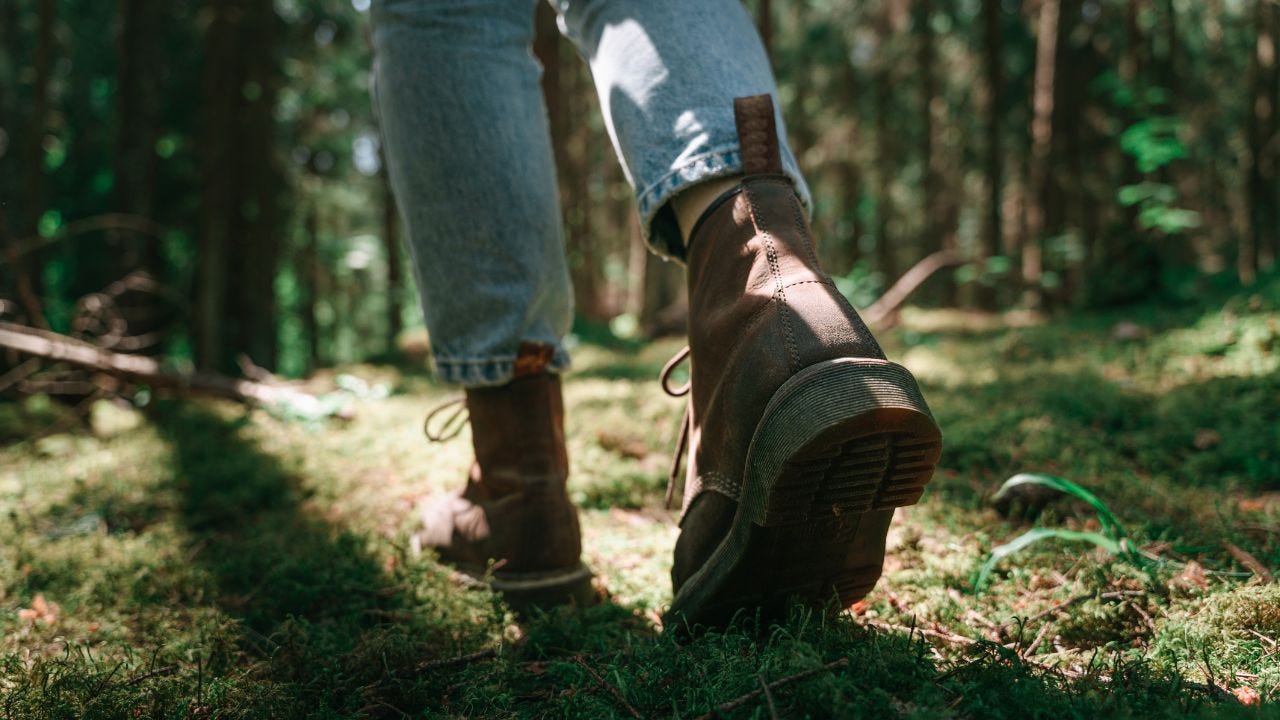
This is something many people discover accidentally, often through walking. There is a reason so many writers, thinkers, and creative people have sworn by the walk as a creative practice. Aristotle taught while walking. Rousseau wrote about the relationship between walking and thinking in his Reveries of a Solitary Walker (1782). Wordsworth and Coleridge composed poetry on foot. Nietzsche wrote: “All truly great thoughts are conceived while walking.” (Twilight of the Idols, 1889.)
What they were describing, without the language to name it precisely, is what we now understand about the relationship between rhythmic movement and the nervous system. Walking, particularly at a slow and deliberate pace, activates a bilateral stimulation of the brain, left and right in alternating rhythm, that has a deeply calming and integrating effect.
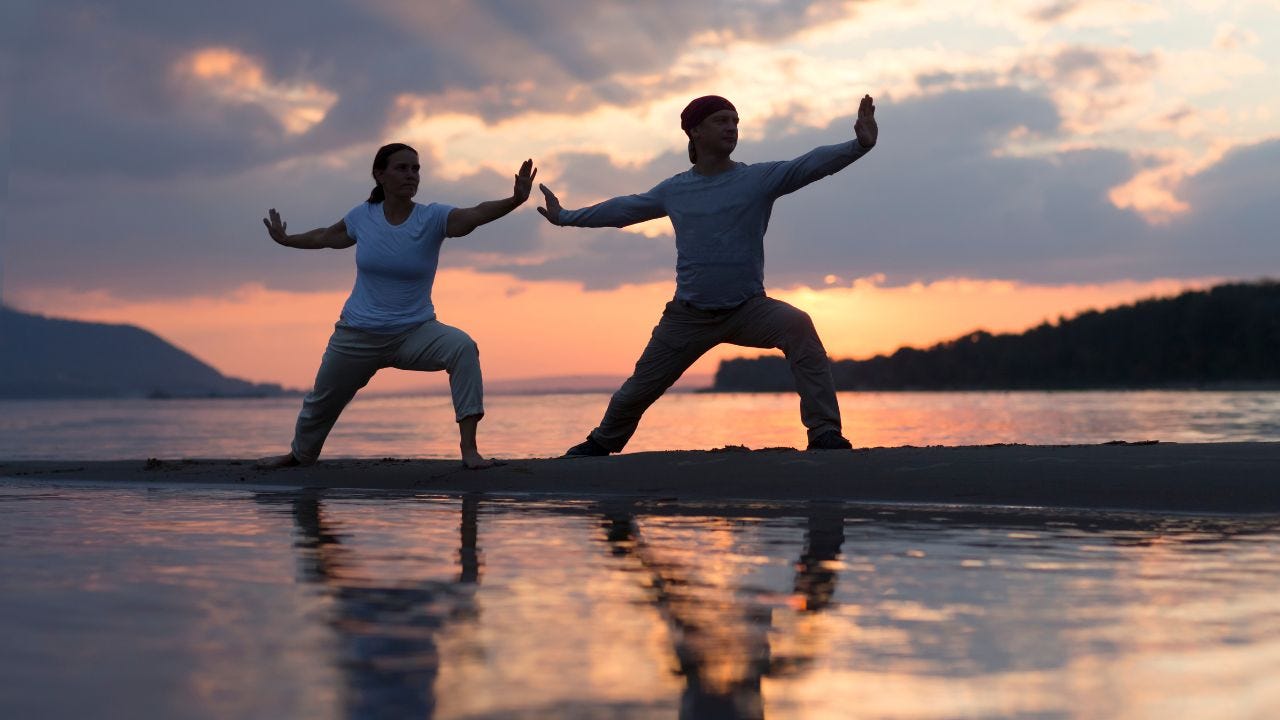
But walking is only one form of mindful movement. Stretching, yoga, tai chi, qigong: any movement that is done with attention, at a pace slow enough to feel what is happening in the body, becomes a somatic practice. It becomes a way of coming home to the body, and through the body, to the present moment.
I want to share something about the relationship between my body and my creative work, because I think it illuminates something important.
When I sit down to draw a mandala, the first few minutes are often the hardest. The mind is busy. The hand feels uncertain. There is a moment of resistance that I have learned to recognise as the gap between thinking about creating and actually creating.
What moves me through that gap is almost always physical. I take a breath. I feel my feet on the floor and my back against the chair. I pick up the pen and let the weight of it rest in my hand for a moment before I make the first mark. These are not elaborate rituals. They take perhaps thirty seconds. But they are the difference between arriving at the page and standing outside it.
The same is true when I sit down to write. The body needs to be gathered before the mind can find its focus. A few deep breaths. A moment of physical settling. The deliberate choice to feel where I am before I try to think about what I am going to say.
This is not incidental to the creative process. It is the beginning of it. Because presence, as we explored in Article 3, is where everything else starts. And the fastest path to presence is through the body.
This is also, I believe, part of what makes EFT tapping such a useful morning practice, which we discussed in Article 2. It is not primarily a thinking practice. It is a physical one: the gentle, rhythmic tapping on specific points of the body, combined with breath and spoken acknowledgment, that helps discharge the accumulated tension of the nervous system and bring you back into physical awareness. It works because the body responds to touch, rhythm, and breath in ways that the thinking mind cannot fully access on its own.
If you are interested in learning more about EFT, see my free video here: What is EFT Tapping - And How Does It Work?
There is a practice in somatic psychology called interoception: the capacity to notice and interpret the signals your body is sending from the inside. Hunger and fullness. Tension and ease. The subtle quickening of the heartbeat that precedes anxiety. The loosening in the chest that accompanies relief.
Most of us have a relatively undeveloped interoceptive awareness. We have been trained, through years of sitting still in school, in offices, in cars, to treat the body primarily as a means of transport for the mind, and to override its signals when they interfere with productivity. We eat past fullness because we are not paying attention. We push through exhaustion because we have learned to ignore it. We carry chronic tension for so long that it stops registering as tension and starts registering as just the way things are.
Developing interoceptive awareness is not complicated. It simply requires the repeated practice of asking: what is my body telling me right now? And then actually waiting for the answer.
Peter Levine, whose work on the body’s capacity to heal from trauma has influenced an entire generation of therapists and researchers, writes that the body holds experiences that the mind has not yet integrated, and that healing, in the deepest sense, happens not in the narrative but in the sensation. (Waking the Tiger, 1997.) What is true for healing is also true for living: the richest experience of being alive is available not in the story we tell about our lives, but in the felt, physical experience of them as they are happening.
The body knows. It has always known. We just need to remember to ask.
This week, I am asking you to practise one very simple thing, three times a day.
Before you begin any significant task or transition, pause for sixty seconds and move through the following sequence:
Feel your feet. Press them gently into the floor. Notice the contact, the weight, the temperature. You do not need to do anything with this. Simply notice.
Take one breath you actually feel. Not a performance of breathing. A real breath, drawn slowly into the belly, held for a moment, released fully through a long exhale. Notice what shifts.
Scan from the top of your head to the base of your spine. Where are you holding tension? Jaw, shoulders, chest, belly, lower back? You do not need to fix anything. Just notice what is there.
Name one physical sensation you are aware of right now. It can be anything: warmth, tightness, lightness, the feeling of your clothes against your skin, the temperature of the air. Just one. Named, silently or aloud.
That is sixty seconds. Three times a day. It will not transform your nervous system overnight. But it will begin to build something important: the habit of checking in with your body as a source of information rather than an inconvenience to be managed.
At the end of the week, sit with these questions in your notebook:
What did you notice that you had been carrying without knowing it?
Was there a moment this week when listening to your body told you something useful?
How did the quality of your attention to a task change after the sixty-second check-in?
We live in a culture that prizes the mind above almost everything else. Intelligence, productivity, analytical skill: these are the currencies we are taught to develop and display. The body, by contrast, is something to be managed, maintained, and occasionally indulged.
But the body is not a vehicle. It is a home. And presence, in any meaningful sense, begins with inhabiting it.
The awe we are building toward in this series, the wonder that is available in ordinary moments, the quality of attention that makes a regular day feel like it is actually yours: all of it is accessed first through the body. Through breath and sensation and the simple, radical act of feeling where you are.
You do not need to become a different person to access this. You do not need more time, more stillness, or a better morning. You need sixty seconds and the willingness to ask the oldest question there is:
What does my body know right now?
Listen. It will tell you.
Next in the series: Finding Awe in the Unremarkable — Why the Extraordinary Is Hiding Inside the Ordinary.
Benson, H. (1975). The Relaxation Response. William Morrow.
Brown, R.P. & Gerbarg, P.L. (2012). The Healing Power of the Breath. Shambhala Publications.
Damasio, A. (1999). The Feeling of What Happens: Body and Emotion in the Making of Consciousness. Harcourt Brace.
Levine, P. (1997). Waking the Tiger: Healing Trauma. North Atlantic Books.
Nietzsche, F. (1889). Twilight of the Idols. (Trans. R.J. Hollingdale, Penguin Classics, 1968.)
Rousseau, J.J. (1782). Reveries of a Solitary Walker. (Trans. Peter France, Penguin Classics, 1979.)
Website: Passion Purpose Today
InsightTimer: Follow Me
Books: Focus Flow Formula and More Books
LinkedIn: Rachel Collins
SubStack: Mandala Card of the Day
Comments
Nothing yet. Say the first thing.
Sign in to join the conversation.