
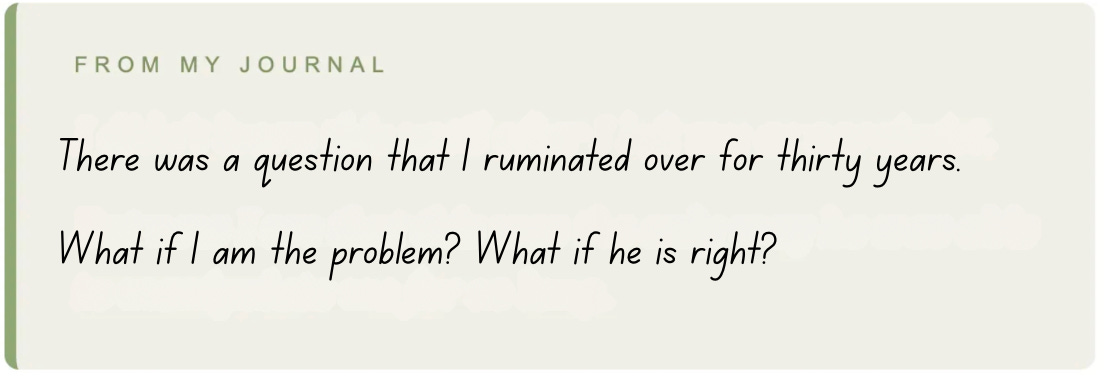
I have been a licensed therapist for 23 years. I was also married to a narcissist for 30 years, and in a relationship with him for 35, since I was 17 years old. It wasn’t until I broke free that I realized what he was doing to me had a name. Even if I had known while I was in it, I doubt it would have done much good. I always say, denial was my best friend. And we all know the phrase, you don’t know what you don’t know. I remember the day I woke up. I couldn’t unsee it. Until then, nothing could have convinced me that I was not the problem. He conditioned me to believe that he was right and I was wrong. So the question, his voice, stuck in my head more than anything else.
What if he is right?
Sometimes it’s subtle, sometimes it screams. Most of the time, it hovered under my skin as a low hum. Maybe I did overreact. Maybe I am too sensitive. Maybe I remembered it wrong. Maybe, if I could just be a better wife, make better decisions, be a little more grateful, he would finally treat me the way I kept begging to be treated.
If any of that sounds familiar, keep reading. Because that hum has a name, and once you can name it, it starts to lose its grip.
THE QUIET QUESTION
By the time this pattern really takes hold, he didn’t have to do the work anymore. I was doing it for him.
After so many years of him denying what I saw, accusing me of the things I accused him of, and turning himself into the victim of every conversation I started, something shifts. I didn’t need him to tell me I was overreacting. I began to say it to myself. I denied myself before he had a chance to. I found it easier to take it if I just believed it myself. In fact, I remember the day I said out loud, I’m just going to live in his reality because mine does not exist. This was the ultimate coping skill. Complete surrender.
His voice became my guide at the grocery store. I knew exactly what to buy because I knew what he wanted. In social settings, I knew how to act, what to say, and what not to say to make him look like the luckiest man in the world. I knew that disagreeing with him would lead to an argument that would wear me down so I skipped the fight and acquiesced. When we weren’t together, my thoughts focused on what he would want me to say or do, or not say and not do. This just made life so much easier. It just made sense, but what about me? There was no me. No space in this marriage existed for “me”. It was only “we”. “Me” was selfish. What I wanted, needed, or felt wasn’t important. In order to survive in this relationship, it had to be all about him, but why was I okay with this?
My motivation was clear. I wanted my marriage to work. I took my vows seriously, for better or for worse, till death do us part. Little did I know that I was the only one who cared about our vows, and I was the one dying a slow, painful death. Married and alone.
WHAT IT IS
It is when you doubt your own reality so completely that you become both the accused and the prosecutor, and there is no one left in the room defending you.
Self-gaslighting is when you no longer need him in the room to make you doubt yourself.
You have learned to do it alone.
I want you to hear it from a therapist and from a survivor at the same time. The fact that you turned the questioning on yourself is what gaslighting is designed to do over time. If you are subjected to gaslighting long enough, this is the predetermined result. It is what a good, empathetic, self-reflecting person does. You looked for your part because you are the kind of person who takes responsibility. He counted on that. Your greatest strength became the exact hook he hung you on.
CHASING THE VALIDATION
When I no longer trusted my own reality, I depended on him to confirm it. This would be acceptable in a healthy relationship. But this is not that. Instead, the person we go to is almost always the one who benefits most from us never being sure.
I kept taking my pain right back to him. I explained it one more time, a little more carefully, hoping that this time he will finally see my perspective and validate me. Over explaining is actually asking the person who set the fire to help us put it out. And every time they refuse, instead of walking away, we think we must have explained it wrong, and we try, and try again.
Let me tell you how long this can last, so you can stop being so hard on yourself for how long it has lasted for you.
Near the end of our marriage, we were separated. I had moved into my own place, and he was determined to win me back. So he planned an elaborate party for what would have been our twenty-ninth anniversary. He invited family and friends to my new home. I call it my fake anniversary, because that is exactly what it was. That night, out on my own patio, he crossed a line with another woman who was a guest in my home. When it came out, no one quite knew what to believe, because who does something like that, at our anniversary party?? Not possible, I thought. He made her look unstable, unbelievable, and we believed him. We gave him the benefit of the doubt. We didn’t know her, she was a stranger to us. How could we believe a stranger over him? I later found out that he had admitted the truth to a family member, but not to me.
Years after our divorce, I came across a photo in my phone that reminded me of that night. I was curious if he would finally admit the truth to me. I sent it to him with one simple question. Are you able, not willing, able, to tell the truth about this. He had nothing to lose. We were long divorced. Maybe now that it would change nothing about the state of our marriage, there was none, he would be able to own it. Thankfully, my healing journey protected me from the surprise when he did what any narcissist would do. DARVO. In textbook order he Denied even remembering (“that was 7 years ago”), Attacked me for asking (“why are you asking me that now?”), Reversed the question and became the Victim making me the Offender (“you left me.”). Classic! I typed back “LOL, I take that as a no. Thank you.”
Knowledge is power.
He confirmed that he was never going to be capable of giving back my reality, not because I asked wrong, and not because I did not deserve it, but because admitting it would cost him the image he would defend to his last breath. Of course he did what he did. And of course he still cannot admit it. Once you truly know who someone is, their refusal stops being a surprise. It becomes expected.
You cannot draw water from a well you already know is dry, no matter how many times you lower the bucket.
You can wait your whole life for your abuser to hand you back your sanity. The waiting is the trap. Your validation was never going to come from the one person on earth who needs you to stay confused.
THE ONE TOOL
If you get one thing out of this post, let it be this single shift. It is small, but it changes everything.
Stop asking, what is wrong with me. Start asking, what happened to me.
The first question assumes you are broken, and then it sends you out hunting for evidence to convict yourself. The second question is simply true, and it puts the events back where they belong. One keeps you spinning. The other grounds you in your reality.
Here is a way to make that shift stick, because your mind will fight it at first. Journal. Keep your own record. On the day something happens, before the doubt has time to roll in and rewrite it, write down what actually happened, in your own words. Not to prove anything to him. Not to show anyone. Just for you. So that when the fog comes back, and it will, you are not left cross-examining a memory. You are reading your own honest experience, in your own handwriting, and no one gets to talk you out of it.
Your nervous system does not get the memo that you are finally allowed to trust yourself. You have to keep handing it the note, over and over, until one day it sticks. That is the beginning of the hard, tedious work of rewiring your brain. Learning to rebuild trust in your own reality, in the right order, with people who are safe, is the deeper work, and I would be lying to you if I said it happened in one journal entry. It’s a process and the process is not linear.
THE SCIENCE
For years I thought all that self-doubt was proof that I was the problem. It was not. It was my mind doing exactly what a mind is built to do when it is handed two things that cannot both be true.
You believe he loves you. You also experience him hurting you. Those two truths cannot sit comfortably side by side.
Cognitive Dissonance
Coined by psychologist Leon Festinger in 1957, author of A Theory of Cognitive Dissonance.
"The existence of dissonance, being psychologically uncomfortable, will motivate the person to try to reduce the dissonance and achieve consonance."
The mind reduces that discomfort by changing whichever belief is easier to change. And it is far easier to believe I must be the problem than to believe the person I love and depend on is hurting me on purpose. So you quietly blame yourself. Not because it is true. Because it is bearable. Self-blame is the exit your mind takes to survive an unbearable contradiction.
The same science explains why we keep going back for validation, and why it has nothing to do with a lack of intelligence or willpower. Decades of behavioral research, going back to the psychologist B.F. Skinner, showed that a reward given unpredictably, sometimes yes and sometimes no, produces the most persistent behavior of all. The reward is unpredictable and inconsistent. The occasional crumb of warmth, the rare moment he is kind, the almost-apology that never quite sticks, the “good times”. We know it’s coming, but we don’t know when and how long it will last. Dr. Patrick Carnes named the attachment that forms inside that cycle a betrayal bond, what we now call a trauma bond. We become conditioned to chase the reward. But this can be undone.
Doubting ourselves does not mean we are unstable. It is one of the most recognized signatures of trauma there is.
"The conflict between the will to deny horrible events and the will to proclaim them aloud is the central dialectic of psychological trauma."
DR. JUDITH HERMAN, PSYCHIATRIST AND AUTHOR OF TRAUMA AND RECOVERY
So if one part of you wants to forget it ever happened, and another part is quietly screaming that it was real, you are not losing your mind. You are describing trauma, exactly as the research describes it. None of this was in your head. Your reality was real. It was always real. Your body knew it, even in the years your mind would not let you say the words. Our healing journey includes learning to listen to our body, our nervous system, our gut. It’s the silent voice that has been overpowered by the voice of the narcissist. We have to practice giving it the attention it deserves.
A REFLECTION FOR YOU
Whose voice is it, really, when you tell yourself you are overreacting?
And what would change if you stopped asking what is wrong with you, and started asking what happened to you?
You were never the problem. You were the one still trying to fix something that was never yours to fix.
Need Help?
If you read this and heard your own voice hiding inside his words, please know you do not have to find your way back to yourself alone. P2P Essentials is my 7-week program, built on the P.E.A.C.E. Method™ and the five stages of healing from narcissistic abuse, created by me, from my own lived experience. It is where we do the deeper work together, in a small group of people who understand. It is where you learn to trust your own reality again, with support.
If you are not ready for any of that yet, I get it, just stay close. Subscribe to my blog and listen to my podcast called The Healing Lounge. Both are free, and both will help you to practice claiming your reality. If I can do it, so can you.
No posts
Comments
Nothing yet. Say the first thing.
Sign in to join the conversation.